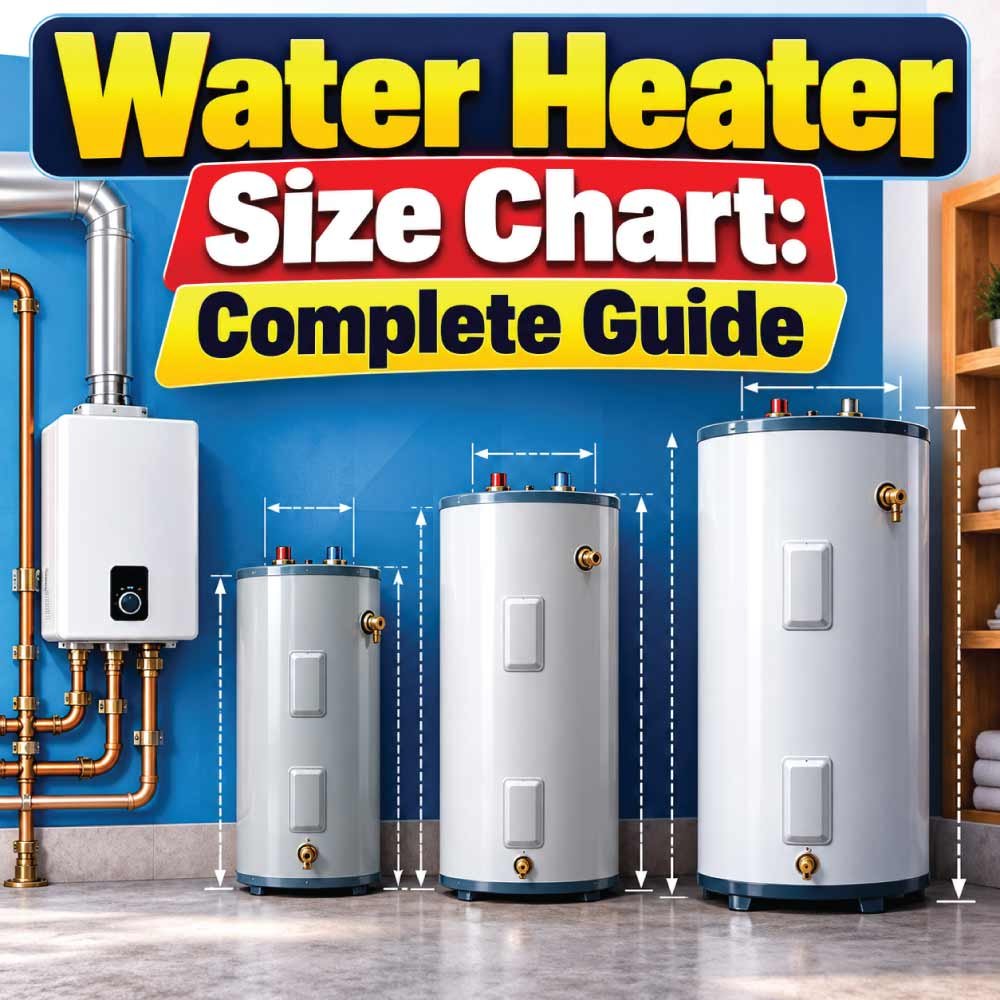
Choosing the right water heater size helps ensure you have enough hot water for showers, laundry, dishwashing, and other household needs without unnecessarily increasing energy costs. A water heater that is too small may run out of hot water during busy periods, while an oversized unit can cost more to purchase and operate than necessary.
This water heater size chart explains how to estimate the correct tank capacity, compare water heater sizes by household needs, understand tankless water heater sizing, and determine which measurements matter when replacing an existing unit. You will also learn how to account for the number of occupants, simultaneous hot water use, recovery rate, and installation space.
The best size depends on more than the number of people in your home. Your daily routines, incoming water temperature, appliance demand, and the type of water heater all influence the final choice.
Water Heater Size Chart by Household Size
A storage water heater holds heated water in an insulated tank and replenishes the supply as hot water is used. Its capacity is usually measured in US gallons or liters.
The following chart provides preliminary sizing guidance for conventional residential storage water heaters. These are planning ranges, not universal manufacturer specifications. Actual requirements vary according to usage patterns, climate, incoming water temperature, and the unit’s performance.
| Household Size | Tank Capacity (US Gallons) | Approximate Capacity (Liters) | Typical Suitability |
|---|---|---|---|
| 1 person | 20–30 gal | 76–114 L | Light daily use |
| 2 people | 30–40 gal | 114–151 L | One or two bathrooms with moderate use |
| 3 people | 40–50 gal | 151–189 L | Average household demand |
| 4 people | 40–60 gal | 151–227 L | Family use with regular showers |
| 5 people | 50–65 gal | 189–246 L | Higher daily demand |
| 6 or more people | 65–80+ gal | 246–303+ L | Heavy demand or multiple simultaneous uses |
Important: These ranges are starting points, not guarantees of hot water availability. A four-person household taking consecutive long showers may need more capacity than a four-person household with shorter showers spread throughout the day.
Before buying a unit, compare its first-hour rating, recovery performance, energy source, and manufacturer sizing recommendations. These details help determine how much hot water the heater can actually deliver.
What Water Heater Size Do You Need?
Household size is a useful starting point, but the correct capacity also depends on when and how hot water is used.
Small Households: 1–2 People
A smaller storage water heater may be sufficient for one or two occupants who take relatively short showers and do not run several hot-water appliances together.
A tank in the 20–40 gallon range may be suitable, depending on the household’s peak demand.
Consider a larger unit if:
-
Both occupants shower consecutively every morning.
-
A bathtub is used frequently.
-
The washing machine regularly uses hot water.
-
Incoming water is particularly cold.
Medium Households: 3–4 People
Homes with three or four occupants commonly use storage heaters in the 40–60 gallon range.
However, a 40-gallon tank may struggle during concentrated periods of use if several people shower one after another. A 50- or 60-gallon model may offer more reserve capacity, although the unit’s first-hour rating is equally important.
Large Households: 5–6 or More People
Larger families generally have greater peak demand, especially when multiple bathrooms are used at the same time.
A 50–80 gallon or larger storage heater may be appropriate, but simply buying the largest available tank is not always the best solution.
You may also consider:
-
A high-recovery storage water heater.
-
A properly sized tankless system.
-
Two water heaters serving separate demand areas.
-
A heat pump water heater with sufficient storage capacity and recovery performance.
The choice should account for installation cost, available space, fuel or electricity supply, and how quickly the household needs hot water replenished.
Water Heater Size Chart by Daily Hot Water Demand
The number of occupants does not tell the whole story. Two households with the same number of people can have very different hot water requirements depending on their bathrooms, appliances, and daily routines.
The next chart compares common household activities and their approximate hot water requirements. These figures are illustrative planning estimates, not fixed consumption standards.
| Activity | Approximate Hot Water Used | Approximate Volume in Liters |
|---|---|---|
| Short shower | 10–15 gal | 38–57 L |
| Longer shower | 15–25 gal | 57–95 L |
| Bath in a bathtub | 15–30 gal | 57–114 L |
| Handwashing | 1–3 gal | 4–11 L |
| Dishwashing by hand | 2–6 gal | 8–23 L |
| Dishwasher cycle | Varies by model | Check appliance specifications |
| Washing machine cycle | Varies by model | Check appliance specifications |
These figures describe approximate hot water drawn from the heater, not necessarily the total mixed water coming out of a shower or filling a bathtub. Actual consumption varies with flow rate, duration, temperature settings, and appliance efficiency.
For example, a shower often mixes hot water with cold water. Consequently, a tank can supply more usable mixed-temperature water than its nominal capacity when its stored water is hotter than the desired shower temperature.
How to Estimate Your Household’s Demand
Use these questions to determine whether your household needs a smaller, medium, or larger water heater:
-
How many people shower during the busiest hour?
-
Do two showers or a shower and dishwasher operate simultaneously?
-
Is a large bathtub filled regularly?
-
Does your washing machine use hot water?
-
Is the incoming water cold during winter?
-
Does your existing heater frequently run out of hot water?
If several high-demand activities overlap, prioritize peak-hour performance rather than choosing a tank based only on household size.
Understanding Water Heater Tank Sizes
Water heater tank capacity is typically expressed in US gallons, liters, or sometimes imperial gallons. These units are not interchangeable, so always check which measurement a manufacturer uses.
| US Tank Capacity | Approximate Liters | Common Residential Application |
|---|---|---|
| 20 gallons | 76 L | Small household or limited demand |
| 30 gallons | 114 L | One or two occupants |
| 40 gallons | 151 L | Small to medium household |
| 50 gallons | 189 L | Medium household |
| 60 gallons | 227 L | Family with higher demand |
| 75 gallons | 284 L | Larger household or heavier demand |
| 80 gallons | 303 L | High storage capacity requirements |
These conversions are rounded. One US gallon equals approximately 3.785 liters.
20–30 Gallon Water Heaters
Small-capacity heaters are useful where space is limited and hot water demand is modest. They may suit small apartments, guest accommodation, or a household with one primary hot water user.
Their main limitation is the relatively small reserve during back-to-back showers or other high-demand activities.
40–50 Gallon Water Heaters
This range is common in residential installations. A 40-gallon heater may be sufficient for a smaller family, while a 50-gallon unit can offer additional reserve capacity.
The correct choice depends on the first-hour rating, recovery rate, and household usage pattern rather than tank capacity alone.
60–80 Gallon Water Heaters
Larger tanks can provide a greater stored supply for households with several occupants, multiple bathrooms, or frequent bathtub use.
However, a larger tank requires more installation space and may have higher standby heat losses. Compare the unit’s energy rating and actual performance before choosing it over a smaller, faster-recovering model.
Storage Water Heater vs. Tankless Water Heater Size
Storage and tankless water heaters use different sizing methods. A storage model is selected mainly by tank capacity and first-hour delivery, while a tankless model is sized by its ability to heat a required flow of water.
| Feature | Storage Water Heater | Tankless Water Heater |
|---|---|---|
| Main sizing factor | Tank capacity and first-hour rating | Flow rate and temperature rise |
| Common capacity measurement | Gallons or liters | Gallons per minute or liters per minute |
| Hot water supply | Stored water plus recovery | Heated on demand within rated capacity |
| Main limitation | Stored supply can be depleted | Output may be insufficient for simultaneous demand |
| Space requirement | Requires tank installation space | Usually more compact, depending on model |
| Best selection method | Match peak-hour demand to rated delivery | Match peak flow to required temperature rise |
Tankless Water Heater Size Chart
A tankless water heater must provide enough flow while raising incoming water to the desired outlet temperature.
The following chart illustrates how flow rates convert between commonly used units. It does not identify a specific model’s heating capacity.
| Flow Rate (GPM) | Approximate Flow Rate (L/min) | Potential Application |
|---|---|---|
| 1 GPM | 3.8 L/min | One low-flow fixture |
| 2 GPM | 7.6 L/min | One fixture with moderate flow |
| 3 GPM | 11.4 L/min | Higher-flow single-fixture demand |
| 4 GPM | 15.1 L/min | Multiple fixtures, depending on conditions |
| 5 GPM | 18.9 L/min | Greater combined demand |
| 6 GPM | 22.7 L/min | Higher-flow applications |
These rates are illustrative. Actual fixture flow varies, and not every tankless heater can deliver its advertised maximum flow at every temperature rise.
Also Read:
How to Size a Tankless Water Heater
First, determine the combined flow rate of the fixtures likely to run simultaneously. Next, calculate the required temperature rise.
For example, suppose the incoming water temperature is 50°F and the desired hot water temperature is 120°F.
The required temperature rise is:
120°F − 50°F = 70°F
A unit that delivers a particular flow rate at a 35°F temperature rise may deliver substantially less at a 70°F rise. Therefore, use the manufacturer’s performance chart at your expected winter inlet temperature.
For gas-powered units, also verify gas supply and venting requirements. For electric tankless units, check the required electrical service, breaker capacity, and wiring specifications.
What Is the First-Hour Rating of a Water Heater?
The first-hour rating (FHR) measures how much hot water a fully heated storage water heater can deliver during the first hour of use under specified test conditions. It accounts for the stored hot water and the additional water heated during that period.
The first-hour rating is different from nominal tank capacity.
For example, two 50-gallon water heaters may have different first-hour ratings because of differences in heating input, recovery performance, and design.
When comparing models:
-
Estimate your household’s busiest hour of hot water use.
-
Check the first-hour rating on the product’s EnergyGuide label or manufacturer documentation.
-
Select a unit whose rated delivery meets the expected peak-hour demand.
-
Review recovery rate and other operating conditions before purchasing.
A heater with an appropriate first-hour rating may serve a household better than a larger tank with slower recovery.
What Is the Recovery Rate?
The recovery rate describes how quickly a water heater can heat incoming water after hot water has been used. It is often expressed as gallons per hour or liters per hour under specified temperature-rise conditions.
A higher recovery rate can be helpful for households that use substantial quantities of hot water throughout the day.
However, recovery performance depends on the energy source, heating input, incoming water temperature, and equipment design. Compare published ratings using consistent test conditions.
How to Measure Your Existing Water Heater
If you are replacing an existing water heater, measuring the current unit can help you determine whether a new model will fit the available space.
However, physical dimensions do not determine hot water capacity. A compact unit may have a different internal tank volume and performance rating than another model of similar size.
Measurements to Take
Measure the following before purchasing a replacement:
-
Tank height: Measure from the bottom of the tank to its highest point.
-
Tank diameter or width: Measure across the widest part of the unit.
-
Available installation height: Include any required clearance above the heater.
-
Available floor space: Allow room for required service access and connections.
-
Connection locations: Record the positions of hot water, cold water, gas, electrical, and vent connections, as applicable.
-
Access route: Check doorways, staircases, and hallways through which the new unit must pass.
Record measurements in inches or centimeters and use the same units throughout your notes.
Also Read:
How to Check the Tank Capacity
Look for the manufacturer’s label, model number, or product documentation. These sources may identify the tank volume, rated input, energy performance, and first-hour rating.
Do not assume that the physical dimensions alone reveal the exact internal capacity.
If the label is missing, search the manufacturer’s documentation using the model number where available. For an older or unidentified unit, a qualified installer can help establish the appropriate replacement specifications.
Safety note: Do not remove gas connections, electrical covers, or pressure-relief components to take measurements. Gas and electrical water heaters require appropriate safety precautions during inspection and replacement.
How to Choose the Right Water Heater Size
Selecting the correct water heater requires balancing hot water availability, operating cost, purchase price, and installation constraints.
1. Count the Occupants
Begin with the number of people who regularly use hot water. This establishes a starting point for storage capacity, but it should not be your only sizing criterion.
Consider future changes as well. A household expecting additional occupants may need more capacity than its current routine suggests.
2. Estimate Peak-Hour Demand
Identify the period when hot water consumption is highest, such as early morning or evening.
Consider whether people take consecutive showers, fill bathtubs, wash dishes, or run appliances during that period.
A household with high simultaneous demand may benefit from a larger tank, a higher first-hour rating, or a properly sized alternative system.
3. Check the Incoming Water Temperature
Cold incoming water requires more energy to reach the desired temperature.
This is especially important for tankless water heaters, whose available flow rate decreases as the required temperature rise increases.
For storage heaters, colder incoming water can also affect recovery performance.
4. Compare Energy Sources
Available energy sources can influence the type and size of water heater you choose.
-
Electric storage heaters: Often straightforward to install where suitable electrical service is available.
-
Gas storage heaters: Can offer substantial heating input, subject to the model’s specifications and proper gas and venting provisions.
-
Heat pump water heaters: Use heat-pump technology to heat stored water efficiently under suitable operating conditions.
-
Tankless heaters: Provide on-demand heating but must be sized for the required flow and temperature rise.
Check local installation requirements and operating costs before selecting an energy source.
5. Confirm Installation Space
A water heater must fit the available space while meeting manufacturer-specified clearances and local requirements.
Check the required footprint, height, service access, ventilation, drainage, and any necessary expansion tank or other components.
A unit that fits physically may still be unsuitable if the location cannot meet its installation requirements.
6. Compare Performance Labels
Before purchasing, compare:
-
Nominal tank capacity.
-
First-hour rating.
-
Recovery rate, where provided.
-
Energy factor or uniform energy factor, as applicable.
-
Energy source and rated input.
-
Manufacturer installation requirements.
-
Warranty terms and maintenance needs.
These specifications provide a more reliable basis for choosing between similar water heaters than tank capacity alone.
Also Read:
Common Water Heater Sizing Mistakes
Even a well-designed water heater can disappoint if it is poorly matched to the household’s needs.
Choosing a Tank Based Only on Household Size
Household size is useful for initial planning, but it cannot predict every demand pattern. Two four-person homes may need different equipment because of shower duration, bathtub use, and appliance schedules.
Better approach: Compare estimated peak demand with the heater’s rated delivery.
Confusing Tank Capacity With Usable Hot Water
A 50-gallon tank does not necessarily provide exactly 50 gallons of mixed water at shower temperature. Stored water may be mixed with cold water, depending on the temperatures involved.
Better approach: Use the manufacturer’s first-hour rating and consider the desired outlet temperature.
Ignoring Winter Conditions
A system that performs adequately during warmer months may struggle when the incoming water becomes colder.
Better approach: Evaluate tankless performance using realistic cold-season inlet temperatures.
Oversizing Without Considering Efficiency
A larger tank can provide a greater reserve, but extra capacity may increase purchase cost, space requirements, and standby losses.
Better approach: Choose a unit that meets demand while considering energy efficiency and total operating costs.
Ignoring Installation Requirements
A water heater may be unsuitable if the existing electrical supply, gas line, venting, or available clearance does not meet its specifications.
Better approach: Confirm compatibility and required upgrades before ordering equipment.
Frequently Asked Questions About Water Heater Sizes
What size water heater do I need for a family of four?
A 40–60 gallon (151–227 liter) storage water heater is a reasonable starting range for a family of four. The right choice depends on shower schedules, bathtub use, simultaneous demand, and the first-hour rating. A properly sized tankless system is another option.
Is a 40-gallon water heater big enough for two people?
A 40-gallon heater is often sufficient for two people with moderate hot water use. However, frequent baths, long showers, or simultaneous appliance use may require more capacity or a higher first-hour rating.
Is a 50-gallon water heater better than a 40-gallon model?
A 50-gallon heater provides more stored hot water, which may help households with greater peak demand. However, a 40-gallon unit with a higher first-hour rating may also perform well. Compare rated delivery, energy efficiency, and operating requirements before deciding.
How many liters is a 50-gallon water heater?
A 50-US-gallon water heater holds approximately 189 liters. Always verify that the listed gallons are US gallons rather than imperial gallons.
What size water heater is best for a three-bedroom house?
The number of bedrooms alone is not enough to determine the correct size. Consider the number of occupants, bathrooms, peak-hour hot water demand, and type of water heater. A 40–60 gallon storage unit may be a starting point for a typical household, but actual requirements can differ.
Can a tankless water heater supply two showers at once?
Yes, if the heater can deliver the combined flow rate at the required temperature rise. A model that works well for one shower may not support two showers simultaneously during winter. Check the manufacturer’s performance chart for your expected inlet temperature and total demand.
Should I replace my water heater with the same size?
Not necessarily. An existing unit may be undersized, oversized, or poorly suited to your current household. Compare its performance with your actual hot water needs, and check the new unit’s physical dimensions and installation requirements before choosing a replacement.
Does a bigger water heater use more electricity or gas?
A larger storage tank can have greater standby heat losses, although actual energy consumption depends on insulation, efficiency, usage, and temperature settings. A larger tank does not automatically mean substantially higher bills. Compare energy ratings and expected demand rather than tank size alone.
Conclusion
The right water heater size depends on household demand, tank capacity, first-hour rating, recovery performance, and the temperature of incoming water. A 40–60 gallon storage heater may suit many families, while smaller households may need less capacity and larger households may require more.
Use this water heater size chart as a starting point, then compare manufacturer performance ratings and installation requirements before purchasing. For tankless systems, prioritize the required flow rate and temperature rise instead of storage capacity. Careful sizing helps you maintain a reliable hot water supply without paying for more equipment than your household needs.