
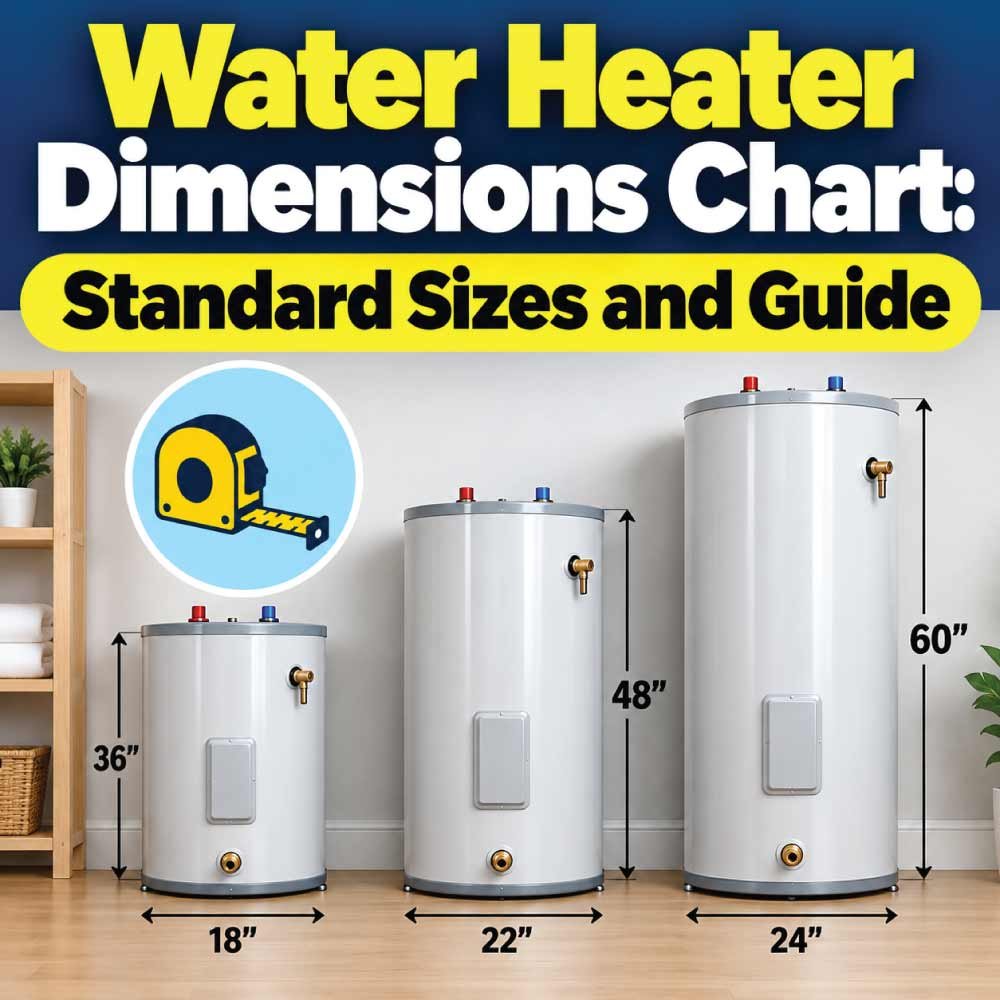
A water heater’s dimensions determine whether it will fit in a utility closet, basement, garage, attic, or other installation space. However, choosing the right unit involves more than checking its height and width. You also need to consider tank capacity, diameter, installation clearances, plumbing connections, and the space required for maintenance.
This water heater dimensions chart explains the typical size differences between residential tank water heaters, tankless models, and other common designs. You will learn how physical dimensions relate to gallon capacity, how to measure an existing unit, and how to choose a replacement that fits your home. Because measurements vary by manufacturer and model, use the charts as general planning guidance rather than exact product specifications.
Water Heater Dimensions Chart by Tank Capacity
Storage water heaters are commonly described by their tank capacity in gallons. Larger tanks generally require more installation space, although the exact height and diameter depend on the design, insulation, burner or heating elements, and manufacturer.
The following chart provides illustrative planning ranges, not universal standard dimensions. Always verify the actual dimensions of the model you intend to install.
| Tank Capacity | Approx. Height (in.) | Approx. Diameter (in.) | Typical Residential Use |
|---|---|---|---|
| 20 gallons | 30–35 | 18–22 | Compact spaces or limited demand |
| 30 gallons | 30–48 | 18–22 | Small households |
| 40 gallons | 45–60 | 20–24 | Small to medium households |
| 50 gallons | 50–60 | 22–26 | Many average households |
| 55–60 gallons | 50–65 | 24–28 | Higher demand or larger homes |
| 75 gallons | 55–70 | 26–30 | High-demand households |
| 80 gallons | 60–70 | 26–30 | Larger storage requirements |
Note: These are approximate example ranges for preliminary planning. A real unit may fall outside them, especially if it has a lowboy, short, tall, slim, or high-efficiency design.
How to Interpret the Dimensions Chart
Three measurements matter most when checking a water heater:
Height: The vertical distance from the bottom of the unit to its highest point. Include fittings or vent components where relevant.
Diameter: The width across a round tank. For a rectangular or irregular unit, measure its maximum width and depth.
Capacity: The amount of water the storage tank holds, expressed in gallons or liters.
Capacity does not determine the physical dimensions by itself. Two 50-gallon water heaters may have different heights and diameters, so never assume that an existing opening will accommodate every replacement with the same capacity.
Standard Water Heater Sizes and Physical Dimensions
Water heaters come in several configurations to accommodate different installation spaces. Understanding the differences can help you narrow down the models that fit your property.
Tall Water Heaters
Tall water heaters use a relatively narrow, vertical tank. They are commonly installed in garages, basements, and utility rooms where there is sufficient overhead clearance.
Typical characteristics include:
-
A relatively tall cylindrical tank.
-
A footprint that may be smaller than that of a short model with similar capacity.
-
Vertical clearance requirements for plumbing, venting, and service access.
A tall 40- or 50-gallon unit may fit into a narrow space but fail to fit beneath a low ceiling, shelf, or staircase.
Short Water Heaters
Short, sometimes called lowboy, water heaters have a lower profile and often a wider tank. They can be useful in locations with limited vertical clearance.
Before selecting one, check whether its greater diameter will fit through the access opening and within the available floor area. A shorter model with the same gallon capacity may occupy more horizontal space than a tall model.
Slim or Compact Water Heaters
Slim water heaters are designed to fit narrower spaces. Their dimensions vary considerably, and some compact models provide less storage capacity than conventional tanks.
These models may be suitable for apartments, small utility closets, or homes where floor space is limited. Check the rated capacity and recovery performance before choosing a compact tank solely because it fits.
Tankless Water Heaters
Tankless water heaters heat water as it flows through the unit instead of storing a large volume in a tank. They are usually much smaller than conventional storage water heaters, but they have different installation requirements.
Important measurements include:
-
Overall height and width.
-
Unit depth and mounting clearance.
-
Water and gas or electrical connection locations.
-
Venting requirements for applicable models.
-
Required service access.
Tankless systems should be selected according to flow rate, temperature rise, and household demand, not physical dimensions alone.
Electric vs. Gas Water Heater Dimensions
The heating method can affect the shape, connections, and installation space required for a water heater. However, neither gas nor electric models have one universal set of dimensions.
Electric Water Heater Dimensions
Electric storage water heaters use heating elements inside an insulated tank. They do not need a combustion flue, which can simplify placement in some homes, although electrical access and applicable clearance requirements still matter.
When checking an electric model, consider:
-
Tank height and diameter.
-
Location of the electrical junction box and access panels.
-
Cold-water inlet and hot-water outlet positions.
-
Space for replacing heating elements and servicing controls.
-
The manufacturer’s required installation clearances.
Electric models are available in tall, short, compact, and larger-capacity configurations. The dimensions depend on the specific product rather than the energy source alone.
Gas Water Heater Dimensions
Gas water heaters use a burner to heat the water. Conventional atmospheric-vent models need an appropriate exhaust route, while power-vent and direct-vent designs have their own venting requirements.
Check the following before installation:
-
Overall tank height and diameter.
-
Burner compartment and control access.
-
Gas connection location.
-
Vent connector or approved exhaust termination requirements.
-
Combustion-air provisions and specified clearances.
A gas water heater that physically fits a closet may still be unsuitable if the location cannot meet combustion-air, venting, or other applicable safety requirements.
Electric vs. Gas: Quick Comparison
| Feature | Electric Tank | Gas Tank |
|---|---|---|
| Tank shape | Tall, short, or compact | Tall, short, or compact |
| Venting | No combustion exhaust flue | Required as specified by design |
| Main connection | Electrical supply | Gas supply and applicable venting |
| Service access | Elements, controls, connections | Burner, controls, vent and connections |
| Dimensions | Model-specific | Model-specific |
Important: Do not choose a replacement based on the dimensions of the tank alone. Its energy source, venting design, and connection requirements must also be compatible with the installation.
How to Measure a Water Heater Correctly
Measuring an existing water heater is an important first step when replacing a unit or checking whether a new model will fit. Measure the actual appliance and the available installation space separately.
Step 1: Measure the Overall Height
Measure vertically from the bottom of the unit to its highest relevant point. Note whether the measurement includes top-mounted fittings, vent connections, or other components.
For a gas model, account for the venting arrangement separately if it extends above the tank. For an electric model, check the height of the plumbing connections and any other components that could interfere with a shelf or ceiling.
Step 2: Measure the Diameter or Width
For a round tank, measure across the widest part of the cylinder. Do not measure only the flat front-to-back surface if the tank is difficult to access.
For rectangular or wall-mounted tankless units, record the maximum width and depth. Include any protruding components that affect the space required for installation.
Step 3: Measure the Available Floor Space
Measure the width and depth of the area where the new heater will stand. Check doorways, closet openings, stairwells, and access routes that the replacement unit must pass through.
A water heater can fit inside a room but still be impossible to move through its doorway without removing an obstruction or changing the delivery route.
Step 4: Locate Plumbing and Utility Connections
Record the positions of the hot-water outlet, cold-water inlet, drain valve, electrical supply, gas connection, and venting components, as applicable.
Connection positions may differ between models, even when the tanks have identical exterior dimensions. Allow for the fittings, valves, and pipework needed to complete the installation.
Step 5: Check Installation Clearances
Do not assume that the unit can be installed directly against every surrounding surface. Follow the manufacturer’s instructions and local requirements for clearances, combustion air, venting, electrical access, and servicing.
If the heater is installed in a closet, also consider whether its access panels and valves can be reached after installation.
Water Heater Measurement Checklist
| Measurement | What to Record |
|---|---|
| Height | Tank and relevant overall height |
| Width or diameter | Widest point of the unit |
| Depth | Maximum front-to-back dimension |
| Installation opening | Doorway and access dimensions |
| Floor space | Available width and depth |
| Connections | Locations and types of utility connections |
| Clearance | Required space around and above the unit |
Keep these measurements together when comparing replacement products. The manufacturer’s dimensional drawing is usually more useful than a photograph because it identifies connection locations and specific measurement reference points.
Water Heater Dimensions in Inches and Centimeters
Water heater specifications may be listed in inches, centimeters, or millimeters, depending on the manufacturer and market. Converting the units helps when comparing products or measuring an installation with a metric tape measure.
Use these standard conversions:
-
1 inch = 2.54 centimeters
-
1 foot = 12 inches
-
1 centimeter = 10 millimeters
The following examples show how common measurements convert between imperial and metric units.
| Measurement (inches) | Equivalent (cm) | Equivalent (mm) |
|---|---|---|
| 18 | 45.72 | 457.2 |
| 20 | 50.80 | 508 |
| 22 | 55.88 | 558.8 |
| 24 | 60.96 | 609.6 |
| 26 | 66.04 | 660.4 |
| 30 | 76.20 | 762 |
| 48 | 121.92 | 1,219.2 |
| 60 | 152.40 | 1,524 |
These are unit conversions, not recommended dimensions for specific water heater models. For example, a 60-inch measurement equals 152.4 cm, but that does not mean every 50-gallon water heater is 60 inches tall.
When comparing specifications, keep the units consistent throughout your calculations. Also distinguish between the appliance’s external dimensions and the dimensions of its installation opening.
How Tank Capacity Affects Water Heater Dimensions
Water heater capacity and physical size are related, but they describe different things. Capacity tells you how much water a storage tank holds, while dimensions describe its external measurements.
A larger tank will generally require more space than a smaller tank of a similar design. However, insulation thickness, tank shape, and the manufacturer’s construction choices can affect the relationship.
Choosing a Tank by Household Demand
The correct capacity depends on the number of occupants, bathing habits, simultaneous hot-water use, and the type of appliances supplied by the heater.
As a preliminary guide, consider the following factors:
-
One or two people: A smaller tank may be sufficient when hot-water demand is limited.
-
Three or four people: A medium-capacity tank may be suitable, depending on shower use and other appliances.
-
Larger households: A larger tank or a different system configuration may be needed when several people use hot water close together.
These descriptions are not fixed capacity recommendations. Two households with the same number of occupants may have very different requirements. A family that takes consecutive showers may use hot water differently from a household that runs several showers, a dishwasher, and a washing machine during the same period.
First-Hour Rating and Recovery Rate
When comparing storage water heaters, tank capacity is only one part of the decision.
The first-hour rating indicates how much hot water a storage heater can deliver during the first hour of use under specified test conditions. The recovery rate describes how quickly the heater can heat incoming water.
A smaller tank with a strong recovery rate may perform differently from a larger tank with slower recovery. Consult the product’s published performance data instead of assuming that a larger tank always provides the best result.
Tankless Capacity Considerations
Tankless water heaters are generally rated by their flow rate and ability to raise incoming water temperature. Their suitability depends on how much hot water must be delivered at the same time and the difference between incoming and desired outlet temperatures.
For example, a model that supplies one shower comfortably may not supply multiple showers and other hot-water outlets simultaneously under the same conditions. Check the manufacturer’s performance chart for your climate, water temperature, and expected flow requirements.
Water Heater Dimensions for Different Installation Locations
The available installation space often determines which water heater designs are practical. A unit that works well in an open basement may be unsuitable for a compact closet or a low-ceiling utility room.
Basement Installations
Basements often provide more flexibility for tall storage tanks. Nevertheless, measure the ceiling height and the route used to bring the appliance into the room.
Consider:
-
Available headroom above the tank.
-
Access to the drain and shutoff valves.
-
Venting and combustion-air requirements for gas models.
-
Floor drainage and protection against water leaks.
-
Space needed for future replacement and servicing.
If the basement is prone to flooding, confirm that the installation location and equipment meet the manufacturer’s requirements and applicable local rules.
Garage Installations
Garages can accommodate a range of tank sizes, but available floor space is not the only concern. Vehicles, stored equipment, doors, and walkways may limit the usable area.
Measure the full footprint and account for any required protection against vehicle impact. Also check the manufacturer’s temperature, location, and installation requirements.
Closet and Utility Room Installations
A closet may restrict both the dimensions and the type of water heater you can install. A tall model may exceed the available height, while a short model may be too wide.
Before choosing a replacement, check the following:
-
The opening through which the heater must pass.
-
Clearance for the tank and connected pipes.
-
Access to controls, valves, and service panels.
-
Venting and combustion-air provisions where applicable.
-
Required access space for maintenance.
Never assume that a compact tankless model can be installed in a small closet without checking its ventilation, mounting, and service requirements.
Attic Installations
Attic installations require particular care because of limited access, structural considerations, and the consequences of a leak. The appliance must be suitable for the location, and the installation must comply with applicable requirements.
Check the load-bearing capacity, access route, drainage provisions, and any required leak protection. Have a qualified professional assess the location if you are unsure whether the structure can support the unit or whether safe servicing is possible.
Also Read:
What Installation Clearances Should You Allow?
There is no single clearance measurement that applies to every water heater. Required spacing depends on the product design, fuel type, venting arrangement, and applicable installation instructions.
The space around the appliance may be needed for safety, airflow, pipe connections, or maintenance rather than for the tank itself.
| Area to Check | Why It Matters |
|---|---|
| Above the unit | Connections, venting, and service access |
| Sides of the tank | Required clearance and maintenance |
| Front or service panel | Access to controls and components |
| Behind the unit | Plumbing, mounting, or specified spacing |
| Floor area | Stability, drainage, and leak protection |
| Vent route | Safe exhaust routing for applicable models |
Use the manufacturer’s installation manual to determine the actual distances. For gas water heaters, clearance from combustible materials and venting requirements are especially important. For electric models, electrical access and working space must also comply with the applicable rules.
Do not reduce a specified clearance simply to make a larger water heater fit. If the available space is insufficient, compare a different model or installation arrangement.
How to Choose the Right Water Heater Size
Selecting a water heater requires balancing physical fit, hot-water demand, energy source, and installation cost. The best choice is not necessarily the smallest unit or the one with the largest tank.
1. Confirm the Available Space
Start by recording the maximum acceptable height, width, and depth. Include the space needed for connections, valves, venting, and maintenance.
Compare these limits with the manufacturer’s published dimensional drawing rather than relying on the capacity printed on the product label.
2. Estimate Your Hot-Water Demand
Consider how many people live in the home and which activities occur simultaneously. Showers, baths, dishwashing, and laundry can all contribute to peak demand.
If your existing heater frequently runs out of hot water, investigate whether the issue is insufficient capacity, slow recovery, a faulty component, or a change in household use before automatically selecting a larger model.
3. Check the Energy Source
Determine whether your property uses electricity, natural gas, propane, or another approved energy source. A replacement may require different connections or installation work if you change the heating system.
Do not assume that a gas-to-electric or tank-to-tankless conversion will fit the same space without modifications.
4. Compare Actual Product Specifications
Review the product documentation for:
-
Exact height, width, and depth.
-
Storage capacity or tankless flow rating.
-
Energy efficiency information.
-
First-hour rating or recovery performance, where applicable.
-
Required clearances and venting.
-
Connection sizes and locations.
-
Warranty and maintenance requirements.
If two models have similar capacities, compare their external dimensions directly. Differences in insulation and overall design can affect the fit.
5. Plan for Installation and Future Maintenance
Allow for the work required to install, inspect, and service the equipment. A model that fits tightly today may become difficult to maintain later.
Also consider the access route for a future replacement. Keeping a clear path to the appliance can prevent unnecessary removal of shelves, doors, or other obstructions.
Also Read:
Common Water Heater Sizing Mistakes to Avoid
Even a carefully selected water heater can create installation problems if important measurements are overlooked.
-
Choosing by gallon capacity alone: Two tanks with the same capacity may have different heights and diameters.
-
Measuring only the tank body: Connections, valves, vent components, and service access may require additional space.
-
Ignoring the doorway: Confirm that the appliance can pass through the entrance and along the delivery route.
-
Forgetting maintenance access: Controls, drain valves, and service panels must remain accessible.
-
Assuming all models use the same clearances: Always follow the exact product documentation.
-
Overlooking hot-water demand: A physically suitable tank may not provide enough hot water for the household.
-
Changing fuel types without planning: A different energy source can require new electrical work, gas connections, venting, or other modifications.
Avoiding these mistakes can save time, reduce installation complications, and help you select a water heater that fits both your space and your household’s needs.
Frequently Asked Questions About Water Heater Dimensions
What are the standard dimensions of a 40-gallon water heater?
A 40-gallon storage water heater may be approximately 45–60 inches tall and 20–24 inches in diameter, depending on the model. These are illustrative ranges, not universal specifications. Check the manufacturer’s dimensional drawing before installation.
How tall is a standard 50-gallon water heater?
Many conventional 50-gallon storage models fall within an approximate height range of 50–60 inches, with diameters around 22–26 inches. Short and tall designs can differ significantly, so verify the dimensions of the specific unit.
How wide is an 80-gallon water heater?
Some conventional 80-gallon storage tanks have diameters in the approximate range of 26–30 inches. Actual widths vary by design, and additional room may be necessary for connections and servicing.
Are water heater dimensions measured with connections?
Not always. Manufacturers may list the tank body’s dimensions separately from the overall height or the dimensions of protruding fittings. Review the product drawing to understand what each measurement includes.
Can I replace a 40-gallon water heater with a 50-gallon model?
Possibly, but check the available space, plumbing connections, energy supply, venting where applicable, and installation requirements. The larger model may not fit the existing opening. You should also verify that the replacement is appropriate for your household’s demand.
Are tankless water heaters smaller than tank water heaters?
Tankless models are generally much more compact because they do not store a large volume of hot water. However, they have different flow-rate requirements, mounting arrangements, and sometimes substantial venting or utility requirements. Physical size alone does not determine suitability.
How much space should be left around a water heater?
There is no universal clearance for every model. Follow the manufacturer’s instructions and local installation requirements. Gas units may require specific clearances, combustion air, and venting, while all installations need appropriate access and servicing space.
Does a larger water heater always provide more hot water?
A larger storage tank generally holds more water, but actual hot-water delivery also depends on recovery rate, first-hour rating, incoming water temperature, and household usage. Compare performance specifications rather than capacity alone.
Conclusion
A water heater dimensions chart is a useful starting point for comparing tank heights, diameters, capacities, and installation requirements. However, standard size ranges should never replace the exact specifications of the model you plan to install.
Measure the available space, check the access route, verify connection locations, and confirm the required clearances before purchasing a replacement. Then compare storage capacity or tankless flow performance with your household’s actual hot-water demand.
By considering both physical dimensions and heating performance, you can choose a water heater that fits your home, meets your needs, and allows safe installation and convenient future maintenance.