When a water heater stops producing enough hot water, takes too long to heat, makes unusual noises, leaks, or does not turn on, the first step is usually a basic inspection. Many water heater problems are caused by simple issues such as a tripped breaker, incorrect temperature settings, a closed valve, a failed pilot light, or sediment buildup.
Knowing the first things to check on a water heater can help you identify the likely cause before calling a professional. However, water heaters combine electricity, gas, pressurized water, and high temperatures, so safety should always come first.
This guide explains what to check on an electric, gas, tank, and tankless water heater, what common warning signs mean, and when professional repair is necessary.
First Things to Check When a Water Heater Is Not Working
If your water heater is not working properly, start with the simplest and safest external checks. Avoid immediately removing electrical covers, gas components, or safety controls.
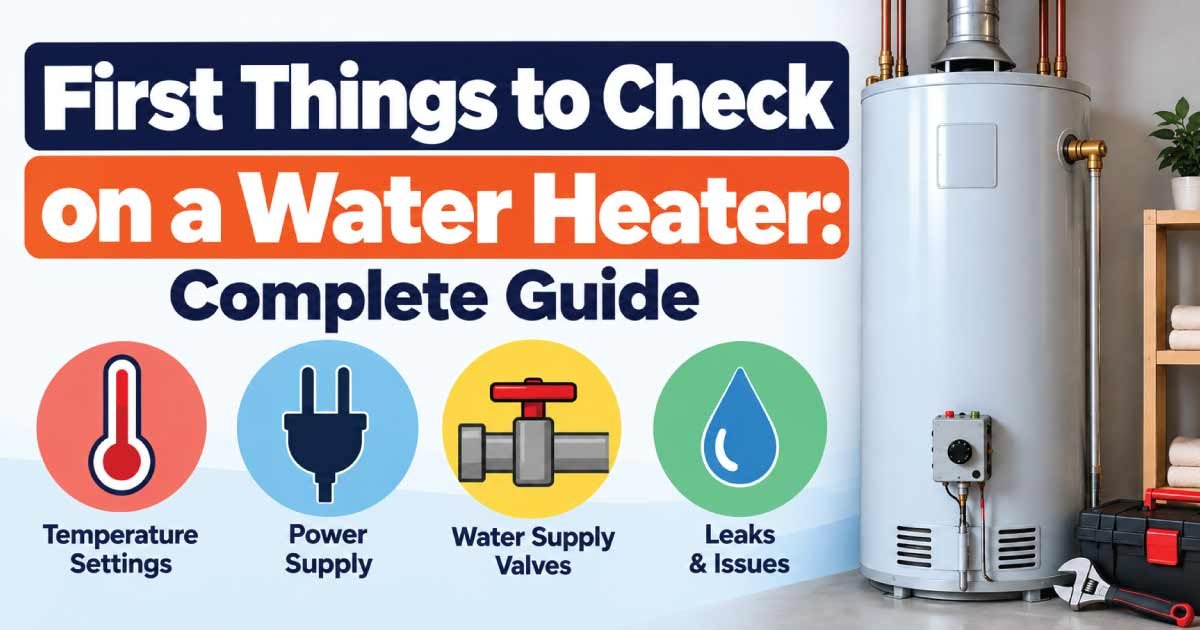
The basic inspection should include:
- Power supply
- Circuit breaker
- Temperature setting
- Water supply valve
- Hot-water flow
- Pilot light on gas models
- Error codes on tankless units
- Visible leaks
- Pressure relief valve
- Unusual sounds
- Rust or corrosion
- Water temperature
These checks can often narrow down the problem without disassembling the heater.
Quick Water Heater Troubleshooting Checklist
| Check | What to Look For | Possible Problem |
|---|---|---|
| Power | Breaker or disconnect | No electrical supply |
| Thermostat | Normal temperature setting | Incorrect setting |
| Water valve | Fully open | Restricted water flow |
| Pilot light | Lit on gas heater | Ignition problem |
| Leaks | Water around tank or fittings | Plumbing or tank failure |
| Temperature | Hot water available | Heating problem |
| Pressure relief valve | No continuous discharge | Pressure or valve issue |
| Sounds | Popping, rumbling, hissing | Sediment or mechanical issue |
| Error display | No error or fault code | Tankless system problem |
| Corrosion | Rust around connections | Aging or leaking components |
Check the Water Heater Power Supply
For an electric water heater, the first thing to check is whether the unit is receiving power.
A water heater can appear completely dead when the actual problem is a tripped circuit breaker, disconnected power supply, or electrical fault.
Check the Circuit Breaker
Locate the electrical panel and look for the breaker labeled for the water heater.
If the breaker is in the middle or OFF position, it may have tripped.
You can check whether the breaker has tripped, but repeated tripping is not normal. If it immediately trips again, leave it off and have the system inspected by a qualified electrician or water heater technician.
Repeated breaker trips may indicate:
- A short circuit
- Failed heating element
- Damaged wiring
- Faulty thermostat
- Overheating
- Electrical insulation problems
Never repeatedly reset a breaker to keep a faulty water heater operating.
Check the Disconnect
Some electric water heaters have a separate disconnect near the unit. Make sure it has not been switched off.
Do not remove electrical panels or touch wiring unless you are qualified to work with high-voltage equipment.
Check the Water Heater Temperature Setting
If the water heater turns on but the water is not hot enough, check the temperature setting.
A thermostat that is set too low can make the heater appear to be malfunctioning even though the heating system is operating normally.
For many household systems, a setting around 120°F (49°C) provides a practical balance between hot-water needs and scalding risk.
Why Temperature Settings Matter
A setting that is too low can result in:
- Lukewarm showers
- Longer heating cycles
- Insufficient hot water
- Increased demand on the system
A setting that is too high can increase:
- Scalding risk
- Energy consumption
- Heat loss
- Stress on plumbing components
If the temperature setting seems normal but the water remains cold, the problem may involve the heating element, thermostat, burner, dip tube, or another component.
Check Whether the Water Supply Valve Is Open
A water heater requires an adequate water supply to operate correctly.
Look at the cold-water inlet pipe entering the top of a conventional tank water heater. There is normally a shutoff valve near the connection.
Make sure the valve is fully open.
What Happens If the Valve Is Closed?
A closed or partially closed supply valve can cause:
- Little or no hot-water flow
- Low water pressure
- Slow filling
- Unusual water flow behavior
- Problems after plumbing maintenance
For a tank-style water heater, never turn on the heating system when the tank is empty. Heating an empty tank can damage components.
Check for Visible Water Leaks
A water leak is one of the most important things to inspect.
Look around:
- The top water connections
- Cold-water inlet
- Hot-water outlet
- Temperature and pressure relief valve
- Drain valve
- Bottom of the tank
- Flexible connectors
- Nearby floor and walls
A small leak from a fitting may have a relatively simple plumbing cause, while water coming from the tank itself can indicate internal corrosion.
Tank Leak vs. Connection Leak
| Leak Location | Likely Cause | Typical Response |
|---|---|---|
| Top fitting | Loose or damaged connection | Inspect/repair fitting |
| Drain valve | Valve leak | Valve service or replacement |
| Relief valve | Pressure or valve problem | Professional inspection |
| Pipe connection | Plumbing connection issue | Repair connection |
| Bottom seam | Tank corrosion | Often requires replacement |
| Around base | Tank or drain issue | Investigate promptly |
If the tank itself is leaking, especially around its lower seam or body, replacement may be more practical than repair.
Check the Hot-Water Temperature
Run a hot-water faucet and determine whether the water is:
- Completely cold
- Lukewarm
- Hot for a short time
- Hot but insufficient
- Extremely hot
- Fluctuating between hot and cold
The pattern provides useful clues.
Cold Water All the Time
Possible causes include:
- No electrical power
- Failed heating element
- Thermostat problem
- Gas supply problem
- Pilot light failure
- Burner problem
- Control-system fault
Hot Water Runs Out Quickly
Possible causes include:
- Undersized tank
- Failed heating element
- Sediment accumulation
- High household demand
- Damaged dip tube
- Incorrect thermostat operation
- Mixing valve problem
Water Is Too Hot
Possible causes include:
- Temperature setting too high
- Thermostat malfunction
- Control problem
- Failed safety component
Extremely hot water presents a serious scalding risk and should be addressed promptly.
Check the Pilot Light on a Gas Water Heater
Gas water heaters commonly use a pilot or electronic ignition system.
If the pilot light is out, the burner may not operate, leaving you with little or no hot water.
Look through the designated viewing area if your model has one. Follow the manufacturer’s instructions for relighting the pilot.
Why Does a Pilot Light Go Out?
Common causes include:
- Weak thermocouple
- Dirty pilot assembly
- Gas supply interruption
- Drafts
- Faulty gas control
- Ignition problems
- Ventilation issues
If the pilot repeatedly goes out, the underlying problem should be diagnosed rather than repeatedly relighting it.
Important Gas Safety
If you smell gas:
- Do not operate electrical switches.
- Do not create flames or sparks.
- Leave the area if necessary.
- Follow your local gas utility or emergency instructions.
- Have the gas system inspected by a qualified professional.
Do not attempt to repair gas valves or bypass safety devices yourself.
Check the Gas Supply
For a gas water heater, verify that the home’s gas supply has not been interrupted.
Other gas appliances can provide a useful external clue. If multiple gas appliances are not operating, the issue may involve the home’s gas supply rather than the water heater itself.
Do not disassemble gas piping or attempt to repair gas-control components without appropriate qualifications.
Check the Heating Elements on an Electric Water Heater
If an electric tank water heater has power but does not heat water properly, the heating elements are important suspects.
Most conventional electric water heaters have two heating elements:
- Upper heating element
- Lower heating element
The upper element generally helps heat the upper portion of the tank, while the lower element is important for heating the lower portion during normal operation.
Symptoms of a Failed Heating Element
A failed heating element may cause:
- Completely cold water
- Reduced hot-water capacity
- Slow recovery
- Hot water that runs out quickly
- Longer heating times
Testing or replacing heating elements involves electrical hazards. Turn off power at the appropriate disconnect and have a qualified technician perform electrical testing if you are not trained to do it safely.
Check the Thermostat
Thermostats control when the heating system operates.
A thermostat problem can cause the water heater to:
- Not heat
- Heat intermittently
- Produce lukewarm water
- Overheat
- Run for unusually long periods
If the thermostat setting appears normal but the water temperature is incorrect, the thermostat or associated control circuit may require professional testing.
Check the Temperature and Pressure Relief Valve
The temperature and pressure relief valve, often called the T&P valve, is a critical safety component on tank water heaters.
It is designed to release pressure or excessively hot water when necessary.
Check the area around the valve for:
- Continuous dripping
- Water discharge
- Corrosion
- Mineral deposits
- Signs of previous leakage
Do not block, cap, or bypass the relief valve.
A relief valve that is continuously discharging water needs attention because the cause may be excessive pressure, excessive temperature, or a defective valve.
Check for Unusual Water Heater Noises
Noise can provide clues about what is happening inside the heater.
Common sounds include:
- Popping
- Rumbling
- Crackling
- Hissing
- Banging
- Clicking
- Whistling
Popping or Rumbling
Popping and rumbling are commonly associated with sediment buildup in tank water heaters.
Minerals can settle at the bottom of the tank. When the burner or heating element heats water around the deposits, steam bubbles can form and collapse, producing noise.
Significant sediment buildup can reduce efficiency and increase heating time.
Hissing
Hissing may be related to:
- Water flow
- Steam
- A leaking fitting
- Heating-element issues
- Pressure-related conditions
A persistent or unusual hissing sound should be investigated.
Clicking
Clicking can sometimes occur during normal electrical or ignition operation, but persistent clicking accompanied by heating failure may indicate an ignition or electrical control issue.
Discover More:
Check for Rusty, Brown, or Cloudy Hot Water
Discolored water can indicate corrosion or sediment.
If only hot water is discolored while cold water remains clear, the water heater may be contributing to the problem.
Possible causes include:
- Corroding tank
- Depleted anode rod
- Sediment
- Corroded plumbing connections
- Water-quality issues
What Does Rusty Hot Water Mean?
Rust-colored water should not automatically be assumed to mean the entire water heater has failed.
However, persistent rusty hot water can be a warning sign of corrosion, particularly in an older tank.
A professional inspection can determine whether the problem involves the anode rod, tank, or plumbing system.
Check the Water Heater Age
Age is another important factor when diagnosing water heater problems.
Traditional tank water heaters often have a service life of roughly 8–12 years, although actual life varies with water quality, maintenance, installation, usage, and equipment quality.
Tankless systems can last longer when properly installed and maintained.
Why Age Matters
An older heater may develop:
- Tank corrosion
- Sediment accumulation
- Failed heating elements
- Thermostat problems
- Burner problems
- Leaking valves
- Reduced efficiency
- Repeated repairs
If an older water heater develops a major tank leak, replacement is usually more practical than attempting to repair the tank itself.
Check the Water Heater Drain and Connections
The drain valve is located near the bottom of most tank water heaters.
Inspect the area for moisture, mineral deposits, or corrosion.
A leaking drain valve can cause:
- Water around the heater
- Slow leaks
- Floor damage
- Reduced pressure
- Corrosion around the base
Do not force a damaged valve or attempt a repair while the system is hot and pressurized.
Check Tankless Water Heater Error Codes
Tankless water heaters usually have electronic controls and diagnostic displays.
If the unit is not producing hot water, check the display for an error code.
Record the exact code and consult the manufacturer’s documentation.
Common Tankless Problems
Potential causes include:
- Gas supply issues
- Ignition failure
- Low water flow
- Scale buildup
- Blocked venting
- Temperature sensor problems
- Electrical faults
- Overheating
- Water-pressure problems
Error codes can significantly narrow down troubleshooting, but some repairs require qualified service.
Discover More:
Check Water Flow and Pressure
A water heater may appear to have a heating problem when the actual issue involves water flow.
Check whether hot water pressure is normal at multiple fixtures.
If hot-water flow is low everywhere, possible causes include:
- Partially closed valve
- Clogged plumbing
- Sediment
- Mineral buildup
- Faulty mixing valve
- Plumbing restriction
If only one faucet has low hot-water flow, the problem may be with that faucet or its aerator rather than the water heater.
Check the Anode Rod on a Tank Water Heater
The anode rod helps protect the steel tank from corrosion.
It gradually deteriorates as it sacrifices itself to protect the tank.
A heavily depleted anode rod can increase the risk of tank corrosion.
Why the Anode Rod Matters
A healthy anode rod can help extend the useful life of a tank by reducing corrosion.
Inspection and replacement depend on the specific heater design and require opening a tank connection. If you are unfamiliar with water heater servicing, have a qualified professional perform the inspection.
Check for Sediment Buildup
Sediment is particularly common in areas with hard water.
Minerals can accumulate at the bottom of a tank and reduce heating efficiency.
Signs of sediment buildup include:
- Popping noises
- Rumbling
- Slow heating
- Reduced hot-water supply
- Higher energy use
- Longer recovery time
Routine maintenance and appropriate flushing can help control sediment, but the correct procedure depends on the heater type and condition.
Discover More:
First Things to Check on an Electric Water Heater
For an electric water heater, prioritize these checks:
- Check whether the unit has electrical power.
- Inspect the circuit breaker without opening electrical compartments.
- Check the thermostat setting.
- Check whether hot water is completely cold or merely lukewarm.
- Look for visible leaks.
- Inspect water supply connections.
- Listen for unusual sounds.
- Consider heating-element or thermostat failure if power is available but heating is inadequate.
- Check for repeated breaker trips.
- Contact a qualified technician for internal electrical diagnosis.
Never work on energized electrical components.
First Things to Check on a Gas Water Heater
For a gas water heater, begin with:
- Check whether there is a gas odor.
- If you smell gas, prioritize safety and leave the area if necessary.
- Check the pilot or ignition status through the manufacturer’s designated viewing area.
- Check the temperature setting.
- Check the water supply valve.
- Look for leaks.
- Check for unusual burner or ignition behavior.
- Inspect for visible corrosion.
- Check for unusual venting symptoms from outside the unit.
- Call a qualified professional for gas-control, combustion, or venting problems.
Gas components should not be disassembled or bypassed as a DIY troubleshooting step.
Water Heater Troubleshooting by Symptom
| Symptom | Possible Causes | First Check |
|---|---|---|
| No hot water | Power, pilot, heating element | Power or ignition |
| Lukewarm water | Thermostat, element, sediment | Temperature setting |
| Hot water runs out quickly | Element, tank size, sediment | Usage and heating performance |
| Water leaks | Fitting, valve, tank | Leak location |
| Rusty hot water | Corrosion, anode rod | Hot vs. cold water |
| Popping noise | Sediment | Tank condition |
| Breaker trips | Electrical fault | Stop resetting breaker |
| Pilot goes out | Thermocouple, gas, burner | Pilot behavior |
| Low hot-water pressure | Valve, restriction, plumbing | Flow at multiple fixtures |
| Tankless error | Sensor, ignition, flow, scale | Error code |
What Should You Check First If There Is No Hot Water?
When there is no hot water, follow the simplest sequence first.
For Electric Water Heaters
Check:
- Circuit breaker
- Disconnect
- Temperature setting
- Water supply
- Recent electrical work or power outage
- Visible leaks
If power is present but the heater does not recover, a heating element, thermostat, or control issue may be responsible.
For Gas Water Heaters
Check:
- Gas odor
- Pilot or ignition status
- Temperature setting
- Water supply
- Error or diagnostic indicators
- Visible leaks
If gas odor or combustion-related concerns exist, stop troubleshooting and seek professional assistance.
When Should You Stop Troubleshooting a Water Heater?
Basic external checks are useful, but troubleshooting should stop when the problem involves potentially dangerous internal components.
Contact a qualified professional if:
- The circuit breaker repeatedly trips.
- You see damaged electrical wiring.
- The tank is leaking from its body.
- The gas supply or gas valve appears faulty.
- The pilot repeatedly goes out.
- There is a gas smell.
- The relief valve continuously discharges.
- Water is extremely hot.
- The heater is overheating.
- The unit shows a serious diagnostic fault.
- You are unsure how to safely perform a repair.
A professional diagnosis can prevent further damage and reduce the risk of electric shock, fire, gas exposure, burns, or flooding.
Water Heater Repair or Replacement?
Not every water heater problem requires a new unit.
Minor issues may involve a valve, thermostat, heating element, anode rod, or other replaceable component.
Replacement becomes more attractive when the heater is old, inefficient, repeatedly failing, or leaking from the tank.
| Problem | Repair Often Possible? | Replacement Often Needed? |
|---|---|---|
| Failed heating element | Yes | No |
| Failed thermostat | Yes | No |
| Pilot/ignition issue | Often | Sometimes |
| Leaking fitting | Yes | No |
| Faulty drain valve | Yes | No |
| Worn anode rod | Yes | No |
| Sediment buildup | Often | Sometimes |
| Tank body leak | Usually no | Yes |
| Severe corrosion | Usually no | Yes |
| Repeated major failures | Sometimes | Often |
The economics depend on the heater’s age, repair cost, efficiency, warranty, and expected remaining service life.
How to Prevent Water Heater Problems
After troubleshooting the immediate issue, preventative maintenance can help reduce future failures.
Useful maintenance practices include:
- Inspect the unit periodically for leaks.
- Keep the surrounding area accessible.
- Check temperature settings.
- Have gas systems professionally inspected when needed.
- Maintain tankless units according to manufacturer recommendations.
- Address unusual noises early.
- Monitor rusty or discolored hot water.
- Inspect the anode rod when appropriate.
- Control sediment and mineral buildup.
- Replace aging equipment before a catastrophic failure when practical.
Regular maintenance is particularly important for water heaters operating in areas with hard water.
10-Point Water Heater Inspection Checklist
Use this checklist when a water heater starts behaving differently:
- Power: Is the electric unit receiving power?
- Breaker: Has the circuit breaker tripped?
- Temperature: Is the thermostat set appropriately?
- Water supply: Is the inlet valve fully open?
- Hot water: Is the water cold, lukewarm, or hot?
- Gas ignition: Is the pilot or ignition system operating normally?
- Leaks: Is water escaping anywhere?
- Noise: Is the heater making popping, rumbling, or hissing sounds?
- Corrosion: Are there rust deposits or damaged connections?
- Age: Is the water heater approaching the end of its expected service life?
This simple checklist can help determine whether the problem is likely minor or requires professional attention.
Frequently Asked Questions About Checking a Water Heater
What is the first thing to check when a water heater stops working?
Check the safest external causes first. For an electric heater, check the power supply and breaker. For a gas heater, check for gas odor and the pilot or ignition status. Also check the temperature setting and visible leaks.
Why is my water heater not heating water?
Possible causes include a tripped breaker, failed heating element, thermostat problem, gas supply interruption, pilot failure, burner problem, sediment buildup, or another control-system fault.
How do I know if my water heater has power?
For basic troubleshooting, check the dedicated circuit breaker and disconnect if present. Do not remove electrical covers or touch wiring unless you are qualified to do so.
Should I reset my water heater?
Some water heaters have reset controls, but a reset should not be treated as a permanent repair. If the system repeatedly trips or shuts down, the underlying problem needs to be diagnosed.
Why is my water heater making a popping noise?
Popping or rumbling commonly occurs when sediment accumulates inside a tank. The deposits can cause steam bubbles to form and collapse during heating.
Why is my water heater leaking?
Leaks can originate from fittings, valves, connections, or the tank itself. A leak from the tank body or bottom seam is particularly concerning and may mean the tank needs replacement.
How do I know if my water heater is failing?
Warning signs include inconsistent hot water, frequent shutdowns, unusual noises, rusty water, leaks, slow heating, repeated breaker trips, rising operating costs, and an aging tank.
What should I check if hot water runs out quickly?
Check the thermostat setting, water usage, heating performance, sediment buildup, and the condition of the heating elements or burner. An undersized tank can also cause frequent hot-water shortages.
Can I troubleshoot a water heater myself?
You can perform basic external checks such as inspecting the breaker, temperature setting, valves, visible leaks, and diagnostic display. Electrical, gas, combustion, and internal component repairs should be handled by qualified professionals when you lack the necessary training.
When should I replace my water heater?
Replacement may make sense when the tank is leaking, severely corroded, very old, repeatedly failing, or becoming expensive to repair. Compare the repair cost and expected remaining life with the cost and efficiency of a new unit.
Final Thoughts
The first things to check on a water heater are usually simple: power, temperature settings, water supply, ignition status, visible leaks, unusual noises, and hot-water performance. These checks can help identify the most likely problem before professional service is required.
The key is to troubleshoot safely. Never bypass safety controls, repeatedly reset a tripping breaker, or attempt unfamiliar gas or high-voltage repairs. A water heater that shows repeated failures, serious leaks, gas-related symptoms, or electrical faults should be inspected by a qualified professional.
A quick inspection can often distinguish between a simple adjustment, a replaceable component, and a water heater that is approaching the end of its useful life.