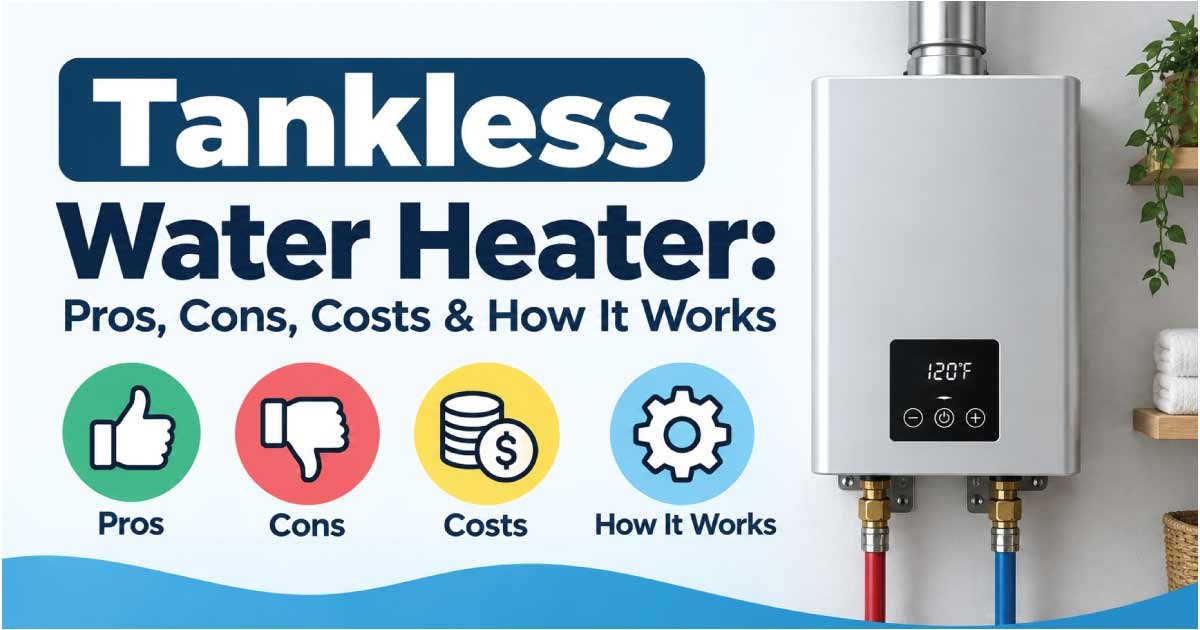
A tankless water heater heats water only when hot water is needed instead of storing a large volume of heated water in a conventional tank. This on-demand approach can save space and reduce standby heat loss, making tankless systems an increasingly popular alternative to traditional storage water heaters.
Tankless water heaters are available in electric and gas models. Electric units use heating elements to raise water temperature as it flows through the appliance, while gas models use a burner and heat exchanger.
Unlike a conventional water heater, a tankless unit does not continuously keep a large tank of water hot. When a faucet or shower opens, the system detects water flow and activates its heating system.
However, tankless water heaters are not automatically the best choice for every home. Installation requirements, flow rate, incoming water temperature, energy source, electrical capacity, gas supply, and upfront cost all need to be considered.
This guide explains how tankless water heaters work, their advantages and disadvantages, typical sizes, costs, flow rates, energy efficiency, installation requirements, maintenance, lifespan, and how to decide whether a tankless system is right for your home.
What Is a Tankless Water Heater?
A tankless water heater is an on-demand water heating system that heats water as it passes through the unit.
Instead of storing 40, 50, or 60 gallons of hot water in a tank, the system remains inactive or operates at a low standby level until water flow is detected.
When a hot-water fixture is opened:
- Cold water enters the heater.
- A flow sensor detects water movement.
- The heating system activates.
- Heat is transferred to the flowing water.
- Hot water leaves the unit and travels to the fixture.
- The heater adjusts its output according to demand.
- When the faucet closes, the heating system shuts down.
This operating method eliminates the need to continuously maintain a large reservoir of hot water.
Tankless water heaters are also known as:
- On-demand water heaters
- Instant water heaters
- Instantaneous water heaters
- Continuous-flow water heaters
- Point-of-use water heaters, for smaller applications
How Does a Tankless Water Heater Work?
The exact operation depends on whether the system is electric or gas, but the basic concept is the same.
The unit must transfer enough heat into the flowing water to raise its temperature from the incoming-water temperature to the desired output temperature.
How an Electric Tankless Water Heater Works
An electric tankless water heater uses one or more high-powered electric heating elements.
The operating sequence is generally:
- A hot-water faucet is opened.
- Water begins flowing through the unit.
- A flow sensor detects demand.
- Electrical heating elements activate.
- The elements transfer heat to the water.
- The control system adjusts heating output.
- Hot water exits the heater.
- The elements switch off when water flow stops.
Because electric tankless units can require substantial electrical power, the home’s electrical service must be suitable for the specific model.
How a Gas Tankless Water Heater Works
A gas tankless water heater uses a burner to heat water through a heat exchanger.
The process generally involves:
- Opening a hot-water fixture.
- Detecting water flow.
- Activating the gas burner.
- Heating the heat exchanger.
- Passing water through the heated heat exchanger.
- Adjusting burner output according to demand.
- Delivering heated water to the fixture.
- Shutting down the burner when demand stops.
Gas models require appropriate combustion air and exhaust venting.
Tankless Water Heater Size Chart
Tankless water heaters are not primarily sized by gallons of storage because they do not store large quantities of hot water.
Instead, sizing focuses on flow rate and temperature rise.
Flow rate is normally expressed as gallons per minute (GPM) in the United States.
| Tankless Size | Approx. Flow Range | Typical Application |
|---|---|---|
| Small | 1–3 GPM | Single fixture or point of use |
| Medium | 3–5 GPM | One shower plus limited demand |
| Large | 5–8 GPM | Small household |
| Extra large | 8–10+ GPM | Larger household |
| High-capacity | 10+ GPM | Multiple simultaneous fixtures |
These are broad planning ranges. Actual performance depends on the required temperature rise, incoming water temperature, fixture flow rates, and the manufacturer’s specifications.
What Size Tankless Water Heater Do You Need?
The correct tankless water heater size depends primarily on simultaneous flow demand.
For example, suppose a household operates:
- One shower
- One bathroom faucet
- One kitchen faucet
at the same time.
The heater must provide enough heating capacity to meet the combined flow rate while achieving the desired temperature rise.
A useful calculation is:
Required flow rate = total simultaneous hot-water demand
Then consider:
Temperature rise = desired hot-water temperature − incoming-water temperature
The greater the temperature rise, the more heating capacity the unit needs.
This is particularly important in colder climates, where incoming groundwater may be significantly colder.
Tankless Water Heater Flow Rate
Flow rate is one of the most important specifications when choosing a tankless water heater.
Typical household fixtures may consume different amounts of water:
| Fixture | Approximate Flow |
|---|---|
| Bathroom faucet | 0.5–2 GPM |
| Kitchen faucet | 1–2.5 GPM |
| Shower | 1.5–2.5 GPM |
| Bathtub faucet | 3–5+ GPM |
| Washing machine | Varies |
| Dishwasher | Varies |
These are general ranges rather than fixed values. Actual flow depends on the fixture, water pressure, flow restrictors, and appliance.
When several fixtures operate simultaneously, their flow rates can add together.
Why Temperature Rise Matters
A tankless water heater does not simply need to produce a certain number of gallons per minute. It must raise those gallons from the incoming temperature to the required hot-water temperature.
For example, heating relatively warm incoming water to a comfortable shower temperature requires less energy than heating very cold incoming water to the same output temperature.
This means a tankless unit’s advertised maximum GPM may not be achievable at every temperature-rise requirement.
Always examine the manufacturer’s performance tables rather than relying on the maximum GPM shown in a product description.
Tankless Water Heater Cost
Tankless water heater costs vary significantly depending on:
- Gas or electric operation
- Heating capacity
- Flow rate
- Efficiency
- Brand
- Model
- Installation complexity
- Venting requirements
- Electrical service
- Gas supply
- Plumbing modifications
- Location
- Local labor rates
The equipment itself can cost more than a basic conventional storage water heater, while installation can also be more complex.
For this reason, the correct comparison should consider total installed cost, not just the purchase price.
What Affects Tankless Installation Cost?
Electrical Requirements
Large electric tankless water heaters can require substantial electrical capacity. Some installations may need additional circuits, wiring, breakers, or electrical-service upgrades.
Gas Supply
Gas models may require appropriately sized gas piping.
Venting
Gas tankless water heaters require compatible venting designed for the appliance.
Water Connections
Replacing an existing tank may require changes to water piping because tankless units often have different connection arrangements.
Installation Location
A new location may require additional plumbing, electrical, gas, or venting work.
Removal of Existing Tank
Replacing a conventional storage heater requires draining and removing the old tank.
Local Requirements
Permits, inspections, and installation requirements vary by jurisdiction.
Tankless Water Heater Energy Efficiency
One of the main reasons homeowners consider tankless water heaters is the potential reduction in energy wasted through standby heating.
A conventional storage water heater maintains a large volume of hot water even when nobody is using it. A tankless system generally does not need to keep a large reservoir hot.
Energy consumption still depends on how much hot water the household uses.
Important factors include:
- Hot-water demand
- Incoming-water temperature
- Desired output temperature
- Flow rate
- Heater efficiency
- Fuel type
- Water usage patterns
- Pipe heat loss
A tankless water heater can reduce standby losses, but that does not mean it will automatically have lower total energy costs in every household.
Tankless vs. Conventional Water Heater Energy Use
The fundamental difference is when energy is consumed.
A conventional water heater:
- Stores hot water.
- Maintains the temperature of stored water.
- Experiences standby heat loss.
- Uses energy during recovery after water is consumed.
A tankless water heater:
- Does not store a large supply of hot water.
- Activates when demand occurs.
- Uses energy primarily during hot-water flow.
- Has little or no tank-related standby loss.
However, the overall energy savings depend on household usage and system efficiency.
Advantages of a Tankless Water Heater
No Large Storage Tank
A tankless unit does not require a large cylindrical storage tank.
This can free valuable floor and closet space.
Reduced Standby Heat Loss
Because there is no large tank of stored hot water, the system does not continuously lose heat from a large reservoir.
On-Demand Heating
Water is heated as it flows through the unit.
Potentially Long Service Life
With proper installation and maintenance, tankless systems can provide a long operating life.
Continuous Hot Water Within Capacity
A tankless heater can continue producing hot water as long as the system has sufficient heating capacity and flow conditions are maintained.
Compact Design
Many tankless models are wall-mounted, making them useful where floor space is limited.
No Large Tank to Corrode
Because there is no large storage tank, tank corrosion-related failure is not the same issue as with conventional tank water heaters.
Disadvantages of a Tankless Water Heater
Higher Upfront Cost
Equipment and installation can cost more than a basic storage water heater.
Complex Installation
Gas venting, gas piping, electrical capacity, or plumbing modifications can make installation more complicated.
Flow Limitations
A tankless unit has a maximum heating capacity. Too much simultaneous flow can result in lower outlet temperatures.
Cold-Water Sandwich
Some systems may experience brief temperature fluctuations when water demand starts and stops repeatedly.
Electrical Requirements
Large electric models may require significant electrical capacity.
Maintenance Requirements
Tankless heat exchangers can accumulate mineral scale, particularly in areas with hard water.
Delayed Hot Water
Although the heater begins heating when water flows, hot water still has to travel through the plumbing system from the heater to the fixture.
Tankless Water Heater Pros and Cons
| Pros | Cons |
|---|---|
| Compact design | Higher upfront cost |
| Reduced standby heat loss | Installation can be complex |
| On-demand heating | Flow capacity is limited |
| Long service potential | May require regular descaling |
| Continuous supply within capacity | Large electric models can need substantial power |
| No large storage tank | Gas models require venting |
| Wall-mounted installation | Performance depends on temperature rise |
The best choice depends on whether these benefits outweigh the additional installation requirements and costs for your property.
Gas vs. Electric Tankless Water Heater
Tankless water heaters are commonly available in gas and electric configurations.
| Feature | Gas Tankless | Electric Tankless |
|---|---|---|
| Energy source | Natural gas or propane | Electricity |
| Combustion | Yes | No |
| Venting | Required | No combustion vent |
| Electrical demand | Usually lower than large electric units | Can be substantial |
| Gas supply | Required | Not required |
| Installation | Can be complex | Can require electrical upgrades |
| Heat output | Model dependent | Model dependent |
| Best fit | Properties with suitable gas infrastructure | Properties with suitable electrical capacity |
Neither option is universally superior.
The existing infrastructure can be one of the biggest factors in determining which type makes sense.
Electric Tankless Water Heater Sizing
Electric tankless systems require special attention to electrical capacity.
A large electric tankless heater may use multiple heating elements simultaneously. This can create a substantial electrical load.
Before choosing an electric model, verify:
- Voltage
- Amperage
- Circuit requirements
- Number of circuits
- Breaker requirements
- Wire specifications
- Main electrical-service capacity
If the home’s electrical service cannot support the heater, an electrical upgrade may be required.
This is an important difference from simply replacing a conventional electric storage heater with another tank-based model.
Gas Tankless Water Heater Sizing
Gas tankless systems are primarily sized around:
- Required GPM
- Temperature rise
- Gas input capacity
- Available gas pressure
- Venting requirements
A model with a high maximum flow rate may still provide lower flow at a high temperature rise.
For example, a household in a cold climate may require more heating capacity than the same household in a warm climate because the incoming water is colder.
Always use the manufacturer’s flow and temperature-rise tables for final sizing.
Tankless Water Heater Installation
Installation should follow the manufacturer’s instructions and applicable local plumbing, electrical, gas, building, and safety requirements.
A typical installation may include:
- Selecting an appropriate location.
- Shutting off the water supply.
- Disconnecting the existing water heater if replacing one.
- Installing water connections.
- Installing required isolation valves.
- Connecting the electrical supply or gas supply.
- Installing required venting for gas models.
- Checking water flow.
- Configuring temperature controls.
- Testing the system.
- Checking connections for leaks.
- Verifying safe operation.
Gas connections, electrical circuits, and combustion venting should be handled by appropriately qualified professionals.
Where Should a Tankless Water Heater Be Installed?
The ideal location depends on the specific model and property.
Possible locations include:
- Utility rooms
- Garages
- Basements
- Exterior walls for approved outdoor models
- Closets that meet applicable requirements
- Near major hot-water demand areas
Placing the heater closer to frequently used fixtures can reduce the distance hot water travels through the plumbing.
However, installation location must satisfy clearance, ventilation, electrical, gas, plumbing, freezing-protection, and manufacturer requirements.
Discover More:
Tankless Water Heater Maintenance
Tankless systems require maintenance even though they do not have a storage tank.
One of the most important maintenance tasks is controlling mineral scale.
Hard water can cause mineral deposits to accumulate inside the heat exchanger. This can reduce heat transfer and affect performance.
Maintenance may include:
- Flushing or descaling the heat exchanger
- Cleaning inlet filters
- Inspecting water connections
- Checking valves
- Inspecting gas burners
- Checking venting
- Inspecting electrical connections
- Checking temperature sensors
- Examining error codes
- Checking for leaks
The maintenance schedule depends on water quality, usage, model, and manufacturer recommendations.
Why Does a Tankless Water Heater Need Descaling?
When water contains significant amounts of dissolved minerals, heating can cause deposits to form on internal heat-transfer surfaces.
These deposits can:
- Reduce heat-transfer efficiency
- Restrict water flow
- Increase operating noise
- Cause temperature fluctuations
- Increase stress on components
Regular flushing or descaling may therefore be recommended, particularly in areas with hard water.
Always use the manufacturer’s approved maintenance procedure and appropriate cleaning solution.
Discover More:
Common Tankless Water Heater Problems
No Hot Water
Possible causes include:
- No electrical power
- Gas supply problem
- Flow sensor issue
- Error condition
- Heating-element failure
- Ignition problem
- Control-board problem
The appropriate troubleshooting procedure depends on the model.
Water Is Not Hot Enough
Potential causes include:
- Excessive flow
- Incorrect temperature setting
- Cold incoming water
- Mineral scale
- Insufficient heating capacity
- Gas or electrical supply limitations
Temperature Fluctuations
Possible causes include:
- Rapid changes in water flow
- Scale buildup
- Flow sensor problems
- Incorrect sizing
- Plumbing configuration
- Very low flow rates
Low Water Flow
Possible causes include:
- Clogged inlet filter
- Mineral deposits
- Restricted plumbing
- Water-pressure problems
- Internal scaling
Error Codes
Modern tankless water heaters often use electronic controls to identify operating faults.
An error code should be interpreted using the manufacturer’s documentation rather than guessing at the cause.
Discover More:
How Long Does a Tankless Water Heater Last?
Tankless water heaters can have a long service life when properly installed and maintained.
Longevity depends on:
- Water quality
- Maintenance frequency
- Usage
- Installation quality
- Operating conditions
- Scale accumulation
- Component quality
- Fuel type
- Venting condition
Regular maintenance is particularly important in hard-water areas.
If a tankless heater begins experiencing repeated component failures, reduced performance, or significant corrosion, replacement may become more economical than continued repairs.
Tankless Water Heater Safety
Tankless systems should be installed and maintained according to manufacturer instructions and local requirements.
Important safety considerations include:
- Use the correct electrical supply.
- Do not bypass safety controls.
- Ensure gas connections are properly installed.
- Keep gas vents unobstructed.
- Maintain required clearances.
- Protect outdoor units from freezing where necessary.
- Use appropriate water-pressure controls.
- Service gas burners properly.
- Do not modify electrical wiring without proper qualifications.
- Address gas leaks immediately.
Gas tankless water heaters also require appropriate combustion air and exhaust management.
If a gas smell or suspected combustion problem occurs, leave the area and contact the appropriate emergency or qualified service provider according to local procedures.
Tankless Water Heater vs. Conventional Water Heater
The choice between tankless and conventional storage heating depends on priorities.
| Feature | Tankless | Conventional Tank |
|---|---|---|
| Hot-water storage | No | Yes |
| Standby heat loss | Very low | Yes |
| Physical footprint | Small | Larger |
| Initial cost | Usually higher | Usually lower |
| Continuous supply | Within flow capacity | Limited by tank and recovery |
| Installation | Can be complex | Generally familiar |
| Maintenance | Descaling may be required | Tank maintenance required |
| Lifespan | Potentially long | Typically shorter |
| Space requirement | Low | Higher |
A tankless system can be attractive for space savings and on-demand heating, while a conventional tank can offer simpler installation and a large stored supply of hot water.
Tankless Water Heater vs. Storage Tank: Which Is Better?
There is no universal winner.
A tankless water heater may be better suited to a property when:
- Space is limited.
- Standby losses are a concern.
- The household prefers on-demand heating.
- The installation can support the required gas or electrical capacity.
- Long-term equipment life is important.
A conventional storage water heater may be preferable when:
- Low upfront cost is important.
- Existing tank infrastructure is easy to replace.
- The household has predictable hot-water demand.
- A large stored supply is preferred.
- Electrical or gas infrastructure makes tankless installation difficult.
When Is a Tankless Water Heater Worth It?
A tankless water heater can make sense when the property’s long-term needs justify the higher initial investment.
It may be particularly attractive for households that:
- Have limited installation space.
- Use hot water throughout the day.
- Want to reduce standby heat loss.
- Are replacing an aging water heater.
- Have suitable electrical or gas infrastructure.
- Prefer wall-mounted equipment.
However, the financial benefits depend on energy prices, water usage, equipment efficiency, installation cost, and service life.
A higher purchase price does not automatically guarantee lower total ownership costs.
When Is a Tankless Water Heater Not the Best Choice?
A tankless system may not be ideal when:
- The existing electrical service cannot support the required load.
- Gas supply or venting would require major modifications.
- The household has extremely high simultaneous demand.
- Installation budget is limited.
- Hard-water maintenance would be difficult.
- The property already has a suitable, efficient storage water heater.
In these situations, a conventional or other water-heating technology may be more practical.
How to Choose the Right Tankless Water Heater
Calculate Simultaneous Flow
Add the flow rates of fixtures likely to operate at the same time.
Determine Temperature Rise
Compare incoming-water temperature with the desired hot-water temperature.
Check Manufacturer Performance Tables
Do not rely only on the maximum advertised GPM.
Choose Gas or Electric
Base the decision on available infrastructure and required heating capacity.
Check Installation Requirements
Review electrical, gas, venting, plumbing, clearance, and mounting requirements.
Consider Water Quality
If the property has hard water, plan for regular scale management.
Compare Total Cost
Consider equipment, installation, energy, maintenance, and expected service life.
Tankless Water Heater Buying Checklist
Before purchasing, check the following:
- Required flow rate
- Maximum flow rate
- Temperature-rise performance
- Fuel type
- Energy efficiency
- Electrical requirements
- Gas input
- Venting requirements
- Physical dimensions
- Indoor or outdoor rating
- Freeze protection
- Warranty
- Maintenance requirements
- Replacement-part availability
- Installation requirements
The best tankless water heater is not necessarily the model with the highest GPM. It is the model that can reliably meet the home’s actual demand under its specific incoming-water and installation conditions.
Frequently Asked Questions About Tankless Water Heaters
What is a tankless water heater?
A tankless water heater is an on-demand system that heats water as it flows through the unit rather than storing a large volume of hot water in a tank.
How does a tankless water heater work?
When a hot-water fixture opens, a flow sensor activates the heating system. Electric elements or a gas burner then heat the water as it passes through the unit.
Are tankless water heaters better than tank water heaters?
Not necessarily. Tankless systems offer space savings and reduced standby heat loss, while conventional tanks can provide simpler installation and stored hot water.
What size tankless water heater do I need?
Sizing depends primarily on simultaneous flow rate and temperature rise rather than gallons of storage. Manufacturer performance tables should be used for final selection.
How many GPM do I need for a house?
The required flow depends on the number of fixtures likely to operate simultaneously. A small household may need only a few GPM, while a larger household may require substantially more capacity.
Do tankless water heaters run out of hot water?
They do not run out of stored hot water because they do not use a storage tank. However, they can be unable to maintain the desired temperature if water flow exceeds their heating capacity.
Are tankless water heaters more energy efficient?
They can reduce standby heat loss compared with conventional storage systems. Actual energy savings depend on usage, efficiency, incoming-water temperature, and operating conditions.
How much does a tankless water heater cost?
Total cost varies according to heater type, capacity, efficiency, installation complexity, electrical or gas requirements, venting, plumbing, and local labor rates.
How long does a tankless water heater last?
Service life depends on model quality, installation, water quality, maintenance, usage, and operating conditions. Regular maintenance can help protect performance.
Do tankless water heaters require maintenance?
Yes. Maintenance may include descaling, filter cleaning, inspection of connections, and servicing of gas, electrical, or control components as recommended by the manufacturer.
Why is my tankless water heater not getting hot enough?
Possible causes include excessive flow, low incoming-water temperature, scale buildup, insufficient heating capacity, incorrect settings, or a component problem.
Can a tankless water heater supply multiple showers?
Yes, if the unit has enough heating capacity to meet the combined flow rate and temperature rise. A unit that is too small may produce cooler water when several fixtures operate simultaneously.
Final Thoughts
A tankless water heater provides hot water on demand rather than storing a large volume of heated water. This design can reduce standby heat loss, save installation space, and provide continuous hot water within the unit’s rated capacity.
However, tankless technology also comes with tradeoffs. The initial equipment and installation cost can be higher, and proper sizing is essential. Gas models require suitable gas supply and venting, while larger electric models can require substantial electrical capacity.
The most important factors to consider are flow rate, temperature rise, heating capacity, fuel type, efficiency, installation requirements, water quality, maintenance, and total ownership cost.
For a successful installation, do not select a tankless water heater solely because it advertises a high maximum GPM. Determine how much hot water the household needs at the same time and evaluate the heater’s actual performance at the required temperature rise.
When correctly sized, professionally installed, and properly maintained, a tankless water heater can be an efficient and space-saving solution for many homes.