A water heater capacity chart helps you determine how much hot water a system can provide, whether you are choosing a tank water heater for a family, comparing storage capacities, or selecting a tankless unit for a home. The correct size depends on household demand, the number of bathrooms and fixtures, peak usage, incoming water temperature, and the heater’s recovery rate or flow capacity.
Understanding the difference between tank capacity, first-hour rating, and gallons per minute (GPM) is essential. These measurements describe different aspects of performance, so a larger water heater does not automatically mean a better choice. This guide explains water heater capacity ratings, common sizes, household requirements, and practical ways to select a suitable unit without paying for unnecessary capacity.
What Is Water Heater Capacity?
Water heater capacity describes how much hot water a heater can store or deliver under specified operating conditions. The meaning of capacity depends on the type of water heater you have.
For a conventional storage tank, capacity is usually expressed in gallons or liters. For a tankless water heater, capacity is generally evaluated by its flow rate at a specified temperature rise.
Three important ratings help you compare different models:
-
Storage capacity: The amount of water the tank holds, usually measured in US gallons or liters.
-
First-hour rating (FHR): The amount of hot water a fully heated storage water heater can deliver during the first hour under specified test conditions.
-
Flow rate: The volume of water a tankless heater can heat per minute at a particular temperature rise, usually measured in gallons per minute (GPM).
These ratings are related, but they are not interchangeable. A 50-gallon storage water heater does not necessarily deliver exactly 50 gallons of usable hot water at the tap, and a tankless unit rated for a certain GPM may deliver less flow when the incoming water is colder.
Water Heater Capacity Chart by Tank Size
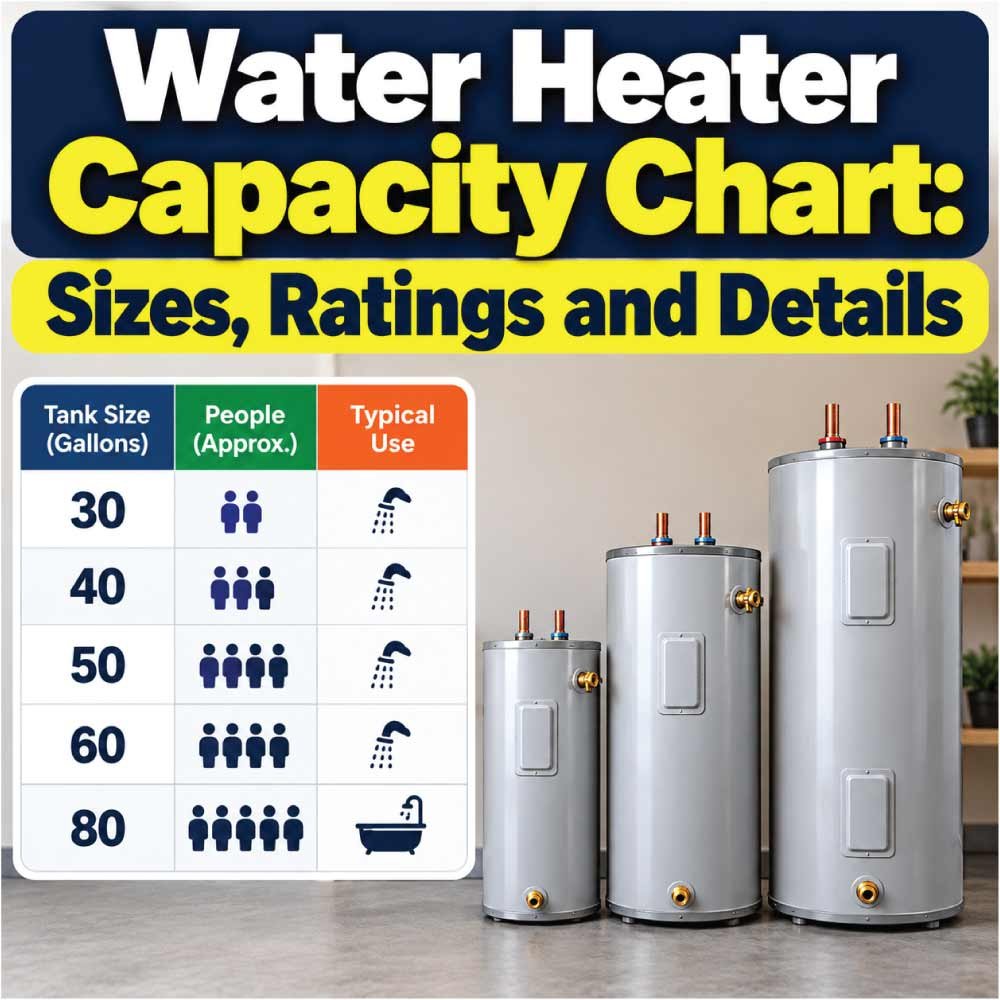
Storage water heaters are available in several capacities for different household requirements. The following chart provides a general reference for common residential tank sizes and their approximate metric equivalents.
| Tank Capacity (US gal) | Approx. Capacity (Liters) | Typical Application |
|---|---|---|
| 10 gallons | 38 L | Small point-of-use applications |
| 20 gallons | 76 L | Limited hot-water demand |
| 30 gallons | 114 L | Smaller households |
| 40 gallons | 151 L | Small to medium households |
| 50 gallons | 189 L | Many medium-sized households |
| 60 gallons | 227 L | Higher household demand |
| 75 gallons | 284 L | Larger households or greater demand |
| 80 gallons | 303 L | High-demand residential applications |
These are common reference capacities, not universal sizing recommendations. Actual availability, usable output, and suitability depend on the heater type, energy source, recovery rate, and usage pattern.
How to Use the Tank Capacity Chart
Start by identifying the amount of hot water your household typically uses during busy periods. Consider showers, laundry, dishwashing, and other activities that may occur close together.
For example, a home with two occupants who usually shower at different times may need less storage than a household of five where several showers occur in the morning. However, a smaller household with a large bathtub or frequent simultaneous hot-water use may still need a higher-capacity system.
Tank size is only the starting point. Compare the first-hour rating and recovery performance before making a final decision.
Water Heater Capacity Chart by Household Size
Household size can help estimate the capacity you need, but it should not be the only factor. The number of showers, bathing habits, appliance usage, and the timing of hot-water demand all affect the final choice.
| Household Size | Starting Tank-Size Range (US gal) | What to Consider |
|---|---|---|
| 1 person | 20–30 gallons | Daily shower and sink use |
| 2 people | 30–40 gallons | Shower frequency and appliance use |
| 3 people | 40–50 gallons | Overlapping morning routines |
| 4 people | 40–60 gallons | Multiple bathrooms and peak demand |
| 5 people | 50–75 gallons | Consecutive showers and laundry |
| 6 or more people | 75–80+ gallons | High demand and simultaneous use |
These ranges are preliminary estimates for conventional storage heaters, not guaranteed sizing requirements. The correct capacity may fall outside them depending on the household and product specifications.
Water Heater Size for a Family of 2
A 30- to 40-gallon storage tank may be a reasonable starting point for two people with moderate hot-water use. A larger tank may be appropriate if both occupants take long showers, use a large bathtub, or regularly run hot-water appliances at the same time.
Water Heater Size for a Family of 3
A 40- to 50-gallon tank is a useful starting range for three occupants. Evaluate the first-hour rating if the household has a busy morning routine or several hot-water fixtures in use during a short period.
Water Heater Size for a Family of 4
A 40- to 60-gallon tank may suit a four-person household, depending on peak demand and recovery speed. A high-recovery model with a suitable first-hour rating may perform better than a larger but slower-recovering unit.
Water Heater Size for a Family of 5 or More
Larger households often need more storage, faster recovery, or both. A 50- to 75-gallon tank can be a starting point for five occupants, while households with six or more people may need a larger system or a different configuration.
Before choosing an oversized tank, compare its operating costs, physical dimensions, energy requirements, and rated hot-water output.
First-Hour Rating Chart: How Much Hot Water Can a Heater Deliver?
The first-hour rating (FHR) is one of the most useful specifications for comparing conventional storage water heaters. It indicates how much hot water a fully heated tank can deliver over one hour under standardized test conditions, accounting for stored hot water and the heater’s ability to replenish it.
The FHR can be higher than the tank’s nominal capacity because the heating element or burner continues heating incoming water during use.
| Tank Capacity | How to Interpret Its First-Hour Rating |
|---|---|
| 30 gallons | Check whether output supports your busiest hour |
| 40 gallons | Compare recovery performance with expected demand |
| 50 gallons | Assess simultaneous showers and appliance use |
| 60 gallons | Consider higher demand and replenishment speed |
| 75 gallons | Check whether the additional storage is necessary |
| 80 gallons | Compare rated output, operating costs, and space |
This chart intentionally does not assign specific FHR numbers to each tank size. Tank capacity alone cannot establish a model’s first-hour rating. Actual performance varies by fuel type, burner or element capacity, incoming water temperature, thermostat setting, and product design.
How to Find the Correct First-Hour Rating
-
Estimate how much hot water your household uses during its busiest hour.
-
Find the FHR on the manufacturer’s EnergyGuide label or product documentation.
-
Compare that rating with your estimated peak-hour demand.
-
Consider whether the heater can recover sufficiently between consecutive periods of heavy use.
If two heaters have similar tank capacities, the one with the higher suitable FHR may be better for a household that frequently uses hot water in quick succession.
Tankless Water Heater Capacity Chart
Tankless water heaters work differently from storage models. Instead of keeping a large volume of hot water in a tank, they heat water as it flows through the unit.
Their practical capacity depends on the flow rate they can maintain while raising incoming water to the required temperature. A rating of 5 GPM, for example, does not mean the unit will provide 5 GPM at every temperature rise.
| Flow Rate (GPM) | Approx. Flow Rate (L/min) | General Interpretation |
|---|---|---|
| 1 GPM | 3.8 L/min | One low-flow fixture |
| 2 GPM | 7.6 L/min | One moderate-flow fixture |
| 3 GPM | 11.4 L/min | Potentially multiple low-flow uses |
| 4 GPM | 15.1 L/min | Greater combined fixture demand |
| 5 GPM | 18.9 L/min | Higher flow capacity |
| 6 GPM | 22.7 L/min | High-flow residential applications |
These figures convert flow rates; they do not guarantee how many showers or fixtures a particular heater can supply simultaneously. Fixture flow rates vary, and the heater’s available output changes with temperature rise.
Why Temperature Rise Matters
Temperature rise is the difference between incoming cold water and the hot water you want the heater to deliver.
For example, if incoming water is 50°F and the desired outlet temperature is 120°F, the required temperature rise is 70°F. If the incoming water becomes colder, the heater must produce a larger temperature rise to maintain the same outlet temperature.
That can reduce the available flow rate.
When comparing tankless models, check the manufacturer’s flow-rate chart at the temperature rise relevant to your location. Do not select a model based only on its maximum advertised GPM.
Electric vs. Gas Water Heater Capacity
Both electric and gas water heaters are available in different storage capacities, but their performance characteristics can differ significantly.
| Feature | Electric Storage Heater | Gas Storage Heater |
|---|---|---|
| Heat source | Electric resistance elements | Gas burner |
| Storage options | Multiple tank capacities | Multiple tank capacities |
| Recovery speed | Depends on element power and design | Depends on burner input and design |
| Installation needs | Suitable electrical circuit and wiring | Approved gas supply and venting where required |
| Capacity selection | Tank size, FHR, and electrical rating | Tank size, FHR, and burner rating |
Neither type is automatically better for every home. Operating costs depend on local electricity and gas prices, equipment efficiency, usage, and installation conditions.
Electric Water Heater Sizing
When sizing an electric storage water heater, compare:
-
Nominal tank capacity.
-
First-hour rating.
-
Heating-element wattage and recovery performance.
-
Electrical circuit requirements.
-
Available installation space.
Electric tankless models have their own flow and power limitations. Some require substantial electrical capacity, so confirm the required voltage, current, and circuit arrangements before purchase.
Gas Water Heater Sizing
Gas storage and tankless models should be evaluated using their rated hot-water output, fuel input, and applicable installation requirements.
Check gas supply capacity, venting requirements, combustion-air provisions, and local building codes. A high-capacity unit should not be installed without confirming that the home’s infrastructure can support it safely.
Also Read:
How to Calculate Your Water Heater Capacity Needs
A practical sizing process begins with actual usage rather than household size alone.
Step 1: Identify Peak Hot-Water Demand
List the activities that commonly occur during your busiest hour, such as:
-
Two or more showers.
-
Bathing a child or filling a bathtub.
-
Running a dishwasher.
-
Washing clothes with warm or hot water.
-
Using kitchen and bathroom sinks.
Not every activity draws hot water continuously. Consider how long each one operates and whether the uses overlap.
Step 2: Estimate Fixture Flow Rates
A fixture’s flow rate tells you how much water it uses per minute. If a shower uses 2 GPM for 10 minutes, its total water use is approximately 20 gallons. The hot-water portion depends on how much cold water is mixed in.
For tankless sizing, simultaneous flow is especially important. Add the expected flow rates of fixtures likely to operate at the same time, then check whether the heater can support that combined demand at the required temperature rise.
Step 3: Account for Recovery Rate
For a storage heater, recovery describes how quickly the unit reheats water as hot water is used. Two tanks with identical capacities can have different recovery performance.
A suitable recovery rate can reduce waiting time between periods of heavy use, although it cannot eliminate every shortage if demand consistently exceeds output.
Step 4: Check Manufacturer Ratings
Compare the expected demand with the manufacturer’s FHR for storage units or temperature-rise performance chart for tankless units.
If your demand varies widely, consider whether the system must accommodate occasional high-demand events, such as visitors staying overnight.
Step 5: Confirm Installation Constraints
Before buying, check the available space, energy supply, plumbing connections, venting requirements, and applicable local codes. A theoretically suitable model may not be appropriate if the home cannot safely support its installation requirements.
Also Read:
Water Heater Capacity by Application
Different hot-water applications place different demands on a heating system. A heater suitable for a kitchen sink may not provide enough hot water for a large bathtub or multiple bathrooms.
| Application | Important Capacity Considerations |
|---|---|
| Kitchen sink | Flow rate, washing duration, and frequency |
| Bathroom sink | Short bursts of hot water and fixture flow |
| Single shower | Shower flow rate and duration |
| Multiple showers | Simultaneous demand and recovery performance |
| Bathtub | Tub volume, filling time, and mixing temperature |
| Laundry | Washer type, water temperature, and cycle |
| Dishwasher | Appliance requirements and timing |
| Whole-house supply | Combined peak demand across fixtures |
Water Heater Capacity for Multiple Bathrooms
The number of bathrooms can help indicate potential demand, but it does not directly determine the required tank size. Two bathrooms used at different times may place less demand on a system than two bathrooms used simultaneously.
For homes with multiple bathrooms, evaluate the number of showers likely to run together, their flow rates, and whether other appliances will operate during the same period.
Water Heater Capacity for a Bathtub
A bathtub’s total volume is not necessarily equal to the volume of hot water drawn from the heater. The water entering the tub is typically mixed with cold water to reach a comfortable temperature.
For a more useful estimate, consider the tub’s fill volume, the temperature of incoming cold water, and the desired bathing temperature. A large soaking tub may require more hot-water capacity than a standard bathtub.
Also Read:
Common Water Heater Sizing Mistakes
Choosing a water heater based on an incomplete comparison can lead to unnecessary expense or insufficient hot water.
-
Choosing by household size alone: People have different routines, and fixture demand can vary considerably.
-
Ignoring the first-hour rating: Tank capacity does not reveal the total amount of hot water a heater can supply during a busy hour.
-
Comparing tankless models by maximum GPM only: Available flow decreases when a greater temperature rise is required.
-
Buying the largest tank available: Excess capacity may increase purchase costs, occupy more space, and contribute to greater standby heat loss.
-
Overlooking recovery performance: A tank may run short of hot water if demand exceeds its stored supply and recovery rate.
-
Ignoring installation requirements: Electrical, gas, ventilation, and plumbing constraints can limit which models are suitable.
-
Assuming nominal capacity equals usable hot water: Mixing, temperature settings, tank stratification, and operating conditions affect delivered output.
The best choice balances actual demand, rated performance, energy consumption, installation constraints, and cost.
How to Read a Water Heater Specification Label
Before purchasing a water heater, review the manufacturer’s documentation rather than relying exclusively on a retailer’s product title.
| Specification | What It Tells You |
|---|---|
| Nominal capacity | Advertised tank size |
| First-hour rating | Hot water delivered during the first hour under test conditions |
| Recovery rate | How quickly the heater reheats water |
| Energy input | Rated power or fuel input |
| Energy efficiency | How effectively the unit uses energy |
| Maximum flow rate | Flow available under specified conditions |
| Temperature rise | Difference between incoming and outgoing water temperatures |
| Dimensions | Physical space required for installation |
| EnergyGuide information | Standardized energy-use information, where applicable |
When comparing products, make sure the specifications refer to the same operating conditions. For instance, tankless flow rates measured at different temperature rises are not directly comparable.
Also verify whether dimensions include required installation clearances, venting components, or additional space for maintenance.
Frequently Asked Questions
What size water heater do I need for a family of four?
A 40- to 60-gallon storage water heater can be a useful starting range for a family of four. The final choice depends on shower schedules, appliance use, peak-hour demand, and the unit’s first-hour rating.
Is a 40-gallon water heater enough for two people?
It may be sufficient for two people with moderate hot-water use. However, a 30-gallon tank may work in some homes, while a larger tank may be preferable for long showers, large bathtubs, or frequent simultaneous use.
What is the difference between tank capacity and first-hour rating?
Tank capacity measures the water the tank is designed to hold. The first-hour rating measures how much hot water a storage heater can deliver over one hour under specified test conditions, including water heated during that period.
How many GPM should a tankless water heater provide?
The required flow rate depends on which fixtures operate simultaneously and the temperature rise needed. Add the expected flow of concurrent fixtures and compare the result with the manufacturer’s performance chart at the relevant temperature rise.
Does a bigger water heater use more electricity or gas?
A larger storage tank can have greater standby heat losses, depending on insulation and design. Actual energy consumption also depends on usage, efficiency, temperature settings, and local energy prices. A larger tank does not necessarily consume more energy in every situation, but unnecessary capacity can increase operating costs.
How long does a water heater take to recover?
Recovery time varies with tank volume, heating input, incoming water temperature, thermostat settings, and equipment design. Check the manufacturer’s recovery specifications rather than assuming that every heater of the same capacity reheats at the same speed.
Should I choose a tank or tankless water heater?
A storage heater provides a reserve of heated water and replenishes it as needed. A tankless model heats water on demand but must have enough output to support the required flow and temperature rise. Compare installation costs, household usage, energy availability, and long-term operating costs before deciding.
Conclusion
A water heater capacity chart is a useful starting point for comparing storage tank sizes, household requirements, first-hour ratings, and tankless flow rates. However, selecting the right system requires more than matching a tank size to the number of occupants.
Estimate peak hot-water demand, compare manufacturer ratings, consider recovery performance, and confirm installation requirements. By evaluating these factors together, you can choose a water heater that delivers reliable hot water without paying for unnecessary capacity.