Common Reasons a Gas Water Heater Pilot Won’t Stay Lit
A pilot light that repeatedly goes out is usually a sign of an underlying mechanical, gas supply, or ventilation problem. Identifying the exact cause is essential for restoring safe operation and preventing repeated shutdowns. Below are the most common reasons a gas water heater pilot light refuses to stay lit.
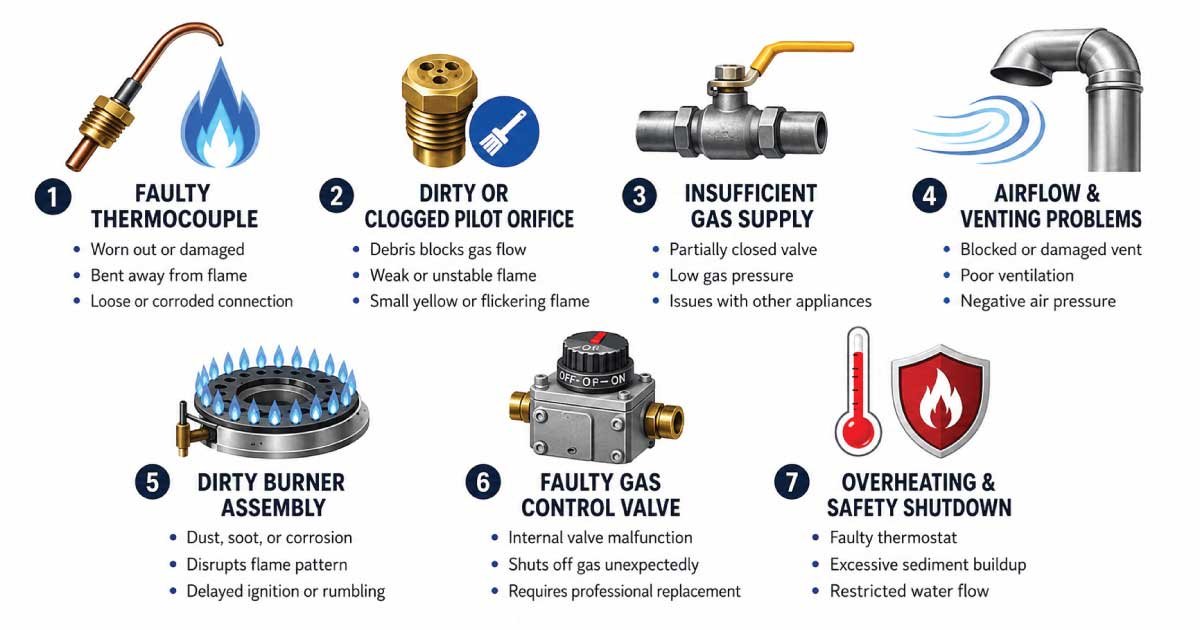
1. Faulty Thermocouple
The thermocouple is one of the most important safety components in a gas water heater. It detects the pilot flame and signals the gas valve to remain open. When it becomes dirty, damaged, or improperly positioned, it can interrupt the gas supply even though the pilot flame has been successfully lit.
The thermocouple is the most common culprit. This safety device senses whether the pilot flame is burning. When heated by the flame, it sends a signal to the gas valve to keep gas flowing.
If the thermocouple:
- Is worn out
- Is bent away from the flame
- Is coated in soot or corrosion
- Has a loose connection
…it may falsely signal that the flame is out, causing the gas valve to shut off.
Signs of a bad thermocouple:
- Pilot lights but goes out when you release the control knob
- Pilot won’t stay lit for more than a few seconds
2. Dirty or Clogged Pilot Orifice
The pilot orifice is a small opening that delivers gas to the pilot flame. Over time, dust, lint, rust, or other debris can partially block this opening, reducing gas flow and producing a weak flame that cannot reliably heat the thermocouple.
Dust, lint, rust flakes, or spider webs can clog the pilot orifice. This restricts gas flow and results in a weak or unstable flame.
A healthy pilot flame should be:
- Steady
- Mostly blue
- Strong enough to fully engulf the thermocouple tip
A dirty pilot assembly often produces a small yellow or flickering flame, which can’t keep the thermocouple hot.
3. Insufficient Gas Supply
A steady supply of gas is necessary to maintain a strong, stable pilot flame. If gas pressure drops or fuel flow becomes restricted, the pilot may ignite briefly before going out. Checking the gas supply can help eliminate one of the most common operational issues.
If your gas supply is inconsistent, the pilot light may not receive enough fuel to stay lit.
Possible causes include:
- Partially closed gas shutoff valve
- Low gas pressure from the utility
- Issues with other gas appliances affecting pressure
If multiple gas appliances are malfunctioning, the issue may be external and require a gas provider or licensed technician.
4. Airflow and Venting Problems
Proper airflow is essential for efficient combustion and safe operation of your gas water heater. If fresh air cannot reach the burner or exhaust gases cannot escape properly, the pilot light may extinguish as a protective safety measure built into the appliance.
Proper airflow is essential for combustion. If your water heater can’t draw in enough air or expel exhaust gases, the pilot may go out.
Common airflow issues include:
- Blocked or damaged vent pipe
- Negative air pressure in tightly sealed homes
- Nearby exhaust fans pulling air away
- Debris around the combustion chamber
Some newer heaters include safety sensors that shut off the pilot if airflow is unsafe.
5. Dirty Burner Assembly
The burner assembly works together with the pilot system to ensure efficient combustion. When dirt, soot, or corrosion builds up over time, it can interfere with normal flame patterns, resulting in unstable operation, ignition delays, and repeated pilot light failures.
Over time, the burner can accumulate dust, soot, and corrosion. This can disrupt the flame pattern and cause improper combustion, leading to pilot outages.
A dirty burner may also cause:
- Delayed ignition
- Rumbling or popping sounds
- Uneven heating
6. Faulty Gas Control Valve
The gas control valve regulates fuel delivery to both the pilot light and the main burner while coordinating with the water heater’s safety systems. If the valve develops an internal fault, it may stop supplying gas even when the pilot flame is functioning normally.
The gas control valve regulates gas flow to both the pilot and main burner. If it malfunctions internally, it may shut off gas even when the pilot flame is present.
This issue is less common but more serious. Gas valves are not DIY-repairable and usually require replacement by a professional.
7. Overheating and Safety Shutdown
Modern water heaters include built-in safety mechanisms that automatically shut off the pilot light if the unit overheats. While relighting the pilot may temporarily restore operation, the root cause of the overheating must be corrected to prevent recurring shutdowns.
If your water heater overheats, built-in safety mechanisms may shut down the pilot light.
Causes of overheating include:
- Faulty thermostat
- Excessive sediment buildup
- Restricted water flow
Once the unit cools, you may be able to relight the pilot, but the underlying issue will persist.
 Also Read
  Why Does My Water Heater Breaker Keep Tripping?