
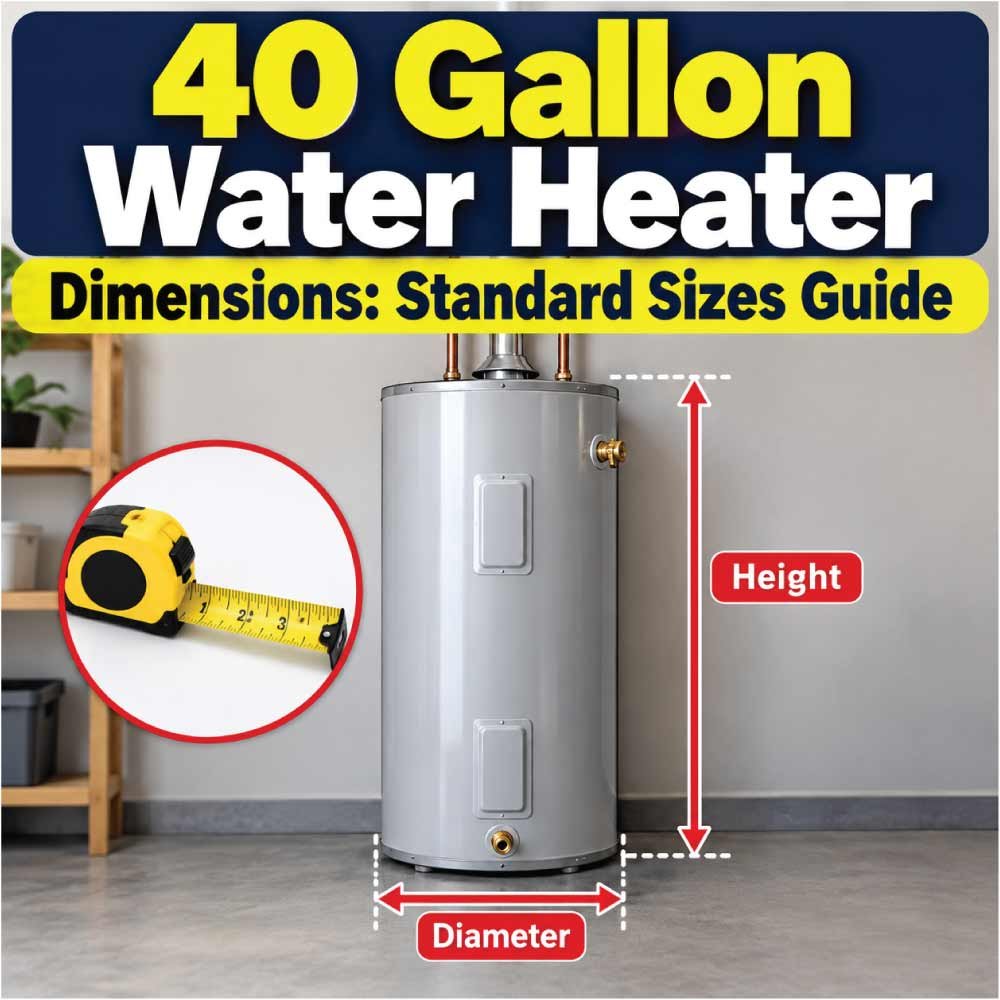
A 40-gallon water heater is a common choice for households that need a dependable supply of hot water without installing a larger storage tank. However, before buying a replacement or planning a new installation, it is important to understand the 40 gallon water heater dimensions, including tank height, diameter, width, clearance requirements, and the space needed for plumbing connections.
A standard 40-gallon water heater does not have one universal set of dimensions. Its size depends on the manufacturer, tank design, fuel type, insulation thickness, and installation configuration. A tall electric model may have different measurements from a short gas model, even when both hold the same amount of water.
This guide explains typical 40-gallon water heater sizes, provides practical dimension charts, compares tall and short models, and explains how to measure your available installation space. You will also learn how to choose a suitable unit for your household and avoid common sizing mistakes.
40 Gallon Water Heater Dimensions Chart
The first step in choosing a water heater is understanding the approximate physical dimensions of a 40-gallon tank. The measurements below are general planning ranges, not guaranteed specifications for every model. Always verify the exact dimensions using the manufacturer’s product data sheet.
| 40-Gallon Tank Type | Typical Height (inches) | Typical Diameter or Width (inches) | Common Configuration |
|---|---|---|---|
| Tall electric | 58–64 | 18–22 | Vertical cylinder |
| Tall gas | 58–62 | 20–24 | Vertical cylinder |
| Short electric | 30–34 | 22–26 | Compact vertical cylinder |
| Short gas | 30–34 | 22–26 | Compact vertical cylinder |
| Lowboy electric | 30–36 | 22–28 | Short, wider tank |
These ranges are illustrative estimates intended to help with early space planning. Actual 40-gallon models can fall outside them, so do not use them as installation specifications.
Understanding the Main Dimensions
Three measurements are especially important when comparing water heater models:
-
Height: The vertical measurement from the bottom of the tank to its highest point. Confirm whether the manufacturer’s listed height includes fittings or other projections.
-
Diameter or width: The measurement across the widest part of the tank. For a round tank, this is the diameter; for other shapes, use the maximum width and depth.
-
Installation clearance: The additional space needed for safe operation, servicing, plumbing, electrical connections, and any required venting.
The physical tank dimensions and the total installation space are not the same. A unit that fits inside a closet may still be unsuitable if there is insufficient room for connections, maintenance, or required safety clearances.
Tall vs. Short 40 Gallon Water Heater Dimensions
Two water heaters can have the same 40-gallon capacity but very different shapes. Manufacturers commonly offer tall and short configurations to accommodate different installation spaces.
Tall 40 Gallon Water Heater Dimensions
Typical planning considerations include:
-
Height: Approximately 58–64 inches for many tall models.
-
Diameter: Often around 18–24 inches, depending on the model.
-
Floor space: Relatively small compared with a shorter, wider tank.
-
Access: Enough room must remain above and around the tank for connections and servicing.
Tall models can be useful when floor space is limited but ceiling height is sufficient. However, a tall tank may not fit beneath low ceilings, shelves, or existing cabinets.
For gas models, the total installation height may also depend on the venting arrangement and required clearances. Electric models may have upper and lower access panels that need to remain accessible.
Short 40 Gallon Water Heater Dimensions
A short 40-gallon water heater has a lower profile and a wider body. It can be useful in spaces where a tall tank would not fit, such as some basements with low ceilings.
Common planning characteristics include:
-
Height: Often approximately 30–36 inches for low-profile designs.
-
Diameter or width: Frequently greater than that of a tall model.
-
Floor space: Requires more horizontal room.
-
Connections: May be located differently from those on a tall model.
Not every short water heater is available in every fuel type or capacity. Some products described as lowboy models also have capacities that differ from 40 gallons, so confirm the actual rated storage volume before comparing dimensions.
Which Configuration Is Better?
| Feature | Tall Model | Short Model |
|---|---|---|
| Vertical space required | More | Less |
| Horizontal space required | Usually less | Usually more |
| Suitable for low ceilings | Often not | Often better |
| Closet installation | Depends on clearance | Depends on width and access |
| Replacement flexibility | Depends on existing layout | Depends on existing layout |
The best option is the one that fits your available space and meets your hot-water requirements. Do not select a shorter tank based on height alone; confirm its capacity, recovery performance, connections, and installation requirements.
Electric vs. Gas 40 Gallon Water Heater Dimensions
Fuel type affects more than the cost of operating a water heater. It can also influence the tank’s shape, connections, and the space needed for installation.
Electric 40 Gallon Water Heater
Electric storage water heaters typically use heating elements installed inside the tank. Many residential models have a cylindrical exterior with electrical access panels on the side.
Before installing an electric model, check:
-
The overall height, width, and depth.
-
The position of the electrical supply and junction box.
-
The location of the hot- and cold-water connections.
-
The location of the drain valve and temperature-and-pressure relief valve.
-
Access requirements for replacing heating elements and servicing controls.
-
The electrical circuit and supply requirements specified by the manufacturer.
Electric models generally do not need a combustion vent, which can simplify some installations. However, they still require appropriate electrical protection, plumbing, and safety provisions.
Gas 40 Gallon Water Heater
Gas water heaters use a burner to heat water in the tank. Depending on the model, they may use natural gas or propane and may have atmospheric, power-vent, or other approved venting arrangements.
Important dimensions and installation considerations include:
-
Tank height and diameter.
-
Burner compartment and access space.
-
Gas supply connection location.
-
Vent connector or exhaust arrangement.
-
Combustion air requirements.
-
Required separation from combustible materials.
-
Access for inspection and maintenance.
A gas model may need more total installation space than its tank measurements suggest because of venting and combustion-air requirements. Never assume that an existing vent is suitable for a replacement unit simply because the old tank had the same capacity.
Electric vs. Gas Comparison Chart
| Specification | Electric Model | Gas Model |
|---|---|---|
| Storage capacity | 40 gallons | 40 gallons |
| Tank shape | Often cylindrical | Often cylindrical |
| Heating method | Electric elements | Gas burner |
| Combustion vent | Not normally required | Depends on model |
| Electrical connection | Required | May be required for controls or powered venting |
| Extra installation checks | Electrical supply | Gas supply, combustion air, and venting |
The physical dimensions of the tank alone do not determine which type is suitable. Consider the existing utilities, local code requirements, operating costs, and the manufacturer’s installation instructions.
How Much Space Does a 40 Gallon Water Heater Need?
Measuring the tank is only the beginning. A proper installation also needs room for plumbing, service access, safety devices, and any applicable code-required clearances.
Minimum Space for Installation
There is no single minimum room size that applies to every 40-gallon water heater. Requirements depend on the product design, installation location, fuel type, local regulations, and whether the unit is placed in a closet, garage, basement, or utility room.
For preliminary planning, measure the available area in three directions:
-
Vertical space: Measure from the finished floor to the lowest obstruction above the proposed tank location.
-
Horizontal space: Measure the usable width and depth of the installation area.
-
Access space: Check the room needed to reach valves, controls, service panels, and connections.
Allow for pipe fittings, shutoff valves, the relief-valve discharge pipe, electrical or gas connections, and venting components where applicable.
Clearance Around a 40 Gallon Water Heater
Clearance requirements are not universal. Some models permit installation close to certain surfaces, while others require specific distances from combustible materials or other objects.
Check the product manual for:
-
Side and rear clearance.
-
Clearance above the unit.
-
Front access requirements.
-
Vent connector clearances for applicable gas models.
-
Space for removing anodes, heating elements, or other serviceable parts.
-
Access to the drain valve and shutoff valve.
Do not use a general online dimension chart as a substitute for the manufacturer’s installation instructions or local plumbing, electrical, and fuel-gas codes.
Can a 40 Gallon Water Heater Fit in a Closet?
Yes, some 40-gallon water heaters can be installed in closets, provided the location meets the model’s installation requirements.
Before purchasing one, verify that:
-
The tank fits through the doorway and into the available space.
-
The closet has sufficient height and width.
-
Required service access is maintained.
-
The floor can support the filled tank.
-
Gas models have the required combustion air and approved venting.
-
Any required drain pan and discharge arrangements can be accommodated.
For gas units, a tightly enclosed closet can create combustion-air and venting problems if it is not designed correctly. Obtain professional advice if you are unsure whether the space is suitable.
Also Read:
How to Measure a 40 Gallon Water Heater
Accurate measurements help you avoid ordering a replacement that does not fit the existing installation.
Step 1: Measure the Tank Height
Measure vertically from the bottom of the tank to its highest point. Record any separate height measurements given by the manufacturer for the tank body and the complete unit.
Also measure the available height from the floor to the ceiling or lowest obstruction. Leave the clearances required by the installation instructions.
Step 2: Measure the Diameter or Width
For a round tank, measure straight across its widest point. Do not measure around the circumference.
If the tank has an exterior jacket, insulation bulge, or projecting component, identify the widest overall dimension rather than relying on the nominal tank-body measurement.
Step 3: Measure the Available Floor Area
Record the usable width and depth of the installation location. Include nearby walls, cabinets, doors, and fixed equipment that could interfere with installation or maintenance.
For a cylindrical tank, the nominal footprint is approximately circular, but connections and access requirements may make the usable installation area larger.
Step 4: Check the Connections
Photograph or record the locations of the hot-water outlet, cold-water inlet, drain valve, relief valve, and energy supply connections.
For a replacement, compare these locations with the proposed model. Similar tank dimensions do not guarantee that the existing pipes or venting will line up.
Step 5: Confirm the Manufacturer’s Specifications
Use the exact model number to find the manufacturer’s technical data sheet. Verify the listed height, diameter, connection locations, shipping dimensions, and installation clearances.
Remember that shipping dimensions and installed dimensions may differ. A boxed unit can be larger than the bare tank, and installation may require room for fittings that are not included in the tank-body measurement.
Also Read:
Is a 40 Gallon Water Heater Big Enough for Your Home?
The correct water heater size depends on how much hot water your household uses, not just the number of people living in the home. A 40-gallon tank may suit a small or medium-sized household, but usage patterns and the unit’s recovery rate matter.
Recommended Household Size
| Household Size | 40-Gallon Tank Suitability | Important Considerations |
|---|---|---|
| 1 person | Often suitable | Depends on bathing and appliance use |
| 2 people | Often suitable | Consider simultaneous hot-water use |
| 3 people | May be suitable | Check peak-hour demand |
| 4 people | Depends on usage | Compare recovery rate and first-hour rating |
| 5 or more people | May be insufficient | Evaluate larger tanks or alternative systems |
This table is a general guide rather than a guarantee. Two people who take long showers and frequently use hot water may require more capacity than four people with lower demand.
Understand First-Hour Rating and Recovery Rate
Tank capacity is not the only measurement to consider when selecting a water heater.
-
Storage capacity: The nominal amount of water the tank holds.
-
First-hour rating (FHR): The amount of hot water the unit can supply during the first hour under specified test conditions, starting with a full tank.
-
Recovery rate: How quickly the heater can heat incoming water after hot water has been used.
-
Temperature rise: The difference between the incoming water temperature and the target hot-water temperature.
A 40-gallon water heater does not necessarily provide exactly 40 gallons of usable hot water at the desired temperature. Stored hot water mixes with incoming cold water as the tank is drawn down, and the heater may continue recovering during use.
When comparing two 40-gallon models, review their published first-hour ratings and recovery specifications rather than assuming they perform identically.
Also Read:
How to Choose the Right 40 Gallon Water Heater
Once you know the available space, compare the physical dimensions with the unit’s performance and installation requirements.
Consider Your Available Space
Start with the installation location and identify the maximum allowable height, width, and depth. If you are replacing an older heater, measure the existing space instead of assuming the new model will fit.
A replacement can have a different jacket diameter, connection layout, or venting arrangement even if both tanks have the same nominal capacity.
Compare Energy Sources
Choose a fuel type that is compatible with your home and suitable for your needs.
-
Electric: Check the required voltage, circuit rating, wiring, and electrical protection.
-
Natural gas: Verify the gas supply, venting system, combustion air, and applicable clearances.
-
Propane: Confirm that the specific model is approved for propane; natural-gas and propane appliances are not automatically interchangeable.
A qualified professional should verify utility compatibility and installation safety where necessary.
Review Energy Efficiency and Operating Costs
Compare the manufacturer’s efficiency information and estimated annual energy use. The most appropriate model is not necessarily the one with the smallest dimensions or lowest purchase price.
Consider insulation, standby heat loss, recovery performance, local energy prices, and how frequently your household uses hot water. For electric resistance and gas models, the available efficiency ratings may use different metrics, so compare equivalent information carefully.
Plan for Maintenance and Replacement
A water heater should be accessible for inspection and servicing. Check whether the location allows access to the drain valve, temperature controls, heating elements or burner components, and other serviceable parts.
If the old heater is being replaced because of a leak, investigate the cause before installing another tank. Corrosion, plumbing problems, excessive pressure, and other issues may need attention to prevent damage to the replacement.
Common Mistakes When Measuring a 40 Gallon Water Heater
Small measurement errors can cause major problems during delivery or installation. Avoid these common mistakes.
-
Measuring only the tank body: The overall unit may include a jacket, fittings, controls, or other projections.
-
Ignoring ceiling height: A tall tank may fit on the floor but leave insufficient room for required connections and maintenance.
-
Assuming all 40-gallon models are identical: Capacity does not standardize external dimensions.
-
Forgetting the access route: Measure doorways, stairwells, hallways, and turns along the delivery path.
-
Ignoring plumbing connections: Inlet and outlet positions may differ between the existing and replacement models.
-
Overlooking safety clearances: Manufacturer instructions and local codes take precedence over generic dimension charts.
-
Choosing by capacity alone: The first-hour rating, recovery rate, energy source, and household demand are also important.
Before ordering, compare the exact product specifications with measurements of both the installation space and the route used to move the tank into position.
Frequently Asked Questions About 40 Gallon Water Heater Dimensions
How tall is a standard 40 gallon water heater?
Many tall 40-gallon residential water heaters are approximately 58–64 inches tall. Short and lowboy models can be considerably shorter, often around 30–36 inches. Exact dimensions depend on the manufacturer, model, and tank design.
What is the diameter of a 40 gallon water heater?
A typical tall model may have a diameter of approximately 18–24 inches, while some short models are wider. Check the manufacturer’s specifications for the exact maximum diameter or width before planning an installation.
How wide is a 40 gallon water heater?
For a round tank, width is generally the same as its diameter. Tall models often occupy less floor space than short models, but insulation and exterior components can increase the overall width.
Can I replace a 40 gallon water heater with another 40 gallon model?
Yes, provided the replacement is compatible with the installation. Verify its dimensions, fuel type, utility connections, venting where applicable, performance ratings, and required clearances. Equal capacity does not guarantee a direct replacement.
How much does a full 40 gallon water heater weigh?
Forty US gallons of water weigh approximately 334 pounds (151.5 kilograms). The filled water heater weighs more because the tank, insulation, jacket, and other components add weight. Check the manufacturer’s shipping and operating weight information when assessing floor support.
Does a 40 gallon water heater need a drain pan?
Drain-pan requirements depend on the installation location, local code, and applicable building requirements. A pan with an appropriate drain can help manage leakage, but it does not replace proper installation, leak detection, or other required safety measures.
Is a 40 gallon water heater better than a 50 gallon model?
Neither capacity is universally better. A 40-gallon model may be adequate for lower demand and may occupy less space in some configurations. A 50-gallon model can provide more stored hot water, but its external dimensions and energy requirements may differ. Compare household demand, first-hour rating, installation space, and operating costs before choosing.
How do I find the exact dimensions of my water heater?
Locate the manufacturer’s nameplate and model number on the existing unit. Search the manufacturer’s official documentation for that model’s specification sheet or installation manual. Confirm the complete unit dimensions rather than relying on a generic capacity chart.
Conclusion
Understanding 40 gallon water heater dimensions helps you select a tank that fits your available space and supplies enough hot water for your household. Tall models generally require more vertical clearance, while short models use more floor space. Electric and gas units can also differ in their installation requirements.
Use general size charts for preliminary planning, then verify the exact height, diameter, connection locations, and clearances against the manufacturer’s documentation. Finally, compare the first-hour rating and recovery performance to ensure that the selected 40-gallon water heater meets your household’s hot-water needs.