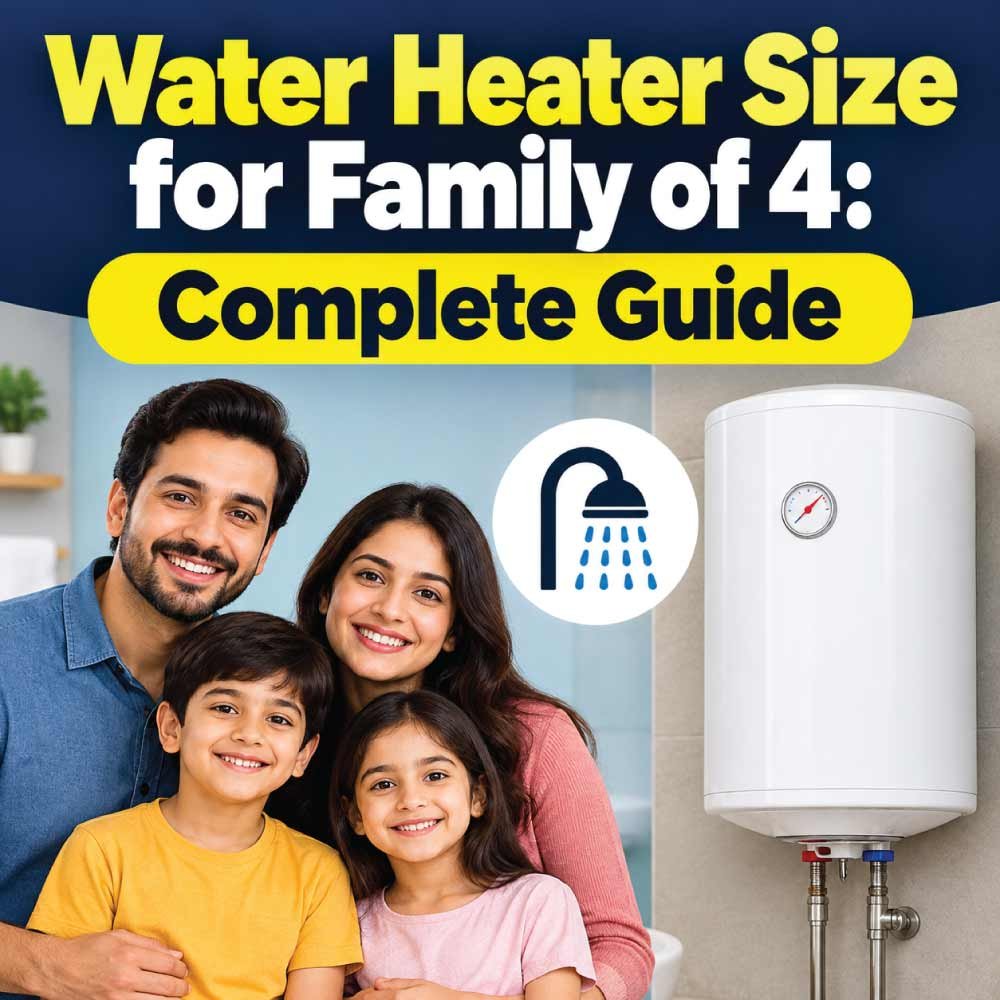
Choosing the right water heater size for a family of four helps ensure everyone has enough hot water for showers, dishwashing, laundry, and everyday cleaning. A unit that is too small may run out of hot water during busy mornings, while an oversized system can cost more than necessary to purchase, install, and operate.
The best water heater size for a family of 4 depends on your household’s hot water habits, the type of heater you choose, the number of bathrooms, and whether several fixtures operate simultaneously. A four-person household might need a 40- to 50-gallon conventional storage water heater, while a tankless system must be sized by its required flow rate and temperature rise.
This guide explains recommended water heater capacities, sizing charts, storage versus tankless systems, energy efficiency, and practical steps for choosing a model that meets your family’s needs without unnecessary expense.
What Size Water Heater Does a Family of 4 Need?
For a typical household of four, a 40- to 50-gallon tank water heater is a reasonable starting point. However, a 50-gallon unit may be a better choice when family members take consecutive showers, use a large bathtub, or frequently run hot-water appliances.
Tankless water heaters do not use a storage-capacity rating in the same way. Instead, their suitability depends on how many gallons per minute (GPM) they can deliver at the temperature rise required by your home.
Here is a quick overview of common starting points:
Electric storage water heater: Consider approximately 50 gallons, especially if hot-water demand is high.
Gas storage water heater: A 40- to 50-gallon model may be suitable, depending on its recovery rate.
Tankless water heater: Select by required simultaneous flow rate and incoming water temperature.
Heat pump water heater: Consider a suitable 50-gallon or larger model, subject to its first-hour rating, installation space, and operating conditions.
These are general recommendations, not guarantees. Check the manufacturer’s first-hour rating, recovery performance, and installation requirements before choosing a specific model.
Why Four People Need Different Water Heater Sizes
Household size is useful, but it does not tell the whole story. Two families with four members can have very different hot-water requirements.
For example, one family may take short showers at different times. Another may have two bathrooms in use every morning, followed by a dishwasher cycle and laundry.
Important factors include:
Shower duration: Longer showers consume more hot water.
Bathroom count: Multiple bathrooms can increase simultaneous demand.
Appliance usage: Dishwashers and washing machines may require hot water during peak periods.
Bathtub size: Large tubs can use substantially more water than ordinary showers.
Water heater recovery: Some heaters replenish hot water faster than others.
Incoming water temperature: Colder water requires more heating to reach the desired temperature.
The goal is to choose a system that handles your family’s busiest period, rather than sizing it only for average daily use.
Water Heater Size Chart for a Family of 4
The following chart provides general starting points for comparing common residential water heater types. Actual requirements depend on the model, fuel, demand pattern, and installation conditions.
| Water Heater Type | Suggested Starting Point | Best Suited For | Important Consideration |
|---|---|---|---|
| Electric storage | 50 gallons | Typical family use | Check first-hour rating |
| Gas storage | 40–50 gallons | Moderate to high demand | Recovery rate matters |
| Heat pump | 50 gallons or larger | Energy-conscious households | Allow for recovery time and installation space |
| Tankless, gas | Sized by GPM and temperature rise | Continuous hot-water demand | Confirm capacity at your actual temperature rise |
| Tankless, electric | Sized by GPM and electrical capacity | Suitable point-of-use or whole-home applications | May require substantial electrical capacity |
| High-demand storage | 65 gallons or more, if justified | Large tubs or heavy simultaneous use | Avoid oversizing without demand analysis |
Important: These ranges are preliminary guidance, not universal sizing standards. A larger tank is not automatically better, and tankless models do not have a single gallon capacity equivalent to a storage tank.
How to Use the Water Heater Size Chart
Start with the storage capacity or tankless category that matches your preferred system. Then compare the actual product specifications against your family’s hot-water requirements.
For storage models, look at:
- Tank capacity in US gallons.
- First-hour rating (FHR).
- Recovery rate.
- Energy source and efficiency.
- Available installation space.
For tankless models, examine:
- Maximum flow rate at the required temperature rise.
- Minimum activation flow.
- Gas supply or electrical requirements.
- Venting and installation requirements.
- Performance when multiple fixtures operate simultaneously.
The first-hour rating is particularly useful for storage heaters because it estimates how much hot water a fully heated tank can deliver during the first hour of use under standardized test conditions.
How Much Hot Water Does a Family of 4 Use?
Understanding your family’s water consumption helps you avoid choosing a heater based on guesswork. The amount of hot water used depends on fixture flow rates, shower duration, appliance settings, and the proportion of hot water mixed with cold water.
For a practical estimate, consider the activities that occur during your busiest hour.
| Activity | Typical Hot-Water Demand Factor | What Affects Usage |
|---|---|---|
| Shower | Flow rate and duration | Showerhead and temperature setting |
| Bath | Tub fill volume | Tub size and desired water temperature |
| Handwashing | Short, intermittent use | Faucet flow and water temperature |
| Dishwashing by hand | Intermittent use | Washing method and faucet habits |
| Dishwasher | Model-specific cycle demand | Cycle, temperature, and appliance design |
| Clothes washer | Model-specific demand | Load size, cycle, and temperature setting |
This table identifies demand factors rather than fixed gallon amounts because appliance and fixture consumption varies significantly.
Estimate Your Family’s Peak-Hour Demand
Suppose three family members shower during the morning, and the fourth uses hot water for washing and preparing for the day. Your heater must supply enough usable hot water for that period or recover quickly enough to meet continuing demand.
To estimate demand more accurately:
- Record the number of showers taken during the busiest hour.
- Note the approximate duration of each shower.
- Identify whether two showers or other fixtures operate simultaneously.
- Account for baths, dishwashing, and laundry if they commonly occur during the same period.
- Compare the resulting demand with the heater’s published first-hour rating or tankless performance data.
A simple demand log over several days can reveal whether your current heater is undersized or whether changing the timing of appliances would solve the problem.
Why the First-Hour Rating Matters
Tank capacity alone does not tell you how much hot water a heater can deliver during a busy period. A storage heater begins with a reservoir of heated water and continues heating incoming cold water as the tank empties.
The first-hour rating combines the usable hot water initially available with the additional hot water the heater can produce during the following hour under specified test conditions.
For example, a heater with a higher first-hour rating may serve a family better than another heater with the same tank capacity but a slower recovery rate.
Always compare the first-hour ratings on product labels or manufacturer specifications rather than assuming two 50-gallon heaters will perform identically.
40-Gallon vs. 50-Gallon Water Heater for a Family of 4
A 40-gallon water heater may work for a family of four with modest hot-water demand, but a 50-gallon model can provide a larger reserve for busy households.
The right choice depends on how much hot water your family uses at once and how quickly the heater can replenish its supply.
| Comparison | 40-Gallon Tank | 50-Gallon Tank |
|---|---|---|
| Storage capacity | 40 US gallons | 50 US gallons |
| Initial hot-water reserve | Smaller | Larger |
| Consecutive shower support | Depends on recovery and usage | Generally offers more reserve |
| Large bathtub use | May be limiting | May be more suitable |
| Space requirement | Often smaller | Often larger |
| Purchase and installation cost | May be lower | May be higher |
| Best selection method | Check FHR against demand | Check FHR against demand |
When a 40-Gallon Water Heater May Be Enough
Consider a 40-gallon model if:
- Family members usually shower at different times.
- Showers are relatively short.
- The home has limited installation space.
- Hot-water demand is moderate.
- The model has a first-hour rating that meets your calculated demand.
A fast-recovery model may perform better than a slower model with the same tank capacity. However, recovery depends on the heater’s design, fuel, and rated input.
When a 50-Gallon Water Heater Is a Better Choice
A 50-gallon unit may be more appropriate when:
- Four people use hot water within a short period.
- Several showers are taken back-to-back.
- The home has two bathrooms used simultaneously.
- A bathtub regularly requires substantial hot water.
- The existing 40-gallon heater frequently runs out.
If a 50-gallon unit still cannot meet peak demand, examine its first-hour rating, incoming water temperature, and household usage before moving to a larger tank. A higher-capacity or faster-recovery system may be appropriate, but the decision should follow the demand calculation.
Storage vs. Tankless Water Heater for a Family of 4
Both storage and tankless water heaters can serve a four-person household. They differ in how they produce hot water, how much space they require, and how they respond to heavy demand.
Storage Water Heaters
A storage water heater heats water in an insulated tank and keeps it available for use.
Advantages:
- Provides a reserve of hot water for simultaneous household activities.
- Offers familiar operation and widely available residential models.
- Can be easier to compare using tank capacity and first-hour rating.
- May have lower initial equipment costs than some whole-home tankless installations.
Limitations:
- The stored supply can run out during prolonged demand.
- Heat is lost from the tank over time.
- The tank requires floor or wall space suitable for its weight and connections.
- Recovery speed affects how soon the full reserve becomes available again.
For many families, a properly sized storage heater is a straightforward solution.
Tankless Water Heaters
A tankless water heater heats water as it flows through the unit rather than storing a large reservoir.
Advantages:
- Can provide hot water for extended periods within its rated capacity.
- Avoids conventional tank standby losses.
- Usually occupies less space than a storage tank.
- May be suitable where installation space is limited.
Limitations:
- Maximum flow rate is limited by the unit’s heating capacity.
- Simultaneous showers can exceed the available output.
- Gas models may require upgraded gas piping or suitable venting.
- Electric whole-home models may require major electrical capacity.
- Equipment and installation costs can be higher.
Which System Is Better?
Choose a storage water heater if your priority is a practical reserve of hot water and the available space supports a tank.
Consider a tankless system if your household has a suitable fuel supply or electrical service and you want continuous hot water within a carefully calculated flow-rate limit.
Neither system is automatically best for every family of four. Purchase price, energy use, installation requirements, maintenance, and peak demand should all influence your decision.
Also Read:
How to Size a Tankless Water Heater for a Family of 4
A tankless water heater must be sized according to flow rate and temperature rise, not simply the number of people in the household.
Flow rate is measured in gallons per minute (GPM). Temperature rise is the difference between incoming cold water and the desired hot-water outlet temperature.
Step 1: Calculate Simultaneous Flow Rate
List the fixtures likely to run at the same time. Use their actual rated flow rates whenever possible.
For example, if two showers each use 2.0 GPM, their combined flow is 4.0 GPM. If a sink also operates at 0.5 GPM, total demand becomes 4.5 GPM.
These figures are an illustrative example, not a prediction of every home’s consumption.
Step 2: Determine the Required Temperature Rise
Use this formula:
Temperature rise = Desired hot-water temperature − Incoming water temperature
If incoming water is 50°F and the desired outlet temperature is 120°F, the required temperature rise is 70°F.
A higher temperature rise generally reduces the flow rate that a tankless heater can sustain. This is why a unit’s advertised maximum GPM may not represent its output during cold weather.
Step 3: Check the Manufacturer’s Performance Chart
Compare your calculated flow rate and temperature rise with the model’s published performance data.
Do not select a unit using its maximum GPM rating alone. Confirm that it can maintain the required output under your actual incoming-water conditions.
Step 4: Check Installation Requirements
Before purchasing, confirm:
- Gas supply capacity for gas-fired units.
- Venting and combustion-air requirements.
- Electrical supply requirements.
- Water pressure and minimum activation flow.
- Local plumbing and building-code requirements.
A qualified installer can verify whether your home can support the selected unit without expensive or unsafe modifications.
Also Read:
Electric, Gas, and Heat Pump Water Heater Sizing
The energy source affects recovery performance, operating costs, installation needs, and the range of suitable models.
Electric Water Heaters
Conventional electric storage heaters may recover more slowly than some gas models of similar capacity, depending on their rated input and design.
For a family of four, a 50-gallon model is a useful starting point when peak demand is substantial. Check the first-hour rating and electrical requirements before deciding.
Gas Water Heaters
Gas storage heaters can offer relatively fast recovery when properly sized and supplied with the required fuel. This can help a family that uses several showers close together.
However, performance varies by model. Confirm the rated recovery, tank capacity, venting requirements, and available gas supply.
Heat Pump Water Heaters
Heat pump water heaters move heat from the surrounding air into the stored water. They can be highly energy-efficient under suitable operating conditions, although recovery behavior differs from conventional electric resistance heaters.
A 50-gallon or larger model may be worth evaluating for a family of four. Consider its first-hour rating, ambient temperature requirements, noise, condensate drainage, and required air space.
The appropriate capacity depends on the manufacturer’s sizing guidance and your family’s actual demand.
Factors That Affect Water Heater Size
A water heater that works well in one home may struggle in another. Consider the following factors before making a final selection.
Number of Bathrooms
A home with one bathroom may have lower simultaneous demand than a home with three bathrooms. However, bathroom count alone is not sufficient: a household may rarely use multiple showers at once, or it may use them every morning.
Showerhead Flow Rate
Water-saving showerheads can reduce hot-water consumption. Check the fixture’s rated flow rather than assuming every shower uses the same amount.
Incoming Water Temperature
Colder incoming water increases the heating required to reach the desired outlet temperature. This affects both storage recovery and tankless output.
Bathtub and Appliance Usage
A large bathtub may require a substantial volume of mixed hot and cold water. Dishwashers and washing machines also contribute to peak demand when their cycles overlap with showers.
Climate and Installation Conditions
Climate affects incoming water temperature, while installation conditions can limit the types of heater that are practical. Heat pump models may need suitable surrounding air conditions, and gas units need compliant venting and fuel supply.
Future Household Needs
If you expect the household to grow or add another bathroom, include that anticipated demand in your sizing calculation. Avoid choosing a much larger unit without considering the cost, space, and energy implications.
Also Read:
Common Water Heater Sizing Mistakes to Avoid
Choosing a heater based only on tank gallons or household size can lead to disappointing results. Avoid these common mistakes.
Buying solely by household size: Four people do not always have the same hot-water requirements.
Ignoring the first-hour rating: Tank capacity does not fully describe peak-hour performance.
Using maximum tankless GPM: Maximum flow may apply only at a lower temperature rise.
Overlooking incoming water temperature: Cold water can reduce available tankless output and slow recovery.
Choosing a tank that is too large: Extra capacity can increase equipment costs and may add unnecessary standby losses.
Ignoring installation requirements: Gas lines, electrical panels, venting, clearances, and drainage may affect the total project cost.
Failing to check local regulations: Plumbing, electrical, combustion, and safety requirements vary by location.
Replacing a failing heater with the same capacity automatically: The old unit may have been poorly sized for the family’s current habits.
If your current heater runs out of hot water regularly, first check for sediment buildup, a faulty heating element or burner, thermostat issues, and other maintenance problems. Increasing capacity will not necessarily fix an equipment fault.
Frequently Asked Questions
Is a 40-gallon water heater big enough for a family of 4?
It can be sufficient for a family with moderate hot-water use and staggered showers. However, heavy simultaneous demand may require a larger or faster-recovery model. Compare the first-hour rating with your peak-hour needs before purchasing.
Is a 50-gallon water heater enough for four people?
A 50-gallon storage heater is a common starting point for a four-person household. Whether it is sufficient depends on shower duration, appliance use, incoming water temperature, and the unit’s recovery rate.
What size tankless water heater does a family of 4 need?
There is no single correct GPM rating for every family of four. Calculate the flow rate of fixtures that operate simultaneously, determine the required temperature rise, and select a model that can meet both conditions.
Should I choose a 40- or 50-gallon water heater?
A 40-gallon unit may suit moderate demand, while a 50-gallon model offers a larger stored reserve. The best choice is the model whose first-hour rating meets your household’s peak demand while fitting your budget and installation space.
Does a larger water heater use more electricity or gas?
Potentially, but tank capacity alone does not determine energy consumption. Actual costs depend on hot-water use, insulation, standby losses, recovery, energy efficiency, fuel prices, and operating settings.
How long should hot water last for a family of four?
There is no fixed duration. It depends on the available hot-water reserve, the flow rate of fixtures, the temperature setting, incoming water temperature, and how quickly the heater recovers.
Can one tankless heater run two showers at once?
Yes, if the unit can deliver their combined flow at the required temperature rise. If demand exceeds its capacity, outlet temperature or flow may fall. Check the manufacturer’s performance chart before assuming two showers can run simultaneously.
What temperature should a residential water heater use?
Many households use a storage setting near 120°F to balance comfort and energy use, but the appropriate setting depends on household needs, equipment instructions, and applicable safety guidance. Hot-water systems also require appropriate scald protection and measures to control microbial risks where relevant. Follow local guidance and consult a qualified professional when necessary.
Conclusion: Choosing the Right Water Heater for a Family of 4
For many households, a 40- to 50-gallon storage water heater is a sensible starting point, with a 50-gallon model often worth considering when four people use hot water during the same busy period. Tankless systems can also work well when their flow rate and temperature-rise performance match the home’s needs.
Before buying, estimate your peak-hour demand, compare the first-hour rating of storage models, and check tankless output under your actual water-temperature conditions. Include installation requirements, energy efficiency, maintenance, and future household needs in your decision.
The best water heater size for a family of 4 is not necessarily the largest model. It is the system that reliably meets your household’s hot-water demand while fitting your budget, available space, and energy supply.