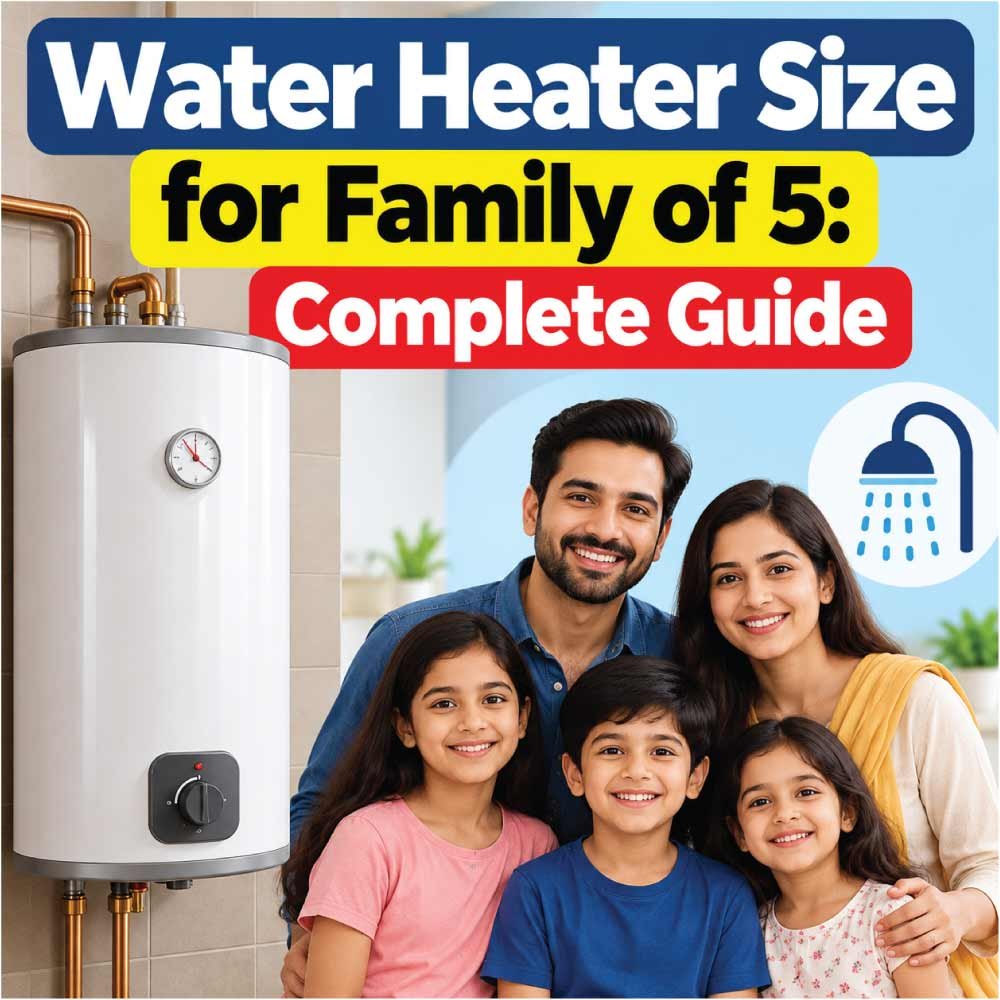
Choosing the right water heater size for a family of five is essential for keeping showers comfortable, supplying hot water to multiple bathrooms, and handling everyday tasks such as dishwashing and laundry. A heater that is too small may run out of hot water during busy mornings, while an unnecessarily large system can increase upfront costs and occupy valuable space.
The best water heater size for a family of 5 depends on the number of bathrooms, shower duration, simultaneous hot-water demand, incoming water temperature, and the type of heating system. A conventional storage water heater with a capacity of 50 to 80 gallons may be worth considering, but the correct size should be based on its first-hour rating and your family’s actual usage.
Tankless water heaters require a different approach because they are sized by flow rate and temperature rise rather than tank capacity.
This complete guide covers water heater size charts, 50- versus 75-gallon tanks, tankless sizing, energy sources, common sizing mistakes, and practical tips to help you select a suitable system for five people.
What Size Water Heater Does a Family of 5 Need?
For a household of five, a 50- to 80-gallon storage water heater is a useful preliminary range to investigate. A 50-gallon model may be sufficient for moderate usage when its first-hour rating meets peak demand. A 65- or 75-gallon model may be more appropriate for families with long showers, several bathrooms, or frequent overlapping hot-water activities.
These figures are starting points rather than universal requirements. The best choice depends on the equipment’s performance, not simply its advertised tank capacity.
General options include:
50-gallon storage heater: Consider for moderate demand and staggered showers.
65-gallon storage heater: Consider when the household needs a larger reserve, subject to model availability and performance.
75- to 80-gallon storage heater: Evaluate for high demand, large tubs, or frequent simultaneous use.
Tankless water heater: Size according to simultaneous flow rate and required temperature rise.
Heat pump water heater: Choose capacity and recovery performance based on the manufacturer’s guidance and your household’s peak demand.
A larger tank is not automatically the best solution. A high-recovery storage heater or a properly sized tankless system may meet demand without requiring the largest available tank.
Why a Family of 5 May Need More Hot Water
Five household members can create a substantial peak demand, particularly when everyone follows a similar morning schedule.
For example, three people may shower while another uses a bathroom sink and the fifth prepares for the day. If the dishwasher or washing machine also needs hot water, demand can rise further.
The most important factors are:
- Number of occupants using hot water at the same time
- Shower duration and flow rate
- Number of bathrooms
- Bathtub size and frequency of use
- Dishwasher and washing machine cycles
- Incoming cold-water temperature
- Water heater recovery rate
- Hot-water temperature setting and mixing
If your household has five people but showers are spread throughout the day, you may need less capacity than a family of five that uses several fixtures simultaneously.
Water Heater Size Chart for a Family of 5
Use this chart to compare possible starting points for a five-person household. Confirm your choice against the product’s first-hour rating, recovery rate, or tankless performance specifications.
| Water Heater Type | Suggested Starting Point | Suitable Usage Pattern | Main Sizing Consideration |
|---|---|---|---|
| Electric storage | 50–65 gallons | Moderate household demand | First-hour rating and recovery |
| Gas storage | 50–75 gallons | Moderate to high demand | Tank capacity and recovery rate |
| Heat pump storage | 65 gallons or larger, if needed | Energy-conscious households | Recovery, first-hour rating, and operating conditions |
| High-demand storage | 75–80 gallons, if justified | Heavy peak demand | Actual demand and installation space |
| Gas tankless | Sized by required GPM | Continuous demand within capacity | Flow at the required temperature rise |
| Electric tankless | Sized by GPM and electrical service | Suitable point-of-use or whole-home applications | Available electrical capacity |
These ranges are general planning guidance, not mandatory sizing standards. Models differ in available capacities and performance, and a particular home’s requirements may fall outside these ranges.
How to Read the Chart Correctly
For storage heaters, look beyond the number of gallons. A tank’s first-hour rating indicates how much hot water it can supply during the first hour of use under standardized test conditions, including the initial stored supply and water heated during that period.
Compare this rating with your household’s estimated peak-hour demand.
For tankless systems, identify the flow rate needed when the busiest combination of fixtures operates. Then check the manufacturer’s output at your required temperature rise.
A tankless heater advertised with a high maximum GPM rating may deliver less water at the required temperature when incoming water is cold. Always use the performance chart for the specific model.
How Much Hot Water Does a Family of 5 Use?
The hot-water needs of a family of five depend on its daily routines. Five people taking short showers at separate times may use less hot water during the peak hour than three people taking long showers simultaneously.
The following table identifies the major household activities that contribute to demand.
| Activity | Demand Characteristics | Factors to Consider |
|---|---|---|
| Five individual showers | Can create high daily demand | Duration, flow rate, and scheduling |
| Two simultaneous showers | Creates concentrated peak demand | Combined fixture flow |
| Bathtub filling | May use a large amount of hot water | Tub size and mixed-water temperature |
| Handwashing and sinks | Usually intermittent demand | Faucet flow and frequency |
| Dishwasher | Uses water according to its cycle | Appliance specifications and timing |
| Clothes washer | Demand varies by machine and cycle | Load size and selected temperature |
Exact consumption cannot be determined from family size alone. Fixture specifications, water temperature, and usage patterns must also be considered.
Estimate Your Family’s Peak-Hour Demand
Start by identifying the busiest hour of the day. This is often the morning, when several family members prepare for work or school.
Follow these steps:
- Count how many showers occur during the busiest hour.
- Estimate shower duration and check the showerheads’ rated flow rates.
- Identify any overlapping activities, such as sink use or bathtub filling.
- Determine whether dishwashing or laundry regularly coincides with shower time.
- Compare your estimated demand with the first-hour rating of a storage heater or the rated output of a tankless model.
A short usage log can help identify the actual bottleneck. If hot water runs out only when two showers overlap, simultaneous demand may be the main issue. If the supply runs out even when usage is spread out, recovery performance or equipment condition may deserve closer attention.
Why First-Hour Rating Matters More Than Tank Capacity Alone
A 50-gallon heater with a relatively high first-hour rating may serve a household better than a 65-gallon model with slower recovery, depending on the demand pattern.
The first-hour rating accounts for the hot water initially available and the additional water the heater can heat during the following hour under standardized conditions.
Use it to compare storage models of different sizes and designs. Remember that real-world results can vary with incoming-water temperature, thermostat settings, fixture flow, and usage patterns.
50-Gallon vs. 65-Gallon vs. 75-Gallon Water Heater
Choosing between a 50-, 65-, and 75-gallon tank involves balancing hot-water demand, recovery performance, space, and cost.
| Comparison | 50-Gallon Tank | 65-Gallon Tank | 75-Gallon Tank |
|---|---|---|---|
| Stored water | 50 US gallons | 65 US gallons | 75 US gallons |
| Initial reserve | Smaller | Larger | Largest of these options |
| Heavy simultaneous use | Depends on recovery and demand | May provide more reserve | May suit higher demand |
| Consecutive showers | Model-dependent | More reserve than 50 gallons | More reserve than 65 gallons |
| Space requirement | Often lower | Often greater | Often greatest |
| Purchase cost | May be lower | May be higher | May be higher |
| Best selection method | Compare first-hour rating | Compare first-hour rating | Confirm demand justifies capacity |
The table compares nominal tank capacities, not guaranteed shower counts or usable hot-water volumes. Actual performance varies by model and operating conditions.
When a 50-Gallon Water Heater May Be Enough
A 50-gallon unit may work for a family of five when:
- Family members take relatively short showers.
- Shower schedules are spread throughout the day.
- Large bathtub use is infrequent.
- The heater has an adequate first-hour rating.
- Other major hot-water activities rarely overlap with showers.
If your family already uses a 50-gallon heater without running out of hot water, replacing it with a larger model may not be necessary.
When a 65-Gallon Water Heater Makes Sense
Consider a 65-gallon model when a 50-gallon tank struggles to meet peak demand and your household needs a larger stored reserve.
It may be worth evaluating if several people shower close together, multiple bathrooms are used regularly, or a larger bath draws a substantial amount of hot water.
Check whether the selected model’s first-hour rating provides a meaningful improvement. Tank capacity alone does not guarantee a particular performance gain.
When to Consider a 75-Gallon or Larger System
A larger storage system may be appropriate when:
- Five people take consecutive showers during a short period.
- Two or more showers frequently operate simultaneously.
- The household regularly fills a large bathtub.
- Hot-water demand remains high after the existing tank begins recovering.
- The manufacturer’s sizing guidance supports the larger capacity.
Before upgrading, check the existing heater for sediment buildup, faulty heating elements, burner problems, thermostat issues, or other faults that can reduce performance.
A larger tank should solve a demonstrated capacity problem, not simply serve as a precaution against every possible scenario.
Storage vs. Tankless Water Heater for a Family of 5
Both storage and tankless water heaters can supply a five-person household. The main difference is how hot water is produced and delivered during periods of high demand.
Storage Water Heaters
A storage water heater heats water in an insulated tank and keeps it available until someone uses it.
Advantages:
- Provides a stored reserve of hot water.
- Makes capacity comparisons relatively straightforward.
- Offers a wide range of residential models.
- Can handle short periods of high demand when properly sized.
Limitations:
- The stored supply can run out during extended use.
- Heat escapes from the tank over time.
- Larger tanks require more installation space.
- Recovery time affects how soon additional hot water becomes available.
For a family of five, a storage system can be a practical choice when its first-hour rating matches the household’s busiest period.
Tankless Water Heaters
A tankless water heater heats water as it passes through the unit rather than storing a large volume.
Advantages:
- Can supply hot water continuously within its rated capacity.
- Avoids conventional storage-tank standby losses.
- Usually requires less physical space than a large storage tank.
- May suit households that want hot water for extended periods.
Limitations:
- Maximum flow is limited by the unit’s heating capacity.
- Several simultaneous showers can exceed its output.
- Gas models may require suitable venting and adequate gas supply.
- Electric whole-home models may require substantial electrical capacity.
- Installation can cost more than replacing a conventional tank.
Which System Is Better for Five People?
A storage heater may be the simpler choice when your home has sufficient space and a model with an appropriate first-hour rating.
A tankless system may be attractive when continuous demand is important and the unit can supply the required combined flow at the necessary temperature rise.
For either type, compare purchase price, installation requirements, energy use, maintenance, and expected household demand before making a decision.
Also Read:
How to Size a Tankless Water Heater for a Family of 5
Tankless water heaters are sized using flow rate and temperature rise, not a fixed number of gallons based on household size.
Flow rate is measured in gallons per minute (GPM). Temperature rise is the difference between the incoming cold-water temperature and the desired hot-water outlet temperature.
Step 1: Calculate Simultaneous Water Flow
List the fixtures that may operate together and find their rated flow rates.
For example, assume your family sometimes uses two showers, each rated at 2.0 GPM, while a sink uses 0.5 GPM.
The combined demand is:
2.0 + 2.0 + 0.5 = 4.5 GPM
This is an illustrative calculation. Your actual demand depends on fixture ratings and whether all three fixtures operate simultaneously.
Step 2: Calculate Temperature Rise
Use this formula:
Temperature rise = Desired outlet temperature − Incoming water temperature
For example, if incoming water is 50°F and the desired hot-water temperature is 120°F, the required temperature rise is 70°F.
When incoming water is colder, the heater must add more heat to achieve the same outlet temperature. This generally reduces the flow a tankless unit can maintain.
Step 3: Check the Manufacturer’s Performance Chart
Compare your required flow rate and temperature rise with the specifications for the exact model you intend to purchase.
Do not rely only on the advertised maximum GPM. That figure may apply under conditions that differ from those in your home.
For a five-person household, pay particular attention to whether the heater can support two simultaneous showers and any additional fixtures your family commonly uses.
Step 4: Verify Fuel and Installation Capacity
Before purchasing, confirm:
- Gas supply capacity and venting for gas-fired models.
- Electrical service and circuit requirements for electric models.
- Minimum activation flow and operating water pressure.
- Required clearances and installation location.
- Applicable plumbing, electrical, and building codes.
A qualified installer can determine whether your home’s existing services can support the selected system.
Also Read:
Electric, Gas, and Heat Pump Water Heater Sizing
The energy source affects heating performance, operating costs, installation requirements, and the models available for a family of five.
Electric Storage Water Heaters
Conventional electric storage heaters may recover more slowly than some gas models of similar capacity, depending on their rated input and design.
A 50- to 65-gallon model may be a reasonable starting point for a five-person household with moderate demand. Heavy peak usage may justify evaluating a larger or faster-recovery option.
Compare first-hour ratings and confirm the home’s electrical requirements before choosing a model.
Gas Storage Water Heaters
Gas storage heaters can offer relatively fast recovery when properly sized and supplied with adequate fuel.
A 50- to 75-gallon model may be worth considering for households with frequent consecutive showers or other concentrated demand. However, actual performance varies by model.
Check tank capacity, recovery specifications, venting requirements, gas supply, and installation costs before purchasing.
Heat Pump Water Heaters
Heat pump water heaters transfer heat from surrounding air into stored water. They can reduce electricity consumption compared with conventional electric resistance heating under suitable operating conditions.
For a family of five, consider a 65-gallon or larger model when justified by peak demand and the product’s first-hour rating. Some households may need a different capacity or a model with faster recovery.
Check the following before installation:
- Manufacturer’s capacity and sizing guidance.
- First-hour rating and recovery behavior.
- Required ambient temperature and air volume.
- Condensate drainage and noise considerations.
- Available space and electrical requirements.
A heat pump water heater should be selected according to both energy efficiency and the family’s ability to meet peak demand.
Also Read:
Factors That Affect Water Heater Size for Five People
Household size is only one part of the sizing decision. These additional factors can significantly affect the required capacity.
Number of Bathrooms
A home with multiple bathrooms may experience higher simultaneous demand, especially during morning routines.
However, bathroom count alone does not determine the correct heater size. A family that uses one shower at a time may need less peak capacity than a family that regularly operates three showers simultaneously.
Shower Flow Rate and Duration
A shower’s water consumption depends on its flow rate and duration. Higher-flow showerheads and longer showers use more water than lower-flow fixtures and short showers.
If your heater regularly runs out, reducing unnecessary flow or staggering showers may improve comfort without requiring a larger system.
Incoming Water Temperature
Cold incoming water increases the amount of heat needed to reach the desired outlet temperature.
This affects tankless performance directly and also influences how quickly storage heaters can replenish their hot-water supply.
Bathtub and Appliance Usage
Large bathtubs can consume substantial amounts of mixed hot and cold water. Dishwashers and washing machines also contribute to demand, depending on their design and cycle settings.
If these activities regularly overlap with showers, include them in your peak-demand assessment.
Installation Space and Budget
A larger tank requires sufficient floor space, structural support, plumbing connections, and appropriate clearances.
Tankless systems may need upgrades to gas piping, venting, or electrical service. Compare the total installed cost rather than the equipment price alone.
Future Household Changes
If your family expects to add another occupant or bathroom, consider the likely change in demand. Choose a system that can meet realistic future needs without paying for unnecessary capacity today.
Common Water Heater Sizing Mistakes to Avoid
Even a high-quality water heater can disappoint if the system is poorly matched to household demand.
Avoid these common mistakes:
Choosing only by the number of people: Family size does not reveal shower duration or simultaneous demand.
Ignoring the first-hour rating: Two tanks of equal capacity can have different performance.
Relying on maximum tankless GPM: Output depends on temperature rise and operating conditions.
Buying the largest tank automatically: Excess capacity can increase upfront cost and may add unnecessary standby losses.
Overlooking recovery rate: A tank’s ability to reheat water matters during repeated use.
Ignoring installation limitations: Electrical capacity, fuel supply, venting, drainage, and clearances all matter.
Replacing a faulty heater without checking it: A broken heating element, burner issue, thermostat problem, or sediment buildup can reduce hot-water availability.
Forgetting local requirements: Installation and safety rules vary by location.
If your current water heater has recently started running out of hot water, investigate maintenance and equipment faults before assuming that the tank is too small.
Frequently Asked Questions
Is a 50-gallon water heater big enough for a family of 5?
It can be sufficient for a family with moderate demand, staggered showers, and an appropriately high first-hour rating. Heavy simultaneous use may require a larger or faster-recovery system.
Is a 75-gallon water heater too big for five people?
Not necessarily. It may suit a household with heavy peak demand, large bathtubs, or frequent simultaneous showers. However, a smaller tank with better recovery performance may meet the same needs. Compare actual specifications before deciding.
What size tankless water heater does a family of 5 need?
There is no universal GPM rating for every five-person household. Calculate the combined flow of fixtures likely to run together, determine the required temperature rise, and select a model that meets both requirements.
Should a family of 5 choose a 65- or 75-gallon tank?
Consider 65 gallons when a larger reserve is needed but demand remains moderate to high. Evaluate 75 gallons when the household has consistently heavy peak demand. Compare first-hour ratings, installation space, and total cost.
Does a family of 5 need two water heaters?
Not always. One correctly sized system can often meet the needs of five people. Two heaters may be worth evaluating in a large home with widely separated bathrooms, unusually high demand, or specific plumbing requirements. A qualified professional should assess the design before recommending a second unit.
How long should hot water last for five people?
There is no fixed duration. It depends on stored capacity, fixture flow rates, incoming-water temperature, desired outlet temperature, and recovery performance. Five short showers spread throughout the day create a different demand pattern from five long showers taken consecutively.
What is the most energy-efficient water heater for a family of 5?
A heat pump water heater can be an energy-efficient option where installation conditions are suitable. High-efficiency gas and tankless models may also fit particular homes. Compare rated efficiency, local energy prices, installation expenses, and expected usage rather than choosing by capacity alone.
What temperature should a family water heater be set to?
Many households use a storage temperature near 120°F for comfort and energy considerations. The appropriate setting depends on the equipment, household needs, and local health and safety guidance. Scald protection and measures to manage microbial risks should also be considered. Follow the manufacturer’s instructions and consult a qualified professional when necessary.
Conclusion: Choosing the Right Water Heater for a Family of 5
For a family of five, a 50- to 80-gallon storage water heater is a useful preliminary range to investigate, with the final choice depending on peak demand, recovery rate, and the model’s first-hour rating. A tankless system can also be suitable when its flow rate and temperature-rise performance meet the household’s needs.
Before purchasing, evaluate your busiest hour, compare manufacturer specifications, and check installation requirements. Consider energy efficiency, available space, maintenance, and future household needs alongside the initial price.
The best water heater size for a family of 5 is the one that consistently supplies enough hot water without unnecessary expense or excessive capacity.