Choosing the right water heater size depends on the number of people in your household, daily hot water usage, peak demand, and the type of water heater you install. A unit that is too small may run out of hot water during showers, while an oversized system can increase purchase and operating costs.
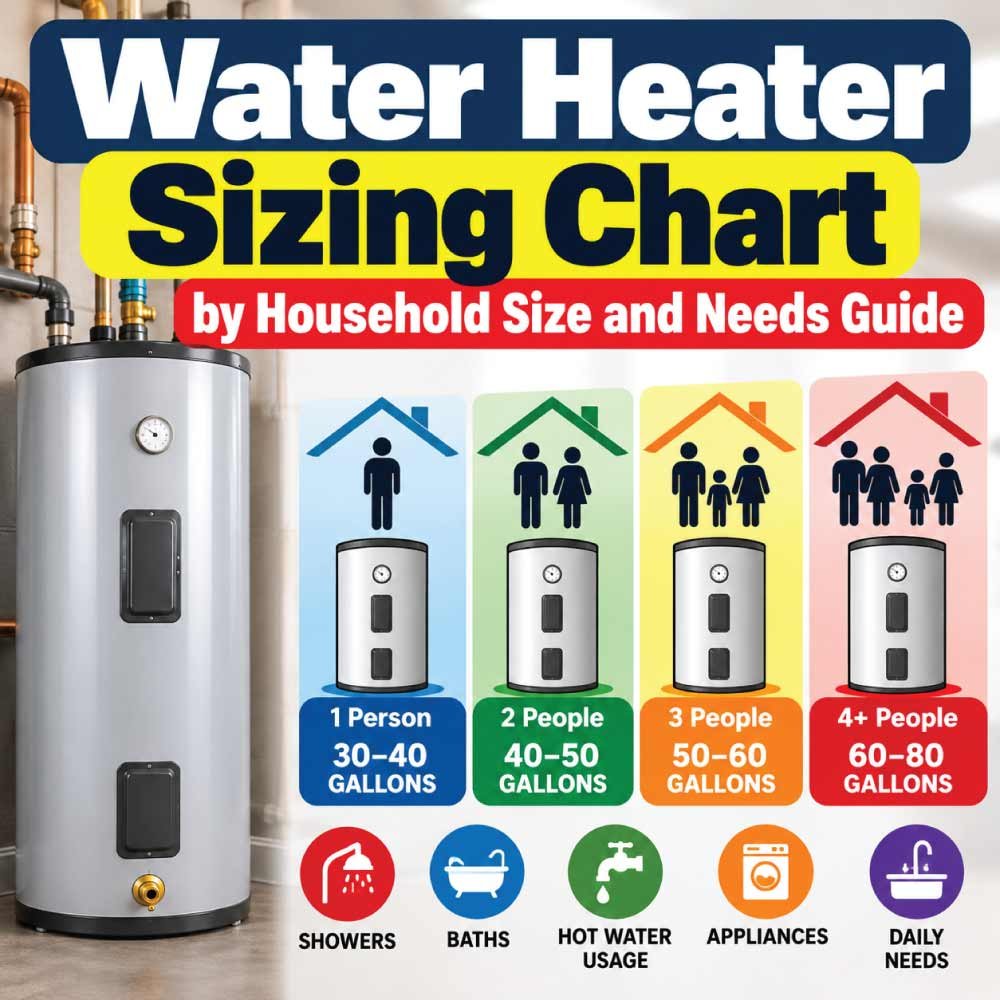
This water heater sizing chart by household size and needs guide explains how to estimate the right capacity for families of different sizes. You’ll learn how to compare tank water heaters, tankless systems, and heat pump models, calculate your hot water requirements, and choose a unit that meets your household’s needs without unnecessary expense.
The recommendations below are starting points rather than universal specifications. Actual requirements depend on fixture flow rates, water temperature, climate, appliance usage, and manufacturer ratings.
Water Heater Size Chart by Household Size
The number of people living in your home is a useful starting point when selecting a water heater. However, two households of the same size may have very different hot water requirements. A family that takes several showers in the morning may need more capacity than a household that spreads hot water use throughout the day.
The following chart provides general planning ranges for conventional storage tank water heaters.
| Household Size | Suggested Tank Capacity (US Gallons) | Approximate Capacity (Liters) | Typical Household Needs |
|---|---|---|---|
| 1 person | 20–30 gallons | 76–114 L | One shower, kitchen, basic laundry |
| 2 people | 30–40 gallons | 114–151 L | One or two showers, regular dishwashing |
| 3 people | 40–50 gallons | 151–189 L | Multiple showers and routine laundry |
| 4 people | 50–60 gallons | 189–227 L | Family showers, kitchen, laundry |
| 5 people | 60–80 gallons | 227–303 L | Higher demand and overlapping showers |
| 6 people | 80 gallons or more | 303 L or more | Large households and frequent simultaneous use |
These ranges are general estimates, not guaranteed sizing recommendations. Some homes can operate comfortably with smaller tanks, while others need larger tanks or faster recovery rates. Check the manufacturer’s first-hour rating and sizing guidance before purchasing.
For tankless water heaters, household size alone is not enough. You need to calculate the combined hot water flow rate of fixtures that may run simultaneously and the temperature rise required by your incoming water.
Water Heater Size Chart for Different Family Sizes
A more specific household water heater size chart can help narrow down your options. Use these recommendations as an initial estimate, then adjust the capacity according to your family’s routines and the system’s performance.
Water Heater Size for a Family of 2
A household of two people may find a 30- to 40-gallon storage tank sufficient for everyday activities such as showering, cooking, and washing dishes. A 40-gallon model may provide more flexibility when both people shower close together.
Consider a larger tank if you have a deep bathtub, a high-flow shower, or frequent hot water use during the same period. If your schedule is predictable, a properly sized tankless unit may also be suitable.
Water Heater Size for a Family of 3
A 40- to 50-gallon storage tank is a reasonable starting point for three people. This range can accommodate ordinary household use, although the best choice depends on shower duration, laundry habits, and the number of bathrooms.
Look for a model with a suitable first-hour rating if all three household members tend to use hot water in the morning. A higher recovery rate may be more useful than simply increasing tank capacity.
Water Heater Size for a Family of 4
A family of four commonly considers a 50- to 60-gallon storage tank. A 50-gallon model may be enough for moderate demand, while a larger tank can provide a buffer when several showers and appliances are used close together.
Homes with multiple bathrooms, large bathtubs, or frequent overlapping hot water use may require additional capacity or a higher-recovery system.
Water Heater Size for a Family of 5
For five people, a 60- to 80-gallon storage tank is a useful preliminary range. The upper end may be appropriate when multiple family members shower consecutively or when laundry and dishwashing overlap with bathing.
Before selecting a large tank, compare its first-hour rating with your household’s peak demand. A system that reheats water quickly may meet your needs without requiring an exceptionally large storage tank.
Water Heater Size for a Family of 6
A household of six may need an 80-gallon tank or a carefully sized alternative. The correct option depends heavily on the number of bathrooms, simultaneous showers, incoming water temperature, and the amount of hot water used for laundry and cleaning.
Tankless systems and multiple water heaters may be worth evaluating in larger homes. However, their combined flow capacity, installation requirements, and energy supply must be checked before choosing a configuration.
Quick Family Size Comparison
| Household | Preliminary Tank Range | Important Sizing Consideration |
|---|---|---|
| 1–2 people | 20–40 gallons | Shower habits and recovery rate |
| 3 people | 40–50 gallons | Consecutive showers |
| 4 people | 50–60 gallons | Morning peak demand |
| 5 people | 60–80 gallons | Overlapping fixtures |
| 6+ people | 80+ gallons | Multiple bathrooms and total demand |
These are broad screening ranges. Manufacturer sizing tables, first-hour ratings, and actual usage patterns should determine the final selection.
Storage Tank vs. Tankless Water Heater Size Chart
Water heater sizing depends on the technology used. A 50-gallon storage tank and a tankless unit rated for a particular flow rate cannot be compared simply by looking at their numbers.
Storage Tank Water Heaters
Storage water heaters heat and hold a reservoir of hot water. Their capacity is expressed in gallons or liters, and their performance depends on tank volume, thermostat settings, incoming water temperature, and recovery speed.
Advantages include:
-
A stored supply of hot water for periods of high demand.
-
Familiar installation and operation in many homes.
-
A wide range of available capacities.
-
The ability to meet short bursts of demand using stored hot water.
The main limitation is that the supply can be depleted if demand exceeds the available hot water and recovery rate.
Tankless Water Heaters
Tankless water heaters heat water as it passes through the unit rather than storing a large volume in a tank. Their output is commonly rated in gallons per minute (GPM) or liters per minute (L/min) at a specified temperature rise.
| Household Situation | What to Evaluate |
|---|---|
| 1–2 people | Required flow for one shower and occasional additional use |
| 3–4 people | Simultaneous shower and appliance demand |
| 5–6 people | Combined flow during peak periods |
| Multiple bathrooms | Maximum likely simultaneous flow |
| Cold incoming water | Available flow at the required temperature rise |
A tankless unit may supply enough hot water for extended use, but its output is not unlimited. Running two showers and a kitchen tap together can exceed the unit’s capacity, particularly when incoming water is cold.
Heat Pump Water Heaters
Heat pump water heaters transfer heat from surrounding air into the water instead of relying exclusively on conventional electric resistance heating. Many models use storage tanks, so you still need to consider tank volume and recovery performance.
Their recovery characteristics can differ from those of conventional electric models. Check the manufacturer’s first-hour rating, operating conditions, installation space requirements, and recommended sizing method.
How to Calculate the Right Water Heater Size
The best water heater size chart is one that reflects how your household actually uses hot water. A practical calculation involves estimating peak demand and checking whether the proposed unit can meet it.
Step 1: Estimate Daily Hot Water Activities
List the activities that use hot water and how frequently they occur. Consider showers, baths, kitchen taps, handwashing, dishwashers, and washing machines.
For each activity, think about:
-
How long it lasts.
-
How much water the fixture uses.
-
Whether the activity happens during peak hours.
-
Whether other hot water fixtures operate at the same time.
You do not need to estimate every drop used throughout the day. Identifying the busiest period is often more useful for choosing a storage tank.
Step 2: Identify Peak-Hour Demand
Peak-hour demand refers to the amount of hot water your household needs during its busiest hour. For storage tank systems, compare this demand with the manufacturer’s first-hour rating (FHR).
The first-hour rating estimates how much hot water a fully heated tank can deliver during the first hour under specified test conditions. It reflects both stored hot water and the heater’s ability to recover.
A tank’s stated gallon capacity is not the same as its first-hour rating. For example, two 50-gallon models may deliver different amounts of hot water during a busy period because their heating elements, burners, and recovery characteristics differ.
Step 3: Check Incoming Water Temperature
Water entering the home is usually colder in winter than in summer, and its temperature varies by location and water source. Colder incoming water requires more heating to reach the same target temperature.
For tankless systems, this is especially important because the unit must provide a required temperature rise while maintaining the desired flow rate.
A system that performs adequately in a warm climate may deliver less hot water per minute in a colder climate. Review the manufacturer’s performance charts for the expected winter inlet temperature.
Step 4: Compare Recovery Rate and Capacity
Recovery rate describes how quickly a heater can raise the temperature of incoming water. It is especially important for households with repeated or overlapping hot water use.
When comparing models, review:
-
Tank capacity in gallons or liters.
-
First-hour rating for storage heaters.
-
Recovery information provided by the manufacturer.
-
Tankless flow rate at the required temperature rise.
-
Energy source and available electrical or gas supply.
Do not select a water heater based on capacity alone. A well-matched combination of storage and recovery performance can be more practical than simply buying the largest available unit.
Water Heater Capacity Chart in Gallons and Liters
Water heater capacity may be listed in US gallons, liters, or both. Use the conversion chart below when comparing product specifications.
| US Gallons | Approximate Liters | Common Description |
|---|---|---|
| 20 gallons | 76 L | Small storage tank |
| 30 gallons | 114 L | Small household tank |
| 40 gallons | 151 L | Small to medium household tank |
| 50 gallons | 189 L | Medium household tank |
| 60 gallons | 227 L | Larger household tank |
| 75 gallons | 284 L | Large storage tank |
| 80 gallons | 303 L | Large household tank |
Conversions are rounded to the nearest liter. One US gallon equals approximately 3.785 liters. Imperial gallons are different, so verify which gallon measurement appears in a product specification.
Remember that nominal tank capacity does not equal the exact amount of hot water available at the tap. The delivered amount also depends on tank temperature, cold-water mixing, recovery, and the plumbing system.
What Factors Affect Water Heater Sizing?
Household size is only one part of the decision. Several other factors can change the amount of hot water your home needs and the type of water heater that makes the most sense.
Number of Bathrooms and Fixtures
A home with one bathroom may have a very different demand profile from a home with three bathrooms. Multiple bathrooms make simultaneous showers more likely, which can increase the required flow rate or first-hour output.
Consider the number and type of fixtures, including:
-
Standard and high-flow showerheads.
-
Bathtubs and soaking tubs.
-
Kitchen and bathroom faucets.
-
Dishwashers and washing machines.
-
Utility sinks and other hot water outlets.
Count the fixtures that might operate together rather than assuming every fixture will run simultaneously.
Shower Duration and Flow Rate
Showers are often a major source of household hot water demand. A longer shower uses more water than a shorter one, while a high-flow showerhead can increase demand further.
For example, a showerhead rated at 2.0 GPM uses approximately 20 gallons of mixed water during a 10-minute shower. That does not mean the water heater must supply 20 gallons of hot water because the shower normally mixes hot and cold water.
The actual hot water contribution depends on the temperature of the stored or supplied water, the incoming cold water, and the desired shower temperature.
Laundry and Dishwashing Habits
Appliances can add to peak demand when they operate during shower times. Modern dishwashers and washing machines may use less hot water than older models, and some heat water internally.
Check the appliance specifications rather than assuming every cycle draws the same amount of hot water. If you can schedule laundry and dishwashing outside the busiest shower period, a smaller system may be sufficient.
Climate and Incoming Water Temperature
Homes in colder regions generally need more heating to raise incoming water to a comfortable temperature. This can affect tankless output and the energy needed by storage systems.
In areas with significant seasonal temperature changes, use the coldest realistic incoming water temperature when checking performance. Manufacturer charts can help establish the expected output under those conditions.
Future Household Changes
A water heater should meet realistic needs over its service life. If your household is likely to grow, you plan to add a bathroom, or you expect to install a large bathtub, account for that future demand.
However, avoid oversizing the system solely for a hypothetical scenario. Compare the additional installation cost and operating requirements with the likelihood of the extra demand.
Also Read:
How to Size a Tankless Water Heater
Tankless water heater sizing requires two main figures: the total hot water flow rate needed during simultaneous use and the temperature rise required to heat incoming water.
Calculate the Required Flow Rate
Estimate which fixtures could run at the same time, then add their flow rates.
For example, suppose your household may use two showers simultaneously, each drawing 1.8 GPM, plus a faucet drawing 0.5 GPM.
| Fixture | Flow Rate | Quantity | Combined Flow |
|---|---|---|---|
| Shower | 1.8 GPM | 2 | 3.6 GPM |
| Faucet | 0.5 GPM | 1 | 0.5 GPM |
| Total | — | — | 4.1 GPM |
This example represents the combined fixture flow, not a guaranteed hot water output requirement for every home. The actual hot water contribution can be lower when fixtures mix hot and cold water. Follow the manufacturer’s sizing procedure for the model being considered.
Calculate the Temperature Rise
Temperature rise is the difference between the incoming water temperature and the desired outlet temperature.
For example, if incoming water is 50°F and your target outlet temperature is 120°F:
The heater must raise the water temperature by 70°F to achieve that outlet temperature under the stated conditions.
A larger temperature rise generally reduces the flow rate a tankless heater can deliver. Review the model’s flow-versus-temperature-rise chart instead of relying on its maximum advertised GPM, which may be measured under a smaller temperature rise.
Check Fuel and Electrical Requirements
Gas tankless heaters require an appropriate gas supply, venting, and combustion air arrangements. Electric tankless models can require substantial electrical capacity.
Before purchasing, confirm that the existing utility service, wiring, gas line, and venting meet the manufacturer’s requirements and applicable local codes. Professional installation may be necessary to ensure safe operation.
Also Read:
How to Choose Between Electric, Gas, and Heat Pump Models
The energy source affects operating cost, recovery speed, installation complexity, and the available range of models.
| Water Heater Type | Main Sizing Consideration | Potential Advantage | Important Limitation |
|---|---|---|---|
| Electric storage | Tank capacity and recovery | Straightforward configuration in suitable homes | Recovery depends on element output |
| Gas storage | Tank capacity and recovery | Some models recover quickly | Requires suitable gas supply and venting |
| Electric tankless | Flow and temperature rise | No large storage tank | May require major electrical upgrades |
| Gas tankless | Flow, temperature rise, and fuel supply | Can provide continuous heating within rated capacity | Output depends on inlet temperature and available gas |
| Heat pump | Storage capacity and recovery | Can use less electricity than conventional resistance heating in suitable conditions | Needs appropriate space and operating conditions |
No single type is best for every household. Compare the equipment’s rated performance, installation cost, available energy source, and typical usage before making a decision.
Also Read:
Common Water Heater Sizing Mistakes
Choosing the wrong capacity can lead to hot water shortages, unnecessary costs, or disappointing performance. Avoid these common errors when comparing water heater models.
Choosing Only by Family Size
A family-size chart is a starting point, not a substitute for demand calculations. Four people taking short showers at different times may need less capacity than three people using multiple showers and a large bathtub simultaneously.
Ignoring the First-Hour Rating
For storage water heaters, comparing only the tank’s gallon capacity can be misleading. Check the first-hour rating and match it to your household’s busiest period.
Using Maximum Tankless GPM Without Checking Temperature Rise
A tankless unit’s maximum advertised flow may not be available when incoming water is cold. Confirm its rated output at the temperature rise your home requires.
Buying an Oversized Unit Without a Reason
A larger tank can provide a greater stored supply, but it may also cost more to purchase and install. It can have greater standby heat loss depending on its design and insulation.
Select a size that meets your actual demand rather than assuming that bigger is always better.
Forgetting Installation Requirements
A heater may appear suitable on paper but require upgrades to electrical service, gas piping, venting, drainage, or plumbing. Include these requirements in the total project budget.
Ignoring Manufacturer Specifications
Water heater ratings and installation requirements vary by model. Always check the product documentation and applicable local requirements before finalizing your purchase.
Signs Your Water Heater Is the Wrong Size
Your current water heater may be too small, too large, or simply unable to meet peak demand because of its condition or recovery performance.
Common warning signs include:
-
Hot water runs out quickly: The stored supply may be too small for your household’s demand, or the unit may not be heating properly.
-
Water temperature drops during simultaneous use: The heater may not have sufficient capacity or output for overlapping fixtures.
-
Long recovery periods: The unit may need more time to reheat its supply, or a heating element, burner, or other component may be malfunctioning.
-
Frequent temperature fluctuations: Plumbing problems, mixing valves, sediment buildup, or equipment faults may be responsible.
-
Higher-than-expected energy use: Incorrect settings, heat loss, poor maintenance, or an inefficient system may increase operating costs.
These symptoms do not automatically mean you need a larger water heater. Have the existing unit inspected before replacing it, especially if its performance has recently changed.
Frequently Asked Questions About Water Heater Sizing
What size water heater do I need for a family of four?
A 50- to 60-gallon storage tank is a common starting point for a family of four. The correct capacity depends on peak-hour demand, shower habits, the number of bathrooms, and the heater’s first-hour rating.
Is a 40-gallon water heater enough for a family of four?
It may be sufficient in a household with moderate hot water use and a heater that recovers quickly. However, families with long showers, multiple bathrooms, or overlapping appliance use may benefit from a larger tank or a different system.
What size water heater is best for two bathrooms?
Two bathrooms do not automatically require a particular tank size. Consider how often both showers operate simultaneously, their flow rates, and the demand from other fixtures. A storage tank’s first-hour rating or a tankless unit’s rated flow at the required temperature rise will help determine suitability.
Is a 50-gallon water heater enough for five people?
It can work in some households, but five people may need a larger tank or higher recovery performance, particularly when everyone showers around the same time. Compare the first-hour rating with your estimated peak demand before deciding.
How many liters is a 50-gallon water heater?
A 50-US-gallon water heater has a nominal capacity of approximately 189 liters. Its actual delivered hot water depends on temperature settings, incoming water temperature, mixing, and recovery.
What size tankless water heater do I need for a family of four?
There is no universal size based on family size alone. Calculate the combined flow rate of fixtures likely to operate simultaneously, determine the required temperature rise, and select a model that meets both requirements according to its performance chart.
Should I buy a larger water heater than I need?
Not necessarily. An oversized tank may cost more and can have greater standby heat loss. A properly sized model with suitable recovery performance is generally a better starting point than buying the largest available unit.
Does a heat pump water heater need a larger tank?
Not always. Heat pump models can have different recovery characteristics from conventional electric resistance heaters. Compare tank capacity, first-hour rating, recovery information, and the manufacturer’s sizing recommendations to determine the appropriate model.
Conclusion
The right water heater size depends on more than the number of people in your home. Household size, peak-hour demand, fixture flow rates, incoming water temperature, recovery performance, and energy source all affect the final choice.
Use the water heater sizing chart by household size and needs to narrow down your options, then compare manufacturer ratings before purchasing. For storage tanks, pay particular attention to capacity and first-hour rating. For tankless models, check simultaneous flow requirements and temperature rise.
Choosing a system that matches your real hot water demand can help you maintain a reliable supply without paying for unnecessary capacity.