
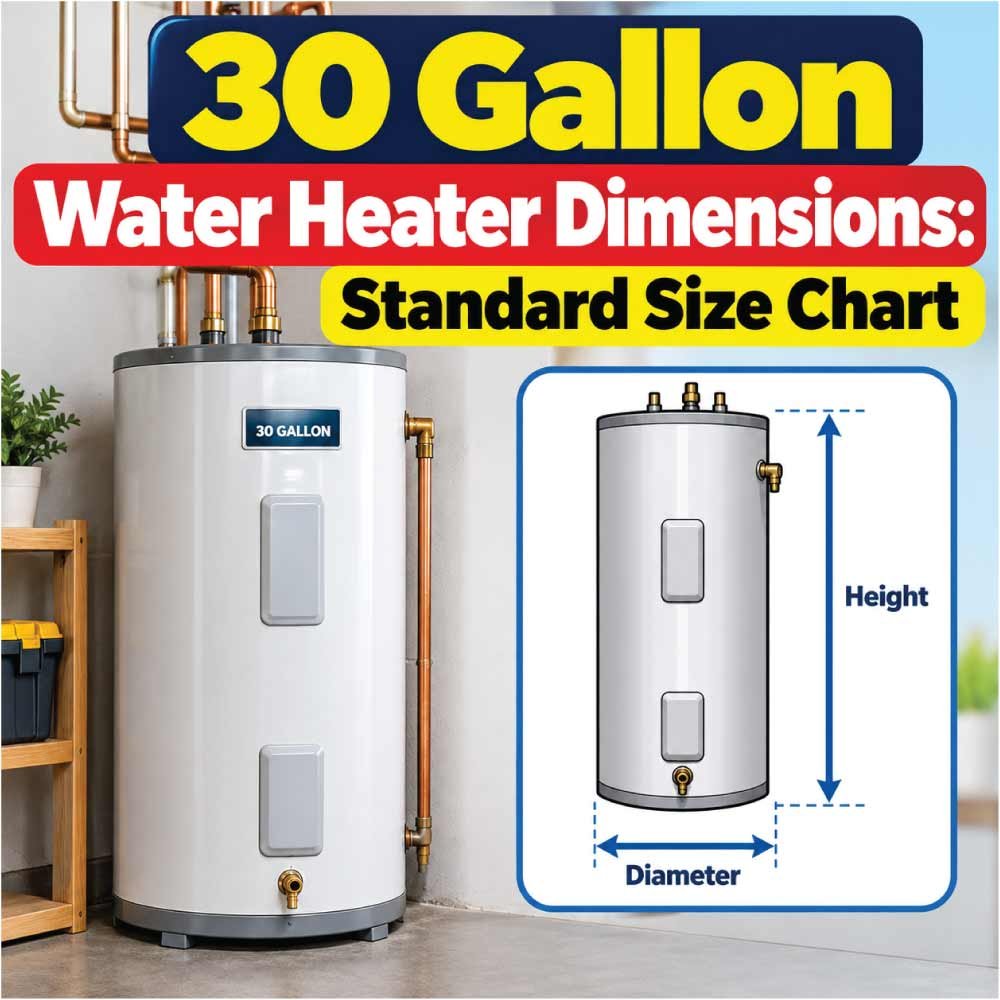
A 30-gallon water heater is a practical option for smaller households, apartments, guest bathrooms, and homes with moderate hot-water demand. However, before purchasing one, it is important to understand its physical dimensions, installation clearance, tank shape, and available space. A unit that holds 30 gallons does not have the same dimensions across every brand or model.
The typical 30 gallon water heater dimensions depend on whether the unit is electric or gas, short or tall, and traditional tank-style or tankless. Many conventional 30-gallon storage models fall within an approximate range of 30 to 50 inches in height and 18 to 24 inches in diameter, although individual products may fall outside these ranges.
This guide explains standard 30-gallon water heater sizes, provides a practical dimensions chart, compares common configurations, and shows you how to measure your installation space. You will also learn how to choose a suitable model, understand clearance requirements, and avoid common sizing mistakes.
30 Gallon Water Heater Dimensions at a Glance
A standard 30-gallon water heater is designed to store approximately 30 US gallons of hot water, equivalent to about 113.6 liters. Its external dimensions vary according to the tank design, insulation thickness, heating system, and manufacturer.
The following chart provides general planning estimates, not guaranteed specifications for every model.
| Measurement | Approximate Range | Metric Equivalent |
|---|---|---|
| Height | 30–50 inches | 76–127 cm |
| Diameter | 18–24 inches | 46–61 cm |
| Width of a round tank | 18–24 inches | 46–61 cm |
| Nominal capacity | 30 US gallons | 113.6 liters |
| Approximate filled water weight | 250 lb | 113.4 kg |
The height and diameter ranges above are broad estimates for initial planning. Some compact, lowboy, or specially designed units may have different dimensions. Likewise, the filled water weight excludes the tank itself, so the total installed weight will be higher.
Before ordering a replacement, check the manufacturer’s specification sheet for the exact model number. Confirm the overall height, tank diameter, connection locations, and required installation clearances.
Standard 30 Gallon Water Heater Size Chart
Although two water heaters can have the same storage capacity, their proportions may be quite different. A tall model uses more vertical space and generally occupies less floor area, while a short model has a lower profile and may have a wider tank.
Typical Dimensions by Tank Configuration
| Water Heater Type | Approximate Height | Approximate Diameter | Common Installation Situation |
|---|---|---|---|
| Tall 30-gallon tank | 45–50 in | 18–22 in | Utility rooms with adequate ceiling height |
| Short 30-gallon tank | 30–36 in | 20–24 in | Low-clearance spaces |
| Compact 30-gallon tank | Varies by model | Varies by model | Tight utility areas where the listed model fits |
| Electric 30-gallon tank | Varies by model | Varies by model | Locations with a suitable electrical supply |
| Gas 30-gallon tank | Varies by model | Varies by model | Locations meeting gas, venting, and combustion-air requirements |
These categories are not universal industry dimensions. A manufacturer’s definition of a short, tall, or compact model may differ from another manufacturer’s definition. The table is intended to help you compare possible configurations, not to replace product specifications.
Tall vs. Short 30-Gallon Water Heaters
A tall 30-gallon water heater is often suitable when the installation area has enough overhead clearance. Its narrower footprint can make it easier to position in a small utility room.
A short model may be more practical beneath a low ceiling, in a basement with limited overhead space, or in a designated low-profile installation area. However, short models may require more floor space because of their wider tank diameter.
Consider these differences when comparing the two designs:
- Tall models: Usually prioritize vertical space efficiency.
- Short models: Usually prioritize reduced height.
- Compact models: Must be evaluated using their actual listed dimensions rather than their marketing label.
- Replacement models: Must fit the existing installation while satisfying current connection and safety requirements.
Do not assume that a short model can automatically fit beneath a counter or inside a cabinet. Allow room for piping, valves, electrical connections, servicing, and any required ventilation.
Electric vs. Gas 30 Gallon Water Heater Dimensions
The fuel or heating method can affect the shape and installation requirements of a 30-gallon water heater. Electric and gas models may have similar storage capacities but different external layouts.
Electric 30-Gallon Water Heaters
Electric storage water heaters typically contain one or more electric heating elements inside an insulated tank. Because they do not require a fuel-burning flue, some models have a simpler top profile than conventional gas units.
However, electric models still require suitable electrical wiring, circuit protection, grounding, plumbing connections, and access for maintenance.
Before selecting an electric water heater, check:
- Overall tank height and diameter.
- Electrical voltage and required circuit specifications.
- Location of the heating-element access panels.
- Space needed to remove or service components.
- Manufacturer-specified clearances and local electrical requirements.
The absence of a gas flue does not mean an electric water heater can be installed in any enclosed space. Follow the product’s installation instructions and applicable electrical and plumbing codes.
Gas 30-Gallon Water Heaters
Gas water heaters use a burner to heat stored water. Their installation may require additional space for the gas connection, venting system, combustion air, and service access.
The exact arrangement depends on whether the unit uses natural gas or propane and whether it has an atmospheric, power-vent, or other approved venting design.
Before measuring for a gas model, verify:
- The tank’s overall height, including relevant top-mounted components.
- Vent connector location and required routing.
- Required clearances around the burner and venting components.
- Gas-line connection location and accessibility.
- Combustion-air and ventilation requirements.
A gas water heater should not be placed in a tightly enclosed area unless the specific appliance is approved for that installation and all applicable requirements are satisfied.
Which Type Is Easier to Fit?
Neither electric nor gas is automatically the better choice for every small space. An electric model may have fewer venting constraints, while a gas model may be preferable where an appropriate gas supply and compliant venting arrangement already exist.
The best choice depends on the available dimensions, utility connections, installation cost, operating requirements, and local building regulations.
How Much Space Does a 30 Gallon Water Heater Need?
The tank’s dimensions are only part of the installation calculation. You must also consider the room needed for connections, maintenance, safe operation, and eventual replacement.
Floor Space and Footprint
The footprint describes the floor area occupied by the tank. For a cylindrical water heater, the footprint is approximately circular.
For example, a tank with a 22-inch diameter occupies a circular area of about 380 square inches, or 2.64 square feet. This calculation represents the tank’s footprint only, not the complete installation area.
A simple way to estimate the footprint is:
Footprint area = π × (diameter ÷ 2)²
Use the tank’s actual diameter when making this calculation. Do not include surrounding clearance in the footprint itself.
Height and Overhead Clearance
Measure from the floor or approved support surface to the lowest overhead obstruction. Compare this measurement with the manufacturer’s overall installed height.
Remember that the tank height may not include every fitting or connection. Depending on the design, additional space may be needed for:
- Water supply and outlet piping.
- Temperature and pressure relief valve discharge piping.
- Electrical connections or a vent connector.
- Removal of the anode rod or other service components.
- Lifting and maneuvering the unit during installation.
A tank that technically fits between the floor and ceiling may still be difficult or impossible to install or service.
Service and Safety Clearances
Clearance requirements vary by appliance design, location, and local code. There is no single clearance measurement that applies to every 30-gallon water heater.
Consult the installation manual for the required distances from combustible materials, nearby walls, overhead surfaces, and access areas. Gas appliances may have additional requirements related to venting and combustion air.
Also consider whether a technician can reach shutoff valves, the drain valve, service panels, and other components without removing permanent fixtures.
How to Measure for a 30 Gallon Water Heater Replacement
Replacing an existing water heater is easier when you record the relevant measurements before shopping. A few minutes of careful measuring can prevent ordering a unit that does not fit.
Step 1: Measure the Available Height
Measure vertically from the intended support surface to the ceiling or lowest obstruction. If the unit sits on a platform, measure from the top of that platform.
Record the usable height, not simply the room’s total ceiling height.
Step 2: Measure the Available Width
Measure the available width between walls, cabinets, or other fixed obstructions. For a round tank, compare this measurement with the tank’s maximum outside diameter.
Include any protruding components that could affect the fit. A nearby pipe or electrical conduit can reduce the usable width.
Step 3: Check the Depth and Access Route
Measure the depth of the installation area and the width of doorways, hallways, stairs, or other routes the tank must pass through.
A replacement can fit in the final location but still be too large to move through the building. Consider the unit’s packaging dimensions if it will be delivered in a box.
Step 4: Record the Existing Connections
Identify the positions of the hot-water outlet, cold-water inlet, drain valve, relief valve, electrical connection, and gas or venting connections where applicable.
Connection locations differ between models. A tank that matches the old unit’s height and diameter may still require plumbing adjustments.
Step 5: Compare the Measurements With the Manufacturer’s Drawing
Use the technical drawing for the exact model under consideration. Check overall dimensions, connection heights, service clearances, and any required installation accessories.
A practical pre-purchase checklist includes:
-
Available installation height.
-
Maximum tank diameter or width.
-
Doorway and delivery-route dimensions.
-
Water-pipe connection locations.
-
Electrical or gas connection requirements.
-
Venting and combustion-air requirements, where applicable.
-
Manufacturer’s service and safety clearances.
-
Support-surface capacity and applicable code requirements.
If any measurement is uncertain, verify it before purchasing the appliance.
Also Read:
Is a 30 Gallon Water Heater Big Enough for Your Home?
Choosing the correct water heater involves more than matching its dimensions to the available space. A 30-gallon tank must also supply enough hot water for the household’s daily needs.
A smaller tank may work well for a household with modest demand, but it can run short when multiple fixtures are used close together.
Typical Household Applications
A 30-gallon water heater may be appropriate for:
- A small apartment with limited simultaneous hot-water use.
- A guest suite or secondary living space.
- A small household with relatively modest bathing and washing needs.
- A replacement installation where a 30-gallon capacity has already proved adequate.
These are general examples, not guarantees. The number of occupants alone cannot determine the correct tank size.
When a 30-Gallon Tank May Be Too Small
Consider a larger storage tank or another suitable system if your household regularly experiences hot-water shortages.
Potential signs of insufficient capacity include:
- The hot water runs out during consecutive showers.
- Multiple bathrooms are used at the same time.
- Laundry, dishwashing, and bathing frequently overlap.
- Household demand has increased since the original heater was installed.
Water demand, incoming water temperature, thermostat setting, recovery rate, and the first-hour rating all affect performance.
Understand Nominal Capacity and Usable Hot Water
A 30-gallon tank does not necessarily provide exactly 30 gallons of water at a constant delivery temperature before becoming cold. Incoming cold water mixes with stored hot water during use, and the tank’s heating system continues to recover heat as designed.
The first-hour rating (FHR) estimates how much hot water a fully heated storage water heater can deliver during the first hour under specified test conditions. It accounts for both stored hot water and recovery.
Compare FHR values on product labels rather than choosing a water heater based on tank capacity alone. The Department of Energy’s consumer guidance and the manufacturer’s documentation can help you understand the rating and select a suitable unit.
Also Read:
30 Gallon vs. 40 Gallon Water Heater Dimensions
A 40-gallon water heater provides greater nominal storage capacity, but it may also need more installation space. The actual difference depends on the product designs being compared.
The following table describes general design considerations rather than universal measurements.
| Feature | 30-Gallon Water Heater | 40-Gallon Water Heater |
|---|---|---|
| Nominal capacity | 30 US gal | 40 US gal |
| Water volume | 113.6 L | 151.4 L |
| Typical purpose | More modest hot-water demand | Greater storage demand |
| Tank footprint | Depends on model | May be larger |
| Overall height | Depends on model | May be taller or wider |
| Filled water weight | About 250 lb | About 334 lb |
| Main selection factor | Space and demand | Additional capacity and space |
The filled water weights are approximate calculations based on water volume, excluding the tank and other components. The actual installed weights will be higher.
A 40-gallon model is not necessarily taller than a 30-gallon model. Some designs increase diameter instead, and others use different proportions to fit specific installation spaces.
Choose between the two capacities by considering hot-water demand, available space, recovery performance, energy use, and the manufacturer’s specifications.
Important Installation Considerations for a 30-Gallon Water Heater
Even a correctly sized water heater must be installed according to its instructions and applicable local requirements.
Floor Support and Total Weight
Water is heavy: 30 US gallons weigh approximately 250 pounds. Add the weight of the empty tank, insulation, fittings, and other components to determine the approximate full operating weight.
The floor, platform, or mounting arrangement must be suitable for the total load. This is particularly important for installations on upper floors, elevated platforms, or older structures.
Do not assume that a smaller tank is automatically suitable for every floor or cabinet.
Temperature and Pressure Relief Protection
Storage water heaters require appropriate temperature and pressure protection. The relief valve and its discharge piping must be installed according to the appliance instructions and applicable plumbing codes.
Do not block the discharge outlet, cap the discharge pipe, or alter the relief system to make the unit fit a restricted space.
Leak Protection and Drainage
Consider what would happen if the tank, a fitting, or a supply line leaked. A suitable drain pan and drainage arrangement may be required or recommended depending on the location and local rules.
An upper-floor installation can require particular attention because a leak may damage rooms below. Confirm the correct pan size and drainage requirements with the installation manual and a qualified professional.
Venting, Electrical, and Plumbing Compliance
Gas models need an approved venting arrangement and adequate combustion air as specified for the appliance. Electric models need a suitable electrical supply and correctly installed protective devices.
All models require appropriate plumbing connections and safe discharge arrangements. Requirements differ by jurisdiction, so local building and plumbing codes should be checked before installation.
For gas connections, electrical work, or modifications to safety systems, use a qualified professional where required.
Also Read:
Common Mistakes When Choosing a 30 Gallon Water Heater
Several avoidable errors can lead to additional costs or installation delays.
Measuring Only the Tank Height
The published height may not account for every connection or fitting. Check the complete dimensional drawing and leave the required installation space.
Assuming All 30-Gallon Models Are the Same Size
Capacity describes how much water the tank is designed to store, not its external dimensions. Always compare model-specific measurements.
Ignoring Tank Diameter
A tank can fit vertically but fail to fit between walls, through a doorway, or beside nearby equipment. Measure the width and access route as carefully as the height.
Forgetting Service Access
A unit may fit inside a tight enclosure but leave no room to reach the controls, remove service components, or perform maintenance. Follow the manufacturer’s access and clearance instructions.
Choosing Capacity Without Considering Demand
A physically compact water heater is not a good choice if it repeatedly runs out of hot water. Consider the first-hour rating, the number of fixtures used together, and the household’s actual consumption.
Assuming the Existing Installation Meets Current Requirements
An older water heater’s placement or connections may not comply with current local requirements. Verify the proposed replacement’s installation instructions and applicable code instead of copying every detail of the old installation.
Frequently Asked Questions About 30 Gallon Water Heater Dimensions
What are the standard dimensions of a 30-gallon water heater?
There is no single standard size for every model. Many conventional units fall within an approximate range of 30–50 inches in height and 18–24 inches in diameter. Check the exact manufacturer’s specifications before installation.
How wide is a 30-gallon water heater?
Many round 30-gallon storage models are approximately 18–24 inches in diameter. The width may differ for short, tall, and compact designs, so confirm the maximum outside dimension of the selected unit.
How tall is a 30-gallon water heater?
A typical planning range is approximately 30–50 inches. Short models tend to have lower profiles, while tall models use more vertical space. The actual overall height depends on the design and manufacturer.
How much does a full 30-gallon water heater weigh?
Thirty US gallons of water weigh approximately 250 pounds, or 113.4 kilograms. The complete filled appliance weighs more because the calculation must also include the tank, insulation, and components.
Can a 30-gallon water heater fit in a small closet?
Possibly, but the tank’s diameter and height are only two factors. The closet must also meet the appliance’s clearance, access, ventilation, electrical or gas, and drainage requirements. Never assume a closed cabinet is suitable without checking the installation manual.
Is a short 30-gallon water heater better than a tall model?
A short model can be useful when overhead clearance is limited. A tall model may occupy less floor space. Neither is universally better; choose according to the available installation dimensions and the manufacturer’s specifications.
Can I replace a 30-gallon heater with a 40-gallon model?
Yes, if the larger unit is appropriate for the household and the installation location can accommodate its dimensions, weight, connections, and safety requirements. Verify the floor support and required clearances before changing capacities.
Are 30-gallon electric and gas water heaters the same size?
No. Their dimensions depend on the specific model, and gas units may have additional venting and combustion-air requirements. Compare the technical drawings of the exact electric and gas products you are considering.
Conclusion
The right 30 gallon water heater dimensions depend on the tank design, heating method, installation space, and manufacturer’s specifications. Although many models fall within a broad range of 30–50 inches in height and 18–24 inches in diameter, these measurements should be used only for preliminary planning.
Before purchasing a unit, measure the available height and width, check the delivery route, confirm connection locations, and allow the required service and safety clearances. Then compare hot-water demand and first-hour ratings to ensure that the tank can meet your household’s needs.
The most reliable approach is to choose a suitable capacity first, verify the exact model’s dimensional drawing, and confirm that the complete installation complies with the manufacturer’s instructions and local requirements. This helps prevent fit problems and supports a safer, more practical replacement.