
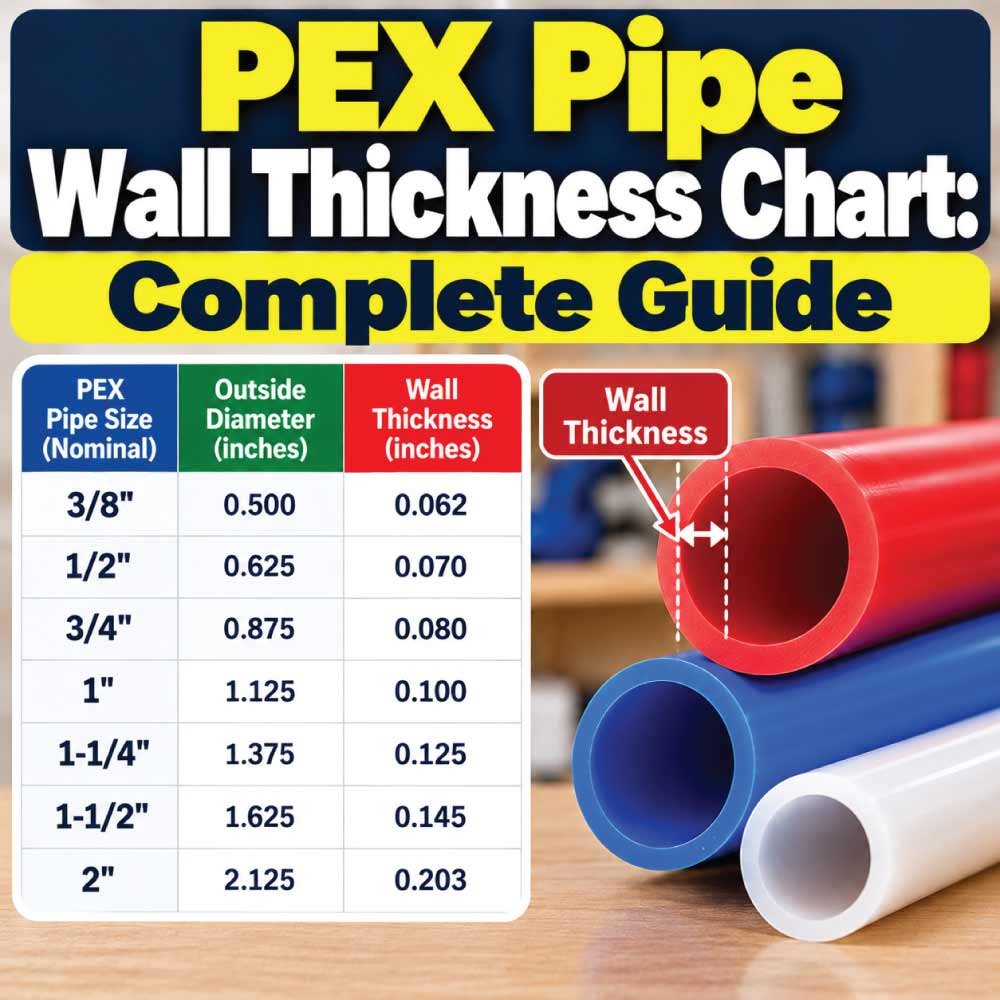
PEX pipe is widely used in residential plumbing, hot- and cold-water distribution, radiant heating, and other approved plumbing applications. However, choosing the correct pipe involves more than checking its nominal size. PEX pipe wall thickness affects the inside diameter, flow capacity, pressure performance, and compatibility with fittings.
This PEX pipe wall thickness chart explains how wall thickness relates to nominal pipe size, outside diameter, inside diameter, and dimensional standards. You will also learn how to measure PEX tubing, understand SDR and CTS terminology, compare common sizes, and select the correct pipe for your project.
Because dimensions and pressure ratings can vary by product and manufacturer, use the charts as a dimensional reference and confirm installation requirements against the markings on your tubing and the applicable product documentation.
What Is PEX Pipe Wall Thickness?
PEX stands for cross-linked polyethylene, a flexible plastic material used to manufacture water-distribution tubing. Cross-linking improves the material’s resistance to heat and contributes to its mechanical performance.
Wall thickness is the distance between the pipe’s outer surface and its inner surface, measured through the pipe wall. It is different from the outside diameter and inside diameter.
Understanding these three measurements helps prevent sizing mistakes when purchasing tubing or connecting it to plumbing components.
Outside Diameter, Inside Diameter, and Wall Thickness
Outside diameter (OD): The measurement across the exterior of the tubing.
Inside diameter (ID): The measurement across the internal opening.
Wall thickness: The thickness of the plastic material between the outside and inside surfaces.
For a uniform circular pipe, the relationship is:
Inside diameter = Outside diameter − (2 × wall thickness)
For example, if tubing has an outside diameter of 0.625 inch and a wall thickness of 0.070 inch, its calculated inside diameter is 0.485 inch.
This is a mathematical example, not a specification for every 1/2-inch PEX product.
Actual tubing can have dimensional tolerances, so a measured inside diameter may differ slightly from the calculated result.
Why Wall Thickness Matters
Wall thickness influences several practical characteristics:
Internal flow area: A thicker wall generally leaves a smaller internal opening when the outside diameter stays constant.
Pressure performance: The tubing’s approved pressure rating depends on its material, dimensions, temperature rating, and applicable standard.
Fitting compatibility: PEX connections must match the tubing size and the fitting system.
Installation clearance: Outside diameter matters when routing tubing through framing, sleeves, and drilled holes.
Material requirements:
Different dimensional series may use different wall thicknesses for a similar nominal size.
Wall thickness alone does not determine whether a pipe is suitable for a particular plumbing installation. Always consider the complete product specification.
PEX Pipe Wall Thickness Chart by Nominal Size
PEX tubing is commonly sold in nominal sizes such as 3/8 inch, 1/2 inch, 3/4 inch, and 1 inch. These labels identify a standardized tubing size rather than guaranteeing that the actual inside diameter equals the stated fraction.
For many North American plumbing products, PEX tubing follows the Copper Tube Size (CTS) dimensional system. In this system, the nominal size corresponds to a standardized outside diameter.
The following chart shows common nominal sizes and their typical CTS outside diameters. It does not assign a universal wall thickness to each size because the correct value depends on the product’s dimensional series and manufacturer specifications.
| Nominal PEX Size | Typical CTS Outside Diameter (in.) | Outside Diameter (mm) | Wall Thickness |
|---|---|---|---|
| 3/8 in. | 0.500 | 12.70 | Verify product specification |
| 1/2 in. | 0.625 | 15.88 | Verify product specification |
| 5/8 in. | 0.750 | 19.05 | Verify product specification |
| 3/4 in. | 0.875 | 22.23 | Verify product specification |
| 1 in. | 1.125 | 28.58 | Verify product specification |
| 1 1/4 in. | 1.375 | 34.93 | Verify product specification |
| 1 1/2 in. | 1.625 | 41.28 | Verify product specification |
| 2 in. | 2.125 | 53.98 | Verify product specification |
Important: These are common CTS dimensional references, not a guarantee that every PEX manufacturer offers every listed size. Availability, tolerances, wall dimensions, and approved uses vary by product.
How to Read the Chart
Start by identifying the nominal size printed on the tubing. Next, check its actual outside diameter and the manufacturer’s dimensional data.
For example, nominal 1/2-inch CTS PEX has a typical outside diameter of 5/8 inch, not 1/2 inch. The inside diameter is smaller still because the pipe wall occupies part of the cross-sectional area.
Do not select a replacement pipe solely because its outside diameter looks similar. The replacement must also match the required dimensional standard, connection method, material approval, and application.
How PEX Wall Thickness Relates to SDR
Standard Dimension Ratio (SDR) is a dimensional relationship used for certain plastic piping systems. It compares the nominal outside diameter with the specified minimum wall thickness.
The general relationship is:
SDR = Outside diameter ÷ Wall thickness
Both measurements must use the same units.
For example, a hypothetical pipe with an outside diameter of 20 mm and a wall thickness of 2 mm has an SDR of 10. This calculation illustrates the ratio only; it does not establish an approved PEX pipe specification.
Understanding Different SDR Values
For pipes with the same outside diameter:
- A lower SDR corresponds to a thicker wall.
- A higher SDR corresponds to a thinner wall.
However, SDR should not be used by itself to determine the allowable working pressure of PEX tubing. Material properties, operating temperature, product certification, and the relevant piping standard also matter.
SDR and CTS Are Not the Same Thing
CTS describes a dimensional sizing system used for products such as many North American PEX plumbing tubes. SDR describes a ratio between outside diameter and wall thickness.
A product may be described using a particular sizing system and a separate dimensional or performance specification. These terms are not interchangeable.
When checking a technical datasheet, look for the actual nominal size, outside diameter, wall thickness, applicable standard, and pressure-temperature rating rather than assuming that one designation supplies every detail.
PEX Pipe Wall Thickness by Common Plumbing Size
Nominal pipe size helps identify compatible tubing, but the wall thickness and internal opening determine additional dimensional details. This section explains the common sizes encountered in residential plumbing and how to interpret their measurements.
1/2-Inch PEX Pipe Wall Thickness
Half-inch PEX is commonly used for individual water-supply branches and connections to plumbing fixtures, subject to local code and the system design.
For CTS tubing, its typical outside diameter is 0.625 inch (15.88 mm). The exact wall thickness and inside diameter must be confirmed using the manufacturer’s specifications for the specific product.
When selecting 1/2-inch PEX, consider:
- The required flow rate for the connected fixture.
- The length of the tubing run.
- Pressure loss through fittings and other components.
- Whether the product is approved for hot or cold potable water.
- Compatibility with the selected connection system.
Do not assume that all 1/2-inch PEX products have identical internal diameters.
3/4-Inch PEX Pipe Wall Thickness
Three-quarter-inch PEX is commonly used for larger branch lines, distribution runs, and other applications requiring more flow capacity than a smaller line may provide.
Its typical CTS outside diameter is 0.875 inch (22.23 mm).
A larger nominal size does not automatically guarantee sufficient flow. The required capacity also depends on the tubing’s internal diameter, run length, fitting restrictions, water pressure, and simultaneous demand.
1-Inch PEX Pipe Wall Thickness
One-inch PEX is used in some larger distribution systems and installations with higher flow requirements. Its typical CTS outside diameter is 1.125 inches (28.58 mm).
When specifying this size, check whether the selected tubing and fittings are intended for the particular distribution system. Larger tubing can require different manifolds, adapters, supports, and connection tools.
3/8-Inch PEX Pipe Wall Thickness
Three-eighth-inch PEX may be available for certain specialized or manufacturer-specific applications. Its availability and intended use vary.
Before using this size, confirm that it is an approved product for the installation and that the associated fittings, flow requirements, and local plumbing rules are satisfied.
PEX Pipe Wall Thickness and Inside Diameter Chart
The inside diameter is important because it determines the cross-sectional area available for water to flow through the tubing. When the outside diameter stays constant, increasing the wall thickness reduces the inside diameter.
Use the following table to understand the relationship between these measurements. The values in the example columns are hypothetical and are included to demonstrate the calculation, not to represent certified dimensions for commercial PEX products.
| Outside Diameter (in.) | Wall Thickness (in.) | Calculated Inside Diameter (in.) | Calculated Inside Diameter (mm) |
|---|---|---|---|
| 0.625 | 0.060 | 0.505 | 12.83 |
| 0.625 | 0.070 | 0.485 | 12.32 |
| 0.625 | 0.080 | 0.465 | 11.81 |
| 0.875 | 0.080 | 0.715 | 18.16 |
| 0.875 | 0.100 | 0.675 | 17.15 |
| 1.125 | 0.100 | 0.925 | 23.50 |
How to Calculate Inside Diameter
Use this formula:
ID = OD − (2 × WT)
Where:
- ID = inside diameter.
- OD = outside diameter.
- WT = wall thickness.
Suppose the outside diameter is 0.875 inch and the wall thickness is 0.100 inch.
First, double the wall thickness:
0.100 × 2 = 0.200 inch.
Then subtract that result from the outside diameter:
0.875 − 0.200 = 0.675 inch.
The calculated inside diameter is therefore 0.675 inch, or approximately 17.15 mm.
Use this method when checking a manufacturer’s published dimensions or evaluating measurements taken from a clean, accessible pipe end. For purchasing and code compliance, the published specification takes priority over a calculation based on approximate measurements.
Also Read:
What Determines PEX Pipe Wall Thickness?
Several factors determine the dimensions and permitted operating conditions of PEX tubing. Understanding them helps explain why two products with the same nominal size may have different specifications.
Dimensional Standards
The dimensional standard establishes how the tubing is sized and which tolerances apply. Products manufactured under different standards may not share the same outside diameter or wall-thickness requirements.
In North American plumbing, look for the applicable PEX product standard, such as ASTM F876, where relevant. The specific edition and product certification should be confirmed in the manufacturer’s documentation.
Material and Product Design
PEX is available in different formulations and manufacturing variants. Products may also be identified as PEX-a, PEX-b, or PEX-c, terms associated with different cross-linking methods.
These designations do not independently tell you the wall thickness. Do not assume that PEX-a always has a thinner wall or that PEX-b always has a thicker wall. Compare the actual product specifications.
Operating Temperature and Pressure
PEX tubing is commonly used in hot- and cold-water distribution, but allowable operating conditions depend on the exact product.
Pressure ratings can change with operating temperature. A pressure value published for cold water should not automatically be applied to a hot-water system.
Check the manufacturer’s pressure-temperature ratings and ensure that all connected components are approved for the intended conditions.
Manufacturer Tolerances
Published dimensions may include allowable tolerances. This means that an individual tube’s measured wall thickness can differ slightly from its nominal or specified value.
A single measurement should not be used to declare tubing defective unless it is evaluated against the applicable specification and measurement procedure.
PEX Pipe Wall Thickness vs. Copper and Other Plastic Pipes
PEX, copper, and other plastic piping products can serve different roles in plumbing systems. Their nominal size labels and dimensional standards are not necessarily interchangeable.
| Pipe Material | Typical Characteristics | Important Sizing Consideration |
|---|---|---|
| PEX | Flexible tubing used in many water-distribution systems | Confirm nominal size, CTS dimensions, and compatible fittings |
| Copper | Rigid metal tubing used in plumbing installations | Nominal size and actual outside diameter follow copper tubing conventions |
| CPVC | Rigid plastic piping available for approved hot- and cold-water uses | Check the applicable schedule, dimensions, and temperature rating |
| PE pipe | Polyethylene piping used in various approved applications | Confirm the product’s dimensional series and intended service |
| PVC | Rigid plastic pipe used in approved drainage, water, and other applications | Verify the pressure class, schedule, and application-specific approval |
Why Similar Outside Diameters Can Be Misleading
Two pipes can have similar outside diameters but different wall thicknesses and internal openings. They may also use different joining systems.
A fitting designed for one pipe material or dimensional standard may not fit another correctly. Never force an incompatible connection or assume that a similar measurement makes two products interchangeable.
When replacing existing tubing, identify the original material, nominal size, connection type, and product approval before purchasing a replacement.
Also Read:
How to Measure PEX Pipe Wall Thickness Correctly
Measuring tubing can help identify its dimensions, but accurate wall-thickness verification requires suitable tools and a reliable reference specification.
Tools You May Need
- A digital or manual caliper for outside-diameter measurements.
- A suitable thickness gauge or micrometer for accessible cut ends.
- A clean, square-cut pipe sample, if measurement is permitted.
- The manufacturer’s technical datasheet.
- A ruler for general checks, although it is less precise than a caliper.
Do not cut or dismantle a pressurized or operating plumbing line just to measure it. Isolate the system and follow appropriate safety procedures before working on an existing installation.
Step 1: Identify the Tubing Markings
Read the printing on the outside of the PEX tube. Depending on the product, it may identify the manufacturer, nominal size, material designation, applicable standard, certification, and pressure-temperature information.
Record the information before attempting to identify an unknown tube.
Step 2: Measure the Outside Diameter
Place the caliper across the outside of the tubing without crushing or deforming it.
Take measurements at more than one orientation if necessary. An irregular, bent, or compressed tube can produce misleading readings.
Compare the result with the expected outside diameter for the product’s dimensional system.
Step 3: Measure the Wall Thickness
If a clean cut end is safely available, measure the wall using a suitable instrument. Take readings at several points around the circumference because the wall may not be perfectly uniform.
Avoid excessive measuring pressure, which can distort flexible plastic tubing.
Step 4: Calculate the Inside Diameter
Subtract twice the measured wall thickness from the measured outside diameter.
Remember that this produces a calculated value. It does not replace a manufacturer’s stated internal diameter or establish that the tube complies with a particular standard.
Step 5: Compare the Results With Documentation
Check the measured values against the manufacturer’s specifications and applicable dimensional tolerances. If the markings are illegible or the dimensions appear inconsistent, contact the manufacturer or a qualified plumbing professional before using the tubing.
Also Read:
How to Choose the Correct PEX Pipe Size
The correct pipe size depends on the plumbing layout, required flow, pressure conditions, and applicable code. Wall thickness is only one part of the decision.
Calculate the System’s Flow Requirements
Identify the fixtures or equipment served by each pipe section and determine the expected demand. A line supplying several fixtures may need a different size from a short branch supplying one fixture.
Follow an accepted plumbing sizing method rather than selecting a pipe solely from its nominal diameter.
Consider Pipe Length and Pressure Loss
Longer pipe runs generally produce greater friction losses than shorter runs under comparable flow conditions. Fittings, valves, manifolds, and changes in direction also influence pressure loss.
A correctly selected diameter helps balance flow performance, installation requirements, and material cost.
Confirm the Connection System
PEX can be installed with different approved connection systems, including expansion, crimp, clamp, and push-fit products where permitted.
Not every fitting or tool works with every PEX tube. Confirm the connection system’s compatibility with the exact tubing size and product type.
Check Local Plumbing Requirements
Local plumbing codes may specify approved materials, temperature and pressure conditions, installation practices, support requirements, and other restrictions.
Before installation, confirm that the tubing is listed for its intended use and meets the rules applicable to the building and jurisdiction.
Common PEX Wall Thickness Mistakes to Avoid
A few basic checks can prevent sizing and installation problems.
- Confusing nominal size with inside diameter: A nominal 1/2-inch CTS PEX tube typically has an outside diameter of 5/8 inch.
- Assuming one wall thickness fits every product: Verify the actual dimensions for the manufacturer and product series.
- Using SDR as a complete pressure rating: SDR describes a dimensional relationship, not the full operating capability of a product.
- Mixing incompatible fittings: Match fittings to the tubing’s material, size, and connection system.
- Ignoring temperature ratings: Pressure limits may depend on the operating temperature.
- Measuring compressed tubing: Deformation can distort outside-diameter and wall-thickness readings.
- Treating an illustrative chart as a certified specification: Use the manufacturer’s technical documentation for purchasing and installation decisions.
- Ignoring local code: Confirm that the material and installation method are approved for the intended application.
These checks are particularly important when replacing existing tubing, where the original pipe markings or installation records may be unavailable.
Frequently Asked Questions About PEX Pipe Wall Thickness
Frequently Asked Questions About PEX Pipe Wall Thickness
Does thicker PEX pipe have a smaller inside diameter?
Yes, when comparing tubing with the same outside diameter, a thicker wall leaves a smaller inside diameter. However, the actual dimensions depend on the product’s dimensional specifications.
What is the standard wall thickness of 1/2-inch PEX?
There is no single wall-thickness value that should be assumed for every 1/2-inch PEX product. Check the manufacturer’s technical datasheet for the exact tubing series, applicable standard, and dimensional tolerances.
Is PEX pipe wall thickness the same as pipe schedule?
No. Pipe schedule is a designation used for certain piping systems, while wall thickness is a physical dimension. Do not assume that a PEX tube follows the same schedule-based sizing system as another plastic pipe.
How do I find the inside diameter of PEX tubing?
Use the manufacturer’s published inside diameter when available. Otherwise, you can calculate it by subtracting twice the wall thickness from the outside diameter, provided both measurements are accurate and expressed in the same units.
Does thicker PEX tubing always have a higher pressure rating?
Not necessarily. Pressure performance depends on the material, dimensions, operating temperature, product design, and applicable standard. Use the manufacturer’s approved pressure-temperature ratings rather than comparing wall thickness alone.
Can I use any fitting with the same nominal PEX size?
No. Fittings must be compatible with the tubing’s dimensions, material, connection method, and manufacturer requirements. Two products with the same nominal size may not use interchangeable connection systems.
Where can I find the exact wall thickness for my PEX pipe?
Start with the manufacturer’s technical datasheet and the information printed on the tubing. If the product identity is unclear, contact the manufacturer or a qualified plumbing professional rather than relying on a generic chart.
Conclusion
A PEX pipe wall thickness chart helps explain how nominal size, outside diameter, inside diameter, and wall thickness relate to one another. These measurements matter when selecting tubing, checking fitting compatibility, and planning plumbing installations.
Remember that nominal size does not equal inside diameter, and wall thickness alone does not establish a pipe’s pressure rating. For accurate selection, verify the tubing’s dimensional standard, manufacturer specifications, temperature and pressure limits, and applicable plumbing requirements before installation.