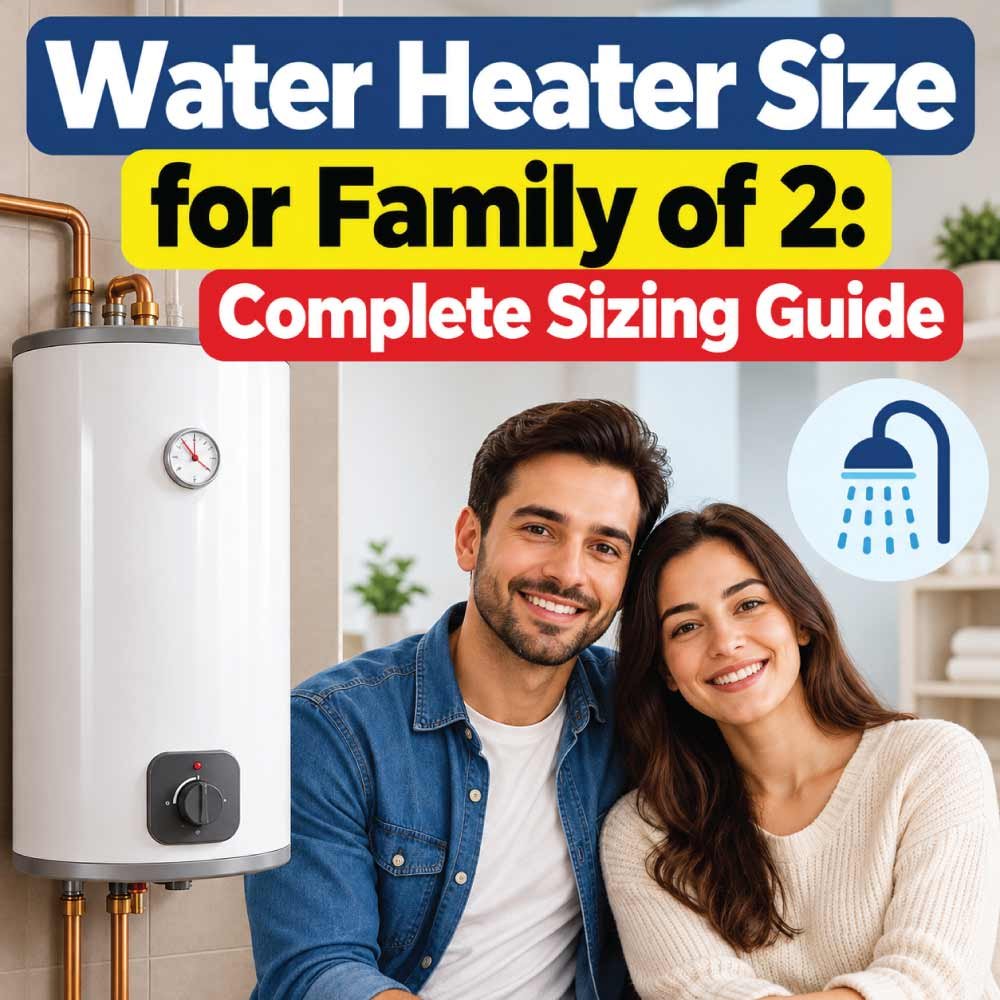
Choosing the right water heater size for a family of two helps ensure you have enough hot water for showers, dishwashing, laundry, and everyday cleaning without paying to heat more water than necessary. The best size depends on your household’s routine, the number of bathrooms, the type of water heater, and whether multiple hot-water fixtures operate simultaneously.
For many two-person households, a 30- to 40-gallon storage water heater may be a reasonable starting point. A 40-gallon model can provide more flexibility for longer showers or frequent hot-water use, while a 30-gallon model may work well when demand is modest. These are general guidelines rather than fixed requirements; actual performance depends on the heater’s recovery rate, first-hour rating, and incoming water temperature.
This complete guide explains water heater sizes for two people, compares tank and tankless systems, and shows how to choose the right model for your home.
Water Heater Size Chart for a Family of 2
The following chart compares common residential storage tank capacities and their potential suitability for a two-person household.
| Tank Capacity | Suitability for 2 People | Best Use Case |
|---|---|---|
| 20 gallons | Limited | Low hot-water demand or point-of-use applications |
| 30 gallons | Often suitable | Short showers and moderate daily use |
| 40 gallons | Good starting point | Typical daily use with added flexibility |
| 50 gallons | May be appropriate | Long showers, baths, or overlapping demand |
| 55–60 gallons | Often more than necessary | High demand or special household requirements |
| 75–80 gallons | Usually unnecessary | Unusually high hot-water demand or specialized needs |
These descriptions are general planning guidance, not guarantees of performance. A well-performing 30-gallon heater may satisfy a household that uses hot water carefully, while a 40- or 50-gallon unit may be preferable when both occupants shower close together or regularly fill a bathtub.
Important: Tank capacity alone does not determine how much hot water a heater can deliver during a busy period. Compare the manufacturer’s first-hour rating and recovery information before making your final decision.
How Many Gallons Does a Family of 2 Need?
A family of two does not automatically need a particular tank size. The right capacity depends on how much hot water both people use during the busiest part of the day.
For example, two people who take short showers at different times may be comfortable with a smaller tank. Two people who take long showers back-to-back, use a bathtub, and run a dishwasher in the evening may need a larger tank or a heater with a stronger recovery rate.
When a 30-Gallon Water Heater Is Enough
A 30-gallon water heater may be suitable when:
-
Both occupants take relatively short showers.
-
Hot-water use is spread throughout the day.
-
The household rarely fills a bathtub.
-
The heater has an adequate recovery rate.
-
There is little simultaneous demand from other fixtures.
A 30-gallon tank can be a practical option for a small apartment or a home with limited installation space. However, its suitability depends on how much usable hot water it delivers, not simply its advertised capacity.
When to Choose a 40-Gallon Water Heater
A 40-gallon water heater is a useful starting point for many two-person homes because it provides additional stored water without moving immediately to a much larger tank.
Consider this capacity if:
-
Both people shower every day.
-
Showers sometimes occur one after another.
-
You occasionally use a bathtub.
-
You run hot-water appliances during busy periods.
-
You want more flexibility than a small tank may provide.
A 40-gallon model is not automatically the best choice for every household. Compare its first-hour rating, recovery performance, physical dimensions, and energy consumption with those of smaller models.
When a 50-Gallon Water Heater Makes Sense
A 50-gallon model may be appropriate for two people with higher-than-average hot-water demand.
Examples include households where both occupants take long showers, frequently use a large bathtub, or need hot water for several activities within a short period.
A larger tank may also be worth considering if a smaller heater consistently runs out of hot water despite working correctly. Before upgrading, check for maintenance problems, incorrect temperature settings, sediment buildup, or a faulty heating element that could be reducing performance.
Water Heater Size for 2 People by Daily Usage
Household size is only one factor in choosing a water heater. Your daily routine can make a significant difference.
| Hot-Water Usage Pattern | Potential Tank Size | Why It May Work |
|---|---|---|
| Light use, short showers | 20–30 gallons | Lower overall demand |
| Typical showers and cleaning | 30–40 gallons | Moderate daily demand |
| Longer showers or consecutive use | 40–50 gallons | More stored hot water |
| Frequent baths and overlapping use | 50 gallons or more | Greater peak-demand capacity |
These are starting points rather than engineering calculations. A 20-gallon unit may not be adequate for every two-person household, and a larger tank may still struggle if hot-water demand exceeds its delivery and recovery capabilities.
Two People Taking Showers
Showers are often an important part of a household’s hot-water demand. The amount of hot water used depends on shower duration, flow rate, and the temperature of the incoming cold water.
Two short showers separated by enough recovery time may be manageable with a smaller tank. Two long showers taken consecutively can use a substantial portion of the available hot water, especially during colder weather.
If you regularly run out of hot water after the second shower, compare the heater’s first-hour rating with your expected usage.
Using a Bathtub
Filling a bathtub can require considerably more hot water than a quick shower, depending on the tub’s size and how deeply it is filled.
A two-person household that frequently takes baths may benefit from a 40- or 50-gallon storage heater. The actual requirement depends on the amount of water used, the desired bath temperature, and the mixing of hot and cold water.
Dishwashers and Washing Machines
Dishwashers and washing machines may contribute to peak demand when they operate while someone is showering or bathing. Modern appliances vary in their water consumption, and some heat water internally.
Check the appliance specifications and consider when each appliance typically runs. Scheduling high-demand activities at different times can sometimes reduce the need for a larger water heater.
Electric vs. Gas Water Heater Size for a Family of 2
Electric and gas water heaters are both options for two-person households, but their performance characteristics differ. The right choice depends on the available energy supply, installation requirements, operating costs, and hot-water demand.
Electric Water Heater
An electric storage water heater may be suitable when electricity is readily available and the installation can support the unit’s electrical requirements.
For two people, a 30- or 40-gallon electric tank may be a reasonable starting point, depending on the model and household usage.
Electric resistance heaters generally recover more slowly than many conventional gas storage heaters of comparable capacity, although actual performance varies by product. If both occupants take showers close together, compare the published recovery rate and first-hour rating carefully.
Gas Water Heater
A gas storage water heater may recover hot water more quickly than a comparable electric resistance model, depending on the equipment.
A 30- or 40-gallon gas tank may satisfy some two-person households, while higher-demand homes may need a larger unit. Do not assume that every gas model will outperform every electric model; compare their published performance figures.
Gas models also require the correct fuel supply, approved venting, combustion air, and installation clearances.
Electric vs. Gas Comparison
| Feature | Electric Tank | Gas Tank |
|---|---|---|
| Possible starting capacity | 30–40 gallons | 30–40 gallons |
| Recovery performance | Model-dependent | Model-dependent |
| Venting | No combustion exhaust flue | Required as specified |
| Installation | Requires suitable electrical supply | Requires suitable gas supply and venting |
| Operating cost | Depends on electricity rates and efficiency | Depends on gas rates and efficiency |
Capacity recommendations are approximate. Compare the actual products available in your area rather than selecting solely by fuel type.
Also Read:
Is a Tankless Water Heater Better for Two People?
A tankless water heater can be an attractive option for a family of two because it heats water on demand instead of storing a full tank. However, its performance depends on flow rate and temperature rise rather than gallons of storage capacity.
Tankless models are commonly rated in gallons per minute (GPM) in the United States. The correct rating depends on how many fixtures need hot water at the same time.
Choosing the Right Tankless Capacity
Consider your typical hot-water activities:
-
One shower at a time: A suitable tankless model may meet your needs without requiring a large storage tank.
-
Two showers simultaneously: You need enough output to support both showers at the required temperature rise.
-
A shower and a kitchen tap: Calculate the combined hot-water flow if both may operate together.
-
Cold incoming water: A greater temperature rise may reduce the maximum flow rate the unit can provide.
For example, if two showers each require 1.5 GPM of mixed water, their combined mixed-water demand is 3 GPM. The actual hot-water flow needed from the heater will depend on the incoming water temperature and the desired shower temperature.
Advantages and Limitations of Tankless Models
Advantages
-
Compact wall-mounted design.
-
No large storage tank taking up floor space.
-
Water is heated as needed.
-
Potential energy savings in suitable usage patterns.
Limitations
-
Maximum flow rate may limit simultaneous use.
-
Installation can require upgraded gas or electrical capacity.
-
Some models have minimum flow requirements or a short delay before hot water arrives.
-
Initial equipment and installation costs may be higher.
For two people who use hot water at different times, a tankless system may work well. If you regularly run several fixtures together, check its performance specifications carefully before choosing it over a storage tank.
Also Read:
Factors That Affect Water Heater Sizing
Before choosing a 30-, 40-, or 50-gallon heater, consider the conditions that influence how much hot water your household can use.
Incoming Water Temperature
Cold water entering the heater requires more energy to reach the desired temperature in colder climates or during winter. This can affect recovery performance and the output of a tankless system.
A model that performs comfortably in a warm climate may deliver less usable hot water under colder incoming-water conditions.
Shower Duration and Flow Rate
Longer showers consume more water, and high-flow showerheads can increase demand. Replacing an older showerhead with an efficient model may help reduce hot-water consumption without changing the water heater.
First-Hour Rating
The first-hour rating estimates how much hot water a storage heater can deliver in its first hour under specified test conditions, including the contribution from reheating water.
This figure is often more useful than tank capacity alone when comparing two models. If you and your partner use most of your hot water in the morning, pay particular attention to this rating.
Recovery Rate
Recovery rate describes how quickly a heater replenishes its supply of hot water after use. A higher recovery rate can help a household recover between consecutive showers.
Compare the manufacturer’s specifications and avoid assuming that two tanks with identical gallon capacities will perform equally.
Future Household Needs
If your household may grow or your hot-water usage is likely to change, consider whether a slightly larger unit makes sense. However, avoid oversizing without a reason, because a larger storage tank may increase standby heat losses and take up more space.
Also Read:
How to Choose the Correct Water Heater Size for Two People
Follow these steps to select a water heater that meets your needs without unnecessarily increasing equipment size or cost.
-
Review your daily routine. Estimate how many showers, baths, and other hot-water activities occur during your busiest hour.
-
Check your existing heater. Record its capacity, fuel type, model, first-hour rating, and any performance problems.
-
Measure the installation space. Check height, width, depth, access openings, and required clearances.
-
Compare performance ratings. Review first-hour rating and recovery rate for storage models, or flow rate and temperature rise for tankless models.
-
Check energy and installation requirements. Confirm that your home’s electrical or gas supply and the proposed installation meet the manufacturer’s specifications and local regulations.
-
Compare operating costs. Consider energy prices, efficiency, expected use, maintenance, and installation expenses.
-
Confirm the model before buying. Use the manufacturer’s product documentation and consult a qualified installer if you are uncertain about sizing or compatibility.
A water heater that meets these requirements is more likely to provide comfortable hot-water service while avoiding unnecessary capacity and installation costs.
Frequently Asked Questions
Is a 30-gallon water heater big enough for two people?
It can be, particularly when both people take short showers and spread their hot-water use throughout the day. However, households with long showers, frequent baths, or overlapping demand may benefit from a 40-gallon model or a heater with a higher first-hour rating.
Is a 40-gallon water heater enough for a family of 2?
A 40-gallon water heater is a reasonable starting point for many two-person households. Its suitability depends on the recovery rate, first-hour rating, shower habits, and simultaneous use of other hot-water fixtures.
Should two people buy a 50-gallon water heater?
A 50-gallon model may be worthwhile when both occupants take long showers, use a large bathtub, or frequently need hot water at the same time. If demand is moderate, a smaller tank may be sufficient.
What size tankless water heater does a family of 2 need?
There is no universal tankless size based on household size alone. Calculate the combined flow rate of the fixtures likely to operate simultaneously and determine the required temperature rise. Then choose a model that can deliver that output under your local water-temperature conditions.
Does a gas water heater need fewer gallons than an electric one?
Not necessarily. Some gas models recover more quickly than comparable electric resistance heaters, which may allow a smaller tank to meet certain usage patterns. However, the correct size depends on the actual performance ratings and household demand.
How can I tell if my water heater is too small?
Frequent hot-water shortages during normal use may indicate insufficient capacity or recovery. However, a faulty heating element, burner problem, sediment buildup, or another maintenance issue can cause similar symptoms. Check the heater’s condition before replacing it with a larger model.
Will a larger water heater increase my energy bill?
It can increase standby energy losses because more stored water may need to be kept hot, although the actual effect depends on the model’s insulation, efficiency, and usage. Choose a capacity that meets your household’s demand rather than automatically purchasing the largest available tank.
Conclusion
For many two-person households, a 30- to 40-gallon water heater is a sensible starting point. A 30-gallon model may suit lighter hot-water use, while a 40-gallon tank can provide additional flexibility. A 50-gallon model may be appropriate for long showers, frequent baths, or higher peak demand.
Before purchasing, compare the manufacturer’s first-hour rating, recovery rate, physical dimensions, and energy requirements. If you prefer a tankless system, focus on simultaneous flow rate and temperature rise.
The best water heater size for a family of two is the one that fits your installation space, reliably meets your actual hot-water demand, and operates efficiently for your household.