
A 50-gallon water heater is a popular choice for households that need a reliable supply of hot water for showers, laundry, dishwashing, and everyday cleaning. However, before purchasing one, it is important to understand its physical dimensions, installation clearance, tank shape, and available space. A unit with the correct capacity may still be too tall, too wide, or too heavy for your existing utility room or closet.
This guide explains 50 gallon water heater dimensions, including standard tank height and diameter, electric and gas models, short and tall designs, installation space, and practical measuring tips. You will also learn how to compare manufacturer specifications and determine whether a 50-gallon unit will fit your home.
What Are the Standard 50 Gallon Water Heater Dimensions?
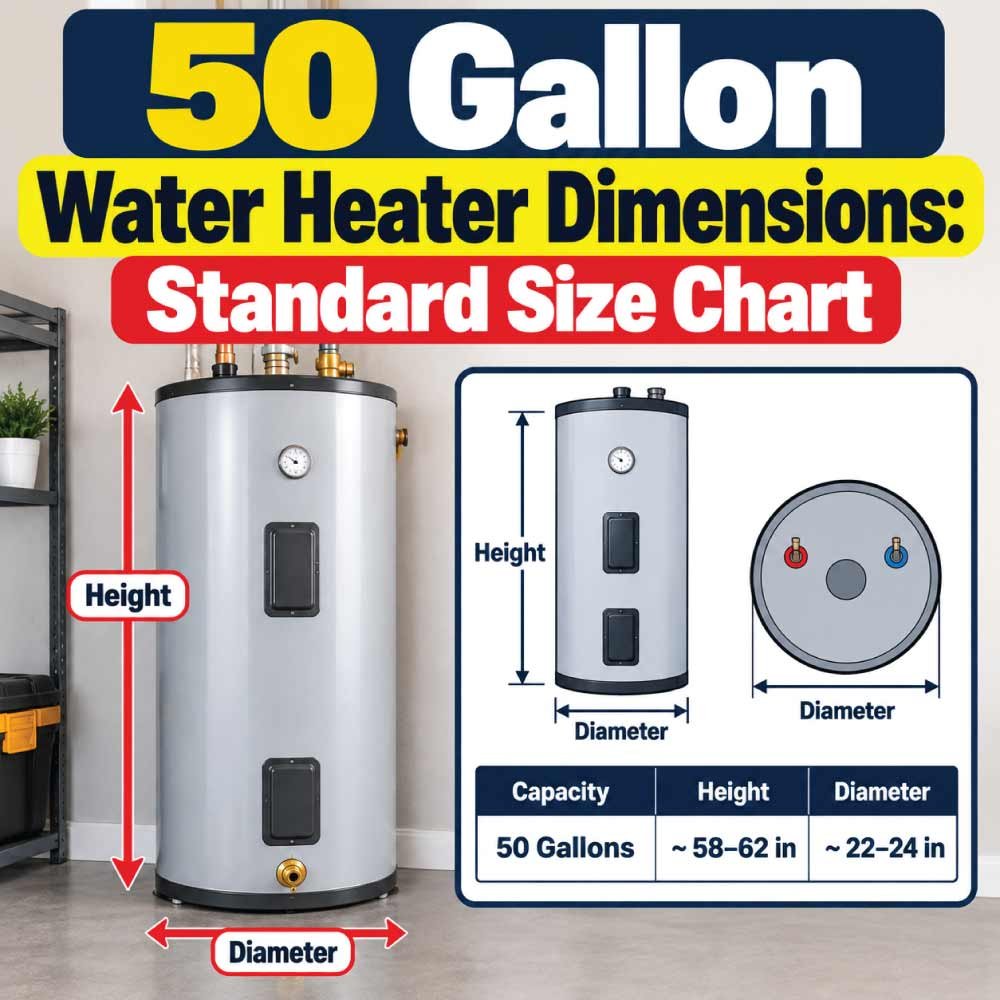
A standard 50-gallon water heater typically measures approximately 50–60 inches tall and 20–24 inches in diameter. However, these measurements vary according to the fuel type, tank design, insulation thickness, manufacturer, and model.
Electric water heaters are often shorter than comparable gas models because gas units may require additional height for their combustion chamber and venting connections. Short or low-profile models can be wider while maintaining the same 50-gallon storage capacity.
The following table provides general planning ranges for common 50-gallon storage water heaters. These are approximate dimensions, not guaranteed specifications for every model.
| Water Heater Type | Approx. Height (inches) | Approx. Diameter (inches) |
|---|---|---|
| Tall electric | 50–60 | 20–24 |
| Tall gas | 58–62 | 20–24 |
| Short electric | 40–50 | 24–28 |
| Short gas | 45–55 | 24–28 |
| High-efficiency gas | Model-dependent | Model-dependent |
Important: Always confirm the exact product dimensions before purchasing. Some manufacturers include the top connections, vent assembly, or other components in their listed height, while others provide the tank body’s dimensions separately.
For accurate planning, check the manufacturer’s dimensional drawing rather than relying exclusively on a general size chart.
50 Gallon Water Heater Size Chart: Height, Diameter, and Capacity
Understanding the relationship between tank capacity and physical size makes it easier to select a suitable water heater. Although two models may both store 50 gallons of water, their external dimensions can differ considerably.
A tank’s shape, insulation, and internal construction affect how much space it occupies.
Standard 50 Gallon Water Heater Dimensions Chart
Use this chart as a preliminary reference when comparing conventional residential storage water heaters.
| Specification | Typical Planning Information |
|---|---|
| Nominal capacity | 50 US gallons |
| Water storage volume | Approximately 189 liters |
| Typical tall-tank height | 50–62 inches |
| Typical tank diameter | 20–24 inches |
| Typical short-tank height | 40–50 inches |
| Typical short-tank diameter | 24–28 inches |
| Empty tank weight | Varies by model |
| Filled tank weight | Water weight plus tank weight |
| Installation footprint | Depends on diameter and required clearance |
The dimensions shown are general estimates for planning purposes. Actual measurements should come from the specific manufacturer’s product documentation.
What Does 50 Gallons Mean?
A 50-gallon water heater stores approximately 189 liters of water when filled to its nominal capacity. This measurement describes the tank’s intended storage capacity, not the amount of hot water you can continuously use.
The quantity of usable hot water depends on the incoming water temperature, thermostat setting, recovery rate, mixing with cold water, and household demand.
For example, a household may draw more than 50 gallons of mixed-temperature water before the tank is depleted because cold water entering the tank can be blended with stored hot water at the fixtures.
Why Do Dimensions Vary Between Models?
Several factors influence the external size of a 50-gallon water heater:
Insulation thickness: Better-insulated tanks may have a larger outside diameter.
Fuel type: Gas models need space for combustion equipment and appropriate venting.
Tank shape: Tall, short, and compact models distribute their volume differently.
Connection placement: Hot-water outlets, cold-water inlets, and relief valves affect installation space.
Efficiency design: Heat pumps and high-efficiency gas appliances may have substantially different dimensions from conventional tanks.
Consequently, capacity alone is not enough to determine whether a particular water heater will fit an existing installation.
Tall vs. Short 50 Gallon Water Heater Dimensions
Tall and short water heaters serve similar storage needs but are designed for different installation environments.
Choosing between them depends primarily on available vertical clearance, floor space, connection locations, and the manufacturer’s approved installation requirements.
Tall 50 Gallon Water Heater Dimensions
Tall models are common in garages, basements, utility rooms, and dedicated mechanical spaces.
A typical tall 50-gallon unit may measure approximately 50–62 inches in height and 20–24 inches in diameter, although certain models fall outside these ranges.
Advantages of tall water heaters:
- Smaller floor footprint than many short models.
- Suitable for spaces with sufficient ceiling height.
- Widely available in conventional electric and gas configurations.
- Can fit existing installations designed around tall tanks.
Potential limitations:
- May not fit beneath low shelves or counters.
- Can be difficult to install in rooms with low ceilings.
- May require additional overhead space for connections and servicing.
Before purchasing a tall unit, measure from the floor to the lowest obstruction above the installation area. Account for the tank’s listed overall height and any additional space needed for plumbing, venting, and maintenance.
Short 50 Gallon Water Heater Dimensions
Short water heaters have a lower profile and a wider body. They can be useful when overhead clearance is limited but sufficient floor space is available.
A short 50-gallon model may be around 40–50 inches tall and 24–28 inches in diameter. These are general estimates; some models have different proportions.
Advantages of short water heaters:
- Better suited to some low-ceiling utility rooms.
- May fit beneath certain overhead obstructions.
- Can provide the same nominal storage capacity as a taller tank.
Potential limitations:
- Requires more floor space.
- May not fit narrow closets.
- Can have different plumbing connection locations from an existing unit.
Do not assume that every short water heater is suitable for a crawl space or low cabinet. The installation must still meet applicable requirements for access, ventilation, drainage, and servicing.
Which Shape Should You Choose?
| Comparison Factor | Tall Model | Short Model |
|---|---|---|
| Overall height | Generally greater | Generally lower |
| Floor footprint | Generally smaller | Generally larger |
| Low-ceiling suitability | Often limited | Potentially better |
| Narrow-space suitability | Often better | May be limited |
| Connection compatibility | Model-specific | Model-specific |
The best choice is the model that satisfies your hot-water requirements and fits the available space without compromising safe installation.
Electric vs. Gas 50 Gallon Water Heater Dimensions
The fuel source can affect a water heater’s height, diameter, connection layout, and installation requirements.
Electric 50 Gallon Water Heater Size
Conventional electric storage water heaters contain heating elements inside an insulated tank. Many residential models have a relatively simple installation arrangement because they do not require a combustion exhaust flue.
A typical tall electric model may be approximately 50–60 inches high and 20–24 inches in diameter.
When evaluating an electric model, check:
- Overall height and diameter.
- Location of the electrical connection and access panels.
- Hot- and cold-water connection positions.
- Temperature and pressure relief valve location.
- Required working space for maintenance.
- Electrical circuit and wiring requirements.
An electric water heater may be a convenient replacement for an existing electric tank, but matching dimensions alone does not establish electrical compatibility.
Gas 50 Gallon Water Heater Size
Gas water heaters use a burner to heat the stored water. Conventional atmospheric-vent models commonly require a flue or vent connection above the tank.
A tall gas unit may measure approximately 58–62 inches high and 20–24 inches in diameter, although its actual size depends on the design.
Before installation, consider:
- Overall appliance height, including relevant vent components.
- Required combustion-air supply.
- Approved venting arrangement and clearances.
- Gas-line location and connection requirements.
- Access to the burner and service components.
- Manufacturer-specified distances from combustible materials.
Some direct-vent, power-vent, and high-efficiency models have different configurations. Their dimensions should not be assumed to match those of conventional atmospheric-vent units.
Gas connections and venting must comply with the manufacturer’s instructions and applicable local codes. A qualified installer should verify these requirements.
How Much Space Do You Need for a 50 Gallon Water Heater?
The water heater’s physical dimensions are only part of the space calculation. You also need enough room to install, connect, inspect, and service the appliance.
A tank that fits tightly between two walls may still be unsuitable if its valves or service panels cannot be accessed.
1. Measure the Available Height
Measure vertically from the intended installation surface to the lowest overhead obstruction.
Include any relevant space needed for:
- Top plumbing connections.
- Venting components on applicable gas models.
- Electrical access or other manufacturer-required clearances.
- Installation and future maintenance.
Compare this measurement with the manufacturer’s overall-height specification. Never assume that a tank measuring 60 inches high will fit comfortably in a space with exactly 60 inches of clearance.
2. Measure the Available Width
Measure the installation area at several points, especially if the walls are uneven or the tank must pass through a narrow opening.
The tank’s diameter determines its basic footprint, but additional space may be needed around the appliance.
For a 24-inch-diameter tank, the body alone occupies a circular footprint approximately 24 inches across. This does not mean a 24-inch-wide closet is adequate for installation.
3. Check the Installation Clearances
There is no single universal clearance measurement suitable for every 50-gallon water heater.
Required spacing depends on the appliance type, model, location, service access, venting arrangement, and applicable regulations.
Review the manufacturer’s installation manual for requirements involving:
- Side and rear clearances.
- Front service access.
- Overhead clearance.
- Combustible surfaces.
- Drainage and relief-valve discharge.
- Combustion air and venting, where applicable.
Do not reduce required clearances simply to make a larger tank fit.
4. Check the Doorway and Access Route
A water heater may fit in its final location but be too large to pass through the doorway, hallway, or stairwell.
Measure the narrowest points along the entire route, including door frames, turns, and stair openings.
Ask the supplier or installer about the packaged dimensions and whether the appliance can be safely moved in the available space.
5. Plan for Plumbing and Maintenance
Leave appropriate access to the shutoff valve, drain valve, temperature and pressure relief valve, and other serviceable components.
Also consider whether a drain pan, expansion tank, water treatment equipment, or other accessories are required for your installation. These can increase the space needed around the heater.
Also Read:
How to Measure a 50 Gallon Water Heater Correctly
If you are replacing an existing appliance, measuring the old unit can help you identify suitable replacement models.
However, the old tank’s dimensions should be treated as a starting point rather than the only selection criteria.
Step 1: Measure the Tank Height
Measure from the bottom of the tank body to its highest relevant point. Record the overall appliance height separately if the top connections, vent assembly, or other components extend beyond the tank.
Step 2: Measure the Diameter
Measure straight across the widest part of the cylindrical tank body. If the insulation jacket or exterior casing protrudes beyond the body, record the maximum outside diameter as well.
Step 3: Record Connection Locations
Note the positions of the cold-water inlet, hot-water outlet, drain valve, relief valve, electrical connections, and gas connection or venting components, as applicable.
Connection positions matter because a replacement may require plumbing modifications even when the tank itself has matching dimensions.
Step 4: Measure the Room
Record the available floor area, ceiling height, doorway width, and access route. Identify any shelves, pipes, beams, or other obstructions.
Step 5: Compare Manufacturer Drawings
Use the model’s official specification sheet and installation manual to confirm its dimensions, connection arrangement, and required clearances.
A product listing’s general dimensions may not show every protruding fitting or installation requirement.
Also Read:
How Heavy Is a 50 Gallon Water Heater When Full?
Weight is an important consideration when selecting a water heater for a raised floor, platform, or upper-level installation.
Water weighs approximately 8.34 pounds per US gallon under ordinary reference conditions. Therefore, 50 gallons of water weigh approximately 417 pounds.
The complete filled appliance weighs more because the tank, insulation, heating equipment, and other components add to the total.
| Weight Component | Approximate Weight |
|---|---|
| Stored water | 417 lb |
| Empty tank and components | Model-dependent |
| Filled water heater | 417 lb plus empty appliance weight |
For example, if a manufacturer’s specification lists an empty appliance weight of 130 pounds, adding approximately 417 pounds of water gives a filled weight of about 547 pounds.
This is an illustration, not a universal weight specification.
Before installation, check the actual empty weight in the product documentation. If the appliance will sit on a suspended floor or elevated platform, verify that the structure can support the load. Consult a qualified professional if structural capacity is uncertain.
Water heaters should also be installed on an appropriate surface and secured where required by the applicable code or manufacturer.
Also Read:
Is a 50 Gallon Water Heater Big Enough for Your Home?
A 50-gallon water heater is often considered for households with moderate to substantial hot-water demand, but the right capacity depends on how and when hot water is used.
The number of occupants is only one part of the calculation.
A household that takes several consecutive showers may have different needs from one that spreads showers throughout the day. Laundry, dishwashing, large bathtubs, and simultaneous hot-water use can also affect performance.
Factors That Affect Hot-Water Capacity
Household size: More occupants can increase daily demand.
Shower habits: Long or back-to-back showers use more stored hot water.
Appliances: Washing machines and dishwashers contribute to peak demand.
Recovery rate: The heater’s ability to reheat water affects how quickly hot water becomes available again.
First-hour rating: This manufacturer-rated figure helps estimate the hot water supplied during the first hour of use.
Incoming water temperature: Colder incoming water generally requires more energy to reach the desired temperature.
For a storage water heater, compare the first-hour rating with your household’s busiest hour rather than choosing by tank capacity alone.
A 50-gallon tank might be sufficient for one family but inadequate for another with the same number of occupants and different usage patterns.
Should You Choose a Larger Water Heater?
A larger tank may provide more stored hot water, but it can also occupy more space, weigh more when full, and have different operating costs.
If a 50-gallon model cannot meet your peak demand, consider a suitable higher-capacity tank, a correctly sized tankless system, or another approved configuration.
Compare performance ratings, installation costs, energy efficiency, and available space before deciding.
Common Mistakes When Choosing a 50 Gallon Water Heater
Avoid these mistakes when comparing tank dimensions and planning installation.
1. Buying based on capacity alone
Two 50-gallon units can have different heights, diameters, and connection arrangements. Confirm the exact model dimensions.
2. Ignoring the full appliance height
A tank body may fit beneath a ceiling while its connections or venting components do not. Check the overall installation drawing.
3. Measuring only the existing tank
A new model may be wider or taller, even if its capacity and fuel type are the same.
4. Forgetting the access route
Doorways, stairs, and narrow hallways can prevent an appliance from reaching its intended location.
5. Overlooking servicing requirements
A tank that fits into a confined space may be difficult or impossible to maintain properly.
6. Assuming every 50-gallon tank has the same performance
Capacity does not determine recovery rate, efficiency, or first-hour delivery. Compare the relevant ratings.
7. Treating approximate dimensions as exact specifications
General size charts are useful for planning, but manufacturer documentation must guide the final selection.
Frequently Asked Questions About 50 Gallon Water Heater Dimensions
How tall is a standard 50 gallon water heater?
A typical tall 50-gallon water heater is approximately 50–62 inches high, depending on its design and fuel type. Some short models are around 40–50 inches tall. Check the exact model specifications before installation.
What is the diameter of a 50 gallon water heater?
Many conventional 50-gallon storage water heaters have a diameter of approximately 20–24 inches. Shorter, wider designs can measure around 24–28 inches or more.
How many liters are in a 50 gallon water heater?
A 50-US-gallon water heater has a nominal storage capacity of approximately 189 liters. This conversion applies to US gallons, not Imperial gallons.
Can a 50 gallon water heater fit in a small closet?
It may fit if the closet provides adequate height, width, access, ventilation where required, and all applicable installation clearances. Measure the complete space and compare it with the manufacturer’s installation instructions.
Are gas and electric 50 gallon water heaters the same size?
No. Their dimensions vary by model. Gas units may need additional space for combustion equipment and venting, while electric units have different connection and service requirements.
How much does a full 50 gallon water heater weigh?
The stored water alone weighs approximately 417 pounds. Add the empty appliance weight to calculate the total filled weight using the manufacturer’s specification.
Does a 50 gallon water heater provide 50 gallons of usable hot water?
Not necessarily. Its nominal capacity describes the stored volume. Actual hot-water delivery depends on the incoming water temperature, thermostat setting, mixing, recovery rate, and first-hour rating.
What should I check before replacing a 50 gallon water heater?
Confirm the new unit’s height, diameter, connection locations, fuel and energy requirements, venting arrangement where applicable, clearances, and access route. Also verify that its capacity and performance ratings suit your household.
Conclusion
Standard 50 gallon water heater dimensions generally fall within a range of approximately 50–62 inches in height and 20–24 inches in diameter for many tall residential models. Short models can be lower and wider, while gas, electric, and high-efficiency designs may have different installation requirements.
Use these ranges to begin planning, then verify the exact measurements in the manufacturer’s specifications. Check ceiling height, floor space, plumbing connections, service access, and the path into the installation area before buying.
Choosing a water heater that fits both your available space and your household’s hot-water demand helps ensure a practical, safe, and reliable installation.