
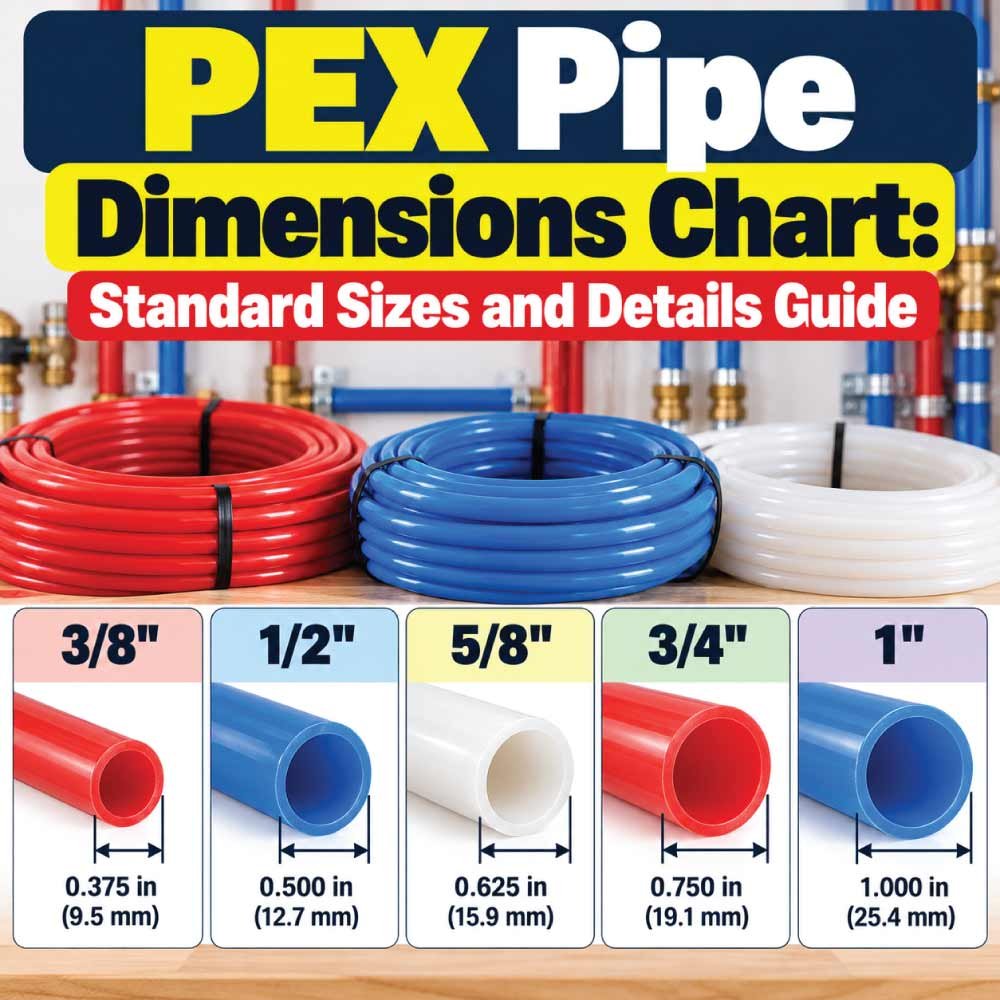
PEX pipe is widely used in residential plumbing because it is flexible, corrosion-resistant, and available in several nominal sizes. However, choosing the correct PEX pipe involves more than matching a size printed on the tubing. Nominal size, actual outside diameter, wall thickness, inside diameter, fitting compatibility, and intended application all affect how the pipe performs.
This guide explains standard PEX pipe dimensions, common sizes, measurement methods, and the differences between PEX-A, PEX-B, and PEX-C tubing. You will also learn how to select the right size for water supply lines, fixtures, radiant heating, and other plumbing applications.
PEX Pipe Dimensions Chart
PEX tubing is commonly sold in nominal sizes such as 3/8-inch, 1/2-inch, 3/4-inch, 1-inch, and larger sizes. In North American plumbing, PEX tubing generally follows standardized outside diameters, meaning tubing with the same nominal size can share an outside diameter even when its wall thickness and inside diameter differ.
The following table provides commonly encountered nominal sizes and approximate outside diameters. The listed inside diameters are illustrative estimates for tubing with a standard dimension ratio (SDR) of 9, not universal specifications for every PEX product.
| Nominal PEX Size | Approx. Outside Diameter | Illustrative Inside Diameter at SDR 9 | Common Applications |
|---|---|---|---|
| 3/8 inch | 0.500 inch | 0.389 inch | Short fixture connections, where approved |
| 1/2 inch | 0.625 inch | 0.486 inch | Individual fixtures and residential branches |
| 3/4 inch | 0.875 inch | 0.681 inch | Main branches and higher-demand fixtures |
| 1 inch | 1.125 inches | 0.875 inch | Larger supply lines and manifolds |
| 1 1/4 inches | 1.375 inches | 1.069 inches | Larger distribution systems |
| 1 1/2 inches | 1.625 inches | 1.264 inches | Large distribution or commercial applications |
| 2 inches | 2.125 inches | 1.653 inches | Large plumbing systems, where approved |
Important: These dimensions are reference values, not a substitute for a manufacturer’s specification sheet. Actual inside diameter depends on the tubing’s wall thickness and dimensional standard. Some sizes may not be offered by every manufacturer, and local plumbing codes determine which products and sizes are permitted for a particular installation.
Understanding Nominal PEX Pipe Size
Nominal pipe size is the standard size designation used to identify tubing. It does not necessarily equal the tubing’s measured outside or inside diameter.
For example, nominal 1/2-inch PEX commonly has an outside diameter of approximately 5/8 inch. This difference is important when selecting fittings, measuring tubing, or planning a plumbing installation.
Nominal Size vs. Outside Diameter
The outside diameter is measured across the exterior of the tubing. It is especially important when checking fitting compatibility and comparing PEX with other tubing systems.
Many common North American PEX products use the following outside diameters:
3/8-inch PEX: approximately 1/2-inch outside diameter.
1/2-inch PEX: approximately 5/8-inch outside diameter.
3/4-inch PEX: approximately 7/8-inch outside diameter.
1-inch PEX: approximately 1 1/8-inch outside diameter.
These values apply to common standardized PEX tubing dimensions. Always confirm the applicable product standard and manufacturer’s documentation before ordering fittings.
Understanding Inside Diameter
The inside diameter determines the open passage available for water to flow through the pipe. It is affected by the outside diameter and the tubing’s wall thickness.
Two PEX products with the same nominal size can have different inside diameters if their wall thicknesses differ. This can affect flow capacity, pressure loss, and the suitability of a pipe for a particular plumbing layout.
What Is Wall Thickness?
Wall thickness is the distance between the inner and outer surfaces of the tubing wall, measured radially.
For a circular tube with uniform walls, the relationship is:
Inside diameter = Outside diameter − (2 × Wall thickness)
For example, if tubing has an outside diameter of 0.625 inch and a wall thickness of 0.070 inch, its calculated inside diameter is 0.485 inch.
This calculation illustrates the relationship between the dimensions. For actual installations, use the manufacturer’s published dimensions because tolerances and product specifications can vary.
Standard PEX Pipe Sizes and Their Uses
Different nominal sizes suit different plumbing requirements. The appropriate size depends on the flow demand, pipe length, pressure available, fittings, and applicable plumbing rules.
3/8-Inch PEX Pipe
3/8-inch PEX has an outside diameter of approximately 1/2 inch in common North American sizing systems. It may be used for certain short fixture connections or specialized applications when the product and local code permit.
Its smaller internal passage can produce greater pressure loss than a larger pipe at the same flow rate. For this reason, it should not automatically be used as a general-purpose water supply line.
1/2-Inch PEX Pipe
1/2-inch PEX is one of the most common sizes for residential plumbing. Typical uses include individual fixture branches and water distribution lines where the calculated demand is suitable.
It can be appropriate for some bathroom fixtures, kitchen fixtures, and appliance connections, but the correct size depends on the number of fixtures supplied and the length of the run.
3/4-Inch PEX Pipe
3/4-inch PEX provides a larger internal passage than 1/2-inch tubing of the same dimensional series. It is frequently considered for branches serving multiple fixtures or other applications requiring greater flow.
A 3/4-inch line may also be used to supply a manifold or distribute water to several smaller branches. The actual design should account for simultaneous fixture demand and pressure loss.
1-Inch PEX Pipe
1-inch PEX is used in larger distribution lines, some residential main supply arrangements, and manifold systems where the design calls for greater flow capacity.
It may be useful for longer runs or systems supplying multiple branches. However, the required size should be determined from the building’s demand, available pressure, pipe length, and fitting configuration.
1 1/4-Inch and Larger PEX Pipe
Larger PEX sizes are available for certain distribution, mechanical, and commercial applications. Their availability, pressure ratings, connection systems, and permitted uses depend on the specific product.
Do not assume that all PEX tubing sizes are suitable for ordinary residential potable-water plumbing. Check the product listing and local code requirements before selecting large-diameter tubing.
PEX-A vs. PEX-B vs. PEX-C Dimensions
PEX-A, PEX-B, and PEX-C refer to different manufacturing methods used to produce cross-linked polyethylene tubing. The letters do not indicate three universal pipe-size systems.
When products follow the same applicable dimensional standard and nominal size, their specified outside diameters can be the same. However, wall thickness, internal diameter, fitting requirements, flexibility, and installation methods may differ by product.
| PEX Type | Manufacturing Method | Dimensional Considerations | Common Characteristics |
|---|---|---|---|
| PEX-A | Peroxide or Engel process | Verify the product’s specified dimensions and fitting system | Generally very flexible |
| PEX-B | Silane or moisture-cure process | Verify wall thickness and fitting compatibility | Commonly used in residential plumbing |
| PEX-C | Electron-beam irradiation | Check the specific product’s dimensional specifications | Characteristics vary by manufacturer |
Does PEX Type Change the Pipe Size?
Not necessarily. A nominal 1/2-inch PEX-A product and a nominal 1/2-inch PEX-B product may share the same specified outside diameter while differing in other characteristics.
The important point is to check the actual product specifications rather than assuming that the manufacturing type determines the dimensions.
Are PEX Fittings Interchangeable?
Not always. PEX systems can use expansion fittings, crimp fittings, clamp fittings, push-fit connections, or other manufacturer-approved joining methods.
A fitting must be compatible with the tubing size, dimensional standard, and intended joining method. Some systems also have specific requirements concerning tubing type, expansion tools, rings, or fitting materials.
Before mixing products from different manufacturers, verify compatibility and approval for the intended plumbing application.
Also Read:
How to Measure PEX Pipe Dimensions
Measuring PEX tubing correctly helps you identify the pipe size and choose compatible fittings. Because nominal size differs from outside diameter, measuring the tube with a ruler alone may lead to confusion.
Measure the Outside Diameter
Use a caliper to measure across the widest part of the tubing’s exterior. If possible, measure a clean, undamaged section of pipe away from a fitting.
Compare the measurement with the manufacturer’s dimensional specifications. A nominal 1/2-inch PEX tube, for example, commonly measures approximately 5/8 inch across its outside diameter.
Determine the Wall Thickness
If the pipe end is exposed, measure the wall thickness with an appropriate measuring tool or consult the product’s technical data.
Do not estimate wall thickness from the appearance of the tubing alone. Small differences can affect the calculated inside diameter.
Calculate the Inside Diameter
If the outside diameter and wall thickness are known, calculate the inside diameter by subtracting twice the wall thickness from the outside diameter.
For example:
- Outside diameter: 0.875 inch.
- Wall thickness: 0.097 inch.
- Calculated inside diameter: 0.681 inch.
This example represents a dimensional calculation rather than a universal specification for every 3/4-inch PEX product.
Check the Printed Pipe Markings
PEX tubing is commonly printed with identification information along its length. Depending on the product, markings may include the nominal size, manufacturer, applicable standard, pressure and temperature ratings, certification information, and production details.
Use these markings alongside the manufacturer’s documentation to identify the correct product.
Also Read:
How to Choose the Correct PEX Pipe Size
Selecting PEX pipe involves balancing flow demand, pressure loss, installation requirements, and compatibility. A larger pipe is not always necessary, and a smaller pipe may restrict flow when several fixtures operate simultaneously.
1. Identify the Fixtures Being Supplied
List the fixtures and appliances connected to the proposed pipe. A line supplying a single low-demand fixture may require a different size from a branch serving several bathrooms.
Consider the likely pattern of simultaneous use rather than counting fixtures alone.
2. Measure the Pipe Run
Longer runs generally create more friction loss than shorter runs at the same flow rate and pipe size.
Record the approximate distance from the supply source to the fixture or branch. Include the effect of fittings, valves, manifolds, and other components in the final design.
3. Check Available Water Pressure
Available pressure affects the flow that a plumbing system can deliver. Elevation changes and restrictions can also influence performance.
A system with low incoming pressure may need a different design from one with adequate pressure, even if both supply the same number of fixtures.
4. Account for Fittings and Manifolds
Fittings and valves can add resistance to water flow. Some PEX connection systems also reduce the internal opening at the connection compared with the tubing itself.
Consider the complete plumbing assembly rather than sizing the tubing in isolation.
5. Follow Plumbing Codes
Residential water supply sizing may be governed by local plumbing codes and recognized sizing methods. Requirements can vary according to the building, fixture demand, supply pressure, and type of installation.
Use the applicable code and manufacturer’s instructions to determine the required pipe size. For a whole-house system, a qualified plumber can calculate demand and pressure loss to help ensure reliable flow.
Also Read:
PEX Pipe Dimensions for Hot Water, Cold Water, and Radiant Heating
PEX tubing is used in several applications, but the correct product must be selected for the intended service.
Hot and Cold Potable Water
PEX tubing listed for potable-water use may be installed in hot- and cold-water distribution systems within its rated temperature and pressure limits.
Confirm that the tubing and fittings are approved for drinking-water service and suitable for the expected operating conditions.
Radiant Floor Heating
PEX is also used in hydronic radiant heating systems. These installations circulate heated water through tubing embedded in or installed beneath floors.
The appropriate tubing diameter depends on the heating design, loop length, required flow, pump performance, and system layout. Oxygen-barrier requirements may also apply to certain hydronic systems.
Do not assume that the pipe size used for a domestic water supply is automatically suitable for a radiant heating loop.
Outdoor and Specialty Applications
Some PEX products are designed for specific mechanical or specialty uses. Exposure to sunlight, temperature extremes, chemicals, and other environmental conditions can affect suitability.
Check the product’s approved uses and installation limitations before using PEX outside its intended environment.
Common PEX Pipe Sizing Mistakes
Choosing the wrong size can contribute to poor flow, unnecessary material costs, or compatibility problems. Avoid these common mistakes:
Confusing nominal size with outside diameter: Check both measurements when selecting fittings.
Assuming all PEX products have identical wall thicknesses: Confirm the dimensional series and manufacturer’s specifications.
Selecting pipe based only on fixture count: Account for simultaneous demand, pressure, and pipe length.
Ignoring fitting restrictions: Connection systems can affect the effective flow passage.
Mixing incompatible joining systems: Confirm that the tubing, fitting, and joining method are approved together.
Using tubing outside its rating: Follow temperature, pressure, and application limits.
Ignoring local plumbing requirements: Verify the applicable code before beginning installation.
Frequently Asked Questions About PEX Pipe Dimensions
What is the outside diameter of 1/2-inch PEX pipe?
Common North American 1/2-inch PEX tubing has an outside diameter of approximately 5/8 inch. Always verify the specified dimensions for the particular product.
What is the outside diameter of 3/4-inch PEX pipe?
Common 3/4-inch PEX tubing has an outside diameter of approximately 7/8 inch. Its inside diameter depends on the wall thickness and dimensional specification.
Is PEX pipe measured by inside or outside diameter?
PEX is commonly identified by nominal size, while dimensional specifications also state outside diameter and wall thickness. For fitting compatibility, check the tubing’s nominal size, product standard, and approved connection system.
Does 1/2-inch PEX have the same inside diameter as 1/2-inch copper?
No, not necessarily. Copper and PEX use different dimensional conventions and can have different wall thicknesses and internal flow passages. Compare the actual inside diameters and account for fittings when evaluating flow capacity.
Which PEX size is best for a house?
There is no single best size for every house. Common residential systems use a combination of larger supply lines and smaller fixture branches. The correct arrangement depends on demand, pressure, pipe length, fittings, and local code requirements.
Can I use 3/4-inch PEX for a main water line?
It may be suitable for some installations, but suitability depends on the building’s water demand, available pressure, run length, and applicable code. Calculate the system requirements before choosing a main supply size.
Does a larger PEX pipe increase water pressure?
A larger pipe can reduce friction-related pressure loss at a given flow rate, but it does not automatically increase the incoming supply pressure. Actual performance depends on the whole plumbing system.
Can PEX pipe be used for both hot and cold water?
PEX products approved for potable-water distribution can be used for hot and cold water within their specified temperature and pressure ratings. Verify product approval and installation requirements before use.
Conclusion
Understanding PEX pipe dimensions helps you choose compatible fittings and plan a plumbing system that delivers adequate flow. Common nominal sizes include 3/8-inch, 1/2-inch, 3/4-inch, and 1-inch tubing, with larger sizes available for specific applications.
Remember that nominal size does not equal actual inside diameter. Check the outside diameter, wall thickness, product specifications, and fitting compatibility before purchasing. For a complete plumbing system, select the size according to fixture demand, pressure loss, pipe length, and applicable codes rather than relying on a general size chart alone.