
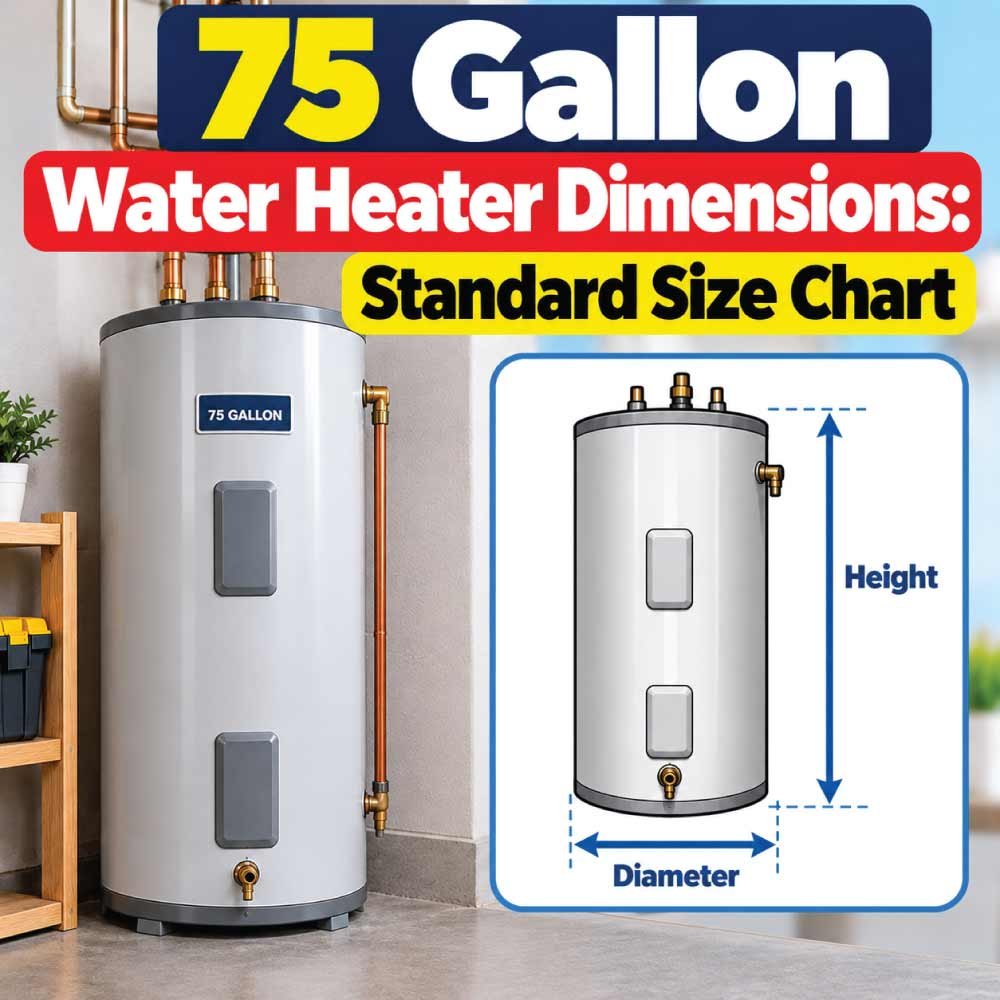
A 75-gallon water heater is a large-capacity option designed for households and buildings with substantial hot water demands. However, the physical size of a 75 gallon water heater varies by manufacturer, fuel type, tank design, and model. Before purchasing or replacing one, it is important to understand its height, diameter or width, installation clearance, and available space.
This guide explains typical 75 gallon water heater dimensions, how to measure the installation area, differences between gas and electric models, and the factors to consider when choosing a replacement. It also explains why the tank’s advertised capacity alone is not enough to determine whether a particular unit will fit.
75 Gallon Water Heater Dimensions Chart
A 75-gallon water heater does not have one universal set of dimensions. Tall storage-tank models, commercial-style units, and different fuel configurations can have noticeably different exterior measurements.
The following table is a planning guide, not a manufacturer-certified size chart. The figures are approximate dimensional ranges intended to help you estimate the space required before checking specific products.
| Dimension | Approximate Planning Range | Measurement Unit |
|---|---|---|
| Tank height | 60–75 | Inches |
| Tank diameter or width | 24–30 | Inches |
| Tank circumference, if cylindrical | 75–94 | Inches |
| Nominal tank capacity | 75 | US gallons |
| Nominal capacity in liters | 283.9 | Liters |
Important: These ranges are not guaranteed dimensions for every 75-gallon water heater. Actual products may fall outside them, particularly commercial or specialty models. Confirm the exact height, width, connection locations, and required clearances in the manufacturer’s specification sheet before buying.
The overall installed footprint may also be larger than the tank itself. Gas venting, water pipes, electrical connections, drain pans, service access, and local code requirements can affect the space needed.
What Is a 75 Gallon Water Heater?
A 75-gallon water heater is a storage-tank unit with a nominal capacity of 75 US gallons, equivalent to approximately 283.9 liters. It stores heated water so that it is available when showers, faucets, appliances, and other fixtures require it.
These units are generally considered large-capacity water heaters. Depending on the model and its recovery rate, they may suit larger households, properties with several bathrooms, or buildings with high simultaneous hot water demand.
Nominal Capacity vs. Actual Usable Hot Water
The advertised 75-gallon capacity describes the nominal tank volume. It does not necessarily mean that the entire volume will be available at the desired temperature whenever you need it.
Several factors affect usable hot water:
Thermostat setting: The temperature at which the tank stores water affects how much hot water can be mixed with cold water at the fixture.
Incoming water temperature: Colder incoming water requires more energy to reach the target temperature.
Recovery rate: This determines how quickly the heater can heat incoming replacement water.
Usage pattern: Several showers or appliances operating together can deplete stored hot water faster than staggered use.
Mixing and operating conditions: Actual delivery depends on the system’s temperature settings, plumbing, and installation.
A larger tank can provide a substantial reserve, but the right choice depends on both storage capacity and how quickly the unit can recover after heavy use.
Common Applications
A 75-gallon water heater may be considered for:
- Larger homes with several bathrooms.
- Households with overlapping shower and bathing schedules.
- Properties with frequent hot water use for laundry and dishwashing.
- Certain commercial or light-commercial applications, where the product is rated for the intended use.
- Replacement projects where the existing system and hot water demand justify a large storage tank.
Capacity alone does not determine suitability. A qualified installer can evaluate peak demand, recovery performance, available fuel, and the requirements of the building.
Standard 75 Gallon Water Heater Height and Diameter
The two most important exterior measurements are usually the unit’s overall height and its diameter or width. These determine whether the water heater can fit through access openings and occupy the proposed installation location.
75 Gallon Water Heater Height
A tank’s height is measured vertically from its lowest point to its highest point. Depending on the design, the highest point may be the top of the tank, an insulated cover, or another fixed component.
For initial planning, a height of approximately 60–75 inches can be used as a rough reference for some tall storage-tank designs. It should not be treated as a standard applicable to every 75-gallon model.
When measuring height, consider:
- The complete appliance height, not just the steel tank.
- The space required for top-mounted water connections.
- The location of the temperature-and-pressure relief valve and discharge piping.
- Gas vent connections or other equipment mounted above the tank.
- The manufacturer’s required service and installation clearances.
A unit may physically fit under a ceiling yet still be unsuitable if its venting, piping, or servicing requirements cannot be accommodated.
75 Gallon Water Heater Diameter
Round storage tanks are generally measured across the widest part of the cylinder. Rectangular or cabinet-style models may instead list width and depth.
A rough planning range of 24–30 inches may be useful for some large storage-tank units, but the exact diameter varies with the product design and insulation thickness.
Before purchasing, verify the listed exterior diameter or width. Do not calculate the tank’s exterior size from its nominal gallon capacity, because insulation, internal construction, and tank geometry differ among models.
How to Calculate Tank Circumference
If you need to estimate the circumference of a cylindrical tank, use this formula:
Circumference = Diameter × 3.1416
For example, a cylinder with an exterior diameter of 28 inches has a circumference of approximately 88 inches.
This calculation is useful for understanding the tank’s perimeter, but circumference is not a substitute for measuring the installation footprint. The appliance still needs sufficient room around it for pipes, access, and maintenance.
75 Gallon Gas vs. Electric Water Heater Dimensions
Gas and electric water heaters can differ in their exterior dimensions, connection arrangements, and installation requirements. The difference is not simply a matter of fuel type; individual models and their construction also matter.
| Feature | 75 Gallon Gas Water Heater | 75 Gallon Electric Water Heater |
|---|---|---|
| Tank shape | Usually cylindrical or model-specific | Usually cylindrical or model-specific |
| Height and diameter | Manufacturer-dependent | Manufacturer-dependent |
| Main energy connection | Gas supply and combustion system | Electrical supply |
| Venting | Required for applicable combustion designs | Generally no combustion vent |
| Additional space considerations | Vent connector, combustion air, gas piping | Electrical access and wiring requirements |
| Maintenance access | Burner or combustion-system servicing, where applicable | Heating-element and electrical servicing |
Gas Water Heater Space Requirements
A gas-fired 75-gallon unit may require space for a vent connector, combustion air, gas piping, and access to the burner or other serviceable components.
The venting arrangement depends on the heater’s design. Atmospheric-vented, power-vented, and other configurations have different installation requirements. Do not assume that a gas water heater can use the same venting arrangement as the old unit without checking the new model’s instructions.
Clearances from combustible materials and other safety requirements must follow the manufacturer’s instructions and applicable local codes.
Electric Water Heater Space Requirements
An electric 75-gallon water heater does not use a combustion vent, but it still requires an appropriate electrical supply, safe wiring, plumbing connections, and service access.
Some electric models use different tank geometries or insulation designs, so their dimensions may differ from comparable-capacity gas units.
Before installation, confirm the required circuit, voltage, overcurrent protection, and wiring specifications against the product documentation and local electrical requirements. Electrical work should be performed by a qualified professional where required.
How Much Space Does a 75 Gallon Water Heater Need?
The amount of space needed for a 75-gallon water heater depends on its exterior dimensions and installation instructions. The tank’s diameter alone is not enough to establish the required room size.
For example, a unit with a 28-inch diameter occupies a nominal circular footprint approximately 28 inches across before accounting for connections, a drain pan, or access requirements. A rectangular installation area must be planned around the actual shape and location of the equipment.
Measure the Available Floor Space
Measure the width and depth of the proposed installation location. Check for nearby walls, cabinets, doors, floor drains, and other obstructions.
Leave enough room to position the unit safely and connect its plumbing, power or fuel supply, and other components. The manufacturer’s clearance requirements take priority over generic estimates.
Check the Ceiling Height
Measure from the finished floor to the lowest overhead obstruction. Pipes, beams, ductwork, and sloping ceilings can reduce the usable height.
Include the height of the appliance’s connections and any required venting components in your assessment. If the unit must be installed in a confined space, verify that it can be moved into position and serviced after installation.
Plan for Drainage and Leak Protection
A drain pan may be appropriate or required depending on the installation location and local code. Where used, it can increase the space occupied by the installation.
Check whether the pan needs a drain connection and whether the floor can support the filled water heater. A full 75-gallon tank contains approximately 625 pounds of water, before adding the weight of the tank, insulation, and other components. The supporting surface must be suitable for the total installed load.
Allow for Maintenance and Replacement
A water heater should not be squeezed into a space that prevents routine inspection or replacement. Consider whether a technician can reach the controls, drain valve, service panels, and connections.
Also check the removal route. A tank may fit in its final location but be difficult to bring through a narrow doorway or around a tight corner.
How to Measure for a 75 Gallon Water Heater Replacement
Accurate measurements help prevent delivery problems, installation delays, and unexpected plumbing changes. If you are replacing an existing water heater, measure the current installation and compare those measurements with the replacement manufacturer’s specifications.
Step 1: Measure the Existing Tank
Measure the tank’s exterior height and widest diameter or width. Record both measurements in inches, and note whether the tank is round or rectangular.
Do not assume that the old heater’s nominal capacity accurately identifies its dimensions. Two units with the same capacity can have different exterior measurements.
Step 2: Measure the Installation Opening
Measure the doorway, hallway, stairwell, and any other narrow passage between the delivery point and the installation area.
Include turns and overhead obstructions. If the water heater must pass through a narrow doorway, its width, height, packaging, and required handling position may affect whether it can be moved safely into the room.
Step 3: Record Connection Locations
Note where the hot water outlet, cold water inlet, drain valve, relief valve, electrical connections, and gas connection are located, as applicable.
Connection locations matter because a replacement tank may be slightly taller or wider, or its fittings may be positioned differently. Existing pipes may need professional adjustment.
Step 4: Compare the Manufacturer’s Specifications
Before placing an order, review the product’s installation manual and dimensional drawing. Check the following:
- Overall height and exterior width or diameter.
- Required side, top, and front clearances.
- Location of plumbing and energy connections.
- Venting and combustion-air requirements, where applicable.
- Drain-pan requirements and discharge-pipe routing.
- Access needed for installation and future servicing.
Best practice: Use the manufacturer’s exact model number when checking dimensions. A general product listing may show rounded measurements or omit the space required for connections.
Also Read:
75 Gallon Water Heater Dimensions Compared With Other Tank Sizes
Comparing storage capacities can help you decide whether a 75-gallon water heater is appropriate for your property. However, tank capacity and physical dimensions do not increase in a perfectly predictable ratio.
The following table compares nominal capacities rather than claiming universal exterior measurements.
| Nominal Capacity | Capacity in US Gallons | Approximate Capacity in Liters | General Consideration |
|---|---|---|---|
| 40 gallons | 40 | 151.4 | Smaller storage capacity |
| 50 gallons | 50 | 189.3 | Common residential option |
| 65 gallons | 65 | 246.1 | Larger storage capacity |
| 75 gallons | 75 | 283.9 | High storage capacity |
| 80 gallons | 80 | 302.8 | Very large storage capacity |
Liter conversions are based on US gallons and rounded to one decimal place.
75 Gallon vs. 50 Gallon Water Heater
A 75-gallon tank stores 25 more US gallons than a 50-gallon tank. That is a 50% increase in nominal storage capacity, although it does not guarantee 50% more usable hot water under every operating condition.
A 75-gallon unit may be worth considering if several people frequently use hot water at the same time. A 50-gallon unit may be sufficient for a smaller household or a home with a more manageable demand pattern.
The correct comparison should also account for recovery rate, energy consumption, installation cost, and available space.
75 Gallon vs. 80 Gallon Water Heater
The nominal difference between a 75-gallon and an 80-gallon tank is only 5 US gallons, or approximately 18.9 liters.
However, an 80-gallon model is not necessarily larger in every exterior dimension. Tank shape, insulation, and product construction can affect height and width.
If you are choosing between these capacities, compare the actual product specifications and performance ratings rather than relying on gallon capacity alone.
Can a 75 Gallon Water Heater Replace a 50 Gallon Unit?
Sometimes, but the replacement is not automatically suitable. A 75-gallon model may need more floor space, greater structural support, different plumbing arrangements, or a different energy supply.
Before upgrading, have a qualified installer check the available space, hot water demand, energy requirements, and applicable building codes.
Also Read:
How to Choose the Right 75 Gallon Water Heater
Physical dimensions are only one part of choosing a water heater. The right unit should match your household’s hot water requirements and the conditions at the installation site.
1. Evaluate Household Hot Water Demand
Consider how many people live in the property and how they use hot water. Multiple simultaneous showers, large bathtubs, and frequent laundry use can create higher peak demand.
A qualified professional can estimate demand using fixture flow rates, usage patterns, and the heater’s first-hour rating or other relevant performance information.
2. Check the First-Hour Rating and Recovery Rate
The first-hour rating (FHR) indicates how much hot water a fully heated storage water heater can deliver during the first hour under specified test conditions. It accounts for stored hot water and the water heated during that period.
The recovery rate describes how quickly the heater can raise the temperature of incoming water. It depends on factors such as heating input and the temperature rise required.
Two 75-gallon water heaters can deliver different amounts of hot water during periods of heavy demand. Review the product’s rated performance rather than assuming that equal tank capacities provide equal results.
3. Compare Energy Sources
Consider whether gas or electricity is the practical option for your property. Existing fuel infrastructure, energy rates, electrical capacity, venting requirements, and installation expenses can affect the decision.
A gas unit may require a suitable gas line and combustion venting. An electric model requires an electrical supply that meets its specifications. Neither type should be selected on purchase price alone.
4. Review Energy Efficiency
Compare the efficiency information provided for each model. Energy-efficiency ratings, operating costs, and applicable certification information can help you evaluate long-term expenses.
Actual energy costs depend on local utility rates, incoming water temperature, household consumption, thermostat settings, and operating conditions.
5. Verify Installation Compatibility
Before selecting a unit, confirm that the heater fits the available space and is compatible with the installation requirements.
Pay particular attention to:
- Overall dimensions and weight.
- Water inlet and outlet locations.
- Electrical or gas connection requirements.
- Venting and combustion-air requirements.
- Temperature-and-pressure relief provisions.
- Drainage, service access, and local code compliance.
If the new model differs substantially from the old one, the installation may require more work than a straightforward tank replacement.
Also Read:
Common Mistakes When Buying a 75 Gallon Water Heater
Even when the nominal capacity is correct, a water heater can be unsuitable if important dimensions or installation conditions are overlooked.
Buying Based on Gallon Capacity Alone
A 75-gallon label tells you the nominal storage capacity, not the complete exterior size. Always check the model’s dimensional drawing.
Ignoring Required Clearances
Measuring only the tank’s width and height can lead to a poor fit. Installation instructions may require additional space for venting, service access, or nearby materials.
Forgetting the Delivery Route
The installation room may have sufficient space while the entrance or hallway does not. Measure the complete route before arranging delivery.
Assuming Every Model Uses the Same Connections
Hot and cold water fittings, electrical access, gas connections, and vent arrangements vary. Confirm their positions before assuming that existing connections can be reused without modification.
Overlooking Floor Load and Drainage
A filled 75-gallon tank contains a substantial amount of water. Verify that the supporting floor is suitable and that required leak protection and drainage provisions can be installed.
Choosing More Capacity Than Necessary
A larger tank is not automatically the most economical option. Compare actual hot water demand, recovery performance, energy use, and purchase and installation costs before upgrading.
Frequently Asked Questions About 75 Gallon Water Heater Dimensions
How tall is a standard 75 gallon water heater?
There is no single standard height for every 75-gallon model. Some tall storage-tank designs may fall within an approximate 60–75-inch planning range, but the exact height depends on the manufacturer and model. Check the dimensional drawing before installation.
What is the diameter of a 75 gallon water heater?
Some large storage-tank designs may have an exterior diameter in the approximate 24–30-inch range. This is not a universal specification, and particular models may be narrower, wider, or noncylindrical.
How much does a 75 gallon water heater weigh when full?
Seventy-five US gallons of water weigh approximately 625 pounds under ordinary reference conditions. The total filled weight is higher because it also includes the tank, insulation, fittings, and other components. Check the manufacturer’s product documentation for the appliance’s empty weight.
Is a 75 gallon water heater suitable for a large family?
It can be suitable for a large family, particularly when hot water use overlaps. However, the best size depends on peak demand, the number of bathrooms, fixture flow rates, and the heater’s first-hour rating and recovery performance.
Will a 75 gallon water heater fit in a standard utility closet?
Not necessarily. Closet dimensions, doorway width, ceiling height, venting, service access, and plumbing locations all affect suitability. Measure the complete installation space and compare it with the manufacturer’s requirements.
Can I install a 75 gallon water heater myself?
Installation involves plumbing, pressure and temperature safety provisions, and potentially gas, electrical, or venting work. Requirements vary by heater type and jurisdiction. Use a qualified installer when required and follow the manufacturer’s instructions and applicable codes.
Are 75 gallon water heaters available in both gas and electric models?
Yes, 75-gallon storage water heaters may be available in different fuel configurations, depending on the manufacturer and market. Confirm product availability, exterior dimensions, and installation requirements for the specific model you are considering.
Conclusion
Choosing a 75-gallon water heater requires more than checking its nominal capacity. Height, diameter, available floor space, delivery access, connection locations, and installation clearances all affect whether the unit is suitable.
Use general dimension ranges only for preliminary planning. Before purchasing, verify the exact model’s specifications and compare its storage capacity and recovery performance with your household’s hot water demand. Careful measurement and professional installation planning can help you avoid fit problems and choose a water heater that works reliably for your property.