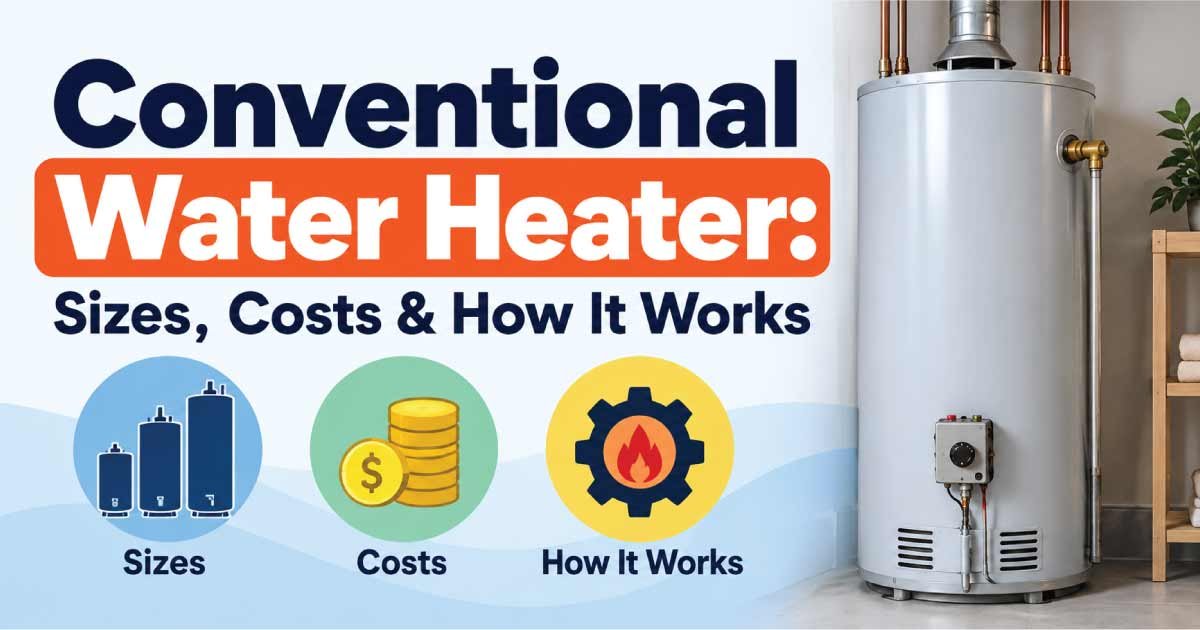
A conventional water heater is one of the most common ways to produce hot water for homes, apartments, rental properties, and commercial buildings. Unlike a tankless water heater, which heats water as it flows through the unit, a conventional water heater stores a supply of heated water inside an insulated tank so it is ready when you need it.
Conventional water heaters are available in different tank capacities, fuel types, energy-efficiency levels, and physical dimensions. Choosing the right model depends on household size, hot-water demand, available installation space, fuel availability, and operating costs.
This guide explains how a conventional water heater works, common tank sizes, typical costs, energy use, installation considerations, maintenance, lifespan, advantages and disadvantages, and how to select the right capacity for your home.
What Is a Conventional Water Heater?
A conventional water heater is a storage-tank water heating system that heats and holds a predetermined amount of water. The tank is normally insulated to slow heat loss, while a heating element or burner raises the water temperature.
When someone opens a hot-water faucet, hot water leaves the top portion of the tank. Cold water then enters through a dip tube and replaces the water that was used. The heater continues operating to bring the incoming cold water back to the desired temperature.
The basic components usually include:
- Storage tank
- Heating element or gas burner
- Thermostat or temperature controls
- Cold-water inlet
- Hot-water outlet
- Dip tube
- Pressure-relief valve
- Drain valve
- Anode rod
- Insulation
- Flue or venting system on gas models
Conventional water heaters are also called storage water heaters, tank water heaters, or simply water heaters.
How Does a Conventional Water Heater Work?
The operating principle is relatively simple. Water enters the storage tank, the heating system raises its temperature, and the insulated tank keeps the hot water available until it is needed.
The exact process depends on whether the unit uses electricity or gas.
How an Electric Conventional Water Heater Works
An electric conventional water heater generally uses one or two electric heating elements installed inside the tank.
The process works like this:
- Cold water enters the tank through the inlet.
- The thermostat detects the water temperature.
- The heating element switches on when the water temperature falls below the selected setting.
- Electrical energy is converted into heat.
- The water surrounding the element becomes warmer.
- Hot water rises toward the upper part of the tank.
- When the target temperature is reached, the thermostat turns the element off.
- The cycle repeats whenever the stored water cools.
Many residential electric models use two heating elements. One is positioned in the upper portion of the tank and another in the lower portion.
How a Gas Conventional Water Heater Works
A gas conventional water heater uses a burner beneath the storage tank.
Its basic operation is:
- Cold water enters the tank.
- The thermostat detects water temperature.
- The gas burner ignites when heating is required.
- The burner heats the water through the bottom of the tank.
- Hot combustion gases pass through a flue inside the tank.
- Heat transfers from the combustion process to the surrounding water.
- The burner turns off when the desired temperature is reached.
- The insulated tank stores the hot water.
Gas models require appropriate venting because combustion produces exhaust gases.
Conventional Water Heater Size Chart
Tank capacity is one of the most important factors when selecting a conventional water heater. A tank that is too small may run out of hot water during periods of heavy demand, while an unnecessarily large tank can increase purchase and operating costs.
The following chart provides common residential storage capacities and their typical applications.
| Tank Size | Approx. Capacity | Typical Household | Common Applications |
|---|---|---|---|
| Small | 20–30 gal | 1 person | Apartment or low demand |
| Medium | 30–40 gal | 1–2 people | Small household |
| Standard | 40–50 gal | 2–3 people | Average household |
| Large | 50–60 gal | 3–4 people | Family home |
| Extra Large | 60–80 gal | 4–6 people | High hot-water demand |
| Very Large | 80+ gal | 5+ people | Large household or heavy use |
These are general planning ranges rather than strict sizing rules. Actual requirements depend on shower duration, bathing habits, appliances, incoming-water temperature, and simultaneous hot-water use.
What Size Conventional Water Heater Do You Need?
The best tank size depends more on peak hot-water demand than simply the number of people in a home.
For example, a three-person household may use relatively little hot water if showers are spread throughout the day. Another three-person household may require substantially more capacity if several people shower consecutively while a dishwasher and washing machine are operating.
A practical starting point is:
| Household Size | Suggested Tank Range |
|---|---|
| 1 person | 20–30 gallons |
| 2 people | 30–40 gallons |
| 3 people | 40–50 gallons |
| 4 people | 50–60 gallons |
| 5 people | 60–80 gallons |
| 6+ people | 80+ gallons |
For final sizing, consider the first-hour rating (FHR) shown on the manufacturer’s specification label. FHR indicates how much hot water the heater can supply during a high-demand period when the tank starts full.
Conventional Water Heater First-Hour Rating
Tank capacity alone does not tell the whole story.
Two 50-gallon water heaters can have different hot-water performance because their heating systems may have different recovery rates. The first-hour rating combines stored hot water with the heater’s ability to produce additional hot water during periods of use.
For example, a household might have several consecutive showers in the morning. The tank initially provides stored hot water, while the heating system simultaneously begins reheating incoming cold water.
When comparing models, look at:
- Tank capacity
- First-hour rating
- Recovery rate
- Fuel type
- Energy efficiency
- Temperature setting
- Incoming water temperature
- Expected peak demand
This provides a more accurate basis for comparison than tank size alone.
Common Conventional Water Heater Tank Sizes
20 to 30 Gallon Water Heaters
Small tanks are suitable for low-demand applications.
They may work well for:
- Single-person apartments
- Guest bathrooms
- Small offices
- Utility rooms
- Low-use properties
A small tank can save installation space, but it has less stored hot water. Long showers or multiple simultaneous users can quickly exhaust the supply.
40 Gallon Water Heaters
A 40-gallon tank is a common choice for smaller households.
It can often work well for one or two people with moderate hot-water demand. However, household habits matter considerably.
If two people take long showers one after another, the heater may require additional recovery time.
50 Gallon Water Heaters
A 50-gallon tank is commonly considered for average family applications.
It can provide a useful balance between capacity and physical size. For households with several occupants, however, the FHR should also be checked before selecting a model.
60 to 80 Gallon Water Heaters
Larger tanks are intended for households with higher hot-water demand.
They may be useful when:
- Several people shower consecutively.
- Multiple bathrooms are frequently used.
- A large bathtub is filled regularly.
- Hot-water appliances operate frequently.
- Household demand is concentrated during a short period.
The downside is that larger tanks require more installation space and may have higher purchase and standby energy costs.
Electric vs. Gas Conventional Water Heaters
The two major conventional storage-heater categories are electric and gas.
| Feature | Electric | Gas |
|---|---|---|
| Heating method | Electric elements | Gas burner |
| Venting | Generally not required for combustion | Required |
| Installation | Often simpler | More installation requirements |
| Recovery | Depends on element power | Often strong recovery |
| Fuel availability | Requires suitable electrical service | Requires gas supply |
| Maintenance | Generally straightforward | Burner and venting require attention |
| Installation location | Flexible | Must meet venting requirements |
The better choice depends on the home’s existing infrastructure, local utility costs, installation requirements, and energy-efficiency goals.
Conventional Water Heater Cost
The total cost of a conventional water heater includes more than the purchase price of the tank.
Typical cost categories include:
- Water heater
- Delivery
- Installation labor
- Plumbing modifications
- Electrical work where required
- Gas-line work where required
- Venting modifications
- Drain pan
- Expansion tank where required
- Valves and fittings
- Removal and disposal of the old unit
- Permits or inspections where applicable
Because installation conditions differ substantially, there is no single universal installed price.
A basic replacement in an existing installation can be considerably simpler than installing a water heater in a new location or changing from one fuel type to another.
What Affects Conventional Water Heater Cost?
Tank Capacity
Larger tanks generally require more materials and can cost more than smaller units.
Fuel Type
Electric and gas models have different equipment and installation requirements. A gas installation may require appropriate venting and gas connections.
Efficiency
Higher-efficiency models can have a higher upfront price but may reduce energy consumption over their operating life.
Installation Complexity
Replacing an existing heater in the same location is usually more straightforward than relocating the heater.
Plumbing Modifications
Old shutoff valves, corroded connections, outdated piping, or unusual installations may increase labor and material requirements.
Code Requirements
Local building, plumbing, electrical, and gas requirements can affect installation costs.
For an accurate price, obtain a quote based on the actual installation location rather than relying only on the equipment price.
Conventional Water Heater Energy Efficiency
A conventional water heater consumes energy not only when actively heating water but also when maintaining the temperature of stored water.
This is known as standby heat loss.
Even when nobody is using hot water, some heat gradually escapes through the tank insulation. The heating system periodically operates to restore the temperature.
Energy efficiency depends on factors such as:
- Tank insulation
- Heating technology
- Fuel type
- Water temperature
- Incoming water temperature
- Hot-water usage
- Pipe insulation
- Heater age
- Recovery requirements
When comparing modern models, use the manufacturer’s efficiency information rather than assuming that every tank of the same capacity uses the same amount of energy.
What Is Standby Heat Loss?
Standby heat loss occurs because stored hot water naturally transfers heat to the surrounding environment.
Better-insulated tanks generally lose less heat.
Standby losses can be reduced by:
- Choosing an appropriately insulated tank
- Insulating accessible hot-water pipes
- Avoiding unnecessarily high temperature settings
- Selecting an appropriately sized heater
- Replacing very old, inefficient equipment
However, adding insulation or modifying a water heater should be done according to manufacturer instructions and applicable safety requirements.
Discover More:
Conventional Water Heater Temperature Setting
Many residential water heaters are operated around 120°F (49°C), although the appropriate setting depends on household requirements, local regulations, manufacturer instructions, and safety considerations.
Higher temperatures can increase the risk of scalding and may increase energy consumption.
Lower temperatures may reduce scalding risk and energy use but must still provide suitable hot-water conditions for the household.
If a property has special requirements, such as a need for higher storage temperatures, temperature control and anti-scalding protection should be evaluated by a qualified professional.
Conventional Water Heater Dimensions
Tank capacity is not the only size consideration. The physical dimensions of the heater are equally important during installation.
A water heater is commonly described by:
- Height
- Diameter
- Tank capacity
- Connection locations
- Required clearance
- Vent dimensions for gas models
A larger-capacity tank may not fit into an existing closet or utility area.
Before purchasing a replacement, measure:
- Available floor space.
- Available height.
- Doorway and access dimensions.
- Existing plumbing connection locations.
- Venting arrangement if applicable.
- Required service clearance.
- Drain location.
- Electrical or gas connection location.
Never assume that a new heater with the same gallon capacity will have exactly the same external dimensions as the old unit.
Discover More:
Short vs. Tall Conventional Water Heaters
Storage water heaters are commonly available in different physical configurations.
A tall model typically has a greater overall height and may be appropriate where vertical space is available.
A short model generally has a lower profile and can be useful where height is restricted.
Some installations may also use larger-diameter tanks or specialty configurations.
When replacing an existing heater, compare the actual manufacturer’s dimensions rather than selecting a model based solely on gallon capacity.
Conventional Water Heater Installation
Installation should follow the manufacturer’s instructions and applicable local plumbing, electrical, gas, and building requirements.
A typical installation may involve:
- Shutting off the water supply
- Disconnecting the old heater
- Draining the old tank
- Positioning the replacement
- Connecting cold-water and hot-water lines
- Installing required valves
- Connecting the energy source
- Connecting venting for applicable gas models
- Checking pressure-relief equipment
- Filling and testing the tank
- Checking for leaks
- Verifying proper operation
Gas and electrical connections can present serious hazards. Work involving gas lines, electrical circuits, combustion venting, or safety controls should be performed by an appropriately qualified professional.
Conventional Water Heater Maintenance
Regular maintenance can help a storage water heater operate reliably and can provide an opportunity to identify problems before they become serious.
Common maintenance considerations include:
- Inspecting connections for leaks
- Checking the pressure-relief valve according to manufacturer guidance
- Inspecting the anode rod
- Flushing sediment when appropriate
- Checking temperature settings
- Inspecting gas venting on applicable models
- Looking for corrosion
- Checking unusual noises
- Inspecting the drain valve
- Checking insulation and exposed pipes
The exact maintenance schedule varies by equipment, water quality, manufacturer instructions, and installation conditions.
Discover More:
Why Does a Conventional Water Heater Make Noise?
A conventional tank may produce sounds during normal operation, particularly as water heats and expands.
However, persistent popping, rumbling, cracking, or unusual sounds can indicate sediment accumulation or other issues.
Sediment can settle at the bottom of a storage tank. When the burner heats water around accumulated sediment, trapped water can create bubbling or popping sounds.
Possible causes of unusual water-heater noise include:
- Sediment buildup
- Mineral deposits
- Thermal expansion
- Heating-element problems
- Burner-related issues
- Water-pressure conditions
If unusual noises become frequent or severe, inspection can help identify the cause.
How Long Does a Conventional Water Heater Last?
A conventional storage water heater commonly has a service life measured in years rather than decades, but actual longevity varies significantly.
Factors affecting lifespan include:
- Water quality
- Tank construction
- Installation quality
- Maintenance
- Operating temperature
- Frequency of use
- Corrosion
- Anode-rod condition
- Sediment accumulation
Warning signs that a heater may be approaching replacement include:
- Repeated leaks
- Visible tank corrosion
- Rust-colored water
- Frequent temperature problems
- Insufficient hot water
- Unusual noises
- Repeated component failures
- Increasing operating problems
A leaking storage tank is particularly important because the tank itself may be deteriorating.
Advantages of a Conventional Water Heater
Conventional water heaters remain popular because their technology is familiar and relatively straightforward.
Large Stored Hot-Water Supply
The tank keeps a quantity of heated water available for immediate use.
Simple Technology
The basic operating principle is easy to understand and service.
Wide Range of Sizes
Homeowners can select from small residential tanks through much larger storage capacities.
Multiple Fuel Options
Conventional models are available in electric and gas configurations.
Familiar Installation
Many plumbers and technicians are experienced with conventional tank replacement and maintenance.
Suitable for Many Homes
For households with predictable hot-water requirements, a storage tank can provide practical performance without requiring an advanced system.
Disadvantages of a Conventional Water Heater
Despite their advantages, conventional heaters also have limitations.
Limited Stored Capacity
Once the tank’s available hot water is depleted, users may need to wait for the heater to recover.
Standby Heat Loss
Stored water gradually loses heat even when no hot water is being used.
Large Physical Footprint
A tank requires dedicated floor or utility-room space.
Potential Water Damage
A failed storage tank can release a large volume of water.
Finite Recovery Rate
High-demand households can exceed the heater’s ability to replenish hot water quickly.
Replacement Requirements
The tank eventually needs replacement because corrosion and other forms of deterioration can occur.
Conventional vs. Tankless Water Heater
A conventional water heater stores hot water, while a tankless water heater generally heats water as it flows through the system.
| Feature | Conventional | Tankless |
|---|---|---|
| Water storage | Yes | No |
| Standby heat loss | Yes | Minimal |
| Physical tank | Yes | No |
| Continuous flow | Limited by system capacity | Available within rated flow |
| Space requirement | Larger | Usually smaller |
| Initial system complexity | Generally simpler | Generally more complex |
| Hot-water recovery | Required | On-demand heating |
Neither technology is automatically best for every household. The right choice depends on demand, installation conditions, energy costs, available space, budget, and personal preferences.
How to Choose the Right Conventional Water Heater
Start by calculating how much hot water the household uses during its busiest period.
Consider:
- Number of occupants
- Number of bathrooms
- Shower frequency
- Shower duration
- Bathtub usage
- Dishwasher use
- Washing machine use
- Simultaneous hot-water demand
- Available installation space
- Existing fuel supply
- Local energy costs
Then compare models using both tank capacity and first-hour rating.
A useful selection process is:
- Estimate peak hot-water demand.
- Determine the required tank capacity.
- Check the first-hour rating.
- Measure the installation space.
- Confirm fuel availability.
- Compare energy-efficiency information.
- Check installation requirements.
- Consider long-term operating costs.
- Verify local code requirements.
- Choose a properly rated model and professional installation where required.
Signs Your Conventional Water Heater Is Too Small
A heater may be undersized if:
- Hot water frequently runs out.
- Multiple showers cannot be completed consecutively.
- The household regularly waits for water to reheat.
- The heater operates almost continuously during peak demand.
- Hot water becomes lukewarm during busy periods.
Before replacing the tank with a larger model, check whether the problem could instead be caused by a faulty heating element, thermostat, burner, dip tube, or another component.
Signs Your Conventional Water Heater Is Too Large
Oversizing can also be inefficient.
A tank may be larger than necessary if the household consistently uses very little hot water compared with the available storage capacity.
Potential drawbacks include:
- More installation space required
- Higher purchase cost
- Greater standby heat loss
- Higher operating costs in some situations
The goal is not simply to choose the largest tank available. The goal is to choose a capacity that matches actual demand.
When Should You Replace a Conventional Water Heater?
Replacement makes sense when repair is no longer economical, the tank is leaking, corrosion is extensive, or the unit has become unreliable.
A professional evaluation is particularly useful when the heater shows:
- A leaking storage tank
- Significant corrosion
- Repeated component failures
- Poor hot-water performance
- Persistent unusual noises
- Safety-related problems
- Age-related deterioration
If water is leaking from the tank itself rather than a replaceable connection or valve, replacement is often the practical solution.
Frequently Asked Questions About Conventional Water Heaters
What is a conventional water heater?
A conventional water heater is a storage-tank system that heats and stores a supply of hot water for later use. It can use electricity or gas, depending on the model and installation.
Is a conventional water heater the same as a tank water heater?
Yes. In most residential discussions, conventional water heater, storage water heater, and tank water heater refer to systems that store heated water inside a tank.
What size conventional water heater is best for a family of four?
A 50–60 gallon range is a common starting point for a four-person household, but actual demand and the heater’s first-hour rating should also be considered.
How much does a conventional water heater cost?
The total cost depends on tank capacity, fuel type, efficiency, installation complexity, plumbing modifications, venting, local labor rates, and applicable requirements. Equipment price alone does not represent the complete installation cost.
Are conventional water heaters energy efficient?
Modern conventional water heaters can be significantly more efficient than older models, but they still experience standby heat loss because hot water is stored continuously.
How long does a conventional water heater last?
Service life varies according to construction, water quality, maintenance, installation, usage, and corrosion. Regular inspection and maintenance can help identify deterioration early.
Can a conventional water heater run out of hot water?
Yes. Because the system stores a finite amount of hot water, heavy demand can exceed the tank’s available supply and recovery capacity.
Is a gas or electric conventional water heater better?
Neither is universally better. The best option depends on available utilities, installation requirements, energy prices, recovery requirements, efficiency, and household preferences.
What is the difference between a conventional and tankless water heater?
A conventional water heater stores heated water in a tank. A tankless unit heats water as it flows through the system rather than continuously storing a large volume of hot water.
What should I check before buying a conventional water heater?
Check tank capacity, first-hour rating, dimensions, energy source, efficiency information, connection requirements, installation space, warranty, and local installation requirements.
Final Thoughts
A conventional water heater remains a practical solution for many homes because it provides a ready supply of stored hot water and comes in a wide range of capacities. The most important decision is selecting a tank that matches the household’s peak demand rather than simply choosing the largest available capacity.
For most homeowners, the key factors are tank size, first-hour rating, fuel type, efficiency, physical dimensions, installation requirements, and long-term operating cost.
A properly sized and maintained conventional water heater can provide dependable hot water for everyday activities such as showering, bathing, washing dishes, and doing laundry. Before purchasing a replacement, compare the manufacturer’s specifications and make sure the selected model is appropriate for the home’s plumbing, energy supply, installation space, and local requirements.