
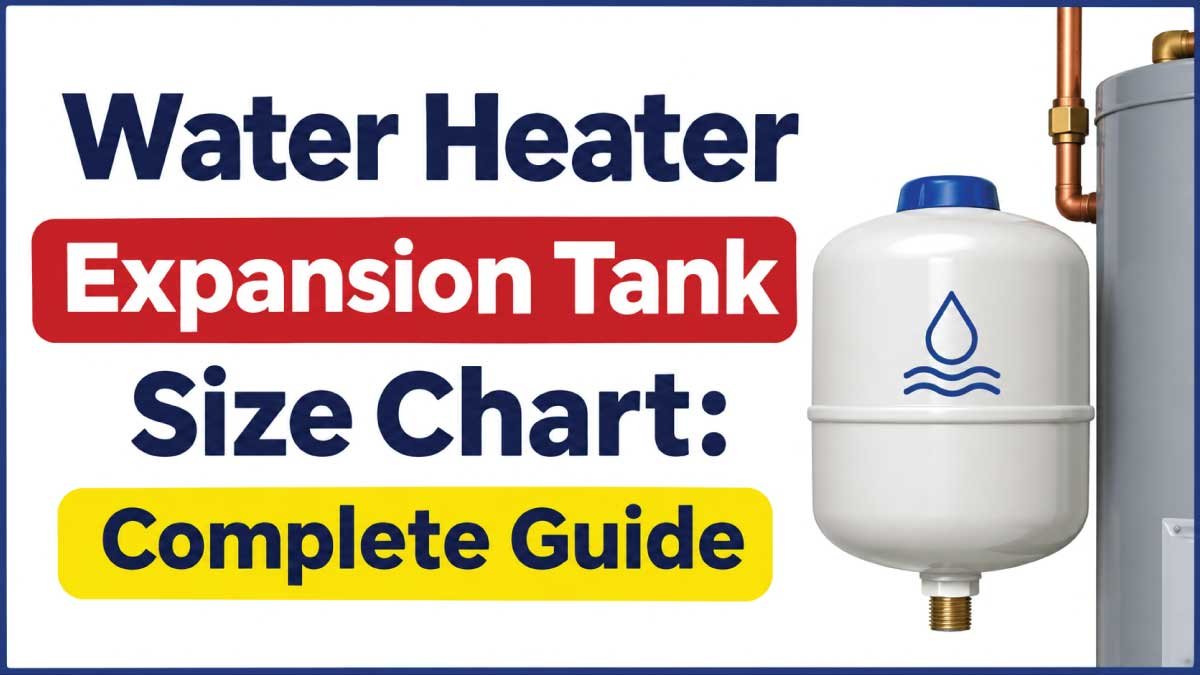
Choosing the correct water heater expansion tank size is essential for maintaining safe water pressure and protecting a residential or commercial hot water system. When water heats up, it expands. In a closed plumbing system, this additional water volume has nowhere to go unless an expansion tank provides the necessary space. Without proper expansion control, pressure can increase and place unnecessary stress on plumbing components, water heaters, and safety valves.
A Water Heater Expansion Tank Size Chart helps homeowners, plumbers, and HVAC professionals identify an appropriate tank based on water heater capacity, incoming water pressure, temperature changes, and the tank’s available acceptance volume.
However, selecting an expansion tank is not simply a matter of matching its size to the water heater’s gallon capacity. Other operating conditions also affect the required tank volume.
This guide explains expansion tank sizing, standard water heater capacities, important technical factors, calculation methods, installation considerations, common mistakes, and practical selection tips.
What Is a Water Heater Expansion Tank?
A water heater expansion tank is a small pressure vessel installed in a plumbing system to accommodate the additional water volume created when water is heated.
Water expands as its temperature increases. In an open plumbing system, some expansion may move backward into the municipal supply. However, many modern plumbing systems include backflow preventers, check valves, or pressure-reducing valves that prevent this reverse movement.
When water cannot flow backward, the plumbing system becomes closed. The additional water volume increases internal pressure.
An expansion tank provides a controlled space for this expanded water, helping maintain more stable pressure.
How Does a Water Heater Expansion Tank Work?
Most modern expansion tanks contain a flexible diaphragm or bladder that separates water from compressed air or nitrogen.
The operating process involves three main stages:
- Cold water condition: The tank contains a precharged gas compartment, and its diaphragm remains in its initial position.
- Water heating: As the water heater raises the water temperature, the water expands and enters the expansion tank. This movement compresses the gas compartment.
- Cooling period: When water temperature decreases, the water contracts. The compressed gas pushes the stored water back into the plumbing system.
This process accommodates thermal expansion without requiring the pressure relief valve to discharge water during normal heating cycles.
Why Is Expansion Tank Sizing Important?
An incorrectly sized expansion tank may not provide sufficient acceptance volume.
A tank that is too small can allow excessive pressure increases during water heating. An oversized tank may work in some applications but can create unnecessary equipment costs and installation-space requirements.
Correct sizing helps:
- Control pressure increases during heating cycles.
- Reduce unnecessary pressure relief valve discharge.
- Protect plumbing connections and fixtures from excessive pressure.
- Support reliable water heater operation.
- Provide adequate capacity for thermal expansion.
- Improve the overall performance of a closed plumbing system.
Water Heater Expansion Tank Size Chart
A water heater expansion tank size chart provides a preliminary reference for matching tank capacity with water heater storage volume.
The correct selection also depends on the incoming water pressure, cold water temperature, hot water temperature, tank precharge, and maximum permitted system pressure.
The following chart provides general orientation ranges rather than guaranteed manufacturer-approved selections.
Expansion Tank Size Chart by Water Heater Capacity
| Water Heater Capacity | Approximate Capacity in Liters | Illustrative Expansion Tank Nominal Volume |
|---|---|---|
| 20 Gallons | 76 L | 2–5 L |
| 30 Gallons | 114 L | 4–8 L |
| 40 Gallons | 151 L | 5–12 L |
| 50 Gallons | 189 L | 8–15 L |
| 60 Gallons | 227 L | 10–18 L |
| 75 Gallons | 284 L | 12–24 L |
| 80 Gallons | 303 L | 15–25 L |
| 100 Gallons | 379 L | 18–35 L |
Important: These ranges are illustrative planning references, not universal sizing specifications. They should not be used as final installation recommendations without checking the actual operating pressure, temperature conditions, and manufacturer sizing data.
Two water heaters with identical storage capacities may require different expansion tanks because their operating conditions can vary significantly.
Understanding Expansion Tank Nominal Volume
The nominal volume describes the tank’s total internal capacity. It does not represent the amount of water the tank can accept during operation.
For example, a tank with a nominal volume of 10 gallons does not necessarily have 10 gallons of available expansion capacity.
Part of its internal volume is occupied by compressed gas. The available acceptance volume depends on the initial gas pressure and the final operating pressure.
This distinction is essential when comparing different expansion tank models.
Factors That Determine the Correct Expansion Tank Size
Several technical factors influence expansion tank selection. Considering all of them provides a more reliable result than using water heater capacity alone.
1. Water Heater Capacity
The storage capacity determines how much water is heated during a normal heating cycle.
A larger tank generally produces more thermal expansion because it contains a greater quantity of water.
Common residential water heater capacities include:
- 20 gallons for compact applications.
- 30 gallons for smaller households.
- 40 gallons for typical residential applications.
- 50 gallons for many standard household installations.
- 75–80 gallons for larger hot water requirements.
- 100 gallons or more for larger residential and commercial systems.
The actual amount of water heated should be used in the calculation.
2. Incoming Water Pressure
Incoming water pressure directly affects expansion tank performance.
Higher initial system pressure generally reduces the available acceptance volume for a given tank size, assuming the same allowable final pressure.
For this reason, the static water pressure should be measured before selecting an expansion tank.
Important considerations include:
- Actual incoming water pressure.
- Pressure after a pressure-reducing valve.
- Changes in municipal supply pressure.
- Existing pressure-control equipment.
- Maximum allowable system pressure.
Pressure readings should be taken with a suitable pressure gauge under appropriate static conditions.
3. Cold Water Temperature
Cold water temperature affects the amount of expansion produced during heating.
For example, water heated from 40°F to 140°F experiences a different volume increase than water heated from 60°F to 120°F.
A greater temperature increase generally produces more thermal expansion.
Seasonal changes in incoming water temperature may also influence actual operating conditions.
4. Hot Water Temperature
The water heater’s thermostat setting is another important sizing factor.
A higher storage temperature generally creates greater water expansion.
Typical domestic water heater settings vary according to household requirements, manufacturer recommendations, local regulations, and scald-prevention considerations.
The actual operating temperature should be used rather than assuming a universal temperature setting.
5. Expansion Tank Precharge Pressure
Precharge pressure is the air or nitrogen pressure inside the expansion tank before water enters it.
The precharge should generally match the measured cold static water pressure at the tank connection, subject to manufacturer instructions.
If the precharge is incorrect, the tank may not provide its intended acceptance volume.
The pressure must be checked with the water side depressurized. Measuring precharge while the tank remains pressurized by the plumbing system can produce misleading results.
6. Maximum Allowable System Pressure
The expansion tank must operate within the permitted pressure limits of the complete installation.
These limits may include:
- Water heater maximum working pressure.
- Expansion tank maximum working pressure.
- Pressure relief valve setting.
- Pressure limitations of connected plumbing components.
- Applicable plumbing regulations.
The final design pressure must be selected carefully. It should never exceed the permitted limits of any relevant system component.
How to Calculate Water Heater Expansion Tank Size
A technical calculation provides a more accurate sizing method than relying exclusively on a general chart.
The process involves calculating water expansion and determining the tank’s available acceptance volume.
Step 1: Determine the Water Heater Volume
Start by identifying the actual storage capacity of the water heater.
For example, assume a residential water heater has a capacity of 50 gallons.
The equivalent volume is approximately 189 liters.
This volume will be used in the expansion calculation.
Step 2: Determine the Temperature Increase
Assume the incoming cold water temperature is 50°F and the desired hot water temperature is 140°F.
The temperature increase is:
140°F − 50°F = 90°F.
The temperature difference helps determine how much the water expands during heating.
Step 3: Calculate Water Expansion
The theoretical volume expansion can be calculated using water density at the initial and final temperatures.
The formula is:
Ve = Vs × (ρc / ρh − 1)
Where:
- Ve = Expanded water volume.
- Vs = Initial water volume.
- ρc = Density of cold water.
- ρh = Density of heated water.
For an approximate example, water heated from 50°F to 140°F expands by roughly 1.5%.
For a 50-gallon water heater:
50 × 0.015 = 0.75 gallons.
Therefore, the water expands by approximately 0.75 gallons under these assumed conditions.
The actual result should be calculated using appropriate water density values for the temperatures involved.
Step 4: Calculate the Tank Acceptance Factor
The acceptance factor represents the portion of the expansion tank’s nominal volume available to receive additional water.
For an idealized diaphragm tank operating at a constant temperature, the approximate acceptance factor is:
AF = 1 − (P1 / P2)
Where:
- AF = Acceptance factor.
- P1 = Initial absolute gas pressure.
- P2 = Final absolute gas pressure.
Both pressures must be expressed as absolute pressures, not gauge pressures.
To convert gauge pressure into absolute pressure, atmospheric pressure must be added.
At approximately sea level:
Absolute pressure = Gauge pressure + 14.7 psi.
Step 5: Calculate the Required Nominal Tank Volume
Once the expansion volume and acceptance factor are known, the required nominal tank volume can be estimated.
The formula is:
Vt = Ve / AF
Where:
- Vt = Required nominal expansion tank volume.
- Ve = Calculated water expansion.
- AF = Acceptance factor.
For example, assume:
- Water expansion = 0.75 gallons.
- Acceptance factor = 0.25.
The calculation becomes:
0.75 / 0.25 = 3 gallons.
The theoretical minimum nominal volume would therefore be approximately 3 gallons.
The selected commercial tank must provide at least the required acceptance volume under the actual operating conditions.
A professional sizing calculation should also consider manufacturer specifications, allowable pressure limits, temperature effects, and appropriate design margins.
Also Read:
Choosing an Expansion Tank for Different Water Heater Sizes
Different water heater capacities have different expansion requirements. Understanding these differences makes it easier to identify suitable equipment.
Small Water Heaters: 20–30 Gallons
Small water heaters are commonly installed in compact homes, apartments, utility rooms, and limited hot water applications.
They generally produce less thermal expansion than larger storage systems under comparable temperature conditions.
When selecting an expansion tank, consider:
- Actual storage capacity.
- Incoming water pressure.
- Operating temperature.
- Available installation space.
- Manufacturer acceptance data.
A compact expansion tank may be suitable when its calculated acceptance volume meets the system requirements.
Medium Water Heaters: 40–50 Gallons
Water heaters with 40–50 gallons of storage capacity are widely used in residential plumbing systems.
These systems require careful sizing because even moderate changes in incoming pressure can affect the required expansion tank volume.
A 50-gallon heater should not automatically be paired with the same expansion tank used for every other 50-gallon installation.
The pressure and temperature conditions must also be considered.
Large Water Heaters: 75–100 Gallons
Larger water heaters are commonly used in properties with higher hot water demand.
Their greater storage capacity can produce more thermal expansion, increasing the required tank acceptance volume.
Before selecting equipment, check:
- Total heated water volume.
- Maximum storage temperature.
- Cold supply temperature.
- Static system pressure.
- Available tank acceptance volume.
- Manufacturer sizing recommendations.
For commercial systems or installations with multiple water heaters, a more detailed engineering calculation may be necessary.
Also Read:
Types of Water Heater Expansion Tanks
Expansion tanks are available in different designs. Understanding their construction helps ensure the correct product is selected.
Diaphragm Expansion Tanks
Diaphragm tanks use a flexible membrane to separate water from compressed gas.
The diaphragm moves as water enters the tank, allowing the gas compartment to compress.
Common characteristics include:
- Compact construction.
- Separated water and gas compartments.
- Multiple available capacities.
- Suitability for applications specifically approved by the manufacturer.
Bladder Expansion Tanks
Bladder-style tanks contain a flexible internal bladder that separates water from the surrounding gas compartment.
As water expands, it enters the bladder and compresses the gas outside it.
These designs are available in different capacities and configurations.
Potable Water vs. Heating System Expansion Tanks
Not every expansion tank is suitable for domestic drinking water.
A tank designed for a closed hydronic heating circuit is not automatically approved for potable water applications.
When purchasing an expansion tank for a water heater, verify:
- Potable water approval.
- Applicable certification requirements.
- Maximum operating temperature.
- Maximum working pressure.
- Connection compatibility.
- Manufacturer installation instructions.
Selecting the correct application-specific model is important for both safety and reliability.
Water Heater Expansion Tank Installation Guide
Correct installation is just as important as proper sizing.
An incorrectly installed expansion tank may fail to accommodate thermal expansion even when its nominal capacity is adequate.
Where Should an Expansion Tank Be Installed?
In a typical closed domestic hot water system, the expansion tank is installed on the cold water supply side of the water heater.
It must generally be connected on the water heater side of a check valve, backflow preventer, or other device that prevents reverse flow.
This arrangement allows expanded water to enter the tank rather than becoming trapped in the closed system.
The exact installation arrangement must follow the applicable plumbing code and manufacturer instructions.
Important Installation Considerations
Before installation, consider the following:
- Check the tank’s precharge pressure.
- Match the precharge to the measured cold static system pressure, as applicable.
- Use fittings approved for potable water.
- Confirm the correct connection size.
- Provide adequate mechanical support.
- Follow the manufacturer’s permitted mounting orientation.
- Allow access for inspection and maintenance.
- Verify that the tank’s pressure and temperature ratings meet system requirements.
The tank should not place excessive mechanical stress on the plumbing connection.
Installation should be performed by a qualified plumbing professional when required by local regulations or when the system design is uncertain.
Also Read:
Common Water Heater Expansion Tank Sizing Mistakes
Several mistakes can result in insufficient expansion capacity or poor system performance.
Selecting a Tank Based Only on Gallon Capacity
Water heater storage capacity is important, but it does not determine the required expansion tank size by itself.
Incoming pressure, temperature increase, and allowable final pressure must also be included.
Ignoring the Precharge Pressure
An incorrect precharge can reduce the tank’s useful acceptance capacity.
Always verify the pressure before installation and follow the manufacturer’s adjustment procedure.
Using a Non-Potable Expansion Tank
A hydronic heating tank should not be installed in a drinking water system unless it is specifically approved for potable water.
Always verify product suitability.
Ignoring the Pressure Relief Valve
An expansion tank does not replace the temperature and pressure relief valve.
The relief valve remains an essential safety component and must never be blocked, capped, or disabled.
Choosing an Oversized or Undersized Tank Without Calculation
An undersized tank may fail to accommodate the full expansion volume.
An unnecessarily oversized tank can increase equipment costs and installation complexity.
A proper calculation provides a more reliable selection.
Signs of an Incorrectly Sized or Failing Expansion Tank
An expansion tank may develop problems because of incorrect sizing, lost precharge, diaphragm damage, or installation errors.
Common warning signs include:
- Water dripping from the pressure relief valve during heating.
- Unusual pressure increases.
- Repeated pressure fluctuations.
- Water appearing at the tank’s air valve.
- Visible corrosion around the tank.
- Leaking connections.
- Reduced expansion control.
These symptoms do not always indicate an incorrectly sized tank.
A defective pressure relief valve, faulty pressure regulator, or other plumbing problem can produce similar symptoms.
How to Check an Expansion Tank
A qualified technician can inspect the tank by checking its physical condition, measuring precharge with the water side depressurized, and examining the system’s operating pressure.
If water comes out of the air charging valve, the internal diaphragm or bladder may have failed.
A damaged tank generally requires replacement rather than simply adding more air.
Water Heater Expansion Tank Maintenance
Regular inspection helps identify problems before they affect the entire hot water system.
Maintenance requirements vary according to the manufacturer, installation conditions, and local regulations.
Important inspection points include:
- Checking for corrosion or physical damage.
- Inspecting threaded connections.
- Verifying precharge pressure when appropriate.
- Checking for signs of diaphragm failure.
- Monitoring pressure fluctuations.
- Inspecting the pressure relief valve.
- Confirming that the tank remains properly supported.
There is no universal service life that applies to every expansion tank. Actual durability depends on construction quality, water conditions, operating temperature, pressure, and maintenance.
Frequently Asked Questions About Water Heater Expansion Tank Sizes
1. What size expansion tank do I need for a 40-gallon water heater?
A 40-gallon water heater contains approximately 151 liters of water. The correct expansion tank depends on incoming pressure, temperature increase, precharge, and allowable system pressure. Use manufacturer sizing data for the final selection.
2. What size expansion tank is needed for a 50-gallon water heater?
A 50-gallon water heater may require a different expansion tank depending on operating conditions. Its storage capacity alone is not enough to determine the correct tank size.
3. Can an expansion tank be too large?
Yes. An oversized tank may increase equipment costs and require more installation space. However, the primary concern is ensuring sufficient acceptance capacity within the system’s design limits.
4. What pressure should a water heater expansion tank have?
The precharge should generally match the cold static water pressure at the tank connection, subject to manufacturer instructions. It must be checked when the water side is depressurized.
5. Does every water heater need an expansion tank?
Not every installation requires a separate expansion tank. However, a closed plumbing system must have an approved method of accommodating thermal expansion. Local plumbing codes determine the applicable requirements.
6. Where should a water heater expansion tank be installed?
It is typically installed on the cold water supply line, between the water heater and the backflow prevention device or check valve that creates the closed system.
7. Why does my water heater pressure relief valve keep dripping?
A leaking relief valve may indicate excessive thermal expansion, an incorrectly charged expansion tank, a failed diaphragm, or a defective valve. The underlying cause should be identified before replacing components.
8. Can I use a heating expansion tank for a water heater?
Only if the specific tank is approved for potable water applications and meets the required pressure and temperature ratings. Many hydronic heating tanks are not suitable for drinking water systems.
9. How often should an expansion tank be inspected?
Inspection frequency depends on manufacturer recommendations, system conditions, and local requirements. Regular checks should include physical condition, connections, precharge, and signs of leakage.
10. Does a larger water heater always need a larger expansion tank?
Generally, a larger heated water volume creates more thermal expansion under comparable conditions. However, the final tank size also depends on pressure, temperature, and acceptance capacity.
Conclusion: Choosing the Right Water Heater Expansion Tank Size
Selecting the correct water heater expansion tank size is essential for controlling thermal expansion and maintaining stable pressure in a closed hot water system.
A Water Heater Expansion Tank Size Chart provides a useful starting point, but the final selection should consider water heater capacity, incoming pressure, cold and hot water temperatures, tank precharge, and maximum allowable system pressure.
The most reliable approach is to calculate the expected water expansion, determine the tank’s available acceptance volume, and compare the result with the manufacturer’s specifications.
Choosing a properly rated potable water expansion tank and installing it according to the applicable plumbing requirements can help protect the system, reduce unnecessary pressure fluctuations, and support dependable long-term operation.