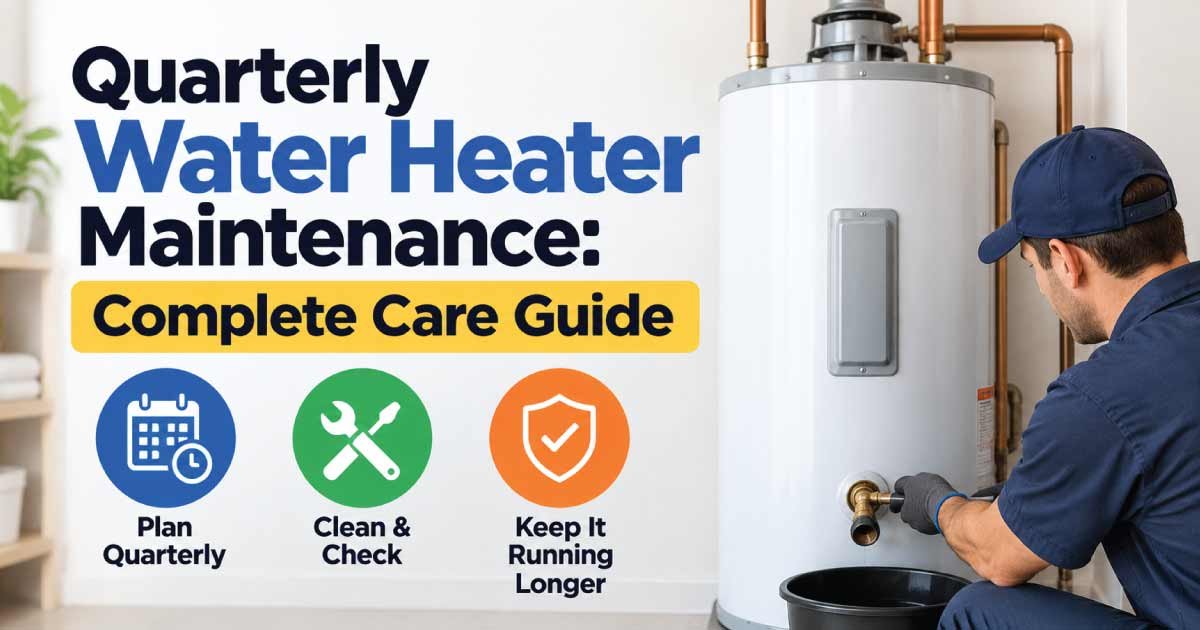
A water heater operates throughout the year, often handling dozens of heating cycles every day. Because of this constant workload, occasional inspection is essential for maintaining reliable hot water, reducing avoidable problems, and identifying developing faults before they become expensive repairs.
Quarterly water heater maintenance provides a practical middle ground between simple monthly inspections and more extensive annual servicing. Every three months, homeowners can perform a more thorough inspection of the tank, plumbing connections, temperature settings, safety components, surrounding area, and overall heating performance.
Quarterly maintenance does not mean every water heater component must be drained, disassembled, or replaced every three months. Maintenance intervals vary by heater type, water quality, age, usage, and manufacturer recommendations. For example, some manufacturers recommend tank flushing every six months or annually, while hard-water conditions can require more frequent service.
The goal of quarterly maintenance is to identify changes, maintain cleanliness, monitor performance, and ensure that periodic tasks such as flushing, descaling, anode inspection, and professional servicing are not forgotten.
What Is Quarterly Water Heater Maintenance?
Quarterly water heater maintenance means performing a more detailed inspection approximately every three months.
Instead of checking only for obvious leaks, a quarterly inspection looks at the heater as a complete system.
Typical quarterly checks include:
- Inspecting the tank and plumbing for leaks
- Looking for rust and corrosion
- Checking hot-water performance
- Reviewing the thermostat setting
- Inspecting visible valves and connections
- Checking the temperature and pressure relief system
- Inspecting the surrounding area
- Looking for sediment-related symptoms
- Checking tankless filters where applicable
- Reviewing the flushing or descaling schedule
- Inspecting accessible insulation
- Checking for unusual sounds
- Reviewing previous maintenance records
- Scheduling professional service when necessary
Quarterly maintenance should complement, not replace, the manufacturer’s maintenance instructions.
Why Quarterly Water Heater Maintenance Is Important
A water heater can develop problems gradually. A small leak may begin as occasional moisture around a fitting. Sediment may slowly accumulate at the bottom of a storage tank. A heating element may gradually lose performance. An anode rod can become depleted without any obvious external warning.
A three-month maintenance cycle makes these changes easier to notice.
Quarterly Maintenance Helps Identify Problems Early
Early detection is particularly valuable because water heaters combine water, heat, pressure, gas or electricity.
A small problem can eventually result in:
- Water damage
- Reduced hot-water capacity
- Higher energy consumption
- Heating-component failure
- Corrosion
- Unpleasant noises
- Safety concerns
- Unexpected replacement costs
Regular inspections cannot prevent every failure, but they can improve the chances of finding developing problems before they become severe.
Quarterly Water Heater Maintenance Checklist
The following checklist provides a practical seasonal inspection.
| Maintenance Task | Every 3 Months | Primary Purpose |
|---|---|---|
| Check tank for leaks | ✓ | Detect water damage |
| Inspect plumbing connections | ✓ | Find drips and corrosion |
| Check hot-water performance | ✓ | Identify heating problems |
| Review temperature setting | ✓ | Maintain safe operation |
| Inspect visible valves | ✓ | Identify leaks or damage |
| Check T&P discharge area | ✓ | Monitor safety condition |
| Inspect tank exterior | ✓ | Detect rust and corrosion |
| Check surrounding area | ✓ | Maintain access and safety |
| Listen for unusual sounds | ✓ | Identify sediment or component issues |
| Review maintenance log | ✓ | Track changes |
| Check tankless filter | As applicable | Maintain water flow |
| Flush storage tank | According to manufacturer | Remove sediment |
| Inspect anode rod | Periodically | Protect tank from corrosion |
| Descale tankless unit | As required | Remove mineral buildup |
The exact schedule should be based on the specific water heater’s manual. For example, Rheem recommends annual flushing for many households and more frequent flushing in hard-water conditions.
Inspect the Water Heater Tank
The tank is one of the most important areas to inspect during quarterly maintenance.
Walk around the entire unit and examine the exterior.
Look for:
- Rust spots
- Corrosion
- Water stains
- Damp areas
- Cracks or physical damage
- Mineral deposits
- Discoloration
- Water pooling underneath the heater
Do not assume a small amount of moisture is harmless.
Try to determine whether moisture originates from the tank itself, a pipe connection, drain valve, relief valve, condensation, or another nearby source.
Why Tank Corrosion Matters
Most conventional storage water heaters contain a steel tank protected by an internal lining and, depending on the design, a sacrificial anode rod.
When corrosion protection becomes inadequate, the steel tank can eventually deteriorate.
Anode rods are specifically designed to sacrifice themselves to help protect the tank from corrosion. Their service life depends on water chemistry, usage, and other conditions. A. O. Smith recommends periodic anode inspection, while other manufacturers specify different intervals.
Check for Water Heater Leaks
Leak inspection should be one of the first quarterly maintenance tasks.
Inspect:
- Cold-water inlet
- Hot-water outlet
- Drain valve
- Temperature and pressure relief valve area
- Flexible connectors
- Pipe joints
- Tank base
- Heating-element areas on applicable electric models
Mineral deposits around a fitting can indicate that water has been leaking and evaporating repeatedly.
What to Do If You Find a Leak
The correct response depends on the location and severity of the leak.
A loose or damaged connection may be repairable. A leaking drain valve may require replacement. However, water emerging from the tank itself can indicate internal tank failure.
If you find significant water leakage, shut down the equipment as appropriate and contact a qualified professional.
Manufacturers such as Bosch specifically advise shutting off appropriate water supplies and contacting a qualified service person when leaks, discoloration, or physical damage are found on certain water-heating systems.
Check the Water Heater Temperature
Quarterly maintenance is a good opportunity to verify that the heater is producing water at an appropriate temperature.
A commonly used residential setting is around 120°F (49°C), although the correct setting depends on the equipment, household needs, manufacturer instructions, and applicable requirements. Rheem, for example, discusses a range around 120°F to 125°F for residential applications.
Water that is excessively hot can increase the risk of scalding.
Water that is consistently too cool can indicate:
- Incorrect thermostat settings
- Heating-element problems
- Burner problems
- Sediment buildup
- Thermostat failure
- Undersized equipment
- Increased household demand
Use a thermometer when you need an actual temperature reading rather than relying only on how the water feels.
Inspect the Temperature and Pressure Relief System
The temperature and pressure relief valve, commonly called the T&P valve, is an important safety component on many storage water heaters.
Its purpose is to provide pressure or temperature relief when conditions exceed the valve’s rated limits.
The valve and discharge piping should be visually inspected during routine maintenance.
Look for:
- Continuous dripping
- Corrosion
- Mineral deposits
- Damaged components
- Improper discharge piping
- Signs of previous discharge
Do not cap, block, or otherwise obstruct a relief-valve discharge outlet.
Should You Test the T&P Valve Quarterly?
There is no universal quarterly testing rule for every water heater.
Manufacturer recommendations vary. A. O. Smith recommends annual consumer inspection, while some water-heater manuals specify different intervals.
Therefore, follow the instructions supplied with your particular heater.
If a relief valve leaks continuously, fails to operate correctly, or does not reseat properly, professional service is recommended.
Inspect the Relief Valve Discharge Pipe
The discharge pipe is just as important as the valve itself.
During quarterly inspection, check that it has not been:
- Capped
- Blocked
- Bent incorrectly
- Damaged
- Disconnected
- Modified in a way that prevents safe discharge
The exact installation requirements are governed by the applicable plumbing code and manufacturer instructions.
Never treat a leaking relief valve by simply blocking its outlet. Manufacturer guidance specifically warns against plugging the T&P outlet.
Check for Sediment Buildup
Sediment is one of the most common maintenance concerns for conventional storage tank water heaters.
Minerals can settle at the bottom of the tank as water is heated. Over time, the sediment layer may become substantial enough to interfere with heating performance.
Potential symptoms include:
- Popping sounds
- Rumbling noises
- Longer heating times
- Reduced hot-water availability
- Reduced efficiency
- Increased wear on heating components
Rheem notes that sediment buildup can reduce performance and increase wear, and recommends flushing frequency based on household and water-quality conditions.
Does Quarterly Maintenance Mean Quarterly Flushing?
Not necessarily.
This is an important distinction.
Quarterly maintenance does not automatically mean flushing the tank every three months.
Some systems are designed for six-month flushing, annual flushing, or another manufacturer-specified schedule. In hard-water environments, the interval may be shorter.
For example, one Bosch electric water-heater maintenance schedule calls for flushing every six months and notes that hard-water conditions may require much more frequent flushing.
Always follow the specific heater’s manual.
Quarterly Water Heater Flushing
When the manufacturer’s schedule calls for flushing, removing accumulated sediment can help maintain the performance of a storage tank heater.
A typical flushing process involves:
- Turning off the appropriate energy source.
- Allowing the water to cool sufficiently.
- Closing the cold-water supply where instructed.
- Connecting a suitable hose to the drain valve.
- Routing the discharge to a safe location.
- Draining and flushing the tank according to manufacturer instructions.
- Restoring the water supply correctly.
- Ensuring the tank is properly filled before restoring energy to applicable units.
- Checking for leaks.
- Confirming normal operation.
The exact procedure varies by equipment.
Why Older Water Heaters Require Extra Caution
A neglected water heater can contain substantial sediment.
Valves can also become difficult to operate as equipment ages.
If a heater has not been maintained for many years, forcing a stuck drain valve or performing unfamiliar maintenance can cause leaks or other problems.
For older or heavily neglected units, professional servicing can be safer.
Inspect the Anode Rod
The anode rod is an important corrosion-protection component in many storage tank water heaters.
It is designed to corrode instead of allowing the tank’s steel components to corrode as quickly.
Because the anode rod is consumed over time, it eventually needs inspection and potentially replacement.
How Often Should the Anode Rod Be Inspected?
Anode inspection is generally periodic rather than quarterly.
A. O. Smith recommends annual inspection, while GE Appliances also recommends annual inspection for applicable units. Other manufacturers can specify different intervals.
Water chemistry matters greatly.
Artificially softened water, aggressive water chemistry, high usage, and other conditions can cause anode consumption to occur faster.
If the anode is significantly depleted, replacement can help restore corrosion protection.
Inspect Water Heater Pipes and Fittings
Every three months, inspect all accessible water connections.
Pay attention to:
- Threaded connections
- Flexible supply lines
- Copper pipe joints
- PEX connections
- Shutoff valves
- Drain valves
- Corrosion
- Mineral deposits
- Moisture
A clean, dry connection is generally preferable to one showing continuous moisture or deposits.
Do not tighten fittings indiscriminately. Plumbing connections can be damaged by excessive force.
If you cannot determine the source of a leak, have the system inspected.
Quarterly Gas Water Heater Maintenance
Gas water heaters require additional attention because they use combustion.
During a quarterly visual inspection, look for unusual conditions around:
- Burner area
- Venting
- Draft hood where applicable
- Combustion-air openings
- Gas connections
- Pilot area
- Flame-related symptoms
- Soot or unusual discoloration
Do not attempt to modify gas controls or combustion components unless qualified to do so.
Check for Gas-Related Warning Signs
Important warning signs include:
- Gas odor
- Repeated pilot failure
- Unusual burner operation
- Soot
- Damaged venting
- Unusual combustion noises
- Persistent ignition problems
If you smell gas, treat the situation as an immediate safety concern rather than routine maintenance.
Follow your local gas emergency procedures and contact a qualified professional.
Quarterly Electric Water Heater Maintenance
Electric water heaters require different inspection points.
Quarterly checks should focus on:
- Tank leaks
- Plumbing connections
- Temperature
- Heating performance
- Unusual sounds
- Visible corrosion
- Repeated breaker trips
- Signs of electrical damage
Do not remove electrical covers or work on energized components unless you are qualified to do so.
Signs of a Heating Element Problem
A failing heating element can cause:
- Lukewarm water
- Reduced hot-water capacity
- Long recovery times
- Inconsistent temperature
- Circuit-breaker trips
These symptoms require proper electrical diagnosis rather than repeatedly resetting the breaker.
Quarterly Tankless Water Heater Maintenance
Tankless water heaters do not use a large storage tank, so their maintenance needs are different.
Quarterly inspections can include:
- Checking water connections
- Inspecting for leaks
- Checking inlet filters
- Reviewing error codes
- Monitoring water flow
- Checking for scale-related symptoms
- Cleaning accessible components according to instructions
Tankless Water Heater Descaling
Mineral scale can accumulate inside a tankless heat exchanger, especially in hard-water areas.
Periodic descaling can remove mineral deposits and help maintain proper heat transfer.
However, descaling should be performed at the interval recommended for the specific system.
Tankless systems generally require descaling, rather than conventional storage-tank flushing.
Discover More:
Quarterly Heat Pump Water Heater Maintenance
Heat pump water heaters use surrounding air as part of their heating process.
Quarterly maintenance can include checking:
- Air filters
- Airflow
- Condensate drainage
- Water connections
- Temperature settings
- Operating modes
- Unusual noises
- Surrounding clearance
A dirty filter or restricted airflow can interfere with operation.
Some manufacturers specifically prescribe periodic filter cleaning; Bosch, for example, lists three-month filter cleaning for certain models.
Always use the schedule for your particular model rather than applying a generic interval to every heat pump water heater.
Inspect Water Heater Insulation
Quarterly maintenance is also a good opportunity to inspect insulation around accessible hot-water pipes.
Pipe insulation can help reduce heat loss between the heater and fixtures.
Check for:
- Missing insulation
- Damaged insulation
- Loose insulation
- Wet insulation
- Deterioration
For gas water heaters, insulation must not interfere with burner access, combustion air, venting, or other safety requirements.
Never cover components that the manufacturer says must remain exposed.
Discover More:
Listen for Unusual Water Heater Sounds
Sound can provide useful clues about the condition of a water heater.
Popping Sounds
Popping can be associated with sediment accumulation.
Rumbling Sounds
Rumbling can also occur when sediment or mineral deposits interfere with normal heating.
Hissing Sounds
Hissing can have several possible causes, including water movement, leaks, pressure-related conditions, or other operating issues.
Banging Sounds
Sudden or unusual banging deserves attention, particularly when accompanied by changes in heating performance.
Sound alone does not provide a diagnosis. However, a new or worsening sound is a good reason to inspect the heater more closely.
Quarterly Water Heater Maintenance Schedule
A simple four-season schedule can make maintenance easier to remember.
| Quarter | Primary Maintenance Focus | Additional Check |
|---|---|---|
| Q1 | Leak and corrosion inspection | Temperature and connections |
| Q2 | Sediment and flushing schedule | Relief system |
| Q3 | Heating performance | Pipes, valves, insulation |
| Q4 | Overall system review | Annual service planning |
This schedule is a planning framework rather than a replacement for the manufacturer’s maintenance schedule.
Discover More:
Quarterly vs Monthly Water Heater Maintenance
Monthly and quarterly maintenance have different levels of detail.
| Maintenance Area | Monthly | Quarterly |
|---|---|---|
| Leak inspection | ✓ | ✓ |
| Basic temperature monitoring | ✓ | ✓ |
| Unusual noise check | ✓ | ✓ |
| Surrounding-area inspection | ✓ | ✓ |
| Plumbing connections | ✓ | Detailed |
| Corrosion inspection | Basic | Detailed |
| Maintenance records | ✓ | Detailed review |
| Sediment review | Basic | Detailed |
| Flushing | — | According to schedule |
| Filter maintenance | As required | Review |
| Anode inspection | — | Review due date |
| Professional service planning | — | ✓ |
Monthly maintenance is primarily about early detection.
Quarterly maintenance is about early detection plus a deeper review of the maintenance schedule and system condition.
Quarterly Water Heater Maintenance for Hard Water
Hard water can significantly influence maintenance needs.
Hard water contains dissolved minerals that can contribute to scale and sediment.
Potential effects include:
- Faster sediment accumulation
- Mineral deposits
- Reduced heating efficiency
- Scale on heating elements
- Tankless heat-exchanger scaling
- More frequent flushing requirements
- Increased maintenance needs
Rheem specifically recommends considering more frequent flushing in hard-water conditions, while manufacturer manuals may provide their own thresholds and intervals.
If you have hard water, your quarterly inspection should pay particular attention to scale and sediment symptoms.
Water Heater Maintenance After Three Months of Operation
A useful quarterly inspection asks a simple question:
Has anything changed since the last inspection?
Compare current conditions with your previous maintenance record.
Check whether:
- The heater is louder
- Hot water takes longer to arrive
- Water temperature has changed
- The tank is showing new corrosion
- A fitting has become damp
- The relief valve has discharged
- Energy use appears unusual
- Hot-water capacity has declined
Changes are often more useful than a single inspection snapshot.
Water Heater Maintenance Log
A maintenance log helps establish a history for the appliance.
| Date | Leak Check | Temperature | Sediment Signs | Valves | Overall Condition |
|---|---|---|---|---|---|
| Q1 | ✓ | ✓ | None | Good | Good |
| Q2 | ✓ | ✓ | Minor | Good | Monitor |
| Q3 | ✓ | ✓ | None | Good | Good |
| Q4 | ✓ | ✓ | Moderate | Service Due | Inspect |
Record actual observations rather than automatically marking every item as normal.
A maintenance history can also be useful when discussing problems with a plumber or technician.
Common Quarterly Water Heater Maintenance Mistakes
Even well-intentioned maintenance can create problems when performed incorrectly.
Avoid these mistakes:
- Flushing the tank on an arbitrary schedule
- Ignoring the manufacturer’s instructions
- Testing a relief valve without considering hot-water discharge
- Blocking a relief-valve discharge pipe
- Ignoring small leaks
- Repeatedly resetting electrical breakers
- Working on gas components without proper qualifications
- Removing electrical covers without appropriate training
- Using unsuitable chemicals for descaling
- Covering combustion-air openings
- Installing insulation where it can interfere with safe operation
- Ignoring hard-water conditions
- Forgetting to inspect anode-rod condition
- Treating unusual noises as normal without investigation
A good maintenance plan should be proactive but also conservative when safety-critical components are involved.
When to Call a Professional
Professional service is recommended when the problem involves gas, electricity, pressure, internal tank corrosion, or components you cannot safely diagnose.
Call a qualified technician if you notice:
- Significant water leakage
- Tank corrosion
- Gas odor
- Repeated pilot failure
- Combustion problems
- Damaged venting
- Repeated breaker trips
- Electrical burning odors
- Relief-valve problems
- Persistent overheating
- Severe sediment buildup
- Failed heating elements
- Major pressure problems
Manufacturers emphasize professional assistance when homeowners are not comfortable working with gas or electricity.
Quarterly Water Heater Maintenance Cost Considerations
The cost of quarterly maintenance depends on what is actually required.
A basic inspection may involve little more than time and simple observation.
More extensive service can involve:
- Tank flushing
- Tankless descaling
- Anode-rod replacement
- Heating-element replacement
- Thermostat replacement
- Relief-valve replacement
- Leak repair
- Professional inspection
- Gas-system service
The most economical strategy is usually to follow the manufacturer’s maintenance schedule rather than performing every possible procedure every three months.
Preventive maintenance can be less expensive than waiting for a major leak or complete system failure.
How to Build a Quarterly Water Heater Maintenance Calendar
A simple calendar can prevent maintenance from being forgotten.
First Quarter
Focus on:
- Leak inspection
- Corrosion
- Temperature
- Plumbing connections
- Maintenance records
Second Quarter
Focus on:
- Sediment
- Flushing schedule
- Relief system
- Water quality
- Tank condition
Third Quarter
Focus on:
- Heating performance
- Pipes
- Insulation
- Filters
- Tankless scale
Fourth Quarter
Focus on:
- Overall condition
- Annual maintenance due dates
- Anode inspection schedule
- Professional servicing
- Replacement planning
The calendar should be adjusted whenever the manufacturer specifies a different interval.
Quarterly Water Heater Maintenance Safety Tips
Water heaters can contain very hot water, pressurized water, gas, or high-voltage electrical components.
Follow these safety principles:
- Read the manufacturer’s instructions first.
- Allow hot components and water to cool when required.
- Wear appropriate protective equipment.
- Keep children away from the equipment.
- Do not obstruct safety valves.
- Do not work on gas systems unless qualified.
- Do not work on electrical components unless qualified.
- Do not ignore gas odors.
- Do not operate damaged equipment unnecessarily.
- Contact a professional when the problem exceeds your experience.
A maintenance task should never create a greater safety risk than the problem it is intended to prevent.
Quarterly Water Heater Maintenance: Complete Checklist
Use this checklist every three months:
- ☐ Inspect the entire tank
- ☐ Check underneath for water
- ☐ Inspect inlet and outlet connections
- ☐ Check drain valve
- ☐ Inspect visible relief-valve components
- ☐ Check discharge piping
- ☐ Look for rust and corrosion
- ☐ Monitor hot-water temperature
- ☐ Check for unusual sounds
- ☐ Check for reduced hot-water capacity
- ☐ Review sediment and flushing requirements
- ☐ Review anode-rod inspection date
- ☐ Check tankless filter where applicable
- ☐ Review descaling requirements
- ☐ Inspect accessible insulation
- ☐ Check surrounding clearance
- ☐ Review maintenance records
- ☐ Schedule professional service when needed
Frequently Asked Questions About Quarterly Water Heater Maintenance
What should I do to my water heater every three months?
Inspect the tank, plumbing connections, valves, temperature, surrounding area, corrosion, unusual sounds, and hot-water performance. Also review whether flushing, descaling, anode inspection, or professional service is due.
Do I need to flush my water heater every three months?
Not necessarily. Flushing frequency depends on the heater, manufacturer recommendations, water quality, and usage. Some manufacturers recommend six-month or annual flushing, while hard-water conditions can require more frequent maintenance.
How often should a water heater be serviced?
There is no single interval for every model. Use the manufacturer’s maintenance schedule and adjust maintenance based on water quality, heater type, age, and operating conditions.
Should I inspect the anode rod quarterly?
Usually, anode inspection is performed less frequently than quarterly. Some manufacturers recommend annual inspection. Check your specific model’s instructions.
How often should a tankless water heater be descaled?
The interval depends on water hardness, usage, equipment design, and manufacturer instructions. Hard-water environments generally require closer attention to mineral scale.
What temperature should my water heater be set to?
Around 120°F (49°C) is a commonly used residential setting, but follow the manufacturer’s instructions and consider household requirements and applicable safety guidance.
Why does my water heater make popping sounds?
Popping sounds can be associated with sediment buildup in a conventional storage tank. If the sound is persistent or worsening, inspect the system and consider whether flushing is due.
Can quarterly maintenance extend water heater life?
Regular maintenance can help identify leaks, sediment, corrosion, and component problems earlier. However, actual service life depends on equipment quality, water chemistry, usage, installation, maintenance, and other factors.
Final Quarterly Water Heater Maintenance Routine
Quarterly water heater maintenance is an effective way to stay ahead of developing equipment problems without unnecessarily performing intensive service every few months.
Every three months, inspect the tank, connections, valves, temperature, surrounding area, and overall heating performance. Review the condition of sediment-related components and confirm whether flushing, descaling, anode inspection, or professional servicing is due.
Remember that quarterly maintenance is a schedule for inspection and maintenance planning, not a rule that every component must be serviced every three months.
The correct maintenance frequency depends on the heater type, manufacturer, water quality, age, household demand, and operating conditions. Manufacturer instructions should always take priority. Rheem, Bosch, A. O. Smith, and other manufacturers publish model-specific maintenance recommendations, and those schedules can differ substantially.
A consistent quarterly routine can help you detect leaks, monitor corrosion, recognize sediment problems, maintain proper performance, and schedule professional service before a minor issue develops into a major water-heater failure.