
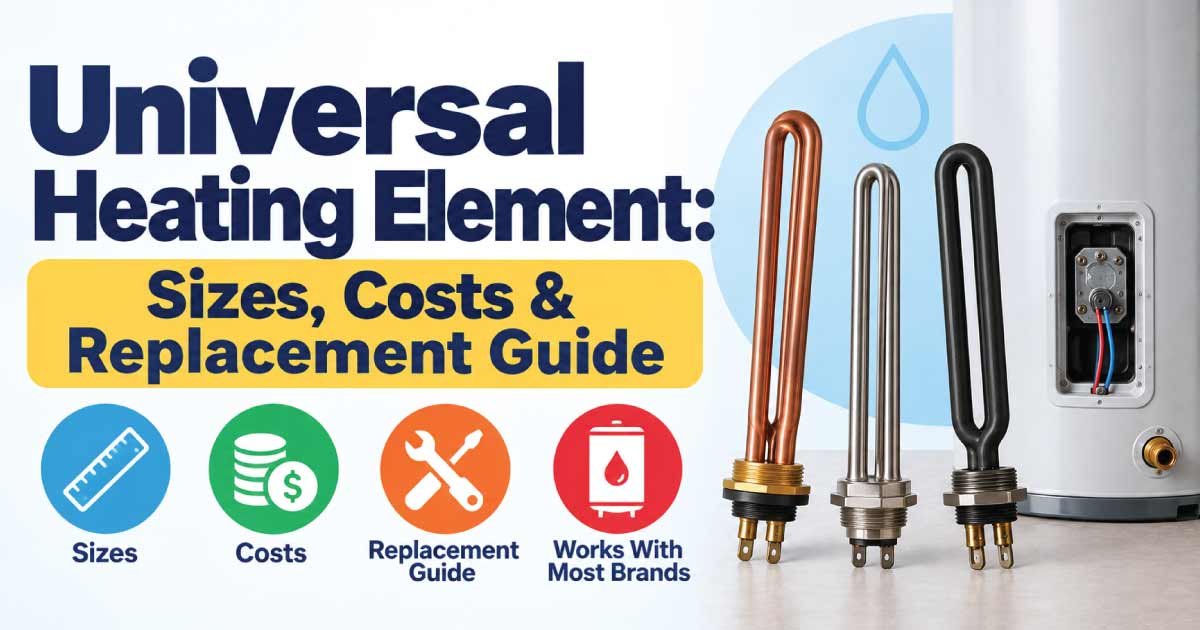
A universal heating element is a convenient replacement option for many electric water heaters, especially when the original heating element is difficult to identify, discontinued, or unavailable. It heats the water inside the storage tank by converting electrical energy into heat, helping restore normal hot-water performance when an old element fails.
However, universal does not mean one size fits every water heater. Universal heating elements are available in different wattages, voltages, lengths, mounting styles, materials, and watt-density ratings. Choosing the wrong element can result in poor heating performance, electrical problems, leaks, or premature failure.
In this guide, you’ll learn how universal heating elements work, which sizes, wattages, and voltages are common, how screw-in and flange designs differ, how much replacement elements typically cost, and how to identify the right element for your water heater. We’ll also cover common failure symptoms, testing methods, replacement steps, and important safety tips to help you make a confident replacement decision.
What Is a Universal Heating Element?
A universal heating element is a replacement water heater element designed to fit a broad range of compatible electric storage water heaters rather than being made for only one specific heater model. Universal elements are available in different mounting styles, wattages, voltages, lengths, materials, and watt-density ratings.
The word “universal” does not mean that one element fits every water heater. Compatibility still depends on important specifications such as the mounting or flange style, voltage, wattage, element dimensions, tank clearance, and manufacturer requirements.
Universal replacement elements can be especially useful when the original element is discontinued, difficult to identify, or unavailable locally. For example, current universal products include both screw-in and universal-flange designs, while manufacturer catalogs list multiple voltage, wattage, and length combinations.
How Does a Universal Water Heater Element Work?
A universal heating element works like a standard electric water heater element.
Inside the metal sheath is a resistance wire. When electrical current passes through the wire, resistance converts electrical energy into heat. The heat transfers through the metal sheath and into the surrounding water.
In a typical electric storage water heater, the thermostat controls when the heating element receives power.
The basic process is:
- Hot water is used.
- Cold water enters the tank.
- The water temperature falls.
- The thermostat detects the temperature drop.
- Electrical power reaches the heating element.
- The element heats the surrounding water.
- The thermostat stops the heating cycle when the target temperature is reached.
A universal element performs this same heating function, but its physical design may allow it to replace several compatible original element configurations.
Universal Heating Element Types
Universal water heater elements are available in several configurations.
Universal Screw-In Heating Elements
A universal screw-in element has a threaded base that screws directly into the tank.
These are common replacement elements and are available in several wattages and voltages.
A universal screw-in design may be useful when the original heater uses the appropriate threaded mounting arrangement.
For example, current replacement products include universal screw-mount elements with gaskets, including 1,500W/240V configurations.
Universal Flange Heating Elements
A universal flange element uses a mounting flange and gasket rather than a conventional threaded base.
This type can be useful for replacing certain bolt-on or flange-style elements.
Current manufacturer documentation lists a universal flange foldback element rated at 4,500W/240V with a 9-inch element length and gasket.
Universal Foldback Elements
Foldback elements bend back toward the mounting area to provide heating surface while reducing the required insertion depth.
They are available in both high- and low-watt-density designs.
Foldback designs can be particularly useful where tank clearance or element length is a concern.
Universal Heating Element Sizes
There is no single universal size.
Universal heating elements are produced in different physical lengths and electrical ratings to accommodate different water heaters.
The size you need depends on:
- Voltage
- Wattage
- Element length
- Mounting style
- Flange dimensions
- Thread type
- Bolt pattern
- Tank diameter
- Internal tank clearance
- Watt density
- Original heater specifications
Camco’s element catalog, for example, lists 240V elements ranging from 2,500W through 5,500W with different element lengths, demonstrating that universal replacement elements are available in multiple configurations.
Common Universal Element Specifications
| Specification | Common Options |
|---|---|
| Voltage | 120V, 208V, 240V |
| Wattage | 1,000W–6,000W+ |
| Mounting | Screw-in, flange, bolt-on |
| Shape | Straight, foldback |
| Material | Copper, stainless steel, alloy |
| Density | High, low, ultra-low |
| Length | Varies by model |
| Gasket | Often included |
| Application | Electric storage water heaters |
The correct replacement should always be selected according to the heater’s specifications rather than simply choosing the physically closest size.
Universal Heating Element Wattage Chart
Wattage determines how much electrical power the element uses and how much heat it can produce.
Common ratings include:
| Wattage | Typical Voltage | General Application |
|---|---|---|
| 1,000W | 120V/240V | Small systems |
| 1,500W | 120V/240V | Small or low-demand heaters |
| 2,000W | 120V/240V | Smaller storage heaters |
| 2,500W | 240V | Moderate heating |
| 3,000W | 240V | Medium-demand systems |
| 3,500W | 240V | Residential systems |
| 4,000W | 240V | Higher heating demand |
| 4,500W | 240V | Common residential rating |
| 5,000W | 240V | Higher-output applications |
| 5,500W | 240V | High-demand residential systems |
| 6,000W | 240V | Certain higher-capacity systems |
Manufacturer guidance states that many residential water heaters use 240V power, while 120V elements are commonly used in smaller or point-of-use heaters. The replacement element should match the specified voltage and wattage, and the nameplate rating should not be exceeded.
120V vs. 240V Universal Heating Elements
Voltage is one of the most important specifications when replacing a water heater element.
120V Elements
120V elements are often used in:
- Small water heaters
- Point-of-use heaters
- Smaller storage systems
- Applications without a 240V circuit
Typical 120V element wattages are lower than those commonly used in full-size residential electric storage heaters.
240V Elements
240V elements are very common in residential electric storage water heaters.
They can be found in ratings such as:
- 3,500W
- 4,000W
- 4,500W
- 5,000W
- 5,500W
Manufacturer documentation notes that residential 240V elements can range from 1,000W to 6,000W, while 120V elements are commonly rated from 1,000W to 2,500W.
Never Choose Voltage by Guessing
Check the:
- Water heater rating plate
- Original element
- Installation manual
- Manufacturer part number
- Wiring diagram
Using an incorrect voltage or wattage can cause improper heating and potentially create electrical or safety problems.
Universal Heating Element Lengths
Physical length is another important consideration.
An element must fit inside the water heater without interfering with the tank, dip tube, anode rod, insulation, or other internal components.
Some universal elements use compact or foldback designs to provide adequate heating surface without requiring a long straight element.
For example, manufacturer listings include universal flange foldback elements around 9 inches long as well as other element designs around 10–15 inches.
Before purchasing, compare the old element with the replacement.
Measure:
- Overall length
- Sheath length
- Flange dimensions
- Terminal position
- Element shape
Never assume that two elements with the same wattage have the same physical dimensions.
Universal Flange Sizes and Mounting
The mounting system determines whether a universal element can physically attach to the heater.
There are two major configurations:
- Screw-in mounting
- Flange or bolt-on mounting
A universal flange element may use a gasket and multiple mounting points.
The Home Depot’s water heater construction guide explains that flange style, voltage/wattage, and watt density are key factors when selecting a replacement element.
What to Check on a Flange Element
Before buying, compare:
- Number of mounting holes
- Hole spacing
- Flange diameter
- Gasket shape
- Terminal arrangement
- Element orientation
- Tank opening
A universal element is only useful if its mounting arrangement is compatible with the heater.
High-Watt-Density vs. Low-Watt-Density Universal Elements
Universal elements are also available in different watt-density designs.
High-Watt-Density Elements
High-watt-density elements concentrate more heat over the element surface.
Benefits include:
- Lower purchase price
- Broad availability
- Compact designs
- Fast heat transfer
The main disadvantage is that high surface temperatures can encourage mineral deposits in hard-water conditions.
Low-Watt-Density Elements
Low-watt-density elements distribute heat over a larger surface area.
They are often a better choice for water heaters operating in areas with hard water or significant mineral buildup.
Manufacturer documentation notes that low-watt-density elements can reduce lime deposit buildup while maintaining heating efficiency.
| Feature | High Watt Density | Low Watt Density |
|---|---|---|
| Heating concentration | Higher | Lower |
| Surface area | Smaller | Larger |
| Mineral buildup | More sensitive | Better resistance |
| Cost | Usually lower | Usually higher |
| Hard-water suitability | Moderate | Better |
| Common shape | Straight | Often foldback |
Universal Heating Element Materials
The metal sheath affects durability and suitability for different water conditions.
Common materials include:
- Copper
- Stainless steel
- Nickel-chromium alloy
- Incoloy-type alloys
- Titanium in specialized products
Copper Elements
Copper elements are popular because they are widely available and relatively inexpensive.
They are often found in standard residential replacement applications.
Stainless Steel Elements
Stainless steel elements are available in both standard and foldback designs.
They may provide a useful alternative where durability and water conditions are concerns.
Titanium Elements
Titanium elements are generally positioned as premium replacements and can cost considerably more than standard copper elements.
Current retail listings show universal-replacement titanium elements priced substantially higher than basic copper elements.
How Much Does a Universal Heating Element Cost?
Universal heating element prices vary according to wattage, material, mounting style, brand, and watt density.
Current retail listings provide a useful example of the price range. A 4,500W/240V Eastman universal-flange element was listed at $10.84, while universal-replacement titanium products can be listed around $60 or more.
A practical planning range is:
| Type | Approximate Cost |
|---|---|
| Basic universal element | $8–$20 |
| Standard 4,500W element | $10–$25 |
| Low-watt-density element | $15–$35 |
| Stainless steel element | $20–$40 |
| Universal flange element | $10–$35 |
| Premium titanium element | $40–$70+ |
| Element and thermostat kit | $30–$70+ |
Prices vary by retailer and market, so these figures should be treated as general estimates.
Why Is a Universal Element More Expensive?
A universal element may cost more than a basic replacement because it can incorporate:
- Multiple mounting configurations
- Foldback construction
- Premium materials
- Low-watt-density construction
- Universal flange hardware
- Additional gasket or mounting components
However, universal does not automatically mean better.
The most important factor is compatibility.
A correctly matched standard element is generally a better choice than an expensive universal element that does not properly match the heater.
Signs Your Universal Heating Element Needs Replacement
A failed heating element can produce several symptoms.
No Hot Water
Complete loss of hot water can result from:
- Failed element
- Failed thermostat
- Tripped breaker
- Wiring problem
- High-limit switch activation
Therefore, do not assume the element is automatically the problem.
Lukewarm Water
Lukewarm water can occur when one element in a dual-element heater fails.
It can also result from thermostat or electrical problems.
Slow Water Heating
If the water takes much longer to heat than normal, an element may be damaged or coated with heavy mineral deposits.
Circuit Breaker Trips
A grounded or damaged element may cause the circuit breaker to trip.
Electrical testing should be performed safely before replacing parts.
Visible Corrosion or Damage
If the element shows severe corrosion, cracking, burning, or other physical damage, replacement may be necessary.
Discover More:
How to Test a Universal Heating Element
Always disconnect electrical power before testing.
Turn Off the Breaker
Switch off the water heater circuit breaker.
Verify that power has been removed before touching wiring.
Remove the Access Cover
Remove the appropriate access panel and insulation to reach the thermostat and element terminals.
Disconnect the Element Wires
Remove the wires from the element terminals.
This helps isolate the element for resistance testing.
Measure Resistance
Use a multimeter set to resistance.
For example, a 4,500W element rated at 240V has an expected resistance of approximately:
R = V² ÷ P
R = 240² ÷ 4,500
R ≈ 12.8 ohms
The actual reading may vary slightly.
Test for Grounding
Check between each element terminal and the metal tank.
An unintended continuity path to ground can indicate a defective element.
If you are unfamiliar with electrical testing, have the heater inspected by a qualified professional.
Discover More:
How to Choose the Right Universal Heating Element
Use the following specifications before purchasing.
| Specification | What You Need to Match |
|---|---|
| Element type | Screw-in or flange |
| Voltage | Original heater rating |
| Wattage | Original heater rating |
| Length | Available tank clearance |
| Mounting | Correct flange/thread |
| Gasket | Compatible seal |
| Shape | Straight or foldback |
| Material | Copper, stainless, alloy, etc. |
| Watt density | HWD or LWD |
| Tank diameter | Manufacturer requirement |
| Manufacturer | Compatible model/series |
The most important rule is simple:
Match the original heater’s required voltage and wattage, and verify the physical mounting system.
Universal Heating Element Replacement Steps
Replacing an element involves electrical and water-system hazards, so safety should be the priority.
Turn Off Electrical Power
Switch off the circuit breaker.
Verify that the circuit is de-energized with an appropriate tester.
Shut Off the Water Supply
Close the cold-water supply valve to the heater.
Relieve Pressure
Open a hot-water faucet to reduce pressure.
Be careful because hot water may be present.
Drain the Tank
Connect a hose to the drain valve and drain enough water to safely remove the element.
Depending on the heater and element location, complete drainage may be required.
Remove the Old Element
Disconnect the wires.
For a screw-in element, remove the element from its threaded opening.
For a flange element, remove the mounting bolts and carefully pull the element away from the tank.
Clean the Opening
Remove old gasket material and loose mineral deposits.
Do not damage the tank’s mounting surface.
Install the New Gasket
Use the correct gasket for the element.
A damaged or incorrectly positioned gasket can cause leakage.
Install the Universal Element
Insert the element carefully.
For a flange design, align the mounting holes.
For a screw-in design, start the threads carefully to prevent cross-threading.
Tighten Correctly
Secure the element according to the manufacturer’s instructions.
Do not overtighten fasteners because excessive force can damage the flange, gasket, or tank opening.
Reconnect Wiring
Reconnect the wires to the correct terminals.
Follow the water heater wiring diagram.
Fill the Tank Completely
Restore the cold-water supply.
Open a hot-water faucet.
Wait until water flows steadily without significant air.
Restore Power
Only restore electrical power after confirming that the heating element is completely submerged.
Energizing an electric element while it is exposed to air can cause rapid damage.
Discover More:
Common Universal Heating Element Replacement Mistakes
Assuming Universal Means Universal
The biggest mistake is assuming that any universal element will fit every water heater.
Universal products still have compatibility requirements.
Matching Only the Wattage
Two elements can both be 4,500W but have different voltages, mounting systems, lengths, or shapes.
Ignoring Voltage
Never assume that every residential element is 240V.
Some smaller systems use 120V elements.
Installing a Higher Wattage
Do not install a higher-wattage element simply to increase heating speed.
The manufacturer’s documentation states that the replacement should use the specified voltage and wattage and should not exceed the heater nameplate rating.
Using the Wrong Gasket
A gasket designed for another flange can leak.
Turning Power On Too Early
The tank must be full before electrical power is restored.
Ignoring the Tank’s Condition
If the water heater tank itself is leaking, replacing the heating element will not solve the tank problem.
Universal Heating Element vs. OEM Element
An OEM element is specifically designed or supplied for a particular manufacturer’s heater or model.
A universal element is designed to replace multiple compatible configurations.
| Feature | Universal Element | OEM Element |
|---|---|---|
| Compatibility | Multiple compatible models | Specific model/series |
| Availability | Usually broad | May depend on manufacturer |
| Price | Often lower | Often higher |
| Installation | Depends on configuration | Usually direct replacement |
| Identification | Requires specification matching | Part number matching |
| Flexibility | High | Lower |
| Best use | Compatible replacement | Exact factory replacement |
Neither type is automatically superior.
An OEM element can simplify replacement when the exact part number is known. A universal element can be useful when the original part is discontinued or difficult to source.
How Long Does a Universal Heating Element Last?
There is no fixed lifespan for every universal heating element.
Service life depends on:
- Water hardness
- Mineral deposits
- Operating temperature
- Element material
- Watt density
- Water quality
- Frequency of use
- Electrical conditions
- Maintenance
- Dry-fire incidents
Heavy mineral buildup can reduce element performance and contribute to premature failure.
Low-watt-density designs may be preferable in hard-water environments because they spread heat over a larger surface area and can reduce lime accumulation.
Universal Heating Element Maintenance Tips
Proper maintenance can help reduce problems.
Flush the Water Heater
Sediment can accumulate inside storage tanks.
Periodic flushing can help reduce sediment accumulation, although the appropriate schedule depends on the heater and water conditions.
Inspect the Element Area
Check for:
- Leaks
- Rust
- Mineral deposits
- Damaged insulation
- Burn marks
- Loose electrical connections
Monitor Heating Performance
Pay attention to changes in:
- Hot-water recovery time
- Water temperature
- Available hot-water volume
- Breaker behavior
Early changes can help identify problems before complete failure.
Universal Heating Element FAQs
Is a universal heating element really universal?
No. Universal means the element is designed for multiple compatible water heaters, not every water heater. Voltage, wattage, mounting style, dimensions, and tank clearance must still match.
What is the most common universal heating element?
4,500W/240V is a very common residential configuration, and universal flange versions are widely available. Current product listings include 4,500W/240V universal-flange elements.
Can I replace a screw-in element with a universal flange element?
Not directly in every case. The mounting system must be compatible, or an appropriate adapter/conversion arrangement must be specifically approved for the heater.
Can I use a universal element with a different wattage?
Only if the heater manufacturer specifically permits that rating. In general, the replacement should match the original specified voltage and wattage.
Are universal heating elements cheaper than OEM elements?
Often they are, although premium universal elements made from materials such as titanium can cost considerably more than basic copper elements.
Are low-watt-density universal elements better?
They can be advantageous in hard-water conditions because the heat is distributed over a larger surface area, potentially reducing mineral buildup.
What size universal element do I need?
Check the original element’s voltage, wattage, mounting style, physical length, flange or thread dimensions, and the water heater’s model and nameplate.
Can a universal element replace a bolt-in element?
Some universal flange elements are specifically designed to replace compatible bolt-on/flange elements. Compatibility must be confirmed before installation.
Should I replace the thermostat with the heating element?
Not necessarily. Test the thermostat and element separately. Replacing a working thermostat unnecessarily increases repair costs.
Universal Heating Element Replacement Checklist
Before purchasing or installing a replacement, confirm:
- Water heater model identified
- Voltage confirmed
- Wattage confirmed
- Element type confirmed
- Screw-in or flange mounting verified
- Element length checked
- Tank clearance verified
- Gasket compatibility confirmed
- Watt density selected
- Material selected
- Electrical power disconnected
- Tank safely drained
- Old gasket removed
- New element installed correctly
- Wiring connected correctly
- Tank completely refilled
- No leaks detected
- Power restored only after filling
Final Thoughts on Universal Heating Elements
A universal heating element can be an economical and convenient replacement for many electric storage water heaters, but the term universal should never be interpreted as one-size-fits-all.
Before buying, compare the heater’s voltage, wattage, mounting style, element length, flange or thread configuration, gasket, watt density, and tank clearance.
For many residential applications, 240V and 4,500W elements are common, while smaller heaters may use lower-wattage 120V elements. Manufacturer documentation confirms that replacement elements should match the heater’s specified voltage and wattage and should not exceed the nameplate rating.
Universal flange, screw-in, foldback, low-watt-density, stainless steel, copper, and premium alloy options give homeowners several replacement choices.
The best universal heating element is therefore not necessarily the cheapest or most powerful model. It is the element that correctly matches the water heater’s electrical requirements and physical mounting system while providing the appropriate heating characteristics for the application.