
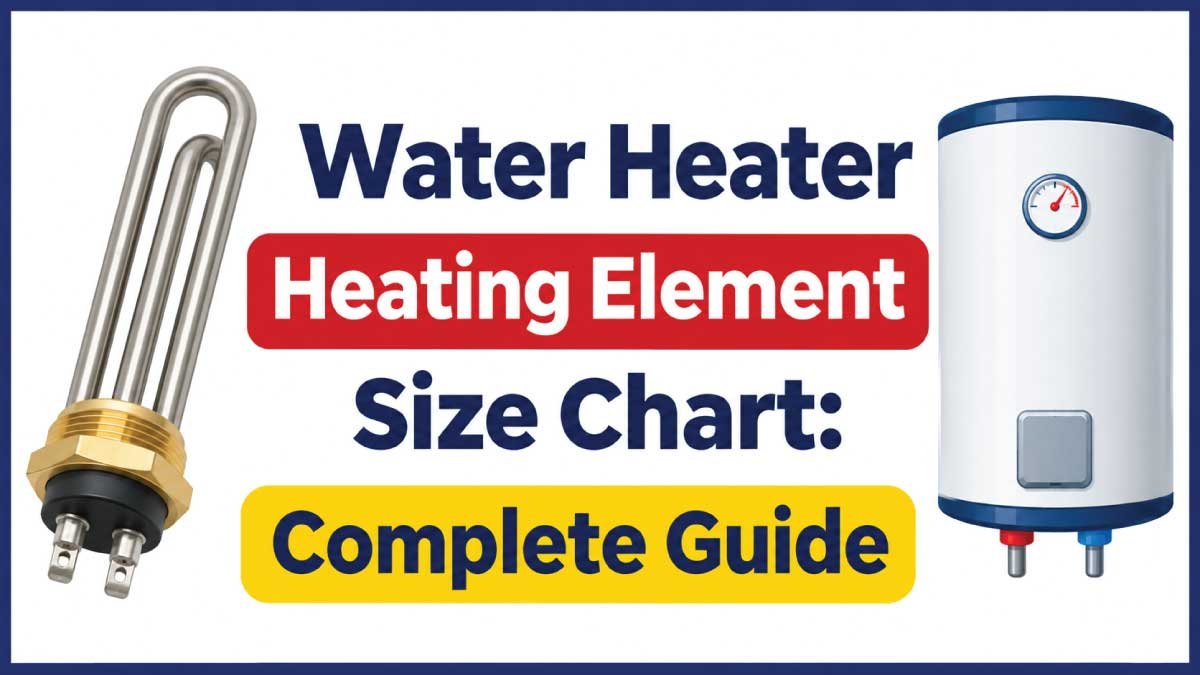
Choosing the correct heating element is essential for keeping an electric water heater operating efficiently and safely. A heating element that has the wrong wattage, voltage, thread size, or physical dimensions may not fit properly or perform as intended. Even when two elements look similar, their electrical specifications and mounting styles can be different.
This Water Heater Heating Element Size Chart explains common element sizes, wattage ratings, voltage options, thread dimensions, and compatibility considerations. It also provides practical instructions for identifying, measuring, and selecting a replacement element.
Whether you are replacing a damaged element, comparing standard residential water heater parts, or checking the specifications of an existing unit, understanding these measurements can help you make a more accurate choice.
1. Understanding Water Heater Heating Element Sizes
An electric water heater uses one or more heating elements to transfer electrical energy into the stored water. These elements are usually installed through the tank wall and positioned inside the water reservoir.
Most conventional residential electric water heaters have two heating elements:
- Upper heating element: Heats the upper portion of the tank and works with the upper thermostat.
- Lower heating element: Heats the lower portion of the tank and is responsible for maintaining the temperature of most stored water.
Although both elements may have similar physical dimensions, they are not automatically interchangeable. Their wattage, voltage, terminal configuration, and manufacturer specifications must be checked.
What Does Heating Element Size Mean?
The term heating element size can refer to several different specifications:
- Wattage: The amount of electrical power the element uses.
- Voltage: The electrical supply required for operation.
- Length: The physical distance from the mounting base to the end of the element.
- Diameter: The thickness of the heating element assembly.
- Thread size: The dimensions of the threaded connection used to secure the element.
- Mounting style: The method used to attach the element to the tank.
For accurate replacement, all relevant specifications should be considered rather than relying on physical appearance alone.
Why Correct Element Size Matters
Using the correct element helps ensure proper heating performance and compatibility with the water heater’s electrical system.
An element with excessive wattage may overload a circuit or exceed the heater’s approved specifications. An element with insufficient wattage may heat water more slowly than intended. Incorrect thread dimensions or mounting styles can prevent proper installation and sealing.
The safest approach is to match the replacement element to the original part number or the water heater manufacturer’s approved specifications.
2. Water Heater Heating Element Size Chart
The following chart provides examples of common residential electric water heater heating element ratings. These are general reference values, not universal specifications. Actual ratings depend on the water heater model, electrical supply, and manufacturer’s design.
Common Heating Element Wattage Chart
| Wattage Rating | Common Voltage | General Application | Typical Consideration |
|---|---|---|---|
| 1,000 W | 120 V | Selected compact or specialty heaters | Lower heating output |
| 1,500 W | 120 V | Small or specialty electric heaters | Check model compatibility |
| 2,000 W | 240 V | Selected residential models | Moderate heating output |
| 3,000 W | 240 V | Residential electric heaters | Common lower-output option |
| 3,500 W | 240 V | Residential electric heaters | Check original rating |
| 4,000 W | 240 V | Selected residential models | Higher heating capacity |
| 4,500 W | 240 V | Many conventional residential heaters | Common standard rating |
| 5,000 W | 240 V | Selected high-output models | Requires approved electrical specifications |
| 5,500 W | 240 V | Selected residential and high-output models | Verify wiring and tank rating |
Not every water heater supports every rating in this chart. A 4,500-watt element, for example, should not automatically replace a 3,500-watt element simply because the mounting connection appears identical.
Common Heating Element Lengths
Heating element length varies according to the tank design and element construction. Some manufacturers use relatively short elements, while others use longer folded or looped designs.
| Approximate Element Length | General Description | Important Note |
|---|---|---|
| 8–10 inches | Compact element designs | Verify clearance inside the tank |
| 10–12 inches | Common residential-style dimensions | Not a universal replacement size |
| 12–14 inches | Longer element designs | Check tank and manufacturer specifications |
| 14–16 inches | Selected extended designs | Confirm internal clearance |
| 16 inches or longer | Specialty or model-specific designs | Use exact replacement specifications |
These length categories are illustrative. Manufacturers may measure element length differently, and the overall shape can affect the amount of clearance required inside the tank.
Common Heating Element Thread and Mounting Types
Residential water heater elements are commonly available in two broad mounting styles:
| Mounting Style | General Description | Compatibility Check |
|---|---|---|
| Screw-in | Uses a threaded base that screws into the tank | Match thread dimensions and gasket |
| Flange-type | Attaches through a flange and multiple fasteners | Match flange shape, bolt pattern, and gasket |
A screw-in element and a flange-type element are not interchangeable unless the water heater is specifically designed to accept both through an approved adapter or replacement arrangement.
3. Common Water Heater Heating Element Voltages
Voltage is one of the most important specifications when selecting a replacement heating element. It describes the electrical potential required for the element to operate as designed.
Residential electric water heaters commonly use 240-volt heating circuits in regions with compatible electrical systems. Some smaller or specialty heaters use 120-volt elements.
120-Volt Heating Elements
A 120-volt element is generally associated with smaller electric water heaters, specialty equipment, and certain compact applications.
These elements usually have lower wattage ratings than common 240-volt residential elements. They should only be installed in equipment designed for that voltage.
240-Volt Heating Elements
Many conventional residential electric water heaters use 240-volt elements. Common ratings include 3,500, 4,000, 4,500, and 5,500 watts, depending on the model.
A 240-volt element must be matched to the water heater’s approved electrical rating. Installing an element with an unsuitable voltage can cause serious performance and safety problems.
Can You Use a Different Voltage Element?
A different voltage rating should never be selected simply because the element physically fits.
Voltage and wattage work together to determine electrical current and heating output. The replacement must comply with the appliance’s specifications and electrical design.
Always check the manufacturer’s rating label and original element markings before purchasing a replacement.
4. Understanding Heating Element Wattage
Wattage measures how much electrical power a heating element consumes when operating at its rated voltage. It directly affects how quickly the element can transfer heat into the water.
A higher-wattage element can generally provide more heating output, but only when the water heater, wiring, thermostat, and electrical circuit are designed to support it.
How Wattage Affects Water Heating
Consider two elements operating at the same voltage:
- A 3,500-watt element provides 3,500 watts of rated heating power.
- A 4,500-watt element provides 4,500 watts of rated heating power.
Under comparable conditions, the 4,500-watt element can heat water faster. However, it also draws more electrical current.
The actual heating time depends on several factors, including:
- Water volume inside the tank.
- Incoming water temperature.
- Desired thermostat setting.
- Element wattage.
- Heat loss through the tank.
- Electrical supply conditions.
- Whether one or both elements are operating.
How to Calculate Heating Element Current
For a simple resistive heating element, electrical current can be estimated using:
[
I = \frac{P}{V}
]
Where:
- (I) = Current in amperes.
- (P) = Power in watts.
- (V) = Voltage.
For example, a 4,500-watt element operating at 240 volts draws approximately:
[
I = \frac{4500}{240} = 18.75\text{ A}
]
This calculation helps explain why wattage changes must be checked against the heater’s approved electrical design. It is not a substitute for checking the circuit, wiring, overcurrent protection, or manufacturer’s instructions.
Does Higher Wattage Always Mean Better Performance?
No. A higher rating does not automatically make an element a better replacement.
If the water heater is designed for a 3,500-watt element, installing a higher-rated element may exceed the permitted electrical load. It can also create problems with the thermostat, wiring, or other components.
The best replacement is the one that matches the manufacturer’s specified voltage and wattage.
5. Screw-In vs. Flange-Type Heating Elements
Mounting style is another important part of heating element compatibility. Even elements with identical wattage ratings may have completely different attachment systems.
Screw-In Heating Elements
Screw-in elements have a threaded base that attaches directly to a matching opening in the water heater tank.
Common characteristics include:
- Threaded mounting connection.
- Sealing gasket or washer.
- Two electrical terminals on many standard designs.
- Replacement options in different wattage ratings and lengths.
Before purchasing a screw-in element, confirm the thread specification, gasket arrangement, and overall compatibility.
Flange-Type Heating Elements
Flange-type elements attach to the water heater using a mounting plate or flange secured with multiple fasteners.
Their specifications may include:
- Flange dimensions.
- Bolt-hole arrangement.
- Number of mounting fasteners.
- Gasket shape.
- Element length and wattage.
The bolt pattern and sealing surface must match the tank connection. A flange element should not be selected based on wattage alone.
Which Mounting Style Is More Common?
Screw-in elements are widely used in many conventional residential electric water heaters. Flange-type elements are also found in certain models and equipment designs.
The water heater’s original construction determines which style is suitable. Always identify the mounting type before ordering a replacement.
Also Read:
6. How to Measure a Water Heater Heating Element
Accurate measurements can help identify a replacement when the original part number is unavailable. However, measuring the element should be combined with checking the heater’s model information.
Step 1: Identify the Original Element
Before measuring, check the manufacturer’s label on the water heater. Record the model number, serial number, voltage, and other available electrical specifications.
If the original element is still available, inspect its markings for wattage and voltage information.
Step 2: Measure the Overall Length
Measure from the mounting surface or base to the farthest end of the element.
Be consistent about the starting point. Some manufacturers specify the insertion length rather than the total length, so compare measurements using the same method.
Step 3: Check the Mounting Connection
For a screw-in element, identify the thread dimensions and base type. For a flange-type element, measure the flange and record the bolt-hole arrangement.
Do not assume that two elements with similar outside dimensions use the same mounting connection.
Step 4: Examine the Element Shape
Heating elements may have different shapes, including straight, folded, or looped designs.
The shape affects how the element sits inside the tank. Check that the replacement has suitable internal clearance and does not interfere with other tank components.
Step 5: Verify Voltage and Wattage
Read the markings on the original element or consult the water heater’s documentation.
These electrical ratings are essential. A physically compatible element may still be electrically unsuitable.
Step 6: Compare the Replacement Specifications
Before purchasing, compare the replacement against the original using:
- Voltage.
- Wattage.
- Mounting style.
- Thread or flange dimensions.
- Length and shape.
- Gasket requirements.
- Manufacturer compatibility information.
If any important specification is uncertain, consult the water heater manufacturer or a qualified technician.
Also Read:
7. How to Choose the Correct Replacement Heating Element
Selecting a replacement requires more than matching the old element’s approximate size. The following considerations can help reduce compatibility problems.
Match the Original Wattage
The original wattage should be your starting point. Check the heater’s label, technical documentation, or original element markings.
Do not increase wattage unless the manufacturer explicitly approves the change for that particular model.
Confirm the Voltage Rating
The replacement voltage must match the heater’s approved electrical configuration.
Never substitute a 120-volt element for a 240-volt element, or the reverse, based only on physical appearance.
Check the Mounting Style
Identify whether the original element uses a screw-in base or a flange. Confirm the thread or flange specifications before ordering.
Consider the Element Material
Heating elements may use different sheath materials and coatings. Common options include copper, stainless steel, and selected alloy or coated designs.
Material selection should account for water chemistry, manufacturer recommendations, and the operating environment.
Use the Water Heater Model Number
The model number is often the most reliable way to identify the correct replacement part.
Manufacturer documentation or an authorized parts supplier can help confirm the appropriate element, gasket, and related components.
Also Read:
8. Common Signs of a Damaged Heating Element
A failing heating element can affect the water heater’s ability to provide hot water. Some symptoms may also be caused by a thermostat, wiring issue, circuit breaker, or other component, so diagnosis is important.
Insufficient Hot Water
If the water heater produces less hot water than usual, one element may not be operating correctly.
In a two-element system, a failed lower element can reduce the amount of water heated during normal operation.
No Hot Water
A complete loss of hot water may indicate an electrical supply problem, thermostat fault, failed element, or other malfunction.
Do not assume that the heating element is the cause without proper testing.
Slow Water Heating
Water that takes unusually long to heat may indicate an element problem, incorrect replacement rating, thermostat issue, or heavy mineral buildup.
Repeated Circuit Breaker Trips
A damaged element or electrical fault can contribute to breaker trips. However, repeated tripping may also indicate wiring or circuit problems.
Do not repeatedly reset a breaker that continues to trip. Have the cause investigated by a qualified professional.
Unusual Noise
Popping, rumbling, or crackling sounds can result from mineral deposits and sediment around the heating element or at the bottom of the tank.
Noise alone does not prove that the element has failed.
9. Important Safety Considerations When Replacing a Heating Element
Water heater heating elements operate on potentially dangerous electrical circuits. Replacement should only be performed by someone qualified to work safely with the equipment.
Disconnect Electrical Power
The electrical supply must be switched off at the appropriate disconnect or circuit breaker before any service work begins.
A qualified person should verify that the circuit is de-energized using suitable test equipment. Turning off the thermostat alone is not sufficient.
Drain Water When Required
The tank may need to be drained below the element opening before removal. Follow the water heater manufacturer’s procedure to prevent water leakage and scalding.
Hot water inside the tank can cause severe burns. Allow the system to cool as required.
Never Energize an Empty Tank
A conventional immersion heating element must be fully covered by water before electrical power is restored.
Operating an element without sufficient water can cause it to overheat and fail rapidly. This is commonly known as dry firing.
Check the Seal and Connections
Use the correct gasket and mounting components. Inspect the sealing surface and follow the manufacturer’s tightening instructions.
Electrical connections must be secure and suitable for the specified circuit.
Have the Work Inspected When Necessary
If the wiring, grounding, breaker, or element specifications are uncertain, contact a qualified electrician or water heater technician.
Following the manufacturer’s service instructions is essential for safe operation.
10. Common Mistakes When Selecting a Heating Element
Even a small specification mismatch can result in an unsuitable replacement.
Choosing by Length Alone
Two elements may have similar lengths but different voltage ratings, wattages, thread sizes, or mounting styles.
Always compare the complete specifications.
Ignoring the Original Wattage
Installing a higher-wattage element without manufacturer approval can create an electrical overload or damage the equipment.
Match the approved rating rather than choosing the highest available option.
Confusing Voltage and Wattage
Voltage and wattage describe different electrical properties. Both must be checked when selecting an element.
An element with the correct wattage but incorrect voltage is not an appropriate replacement.
Using the Wrong Gasket
A mismatched or damaged gasket can cause leaks around the element opening.
Use the gasket specified for the exact mounting arrangement.
Ignoring Mineral Buildup
Hard-water deposits can accumulate around heating elements and reduce performance. Replacing an element without addressing severe sediment or scale problems may not resolve the underlying issue.
Assuming All Residential Elements Are Interchangeable
Water heater designs vary by manufacturer and model. A replacement that fits one tank may not fit another, even when both have similar capacity and electrical ratings.
11. Frequently Asked Questions
What Is the Most Common Water Heater Heating Element Size?
Many conventional residential electric water heaters use 240-volt elements rated around 4,500 watts. However, other wattage ratings are also used. The correct specification depends on the water heater model.
Are All 4,500-Watt Heating Elements the Same Size?
No. Elements with the same wattage can differ in length, shape, mounting style, thread dimensions, and terminal arrangement. Always check compatibility before purchasing.
Can I Replace a 3,500-Watt Element With a 4,500-Watt Element?
Only if the water heater manufacturer specifically approves that rating for the model. A higher-wattage element draws more current and may exceed the equipment’s approved electrical specifications.
How Long Is a Standard Water Heater Heating Element?
There is no single universal length. Many residential elements fall within approximate lengths of 8 to 16 inches, but designs vary. Use the original part number or manufacturer’s measurements for an accurate replacement.
What Is the Difference Between Screw-In and Flange Elements?
A screw-in element attaches through a threaded base, while a flange element attaches using a mounting plate and fasteners. They require different tank connections and are not automatically interchangeable.
How Many Heating Elements Does an Electric Water Heater Have?
Many conventional residential electric water heaters have two elements: an upper element and a lower element. Some compact, specialty, and commercial designs may use a different arrangement.
Can a Heating Element Be Too Powerful?
Yes. An element with excessive wattage may draw more current than the water heater’s wiring and electrical circuit are designed to handle. Always follow the manufacturer’s approved rating.
Why Does a Water Heater Element Burn Out?
Possible causes include mineral buildup, corrosion, age, electrical faults, incorrect voltage, and dry firing. The actual cause should be identified before installing a replacement.
Should Both Heating Elements Be Replaced at the Same Time?
Not necessarily. If testing confirms that only one element has failed, replacing that element may be sufficient. However, the condition of both elements should be checked, particularly on an older water heater.
How Do I Find the Correct Heating Element for My Water Heater?
Start with the model and serial number on the manufacturer’s rating label. Compare the original element’s voltage, wattage, mounting style, and dimensions with the approved replacement information.
12. Conclusion
Choosing the correct water heater heating element requires careful attention to wattage, voltage, length, mounting style, and thread or flange dimensions. Although many residential electric water heaters use common ratings such as 3,500, 4,500, or 5,500 watts at 240 volts, these values should only be treated as general reference points.
The most reliable replacement is one approved for the exact water heater model. Check the manufacturer’s specifications, compare the original element markings, and verify every important dimension before purchasing.
By using a heating element size chart as a starting point and confirming the complete technical requirements, you can avoid common compatibility mistakes and support safe, reliable water heater performance.