
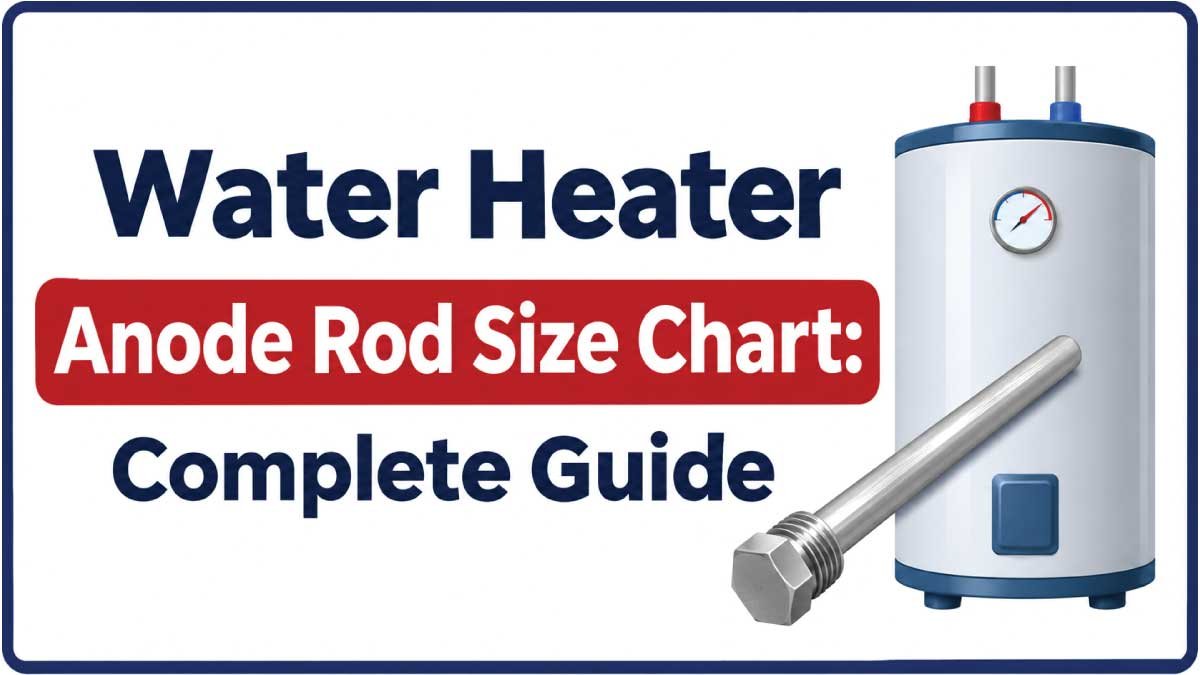
Choosing the correct water heater anode rod size is essential for protecting a storage water heater against internal corrosion and extending its service life. An anode rod is a metal component installed inside the water heater tank. It attracts corrosive elements in the water, helping protect the steel tank lining from deterioration.
A Water Heater Anode Rod Size Chart helps homeowners, plumbers, and maintenance professionals identify suitable replacement rods based on water heater capacity, tank dimensions, connection type, and available installation space. However, selecting the correct anode rod involves more than matching its length to the water heater’s gallon capacity.
Material, diameter, thread size, flexibility, and manufacturer compatibility are also important considerations.
This guide explains common anode rod dimensions, standard connection sizes, different rod materials, measurement methods, replacement considerations, and practical selection tips. It also covers common mistakes and frequently asked questions to help readers choose an appropriate anode rod for their water heating system.
What Is a Water Heater Anode Rod?
A water heater anode rod is a protective metal component installed inside a storage-type water heater. Its primary purpose is to reduce corrosion of the tank’s internal steel surface.
Most conventional storage water heaters contain a steel tank with a protective glass or enamel lining. Although this lining helps prevent corrosion, small imperfections can develop during manufacturing, transportation, installation, or normal operation.
The anode rod provides additional corrosion protection by acting as a sacrificial metal component.
It gradually corrodes instead of allowing the exposed steel tank to deteriorate as quickly.
How Does an Anode Rod Work?
An anode rod works through an electrochemical process known as sacrificial corrosion protection.
When the rod is installed inside the water heater, it reacts with the surrounding water and corrodes preferentially compared with the protected steel tank.
The process generally involves three stages:
- Initial protection: The anode rod begins reacting with water and provides sacrificial corrosion protection.
- Gradual consumption: Over time, the rod material is consumed as it protects exposed areas of the tank.
- Replacement: When the anode material becomes significantly depleted, the rod should be replaced according to its condition and manufacturer recommendations.
Without an effective anode rod, exposed areas of the tank lining may become more vulnerable to corrosion.
Why Is the Correct Anode Rod Size Important?
An incorrectly selected anode rod may not fit the water heater or provide the intended protection.
Important reasons for selecting the correct size include:
- Ensuring proper thread compatibility.
- Providing suitable protective material.
- Allowing adequate clearance inside the tank.
- Avoiding interference with internal components.
- Maintaining compatibility with the manufacturer’s design.
- Supporting effective corrosion protection.
A rod that is too long may not fit into a restricted installation space. A rod with the wrong connection cannot be installed correctly without potentially damaging the tank fitting.
Water Heater Anode Rod Size Chart
Anode rods are available in different lengths, diameters, materials, and connection configurations.
The correct dimensions depend primarily on the water heater’s design rather than storage capacity alone.
The following table provides a general reference for commonly encountered anode rod dimensions. These values are illustrative measurement ranges, not universal manufacturer specifications.
Common Water Heater Anode Rod Dimensions
| Anode Rod Length | Approximate Length in Centimeters | Common Application |
|---|---|---|
| 18 Inches | 45.7 cm | Compact or restricted-space applications |
| 24 Inches | 61.0 cm | Selected smaller water heaters |
| 30 Inches | 76.2 cm | Certain residential water heaters |
| 32 Inches | 81.3 cm | Selected residential models |
| 36 Inches | 91.4 cm | Common replacement configurations |
| 40 Inches | 101.6 cm | Selected larger tank designs |
| 42 Inches | 106.7 cm | Certain residential and commercial models |
| 44 Inches | 111.8 cm | Selected large storage water heaters |
| 48 Inches | 121.9 cm | Specialized larger tank applications |
Important: These lengths do not represent guaranteed replacement sizes for specific water heater capacities. Always check the manufacturer’s parts documentation before purchasing.
Common Anode Rod Diameter
The diameter of an anode rod can vary according to its construction and manufacturer.
A general measurement reference is shown below.
| Approximate Diameter | Approximate Metric Size | Selection Consideration |
|---|---|---|
| 3/4 Inch | 19.05 mm | Verify actual rod and fitting specifications |
| 7/8 Inch | 22.23 mm | Check tank clearance and manufacturer compatibility |
| 1 Inch | 25.4 mm | Confirm the original design dimensions |
These are reference dimensions, not a universal industry standard for all water heater anode rods.
Anode Rod Size by Water Heater Capacity
Water heater capacity can provide a starting point when researching replacement components. However, the same gallon capacity may be available in different tank shapes and internal configurations.
| Water Heater Capacity | Approximate Storage Volume | Anode Rod Selection |
|---|---|---|
| 20 Gallons | 76 L | Check the original model specification |
| 30 Gallons | 114 L | Verify length and connection type |
| 40 Gallons | 151 L | Match the manufacturer’s approved rod |
| 50 Gallons | 189 L | Confirm original rod dimensions |
| 60 Gallons | 227 L | Check tank design and available clearance |
| 75 Gallons | 284 L | Verify manufacturer-specific requirements |
| 80 Gallons | 303 L | Confirm rod type and installation configuration |
| 100 Gallons | 379 L | Use the approved commercial or large-tank specification |
A larger water heater does not automatically require a longer anode rod. Tank geometry and internal component placement are equally important.
Types of Water Heater Anode Rods
Anode rods are manufactured using different materials. Each type has distinct characteristics that influence its performance and suitability.
1. Magnesium Anode Rods
Magnesium anode rods are widely used in residential water heaters.
Magnesium is relatively reactive, allowing it to provide sacrificial corrosion protection in many water conditions.
Advantages include:
- Effective sacrificial protection.
- Common availability.
- Compatibility with many conventional storage water heaters.
- Suitable performance in many residential applications.
However, magnesium rods may be consumed more quickly in certain water conditions.
Some water heaters may also develop odor problems associated with interactions between water chemistry, bacteria, and the anode system.
2. Aluminum Anode Rods
Aluminum anode rods are another common option.
They provide sacrificial corrosion protection and may be suitable for specific water conditions and water heater designs.
Important characteristics include:
- Alternative corrosion protection material.
- Availability in different lengths.
- Compatibility with selected residential water heaters.
- Different consumption characteristics compared with magnesium.
The correct material should be selected according to manufacturer recommendations and local water conditions.
3. Aluminum-Zinc Anode Rods
Some anode rods use aluminum alloys containing zinc.
These products are designed for particular water conditions and may help address certain odor-related concerns when used in compatible systems.
However, an aluminum-zinc rod should not automatically be considered suitable for every water heater.
Its material composition and approval should be checked before installation.
4. Powered Anode Rods
Powered anode rods use an electrical current to provide corrosion protection instead of relying exclusively on the gradual consumption of a sacrificial metal rod.
They are designed differently from conventional magnesium and aluminum rods.
Potential characteristics include:
- Reduced consumption of sacrificial metal.
- Different maintenance requirements.
- Compatibility with selected water heater models.
- Dependence on an appropriate electrical connection.
Powered anode rods must be specifically approved for the water heater. They are not universal replacements for conventional anode rods.
How to Measure a Water Heater Anode Rod
Measuring an existing anode rod is useful when identifying a replacement. However, the original rod’s condition and manufacturer specifications should also be considered.
Step 1: Identify the Water Heater Model
Locate the manufacturer’s identification label on the water heater.
Record the following information:
- Manufacturer name.
- Model number.
- Serial number.
- Tank capacity.
- Product series, if available.
The model number is particularly useful because manufacturers may use different anode rod configurations for water heaters with identical capacities.
Step 2: Locate the Anode Rod
Most conventional storage water heaters have an anode rod installed through a dedicated opening at the top of the tank.
Depending on the design, the anode rod may be located beneath a protective cap or integrated with another component.
Some water heaters have specialized arrangements that are not immediately visible.
Follow the manufacturer’s instructions before attempting removal.
Step 3: Measure the Rod Length
After safe removal, measure the rod from its upper end to its lower end.
Use a measuring tape or ruler.
Record the measurement in inches or millimeters.
For example:
- 24 inches = 609.6 mm.
- 30 inches = 762 mm.
- 36 inches = 914.4 mm.
- 42 inches = 1,066.8 mm.
If the original rod is severely corroded or shortened, its remaining length may not represent the original specification.
Step 4: Measure the Diameter
Use a caliper to measure the rod diameter at a section that has not been significantly corroded.
The diameter should be compared with the replacement manufacturer’s specifications.
Do not assume that all rods with similar lengths have identical diameters.
Step 5: Check the Thread Size
The threaded connection is one of the most important compatibility factors.
Inspect the original fitting and verify:
- Thread diameter.
- Thread type.
- Thread pitch, where applicable.
- Connection configuration.
- Manufacturer compatibility.
A replacement with an incompatible thread can damage the water heater’s connection.
Step 6: Check Available Installation Clearance
Some water heaters are installed in garages, basements, closets, and other restricted spaces.
A full-length rigid anode rod may not fit if the ceiling or nearby equipment limits vertical clearance.
In such cases, a manufacturer-approved flexible or segmented anode rod may be appropriate.
Also Read:
How to Choose the Correct Replacement Anode Rod
Choosing a replacement requires matching the physical dimensions and material with the water heater’s original design.
Check Manufacturer Compatibility
The most reliable method is to use the model number to identify the approved replacement part.
Manufacturer documentation can provide:
- Original anode rod part number.
- Required rod length.
- Rod diameter.
- Thread configuration.
- Material specification.
- Approved alternative components.
This information is more reliable than choosing a rod based only on the tank’s gallon capacity.
Select the Appropriate Material
Consider the water chemistry and manufacturer’s recommendations.
For example:
- Magnesium may be suitable for many conventional residential systems.
- Aluminum may be appropriate for selected water conditions.
- Aluminum-zinc products may be recommended for certain odor-related concerns.
- Powered rods may be suitable for compatible specialized applications.
The material should not be changed without considering the water heater manufacturer’s guidance.
Consider Installation Space
Measure the available vertical clearance above the tank.
If there is insufficient room for a rigid rod, investigate approved flexible alternatives.
Do not cut or modify a conventional anode rod unless the manufacturer specifically permits that procedure.
Verify Thread Compatibility
Even when length and diameter appear correct, an incompatible threaded connection can prevent proper installation.
Always confirm the exact connection requirements before ordering.
Also Read:
Signs That a Water Heater Anode Rod Needs Replacement
Anode rods gradually deteriorate during normal operation. Their condition should be inspected according to manufacturer recommendations and water conditions.
Common signs of deterioration include:
1. Significant Material Loss
A rod that has lost a substantial portion of its original material may no longer provide adequate protection.
Deep corrosion, severe thinning, and missing sections are reasons to evaluate replacement.
2. Exposed Internal Wire
Many conventional anode rods contain a metal core wire.
If much of the sacrificial material has disappeared and the internal wire is exposed, the rod may be nearing the end of its useful service life.
3. Reduced Rod Diameter
A rod that has become substantially thinner than its original dimensions may require replacement.
Compare its condition with the manufacturer’s inspection criteria rather than relying on appearance alone.
4. Water Heater Corrosion Symptoms
Rust-colored water, tank leakage, or corrosion around connections may indicate problems with the water heater.
However, these symptoms do not automatically prove that the anode rod is depleted.
A qualified technician should inspect the tank and determine the cause.
5. Unusual Water Odor
Some hot water systems develop sulfur-like odors because of interactions between water chemistry, bacteria, and anode materials.
Changing the anode rod material may help in certain situations, but the cause should be identified before replacing components.
Also Read:
Anode Rod Installation and Replacement Guide
Replacing an anode rod involves working with a pressurized hot water system and a heavy threaded component.
Proper preparation is important.
Prepare the Water Heater
Before replacement:
- Turn off the electric supply to an electric water heater.
- Turn off the gas supply to a gas water heater according to manufacturer instructions.
- Allow the water to cool sufficiently.
- Shut off the cold water supply.
- Relieve system pressure using the approved procedure.
- Prepare a suitable drainage arrangement.
Never attempt to remove an anode rod from a hot, pressurized tank.
Remove the Old Anode Rod
Use the correct socket and suitable tools for the original connection.
Some rods can be difficult to remove because of corrosion, mineral deposits, or excessive tightening.
Avoid applying force that could damage the tank fitting.
If the rod cannot be removed safely, professional assistance is recommended.
Install the Replacement Rod
Before installation:
- Verify the replacement part number.
- Check the rod’s physical dimensions.
- Confirm the thread compatibility.
- Inspect the tank opening.
- Follow the manufacturer’s sealing and tightening instructions.
Install the rod without cross-threading or damaging the tank connection.
Restore the Water Heater
After installation, follow the manufacturer’s startup procedure.
Refill the tank completely and remove trapped air from the hot water plumbing before restoring power to an electric water heater.
For gas equipment, follow the approved relighting and startup instructions.
Check the connection for leaks.
Common Anode Rod Replacement Mistakes
Incorrect replacement practices can reduce corrosion protection or damage the water heater.
Choosing the Rod Only by Tank Capacity
Two 50-gallon water heaters may require different anode rod lengths and connection configurations.
Always check the model-specific part specification.
Ignoring the Thread Size
An incorrectly threaded rod can damage the tank opening.
Verify thread compatibility before installation.
Installing an Unapproved Material
Changing from magnesium to aluminum or another material without checking compatibility may produce undesirable results.
Follow manufacturer recommendations.
Cutting a Rod Without Approval
Shortening a rod may seem like an easy solution for restricted spaces, but modification can affect the product’s design and performance.
Use an approved flexible or segmented replacement when required.
Removing the Rod Without Depressurizing the Tank
A pressurized tank can discharge hot water when the anode rod is removed.
Always follow the proper shutdown and depressurization procedure.
Water Heater Anode Rod Maintenance and Service Life
The service life of an anode rod depends on several factors.
These include:
- Water chemistry.
- Water hardness.
- Chloride concentration.
- Water temperature.
- Hot water consumption.
- Tank design.
- Anode material.
- Operating conditions.
There is no single replacement interval that applies to every water heater.
Many manufacturers recommend periodic inspection, with the first inspection often performed within the initial few years of operation. The exact interval should follow the water heater documentation and actual water conditions.
Regular inspections can identify deterioration before the protective material becomes depleted.
Replacing the anode rod at the appropriate time can help protect the tank’s internal steel surface and support a longer service life.
Frequently Asked Questions About Water Heater Anode Rod Sizes
1. What size anode rod does a 40-gallon water heater need?
A 40-gallon water heater does not have one universal anode rod size. The correct length, diameter, material, and thread configuration depend on the specific manufacturer and model.
2. What size anode rod is used in a 50-gallon water heater?
A 50-gallon water heater may use different anode rod configurations depending on tank design. Check the manufacturer’s replacement part number rather than selecting a rod by capacity alone.
3. Are all water heater anode rods the same size?
No. Anode rods vary in length, diameter, material, thread configuration, and construction. Always verify compatibility before purchasing a replacement.
4. How long should a water heater anode rod be?
Anode rod length depends on the original water heater design. Commonly encountered lengths include 24, 30, 36, 40, and 42 inches, but the correct specification must be confirmed for the particular model.
5. Which is better: magnesium or aluminum anode rods?
Neither material is universally better. Magnesium rods are commonly used in residential systems, while aluminum rods may be suitable for particular water conditions. Follow manufacturer recommendations when selecting the material.
6. Can I use a flexible anode rod instead of a straight rod?
A flexible or segmented anode rod may be suitable when installation clearance is restricted. However, it must be compatible with the water heater and approved for that application.
7. How often should a water heater anode rod be replaced?
Replacement frequency depends on water chemistry, usage, and rod material. Inspect the rod according to manufacturer recommendations and replace it when its remaining protective material reaches the specified replacement condition.
8. Can a water heater operate without an anode rod?
Some specialized water heaters use alternative corrosion protection systems. However, removing a required anode rod from a conventional storage water heater can increase tank corrosion risk. Follow the manufacturer’s design requirements.
9. Why does my hot water smell like rotten eggs?
A sulfur-like odor can result from interactions between water chemistry, bacteria, and the anode rod. A qualified professional can identify the cause and determine whether changing the anode material or treating the water is appropriate.
10. Can I cut an anode rod to make it fit?
Do not cut or modify an anode rod unless the manufacturer specifically allows it. An approved flexible or segmented replacement is generally a better option when vertical clearance is limited.
Conclusion: Choosing the Right Water Heater Anode Rod Size
Selecting the correct water heater anode rod size is important for maintaining effective corrosion protection and supporting the long-term performance of a storage water heater.
A Water Heater Anode Rod Size Chart provides a useful reference for understanding common rod lengths and dimensions. However, the correct replacement must also match the manufacturer’s specifications, tank design, thread configuration, material requirements, and available installation space.
Before purchasing a replacement, identify the water heater model, verify the original part number, and inspect the existing rod’s condition. Regular maintenance and timely replacement help preserve the tank’s internal protection and reduce the risk of premature corrosion.
The best approach is to select a compatible, manufacturer-approved anode rod rather than relying on storage capacity or approximate dimensions alone.