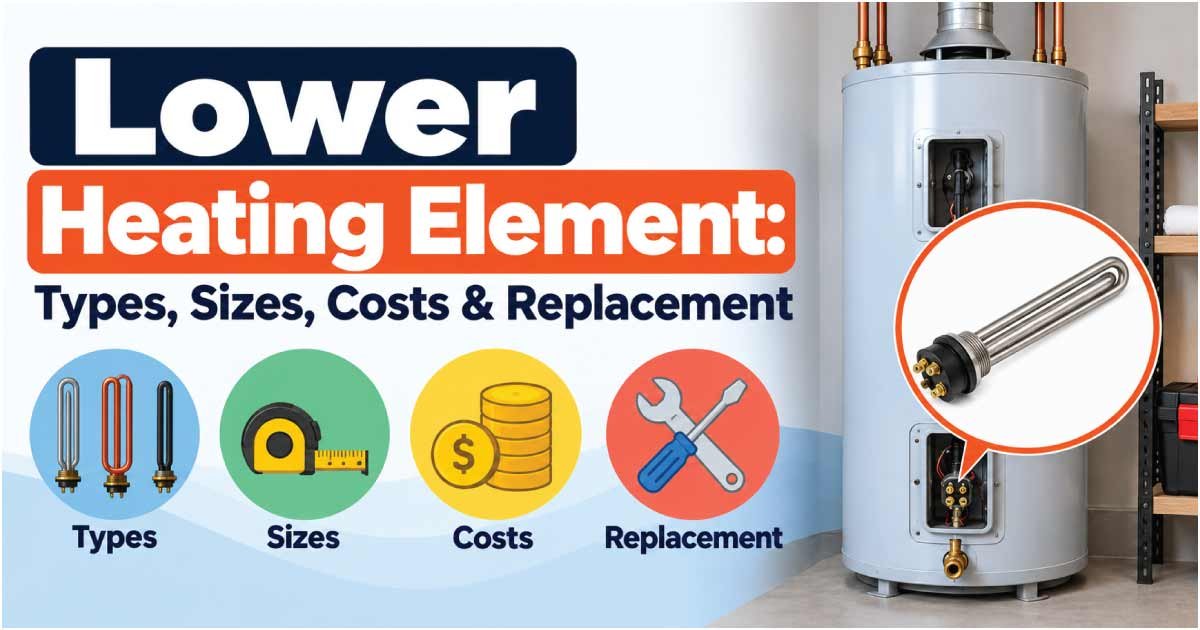
The lower heating element is one of the most important components in a two-element electric storage water heater. Installed in the lower portion of the tank, it heats a large volume of stored water and helps maintain the heater’s recovery performance after hot water is used.
When a lower heating element fails, a water heater may still produce some hot water, but the supply can run out quickly or take much longer to recover. Identifying the correct replacement requires attention to wattage, voltage, mounting style, physical length, watt density, material, and water heater compatibility.
This guide covers lower heating element types, sizes, wattages, costs, failure symptoms, testing, replacement, and maintenance.
What Is a Lower Heating Element?
A lower heating element is an electrically powered resistance-heating component positioned toward the bottom of an electric storage water heater.
Its purpose is to transfer heat into the water surrounding the element. In a typical two-element water heater, the lower element is responsible for heating a substantial portion of the tank after the upper heating zone has reached its target temperature.
A conventional two-element system commonly includes:
- Upper heating element
- Lower heating element
- Upper thermostat
- Lower thermostat
- High-limit safety control
- Electrical wiring
- Storage tank
The lower element is particularly important because it heats the larger lower volume of the tank.
How Does a Lower Heating Element Work?
A lower heating element uses electrical resistance to produce heat.
When the element receives electrical power, its internal resistance causes it to heat. The heat passes through the element’s metal sheath and into the surrounding water.
In a typical two-element system, the upper element has priority during certain heating cycles. Once the upper portion reaches the thermostat setting, power can be directed to the lower element.
The lower element then heats the water in the lower section of the tank.
Typical Heating Sequence
A simplified operating sequence can include:
- Hot water is used from the tank.
- Cold replacement water enters the tank.
- The thermostat detects reduced temperature.
- The upper heating circuit receives priority.
- The upper section is reheated.
- Control transfers heating to the lower section.
- The lower heating element heats the remaining water.
- The thermostat cycles the element off when the target temperature is reached.
Actual operation varies according to the water heater design and controls.
Why Is the Lower Heating Element Important?
The lower element is important because the majority of the tank’s stored water is located around and above the lower heating zone.
When the lower element operates correctly, it helps restore the tank’s overall hot-water capacity.
A failed lower element may not eliminate all hot water immediately. Instead, you may notice that the first amount of hot water is normal but the supply becomes cold much sooner than expected.
This is one reason lower-element failures can sometimes be confused with other water heater problems.
Types of Lower Heating Elements
Lower heating elements are available in several designs.
Common categories include:
- Screw-in lower heating elements
- Bolt-in lower heating elements
- Universal lower heating elements
- High-watt-density elements
- Low-watt-density elements
- Foldback elements
- Copper elements
- Stainless-steel elements
The correct type depends on the water heater’s original design and manufacturer specifications.
Screw-In Lower Heating Element
The screw-in lower heating element has a threaded mounting base that screws directly into a compatible tank opening.
This is one of the most common designs in residential electric storage water heaters.
A gasket is generally used to create the water-tight seal between the element and tank.
Advantages of Screw-In Elements
Screw-in elements are widely available and come in many different wattages, voltages, lengths, and materials.
Benefits include:
- Broad availability
- Simple threaded mounting
- Many replacement choices
- Multiple watt-density options
- Different material options
- Easy specification matching
The replacement must have the correct thread, electrical rating, physical dimensions, and gasket.
Bolt-In Lower Heating Element
A bolt-in lower heating element is secured using bolts through a mounting flange.
This design differs from the threaded screw-in style.
Bolt-in elements are used on certain water heater models and should be replaced with the same mounting configuration unless the manufacturer specifies an approved alternative.
What to Check
Before buying a bolt-in element, verify:
- Number of bolts
- Bolt-hole pattern
- Flange dimensions
- Gasket shape
- Element length
- Voltage
- Wattage
- Terminal configuration
A bolt-in element that has the correct wattage but the wrong flange will not be a suitable replacement.
Universal Lower Heating Element
A universal lower heating element is designed to accommodate multiple compatible water heater models.
These elements can be useful when an exact original replacement is unavailable.
However, universal does not mean that the element will fit every water heater.
Always confirm:
- Voltage
- Wattage
- Mounting style
- Physical dimensions
- Terminal arrangement
- Thread or flange configuration
- Manufacturer compatibility
The water heater’s specifications should always take priority over a generic “universal” label.
Lower Heating Element Wattage Sizes
Wattage represents the amount of electrical power converted into heat by the element.
Common residential element ratings include:
| Wattage | Relative Heating Output | Typical Use |
|---|---|---|
| 1,000 W | Low | Small/specialty systems |
| 1,500 W | Low–moderate | Compact systems |
| 2,000 W | Moderate | Selected residential heaters |
| 2,500 W | Moderate | Selected applications |
| 3,000 W | Moderate–high | Higher demand |
| 3,500 W | High | Compatible residential heaters |
| 4,000 W | High | Higher-output systems |
| 4,500 W | High | Common residential rating |
| 5,000 W | Very high | Selected systems |
| 5,500 W | Very high | Compatible high-output heaters |
These values are reference categories rather than a recommendation to change the wattage of a particular heater.
What Is the Most Common Lower Element Wattage?
Many residential electric storage water heaters use a lower element rated around 4,500 watts at 240 volts.
However, some systems use different ratings.
The correct wattage is determined by the heater’s electrical design, not simply its tank capacity.
For example, installing a higher-wattage element into a system designed for a lower rating can increase electrical current beyond the intended design.
Always match the specified rating unless the manufacturer explicitly permits an alternative.
Lower Heating Element Voltage Sizes
Voltage is another critical specification.
Common element voltage ratings include:
| Voltage | General Application |
|---|---|
| 120 V | Small or specialty heaters |
| 208 V | Certain commercial systems |
| 220 V | Selected installations |
| 240 V | Common residential systems |
| 277 V | Certain commercial applications |
| 480 V | Industrial/commercial systems |
The voltage rating should be taken from the water heater specifications or original element.
Never select an element based only on the wattage.
Lower Heating Element Physical Sizes
Physical size usually refers to the length of the heating section and the dimensions of the mounting assembly.
Common element lengths can range from approximately 7 inches to more than 15 inches depending on the design.
| Approximate Length | General Description |
|---|---|
| 7 in | Short/foldback design |
| 8 in | Compact element |
| 9 in | Short element |
| 10 in | Medium-short |
| 11 in | Medium |
| 12 in | Common range |
| 13 in | Longer design |
| 14 in | Extended design |
| 15+ in | Specialty applications |
Length should always be checked against the heater specifications.
Two elements with identical wattage can have different physical lengths and constructions.
Lower Heating Element Size Chart
| Specification | Common Range |
|---|---|
| Residential voltage | Often 240 V |
| Residential wattage | Often 3,500–5,500 W |
| Common wattage | Around 4,500 W |
| Physical length | Approximately 7–15+ in |
| Mounting | Screw-in or bolt-in |
| Materials | Copper, stainless steel, specialty alloys |
| Watt density | Low, medium, or high |
| Position | Lower tank |
This chart provides general reference information. The exact heater model determines the correct replacement.
Lower Heating Element Costs
The cost of a lower heating element depends on its specifications and construction.
Standard screw-in elements are generally among the simpler replacement components, while specialty elements can cost more.
| Element Type | General Cost Level |
|---|---|
| Standard screw-in | Lower |
| Standard bolt-in | Low–moderate |
| Universal | Moderate |
| Low-watt-density | Moderate–higher |
| Stainless steel | Moderate–higher |
| Specialty commercial element | Higher |
| Professional replacement | Higher total cost due to labor |
Actual prices vary significantly by manufacturer, location, model, retailer, and replacement quality.
When comparing prices, compare the exact specifications and part number, not just the listed wattage.
Low-Watt-Density Lower Heating Element
A low-watt-density element distributes its heating output across a relatively larger heating surface.
This generally reduces the amount of heat concentrated at a particular section of the element.
Low-watt-density elements are often considered for environments where mineral buildup is a concern.
Potential Benefits
They may provide:
- Lower surface temperature
- Reduced stress from mineral scale
- Good performance in hard-water environments
- Potentially longer service life in suitable conditions
The total wattage can still be substantial. “Low watt density” does not mean “low wattage.”
High-Watt-Density Lower Heating Element
A high-watt-density element produces substantial heat over a relatively smaller heating surface.
These elements can provide strong heating performance and are widely used in conventional water heaters.
The higher surface temperature can make mineral deposits more problematic in some hard-water environments.
The correct choice depends on the original heater design and water conditions.
Discover More:
Copper Lower Heating Element
Copper is widely used in heating-element construction because of its excellent thermal conductivity.
Copper elements are available in many residential configurations.
Their suitability depends on:
- Water chemistry
- Tank construction
- Manufacturer specifications
- Element wattage
- Mounting configuration
A copper element should not be selected solely because it transfers heat efficiently.
Stainless-Steel Lower Heating Element
Stainless-steel elements can provide strong corrosion resistance in appropriate applications.
They are available in both standard and specialty configurations.
Potential advantages include:
- Good corrosion resistance
- Durable construction
- Compatibility with selected water conditions
- Availability in low-watt-density designs
However, stainless steel is not automatically the best choice for every water heater. Compatibility remains essential.
Discover More:
Signs of a Bad Lower Heating Element
A defective lower element often produces a recognizable pattern.
Common symptoms include:
- Hot water runs out quickly
- Water heater recovery is unusually slow
- The tank does not maintain temperature properly
- Water becomes cold after moderate use
- Element resistance is outside the expected range
- The element has visible corrosion
- Electrical connections show damage
- The circuit breaker trips
A failed lower element is not the only possible cause of these symptoms.
Thermostats, wiring, electrical supply, sediment, or other components can create similar problems.
What Happens When the Lower Element Fails?
When the lower heating element fails, the upper section of the tank may still become hot.
This means the water heater can initially appear to work normally.
However, because the lower portion remains inadequately heated, the total usable hot-water supply can be greatly reduced.
A common symptom is:
Hot water starts normally → hot water runs out quickly → recovery becomes slow.
This pattern can point toward a lower-element or lower-control problem, although proper diagnosis is required before replacing components.
Discover More:
Why Lower Heating Elements Fail
Several factors can contribute to element failure.
Mineral Scale
Hard-water minerals can accumulate on the element.
Heavy scale can reduce efficient heat transfer and increase thermal stress.
Corrosion
The element’s metal sheath can deteriorate because of water chemistry and long-term exposure.
Dry-Firing
If an electric element is energized without being properly submerged, it can overheat rapidly and fail.
Electrical Damage
Loose connections, damaged wiring, incorrect voltage, and other electrical problems can contribute to failure.
Normal Aging
Heating elements repeatedly expand and contract during heating cycles. Eventually, the internal heating wire or outer sheath can fail.
How to Test a Lower Heating Element
Testing an element should only be performed after the electrical supply has been safely disconnected.
A multimeter can be used to measure resistance.
For a resistive element:
R = V² ÷ P
For a 4,500-watt element at 240 volts:
R = 240² ÷ 4,500
R ≈ 12.8 Ω
For a 3,500-watt element at 240 volts:
R ≈ 16.5 Ω
For a 5,500-watt element at 240 volts:
R ≈ 10.5 Ω
These are calculated reference values. Actual measurements can vary slightly.
Testing for a Ground Fault
A qualified person can also check whether the element has unintended continuity to the tank.
An element that has developed a ground fault may trip the electrical protection or cause other symptoms.
Because water heaters involve high electrical voltage and water, electrical testing should be performed only with appropriate safety knowledge and equipment.
How to Choose the Correct Lower Heating Element
The best starting point is the water heater’s model and rating plate.
Record:
- Manufacturer
- Model number
- Voltage
- Wattage
- Tank capacity
- Element specifications
Then compare those specifications with the replacement.
Essential Specifications
Check all of the following:
Voltage: Must match the heater’s electrical system.
Wattage: Should match the specified rating.
Mounting style: Confirm screw-in or bolt-in.
Physical length: Make sure the element fits inside the tank correctly.
Terminal type: Confirm electrical connection compatibility.
Material: Select an appropriate element construction.
Gasket: Use the correct replacement seal.
Lower Heating Element Replacement
Replacing a lower element requires careful electrical and plumbing preparation.
A general replacement sequence is:
- Turn off the water heater’s electrical supply.
- Verify that the power is actually off.
- Allow the water to cool as appropriate.
- Shut off the water supply when necessary.
- Drain enough water to expose the lower element.
- Disconnect the electrical wires.
- Remove the old element.
- Clean and inspect the sealing area.
- Install the correct gasket.
- Install the replacement element.
- Reconnect wiring according to the manufacturer’s instructions.
- Refill the tank completely.
- Check the element area for leaks.
- Restore power only after confirming the tank is full.
The exact procedure varies according to the water heater design.
Why You Should Never Energize an Empty Tank
An electric heating element is designed to transfer heat into water.
If the element is exposed to air while energized, its temperature can rise extremely quickly because air does not remove heat as effectively as water.
This can cause immediate element failure.
After replacement, make sure the tank is properly filled before restoring electrical power.
A hot-water faucet can generally be opened during filling to help release trapped air, following the heater manufacturer’s instructions.
Lower Heating Element vs Upper Heating Element
| Feature | Lower Element | Upper Element |
|---|---|---|
| Location | Lower section | Upper section |
| Heating role | Heats most of tank volume | Usually receives heating priority |
| Typical thermostat | Lower thermostat | Upper thermostat |
| Failure symptom | Often reduced hot-water capacity | Can cause major heating loss |
| Common wattage | Model dependent | Model dependent |
| Mounting | Screw-in/bolt-in | Screw-in/bolt-in |
| Replacement | Match heater specifications | Match heater specifications |
The elements can sometimes have similar physical characteristics, but they should not be assumed to be interchangeable.
Screw-In vs Bolt-In Lower Elements
| Feature | Screw-In | Bolt-In |
|---|---|---|
| Mounting method | Threaded base | Bolted flange |
| Installation | Screws into tank | Bolts to tank |
| Availability | Very broad | Model dependent |
| Gasket | Usually required | Usually required |
| Identification | Threaded mounting | Bolt pattern/flange |
| Compatibility | Must match thread | Must match flange |
The mounting design must match the water heater unless an approved conversion is specified.
How to Make a Lower Heating Element Last Longer
Good maintenance can reduce stress on the heating system.
Useful practices include:
- Follow the manufacturer’s maintenance schedule.
- Flush the tank when appropriate for the heater.
- Monitor for leaks.
- Check electrical connections during qualified maintenance.
- Inspect the anode rod when applicable.
- Address excessive mineral buildup.
- Use the correct wattage replacement.
- Avoid energizing an empty tank.
- Investigate repeated element failures instead of repeatedly replacing the element.
If an element fails repeatedly, the underlying cause should be investigated.
Frequently Asked Questions
What is a lower heating element?
A lower heating element is an electric resistance heater installed in the lower section of a two-element storage water heater. It heats a large portion of the stored water.
What is the most common lower heating element size?
Many residential systems use elements around 4,500 watts at 240 volts, but the correct rating varies by water heater model.
How do I know if my lower element is bad?
Common signs include hot water running out quickly, slow recovery, and abnormal resistance measurements. A thermostat or electrical problem can cause similar symptoms.
Are upper and lower heating elements interchangeable?
Not necessarily. Some heaters use similar elements in both positions, but others have position-specific components. Always follow the manufacturer’s specifications.
How much does a lower heating element cost?
Cost depends on the element’s wattage, voltage, mounting design, material, manufacturer, and whether it is a standard or specialty component. Professional labor adds to the total.
Can I install a 5,500-watt element instead of a 4,500-watt element?
Do not do so unless the manufacturer specifically approves the change. Higher wattage can increase electrical load and may exceed the heater’s design limits.
What voltage is a lower heating element?
Many residential elements are rated for 240 volts, but 120, 208, 220, 277, and 480-volt elements are also used in different systems.
Is a low-watt-density element better?
A low-watt-density element can be beneficial in some hard-water environments because its heating output is spread over a larger surface. Compatibility is still essential.
How long does a lower heating element last?
There is no fixed lifespan. Service life depends on water chemistry, scale, corrosion, electrical conditions, usage, maintenance, and element construction.
Lower Heating Element Replacement Checklist
Before ordering a replacement, verify:
- Water heater manufacturer
- Model number
- Lower-element position
- Voltage
- Wattage
- Mounting type
- Thread or bolt pattern
- Element length
- Terminal configuration
- Gasket
- Element material
- Watt density
- Manufacturer compatibility
Matching every important specification is much safer than choosing an element based on appearance alone.
Final Takeaway
The lower heating element plays a major role in maintaining the hot-water capacity of a two-element electric storage water heater. Because it heats a large portion of the tank, its failure can cause hot water to run out quickly even when the upper section still becomes hot.
The most common designs include screw-in, bolt-in, universal, high-watt-density, low-watt-density, copper, stainless-steel, and foldback elements.
When selecting a replacement, check the voltage, wattage, mounting style, physical length, terminal configuration, material, and water heater model. Many residential heaters use 240-volt elements, with 4,500 watts being a common rating, but these specifications are not universal.
For safe replacement, disconnect electrical power, drain the tank as required, install the correct gasket and element, refill the tank completely, check for leaks, and only then restore power.
A correctly matched lower heating element can restore normal recovery performance and help the water heater operate efficiently for years.