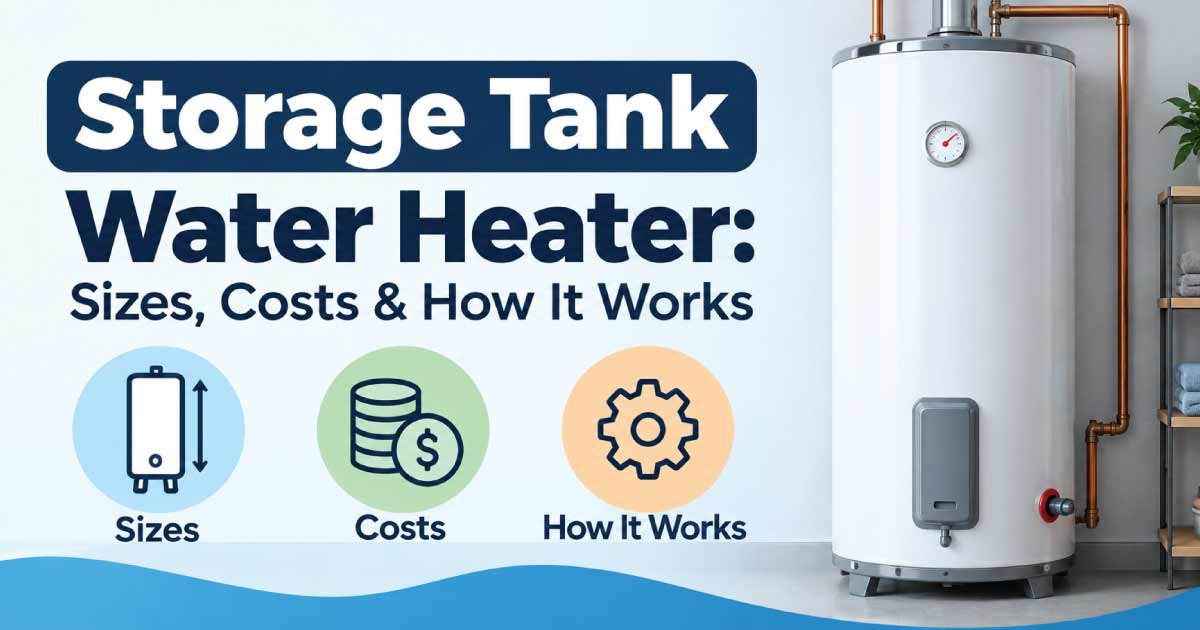
A storage tank water heater is one of the most widely used systems for producing and storing hot water in residential and commercial properties. Unlike a tankless water heater, which heats water only when it flows through the unit, a storage tank water heater keeps a reserve of heated water ready for use.
Storage tank water heaters are available in different sizes, fuel types, efficiency levels, and configurations. Common options include electric storage water heaters, gas storage water heaters, and heat pump water heaters that use a storage tank.
Choosing the right model requires more than simply selecting the largest tank available. Tank capacity, household size, peak hot-water demand, recovery rate, energy source, installation space, operating cost, and efficiency all affect which water heater is appropriate.
This guide explains how a storage tank water heater works, common tank sizes, estimated costs, types, energy efficiency, installation requirements, maintenance, common problems, and how to select the right model for your home.
What Is a Storage Tank Water Heater?
A storage tank water heater is an appliance that heats water and stores it inside an insulated tank until it is needed. The tank contains a heating system that periodically raises the water temperature to the desired setting.
When someone opens a hot-water faucet, shower, or other fixture, hot water leaves the upper portion of the tank. Cold water then enters the tank through the cold-water inlet and replaces the water that has been used.
The heating system reheats the incoming water and restores the tank to its selected temperature.
A typical storage tank water heater includes:
- Insulated storage tank
- Cold-water inlet
- Hot-water outlet
- Heating element or burner
- Thermostat
- Temperature and pressure relief valve
- Drain valve
- Anode rod
- Dip tube
- Water connections
- Venting components on combustion models
The tank is normally insulated to reduce heat loss between heating cycles.
How Does a Storage Tank Water Heater Work?
The operating principle of a storage water heater is straightforward. Water enters the tank, gets heated, remains stored, and is delivered whenever hot water is required.
The process generally follows these steps:
- Cold water enters through the inlet pipe.
- The water fills the storage tank.
- The thermostat monitors the water temperature.
- When the temperature drops below the selected setting, the heating system activates.
- The burner or heating element transfers heat to the water.
- Hot water rises toward the top of the tank.
- When a hot-water fixture is opened, hot water exits the tank.
- Cold water enters to replace the water being used.
- The heater operates again as needed.
This cycle allows the system to maintain a relatively consistent supply of hot water.
Why Hot Water Comes From the Top of the Tank
Water naturally becomes less dense as it is heated, so hot water tends to move upward inside the tank.
The hot-water outlet is positioned near the upper portion of the storage tank. This allows the system to deliver heated water while colder incoming water remains toward the lower portion.
This design helps the heater provide hot water even while the incoming water is being heated.
Types of Storage Tank Water Heaters
Storage tank water heaters are mainly differentiated by their heating technology and energy source.
The most common categories include electric, gas, and heat pump storage water heaters.
Electric Storage Tank Water Heater
An electric storage tank water heater uses electrical heating elements to heat the water.
Many residential electric models have one or two heating elements. The thermostat controls when the elements operate.
Electric storage water heaters are commonly used where:
- Natural gas is unavailable
- Electrical service is readily available
- Combustion venting is undesirable
- Installation simplicity is important
- The property already uses electricity for water heating
Electric models do not require combustion gases to be vented because they do not burn fuel.
Gas Storage Tank Water Heater
A gas storage tank water heater uses a burner located beneath or associated with the tank to heat the stored water.
Natural gas is a common fuel, although specific models may be designed for other gas fuels.
Gas storage water heaters generally require:
- Gas supply
- Burner assembly
- Gas control system
- Combustion air
- Appropriate venting
- Temperature and pressure protection
Because fuel combustion is involved, installation must follow applicable safety requirements and manufacturer instructions.
Heat Pump Storage Water Heater
A heat pump water heater combines a storage tank with heat-pump technology.
Instead of relying primarily on electrical resistance heating, the heat pump transfers thermal energy from surrounding air into the water.
This approach can use considerably less electricity than conventional electric resistance heating under suitable operating conditions.
Heat pump water heaters may have a higher initial purchase price but can provide lower energy consumption over time.
Storage Tank Water Heater Sizes
Storage tank capacity is one of the most important specifications to consider.
Residential storage water heaters commonly range from small tanks of around 20 gallons to large tanks of 80 gallons or more. Exact capacities vary by manufacturer and model.
A general sizing guide is shown below.
| Household Size | Suggested Tank Range | Typical Use |
|---|---|---|
| 1–2 people | 20–40 gallons | Low hot-water demand |
| 2–3 people | 30–50 gallons | Small household |
| 3–4 people | 40–60 gallons | Average household |
| 4–5 people | 50–70 gallons | Higher demand |
| 5+ people | 60–80+ gallons | Large household |
These ranges are general guidelines, not universal sizing rules.
The correct tank size depends on how much hot water the household uses during its busiest period.
20-Gallon Storage Tank
A 20-gallon tank is generally intended for low-demand applications.
It may be suitable for:
- One-person households
- Small apartments
- Guest spaces
- Offices
- Utility areas
- Point-of-use applications
A 20-gallon tank can be insufficient for households with multiple simultaneous showers.
30-Gallon Storage Tank
A 30-gallon storage tank offers more capacity while remaining relatively compact.
It may be suitable for one or two people with moderate hot-water consumption.
The actual suitability depends on shower duration, water flow, appliance use, and the heater’s recovery rate.
40-Gallon Storage Tank
A 40-gallon water heater is a common residential size.
It can be suitable for small to medium households, particularly where hot-water demand is moderate and usage is spread throughout the day.
50-Gallon Storage Tank
A 50-gallon tank is frequently considered for households with moderate to high hot-water demand.
It can provide a useful balance between storage capacity and physical size.
60-Gallon Storage Tank
A 60-gallon storage tank provides additional reserve capacity and may be appropriate for larger households or properties with greater hot-water requirements.
80-Gallon Storage Tank
An 80-gallon tank provides substantial stored capacity and may be used for large homes or applications with high hot-water demand.
However, a larger tank also requires more physical space and may have greater standby heat loss.
How to Calculate Storage Tank Size
Household size provides only a starting point. A better approach is to estimate peak hot-water consumption.
Consider the activities that may occur during the busiest one-hour period.
For example, peak demand might include:
- Multiple showers
- A bath
- Hand washing
- Dishwasher operation
- Clothes washing
- Kitchen use
A household that uses several hot-water fixtures simultaneously requires more capacity than a household with the same number of occupants but staggered usage.
First-Hour Rating
The first-hour rating is an important specification for storage water heaters.
It represents the approximate amount of hot water the system can supply during a high-demand period, taking into account both the water initially stored in the tank and the heater’s recovery capability.
When comparing two storage water heaters with similar tank capacities, the first-hour rating can help identify which model can better handle peak demand.
This is why tank capacity alone should not determine your purchase.
Storage Tank Water Heater Dimensions
Tank capacity and physical dimensions are closely related, but there is no single standard dimension for every capacity.
Manufacturers may offer the same tank capacity in different designs, including tall, short, compact, and specialty configurations.
Before purchasing a replacement water heater, measure the available installation space.
Important measurements include:
- Overall height
- Tank diameter
- Width
- Doorway clearance
- Service clearance
- Pipe locations
- Drain location
- Vent location
- Electrical connection location
A replacement with the same gallon capacity may still be physically incompatible with the existing installation.
Storage Tank Water Heater Costs
The total cost of a storage tank water heater includes the equipment, installation, connections, and potentially other modifications.
Equipment prices vary widely according to tank capacity, fuel type, efficiency, brand, technology, and market.
A useful way to think about total cost is:
Total cost = Water heater + installation + required modifications + operating costs + maintenance
Potential installation expenses include:
- Plumbing labor
- Electrical work
- Gas-line work
- Venting modifications
- Removal of the old water heater
- Disposal
- Drainage improvements
- Safety equipment
- Permits where required
Electric Storage Tank Cost Factors
Electric storage water heaters may have relatively straightforward installation when an appropriate electrical circuit and plumbing connections already exist.
However, installation costs can increase if the electrical service needs modification.
The long-term operating cost depends largely on electricity prices, water usage, tank efficiency, temperature setting, and standby heat loss.
Gas Storage Tank Cost Factors
Gas storage water heaters can involve additional installation requirements because they burn fuel.
Potential costs may include:
- Gas connection
- Venting
- Combustion-air requirements
- Gas shutoff equipment
- Plumbing
- Removal of the old unit
An existing compliant gas installation can make replacement simpler than installing gas service from scratch.
Heat Pump Storage Tank Cost Factors
Heat pump water heaters typically have a higher initial equipment cost than conventional electric resistance storage heaters.
However, their higher efficiency can potentially reduce electricity consumption.
When comparing costs, consider the entire ownership period rather than only the purchase price.
Storage Tank Water Heater Energy Efficiency
A storage water heater uses energy to heat water and to maintain the temperature of water already stored in the tank.
The latter is called standby heat loss.
Even when no hot water is being used, some heat escapes through the tank walls and connections. The heater periodically operates to restore the desired temperature.
Modern storage water heaters use insulation, improved controls, and more efficient heating technologies to reduce energy consumption.
Factors That Affect Energy Use
Several factors influence how much energy a storage water heater consumes:
- Tank insulation
- Water temperature
- Household hot-water consumption
- Fuel type
- Heating technology
- Ambient temperature
- Pipe insulation
- Tank age
- Sediment accumulation
- Recovery requirements
Reducing unnecessary hot-water use can also reduce the amount of energy required to operate the system.
Storage Tank vs Tankless Water Heater
The biggest difference between these technologies is how hot water is produced.
A storage tank water heater heats and stores water before it is needed. A tankless water heater heats water as it passes through the appliance.
| Feature | Storage Tank | Tankless |
|---|---|---|
| Stores hot water | Yes | No |
| Standby heat loss | Yes | Minimal |
| Hot-water reserve | Yes | No |
| Continuous output | Limited by capacity/recovery | Limited by flow and heating capacity |
| Physical tank | Yes | No |
| Installation footprint | Larger | Smaller |
| Initial cost | Often lower | Often higher |
| Recovery method | Reheats stored water | Heats incoming water |
A storage tank can be a practical choice for households that prefer a reserve of hot water and straightforward operation.
Tankless systems can be attractive where space is limited or continuous on-demand heating is preferred.
Advantages of Storage Tank Water Heaters
Storage water heaters remain popular for several reasons.
Ready Supply of Hot Water
The tank keeps heated water available for use, so the system does not need to begin heating completely cold water every time a tap is opened.
Wide Range of Sizes
Storage water heaters are available in capacities suitable for small apartments through large households and commercial applications.
Simple Operating Principle
The technology is well established and relatively easy to understand.
Multiple Energy Options
Consumers can choose among electric, gas, and heat pump storage systems depending on availability and installation conditions.
Easy Replacement in Existing Homes
When an existing property already uses a storage water heater, replacing it with another storage model can often be relatively straightforward if the new unit has compatible dimensions and connections.
Disadvantages of Storage Tank Water Heaters
Storage systems also have several limitations.
Standby Heat Loss
Because hot water remains stored in the tank, some energy is lost even when hot water is not being used.
Limited Storage Capacity
If the tank is emptied faster than it can recover, the household may temporarily run out of hot water.
Large Installation Footprint
A traditional storage tank requires dedicated space.
Potential Corrosion
Over time, the tank can corrode, particularly if protective components are neglected or water conditions are unfavorable.
Maintenance Requirements
Sediment, anode-rod wear, valves, and heating components may require inspection or maintenance.
Storage Tank Water Heater Maintenance
Regular maintenance can help identify problems early and preserve performance.
Common maintenance considerations include:
- Inspecting for leaks
- Checking water connections
- Inspecting the temperature and pressure relief system
- Flushing sediment according to manufacturer instructions
- Inspecting the anode rod where applicable
- Checking heating elements on electric models
- Checking burners and venting on gas models
- Inspecting insulation and exposed piping
- Monitoring unusual noises
Maintenance requirements differ between models, so the manufacturer’s instructions should take priority.
Sediment Buildup
Minerals and sediment can accumulate at the bottom of a storage tank.
Sediment can reduce heat-transfer efficiency and may contribute to unusual popping or rumbling sounds.
Flushing the tank may help remove accumulated sediment, but the procedure involves hot water and pressurized plumbing. Follow the manufacturer’s instructions or have qualified personnel perform the work when appropriate.
Anode Rod
Many storage water heaters contain a sacrificial anode rod.
The anode rod is designed to corrode preferentially, helping protect the steel tank from corrosion.
Because the rod is gradually consumed, inspection and replacement may be useful depending on the model and water conditions.
Common Storage Tank Water Heater Problems
Like any mechanical appliance, storage water heaters can develop problems.
No Hot Water
A complete lack of hot water can result from different issues depending on the heating type.
Electric models may have:
- Tripped electrical protection
- Failed heating element
- Thermostat problems
- Wiring or control issues
Gas models may have:
- Gas supply problems
- Burner issues
- Ignition problems
- Gas-control problems
- Venting or safety-related shutdowns
Electrical and gas components should be inspected safely and professionally when necessary.
Not Enough Hot Water
If the water heater provides hot water but runs out quickly, possible causes include:
- Undersized tank
- Excessive simultaneous usage
- Failed heating element
- Incorrect thermostat setting
- Sediment buildup
- Recovery problems
- Dip-tube issues
Increasing tank size is not always the correct solution. The actual cause should be identified first.
Water Heater Leaking
A storage tank leak can originate from a connection, valve, drain, fitting, or the tank itself.
If the tank shell is leaking because of internal corrosion, replacement is generally more practical than repairing the tank.
Strange Noises
Popping, cracking, or rumbling sounds can be associated with sediment accumulation or other operating conditions.
Persistent or severe noises should be investigated rather than ignored.
How Long Does a Storage Tank Water Heater Last?
The lifespan of a storage water heater depends on construction quality, water chemistry, maintenance, usage, installation, and operating conditions.
A conventional tank water heater is often planned around a service life of roughly 8 to 12 years, although actual lifespan can vary.
Signs that replacement may be approaching include:
- Persistent leaks
- Significant corrosion
- Frequent component failures
- Reduced hot-water performance
- Increasing repair costs
- Unusual operating noises
- Advanced age
A water heater does not automatically need replacement simply because it reaches a particular age. Its condition and performance should also be considered.
When Should You Replace a Storage Tank Water Heater?
Replacement is usually worth considering when the tank itself has developed a significant leak or when repairs and operating problems have become frequent.
Consider replacement if:
- The storage tank is leaking
- Corrosion is extensive
- Repair costs are increasing
- Hot-water production is unreliable
- The unit is approaching the end of its expected service life
- Energy performance is unsatisfactory
- Replacement components are difficult to obtain
When replacing an old water heater, reassess the required capacity rather than automatically installing the same size.
How to Choose the Right Storage Tank Water Heater
Selecting the right water heater involves balancing capacity, performance, installation requirements, and long-term costs.
Start by determining your household’s peak hot-water demand.
Then consider:
- Required tank capacity
- First-hour rating
- Energy source
- Energy efficiency
- Available installation space
- Tank dimensions
- Local utility costs
- Purchase price
- Installation cost
- Maintenance requirements
- Manufacturer warranty
- Expected service life
A properly sized heater should supply enough hot water during periods of high demand without unnecessarily storing a large amount of unused hot water.
Storage Tank Water Heater Installation Requirements
Storage water heater installation involves water, energy, temperature, and pressure, so proper installation is important.
Depending on the model, installation may involve:
- Cold-water connection
- Hot-water connection
- Shutoff valve
- Drainage
- Temperature and pressure relief protection
- Electrical connection
- Gas connection
- Combustion-air supply
- Venting
- Service clearance
- Appropriate support
Gas models require particular attention to combustion and venting. Electric models require an appropriately sized electrical circuit and suitable protective equipment.
Always follow the manufacturer’s installation instructions and applicable local codes.
How to Reduce Storage Tank Water Heater Energy Costs
Several practical measures can reduce unnecessary hot-water energy consumption.
Use an Appropriate Temperature Setting
Avoid setting the heater unnecessarily high. Higher temperatures generally increase energy use and can increase scalding risk.
Reduce Hot-Water Waste
Low-flow fixtures, shorter showers, and efficient appliance use can reduce demand.
Insulate Hot-Water Pipes
Insulating accessible hot-water pipes can reduce heat loss as water travels from the heater to fixtures.
Maintain the Heater
Sediment buildup and deteriorating components can affect performance.
Choose the Correct Tank Size
An oversized tank may store significantly more hot water than the household requires, while an undersized tank can struggle with peak demand.
Correct sizing is therefore an important part of energy management.
Discover More:
Frequently Asked Questions About Storage Tank Water Heaters
What is a storage tank water heater?
A storage tank water heater heats water and keeps it inside an insulated tank until it is needed. The system reheats the water whenever its temperature falls below the thermostat setting.
What size storage tank water heater do I need?
Many households fall within the 40- to 60-gallon range, but the correct size depends on household size, peak hot-water usage, recovery rate, and appliance demand.
Is a 50-gallon water heater enough for a family of four?
A 50-gallon tank can be suitable for many four-person households, but actual requirements depend on simultaneous showers, bathing habits, appliance usage, fixture flow rates, and the heater’s recovery performance.
How much does a storage tank water heater cost?
The total cost depends on tank capacity, technology, fuel type, installation requirements, location, and efficiency. Equipment price is only one part of the total ownership cost.
How long does a storage tank water heater last?
Many conventional storage water heaters are planned around an approximately 8- to 12-year service range, although actual lifespan varies according to water quality, maintenance, installation, and usage.
Is a storage tank water heater better than tankless?
Neither is universally better. Storage systems provide a reserve of heated water, while tankless systems heat water on demand. The better option depends on household demand, available space, energy costs, and installation conditions.
Do storage tank water heaters use electricity?
Electric storage models use electricity directly. Gas models primarily use gas for heating but may also require electricity for certain controls or ignition systems depending on the design.
Why does my storage water heater run out of hot water?
It may be undersized, experiencing unusually high demand, or have a heating or recovery problem. Sediment buildup, failed elements, thermostat problems, or other component issues can also reduce available hot water.
Can I replace my storage tank with a larger one?
In many cases, a larger tank can be installed, but the available space, plumbing, electrical or gas service, venting, drainage, and local requirements must all be checked first.
Does a bigger water heater use more energy?
A larger tank can have greater standby heat loss because it stores more hot water. However, actual energy consumption depends on insulation, efficiency, temperature, usage, fuel type, and other operating factors.
Final Thoughts on Storage Tank Water Heaters
A storage tank water heater remains a practical and widely used solution for residential hot-water production. Its main advantage is simple: it heats water in advance and keeps a reserve available for showers, faucets, appliances, and other household needs.
Choosing the right system requires attention to more than tank capacity. Household demand, first-hour rating, energy source, efficiency, dimensions, installation requirements, purchase price, and long-term operating costs should all be considered.
For smaller households, a compact storage tank may provide sufficient capacity without occupying unnecessary space. Larger households may need a 50-, 60-, or 80-gallon system depending on peak demand and recovery performance.
Electric, gas, and heat pump storage water heaters each have different characteristics. The most suitable choice depends on the property’s existing infrastructure, energy costs, installation conditions, and long-term priorities.
A correctly sized, properly installed, and regularly maintained storage tank water heater can provide dependable hot water for many years while helping avoid unnecessary energy consumption and replacement costs.