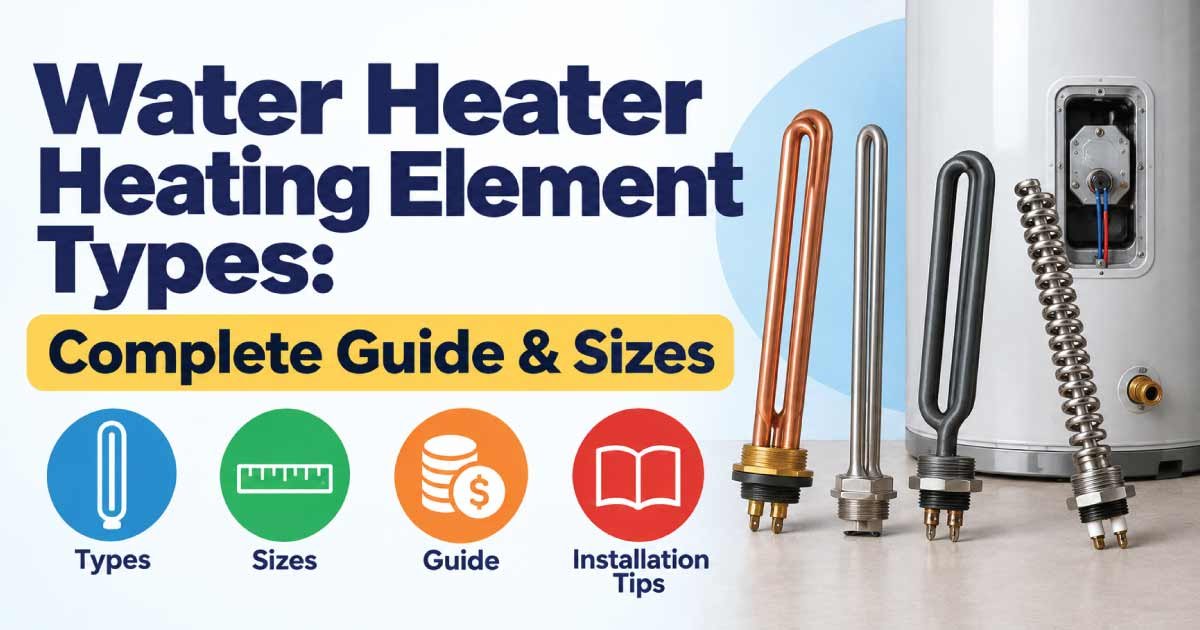
A water heater heating element is the component that converts electrical energy into heat inside an electric storage water heater. Choosing the correct element requires more than matching wattage. You also need to consider the element type, voltage, mounting style, thread size, physical dimensions, material, and whether the heater uses an upper or lower element.
This complete guide explains the most common water heater heating element types, standard sizes, wattages, voltages, resistance values, materials, and replacement considerations. It also covers upper heating elements, lower heating elements, screw-in elements, bolt-in elements, and universal heating elements so you can identify the right replacement with confidence.
What Is a Water Heater Heating Element?
An electric water heater heating element is a resistance-heating component installed inside the tank. When electrical current passes through the element, its resistance converts electrical energy into heat. That heat transfers through the element’s metal surface into the surrounding water.
Most conventional electric storage water heaters use either one or two heating elements.
A single-element water heater generally heats the tank with one element, while a two-element system uses:
- An upper heating element
- A lower heating element
- A thermostat or control system
- Electrical wiring and safety controls
In a two-element design, the upper element typically heats the upper portion of the tank first. Once the desired temperature is reached, the control system can transfer operation to the lower element to heat the remaining water.
The heating element is therefore one of the most important components affecting water heater recovery time, hot-water availability, and electrical consumption.
Types of Water Heater Heating Elements
Heating elements can be classified in several ways. The most useful classifications are based on their position, mounting method, wattage, voltage, and construction.
The main types include:
| Heating Element Type | Typical Application | Common Feature |
|---|---|---|
| Upper Heating Element | Two-element tank heaters | Controls upper tank heating |
| Lower Heating Element | Two-element tank heaters | Heats the lower tank section |
| Screw-In Element | Common residential heaters | Threads directly into tank |
| Bolt-In Element | Selected older/specialty heaters | Secured with bolts |
| Universal Element | Replacement applications | Designed to fit multiple models |
| Low-Watt-Density Element | Hard-water environments | Lower surface temperature |
| High-Watt-Density Element | Fast recovery | Higher heat output per surface area |
| Foldback Element | Compact tank designs | Reduced physical length |
| Flanged Element | Specialty heaters | Uses a flange mounting system |
Understanding these categories makes it easier to select a compatible replacement.
Upper Heating Element
The upper heating element is normally found in electric water heaters that use two heating elements.
It is positioned in the upper section of the tank and works with the upper thermostat. Its primary role is to heat the upper portion of the tank and ensure hot water becomes available relatively quickly after demand.
The upper element can have a similar electrical rating to the lower element, but the two elements perform different roles within the heating sequence.
How the Upper Element Works
When the water heater requires heating, the upper thermostat can energize the upper element. Once the upper section reaches the thermostat’s target temperature, the control system can direct power toward the lower element.
This arrangement helps maintain a supply of hot water throughout the tank.
A faulty upper element can cause symptoms such as:
- Little or no hot water
- Slow recovery
- Water that becomes warm but not fully hot
- Frequent electrical cycling
- A tripped circuit breaker in some situations
Because the upper element participates in the heating sequence, its failure can affect the overall operation of a two-element water heater.
Lower Heating Element
The lower heating element is installed toward the bottom of a two-element storage water heater.
Its main job is to heat the larger lower section of the tank after the upper section has reached the required temperature.
The lower element is particularly important because most of the stored water volume is located around it.
Lower Element Failure Symptoms
A failed lower heating element may allow the water heater to produce some hot water initially but run out of hot water much faster than normal.
Common symptoms include:
- Hot water runs out quickly
- Recovery takes longer than usual
- Upper tank water becomes hot but lower water remains cool
- Water temperature fluctuates
- Element tests open when checked with a multimeter
A lower element can fail because of age, mineral buildup, corrosion, electrical problems, or physical damage.
Screw-In Heating Element
The screw-in heating element is one of the most common designs used in residential electric water heaters.
Instead of being attached with multiple bolts, it has a threaded base that screws directly into the tank opening.
Many screw-in elements use a standard threaded mounting connection, although compatibility must always be verified against the specific water heater.
Advantages of Screw-In Elements
Screw-in elements are popular because they are relatively straightforward to replace when the correct replacement is selected.
Benefits include:
- Simple threaded installation
- Wide availability
- Many wattage choices
- Numerous material options
- Easy identification on many modern water heaters
A replacement screw-in element should match the heater’s required voltage and wattage. Thread compatibility alone does not guarantee that the element is electrically suitable.
Bolt-In Heating Element
A bolt-in heating element is secured to the tank using bolts rather than being screwed into a threaded opening.
This design is found on certain water heater models and older systems.
Bolt-in elements generally use a mounting flange with holes through which bolts pass into the tank connection.
Bolt-In Element Considerations
When replacing a bolt-in element, check:
- Number of mounting bolts
- Bolt-hole arrangement
- Flange dimensions
- Gasket size
- Element length
- Voltage
- Wattage
- Terminal configuration
A bolt-in element should not automatically be replaced with a screw-in element simply because the electrical specifications appear similar. The physical mounting system must also be compatible.
Universal Heating Element
A universal heating element is designed to fit a range of compatible water heater models rather than only one specific model.
Universal elements are useful when the original element is difficult to identify or when several replacement configurations are supported.
However, “universal” does not mean that an element fits every water heater.
You should still verify:
- Voltage
- Wattage
- Mounting type
- Thread or flange configuration
- Element length
- Terminal style
- Tank compatibility
A universal replacement is appropriate only when its specifications match the water heater.
Heating Element Wattage Sizes
Wattage is one of the most important specifications when selecting an electric water heater element.
Common residential heating element ratings include approximately:
| Element Wattage | Typical Use | Relative Heating Output |
|---|---|---|
| 1,000 W | Lower-demand systems | Low |
| 1,250 W | Smaller heating loads | Low–moderate |
| 1,500 W | Some compact systems | Moderate |
| 2,000 W | Selected residential heaters | Moderate |
| 2,500 W | Residential applications | Moderate–high |
| 3,000 W | Higher heating demand | High |
| 3,500 W | Selected systems | High |
| 4,000 W | Higher-capacity applications | Very high |
| 4,500 W | Common residential rating | High |
| 5,000 W | Selected high-output systems | Very high |
| 5,500 W | Certain modern systems | Very high |
These are common rating categories rather than a universal sizing chart. The correct replacement must follow the rating specified for the water heater.
Water Heater Heating Element Voltage Sizes
Heating elements are also classified by operating voltage.
Common ratings include:
| Voltage | Typical Application |
|---|---|
| 120 V | Smaller or specialty electric heaters |
| 208 V | Some commercial or specialty installations |
| 220 V | Certain installations |
| 240 V | Very common residential electric water heaters |
| 277 V | Certain commercial systems |
| 480 V | Commercial/industrial applications |
A replacement element must be compatible with the heater’s electrical system.
Using the wrong voltage can significantly change the amount of power produced by the element.
How Voltage and Wattage Affect Heating
Voltage and wattage are closely related to heating performance.
For a resistive heating element, electrical resistance can be calculated using:
R = V² ÷ P
Where:
- R = resistance in ohms
- V = voltage
- P = wattage
For example, a 4,500-watt element operating at 240 volts has an approximate resistance of:
R = 240² ÷ 4,500
R ≈ 12.8 ohms
The actual measured resistance can vary because of manufacturing tolerances and measurement conditions.
Why This Matters
If you install an element with a different wattage than the heater is designed for, the electrical load can change.
Higher wattage generally means:
- Faster heating
- Greater electrical current
- Potentially faster recovery
- Greater demand on the electrical circuit
Lower wattage generally means:
- Slower heating
- Lower electrical demand
- Longer recovery time
The safest approach is to use the rating specified by the manufacturer.
Heating Element Sizes by Physical Length
Heating elements are available in different physical lengths.
The element’s length refers to the portion extending into the tank, not necessarily the entire assembly including the mounting base and terminals.
Typical replacement elements may have lengths such as:
| Approximate Element Length | Common Application |
|---|---|
| 7 in | Compact/foldback designs |
| 8 in | Short elements |
| 9 in | Compact tanks |
| 10 in | Common replacement range |
| 11 in | Medium-length designs |
| 12 in | Common residential applications |
| 13 in | Selected heater models |
| 14 in | Longer tank elements |
| 15 in+ | Specialty applications |
There is no universal physical length for a particular wattage.
Two 4,500-watt elements, for example, can have different physical constructions and lengths.
Heating Element Watt Density
Watt density describes how much electrical power is concentrated over the element’s heating surface.
This is an important specification because it influences the surface temperature of the element and how it interacts with minerals in the water.
The major categories are:
- High-watt-density
- Medium-watt-density
- Low-watt-density
High-Watt-Density Heating Elements
A high-watt-density element produces substantial heat from a relatively smaller heating surface.
This design can provide fast water heating and is widely used in conventional electric water heaters.
However, the higher surface temperature can encourage mineral deposits to accumulate on the element in areas with hard water.
Best Applications
High-watt-density elements can be appropriate when:
- Fast recovery is important
- The heater is designed for this element
- Water quality is relatively favorable
- The original element has a similar specification
Low-Watt-Density Heating Elements
A low-watt-density element spreads its heating output over a larger surface area.
Because the heat is distributed across more surface area, the element can operate at a lower surface temperature for a similar total wattage.
This can make low-watt-density elements attractive in areas with mineral-rich or hard water.
Benefits
Potential benefits include:
- Reduced surface temperature
- Less aggressive mineral buildup
- Longer element service life in suitable conditions
- Better performance in some hard-water environments
However, the element must still be compatible with the tank and thermostat system.
Discover More:
Foldback Heating Elements
A foldback element is designed with bends that allow a relatively long heating surface to occupy a shorter physical space.
This can be useful where the tank opening or available internal space limits the straight length of the element.
Foldback construction can provide a larger heating surface without requiring the same amount of straight-line space.
Heating Element Materials
Heating elements can be made from different materials and alloys.
Common construction materials include:
- Copper
- Stainless steel
- Nickel-based alloys
- Specialized heating-element alloys
The choice of material can influence corrosion resistance, durability, heat transfer, and suitability for different water conditions.
Copper Heating Elements
Copper elements are widely used because copper provides good thermal conductivity and is suitable for many conventional water heater applications.
However, compatibility with water chemistry and the tank system should still be considered.
Stainless Steel Heating Elements
Stainless steel elements can offer increased corrosion resistance in certain environments.
They are particularly interesting where water chemistry creates additional corrosion concerns, although stainless steel does not make an element universally immune to corrosion or scale.
Discover More:
How to Choose the Correct Water Heater Heating Element
Selecting a replacement element should be treated as a specification-matching process.
Before purchasing, identify the following information:
- Water heater manufacturer
- Model number
- Element voltage
- Element wattage
- Upper or lower position
- Mounting type
- Element length
- Terminal configuration
- Gasket requirements
- Recommended element material
The model number on the water heater’s rating plate is often one of the most useful pieces of information.
Water Heater Heating Element Size Chart
The following chart provides a practical reference for common residential element specifications.
| Element Type | Common Wattage Range | Common Voltage | Mounting Style | Typical Position |
|---|---|---|---|---|
| Upper Element | 3,500–5,500 W | 240 V | Screw-in/Bolt-in | Upper tank |
| Lower Element | 3,500–5,500 W | 240 V | Screw-in/Bolt-in | Lower tank |
| Screw-In | 1,000–5,500 W | 120–240 V | Threaded | Upper/Lower |
| Bolt-In | 1,500–5,500 W | 120–240 V | Flange + bolts | Upper/Lower |
| Universal | Varies | Varies | Multiple designs | Model dependent |
| Low-Watt-Density | Varies | Varies | Usually screw-in | Usually lower |
| High-Watt-Density | Varies | Varies | Screw-in/bolt-in | Upper/Lower |
Always compare the chart with the heater manufacturer’s specifications before installing an element.
How to Identify an Existing Heating Element
If you are replacing an element, identifying the existing part can prevent compatibility problems.
Start by locating the water heater’s rating plate. It may contain:
- Model number
- Serial number
- Voltage
- Total wattage
- Tank capacity
- Manufacturer information
The element itself may also have markings showing its wattage and voltage.
What to Check on the Old Element
Look for:
- Wattage marking
- Voltage marking
- Manufacturer part number
- Thread size
- Mounting configuration
- Length
- Terminal arrangement
- Element material
Do not rely only on appearance. Two elements can look almost identical while having different electrical ratings.
Discover More:
How to Test a Water Heater Heating Element
A heating element can often be tested with a multimeter after the water heater has been properly disconnected from its electrical supply.
Safety should come first.
Basic Resistance Test
With the power safely isolated, disconnect the appropriate wires from the element terminals and measure resistance across the element terminals.
For a resistive element, the expected resistance can be estimated using:
R = V² ÷ P
For example:
- 240 V / 4,500 W → approximately 12.8 Ω
- 240 V / 3,500 W → approximately 16.5 Ω
- 240 V / 5,500 W → approximately 10.5 Ω
A reading that is completely open can indicate a broken element.
A reading that suggests a short to the tank can indicate a ground fault.
Electrical testing should only be performed by someone who understands the hazards of water heater electrical circuits. When uncertain, use a qualified professional.
Common Signs of a Bad Heating Element
A failed element can produce different symptoms depending on whether it is the upper or lower element.
Common signs include:
- No hot water
- Not enough hot water
- Water takes too long to heat
- Hot water runs out quickly
- Temperature fluctuates
- Circuit breaker trips
- Element shows incorrect resistance
- Visible corrosion or physical damage
- Mineral buildup around the element
The symptoms do not always prove that the element itself is defective. A thermostat, wiring problem, electrical supply issue, or other component can produce similar symptoms.
Why Heating Elements Fail
Heating elements are exposed to water, heat, electrical current, and mineral deposits throughout their service life.
Common causes of failure include:
Mineral Scale
Hard water can leave calcium and other mineral deposits on the heating element. Thick deposits can interfere with heat transfer and increase the element’s operating temperature.
Electrical Problems
Incorrect voltage, loose connections, damaged wiring, or circuit problems can contribute to element failure.
Operating Without Proper Water Coverage
An element designed to operate submerged in water can be damaged if it is energized while the tank is not properly filled.
This is why electrical power should not be restored until the tank has been correctly filled and air has been removed from the hot-water system as appropriate.
Age and Corrosion
Repeated heating cycles eventually place stress on the element. Corrosion can also damage the metal sheath and internal heating wire.
Heating Element Replacement: Important Considerations
Replacing an element involves more than removing the old component and installing a new one.
Before replacement, confirm:
- The correct replacement element
- The correct gasket
- The correct voltage
- The correct wattage
- The correct mounting configuration
- The tank is drained appropriately
- Electrical power is isolated
- The tank is completely refilled before restoring power
If a screw-in element is installed, the gasket and threaded connection must seal properly.
A leak around the element can cause water damage and potentially create an electrical hazard.
Screw-In vs Bolt-In Heating Elements
| Feature | Screw-In Element | Bolt-In Element |
|---|---|---|
| Mounting | Threaded | Bolted flange |
| Installation | Screws into tank | Secured with bolts |
| Replacement Availability | Very broad | More model dependent |
| Gasket | Usually required | Usually required |
| Identification | Threaded base | Flange and bolt pattern |
| Compatibility | Must match thread | Must match flange |
| Typical Use | Many residential heaters | Selected models |
Neither design is automatically better for every water heater. The correct choice is the design specified for your tank.
Upper vs Lower Heating Element
| Feature | Upper Element | Lower Element |
|---|---|---|
| Position | Upper tank | Lower tank |
| Primary Role | Initial/upper heating | Main lower-tank heating |
| Thermostat | Upper thermostat | Lower thermostat |
| Failure Effect | Can cause major loss of heating | Often causes reduced hot-water capacity |
| Common in | Two-element heaters | Two-element heaters |
| Replacement | Must match heater | Must match heater |
Although upper and lower elements can sometimes look similar, their role within the heating sequence is different.
How Long Does a Water Heater Heating Element Last?
Heating element life varies considerably.
Factors affecting service life include:
- Water hardness
- Sediment accumulation
- Water chemistry
- Element material
- Watt density
- Heating frequency
- Electrical conditions
- Water heater maintenance
- Installation quality
There is no single guaranteed replacement interval. Instead, the element should be inspected or tested when performance problems occur and during appropriate water heater maintenance.
How to Improve Heating Element Life
Several maintenance practices can help protect an electric water heater.
Flush the Tank
Sediment and mineral deposits can accumulate at the bottom of the tank. Periodic flushing, when recommended for the specific heater, can help reduce sediment accumulation.
Inspect the Anode Rod
For compatible tank water heaters, an anode rod provides corrosion protection by sacrificing itself over time. Inspecting and replacing it when appropriate can help protect the tank.
Check Water Temperature
Excessively high temperatures increase energy use and can increase scalding risk. Follow the manufacturer’s recommended temperature and applicable safety guidance.
Use Compatible Elements
Do not install a higher-wattage element simply because it appears physically compatible. The heater’s electrical system must be designed for the selected element.
Frequently Asked Questions About Water Heater Heating Elements
What is the most common water heater heating element type?
Screw-in elements are among the most common types used in residential electric storage water heaters. However, bolt-in, foldback, low-watt-density, and other designs are also used.
What size heating element does a water heater use?
Many residential electric water heaters use elements in the range of roughly 3,500 to 5,500 watts, with 4,500 watts being a common rating. The correct size depends on the specific heater.
Are upper and lower heating elements the same?
They can have similar electrical ratings, but their positions and functions are different. Always check the water heater manufacturer’s specifications before replacing either element.
Can I replace a 4,500-watt element with a 5,500-watt element?
Not automatically. A higher-wattage element can increase electrical load beyond what the heater, wiring, thermostat, or circuit is designed to handle. Use the manufacturer’s specified rating.
What voltage are most residential heating elements?
240 volts is a common rating for residential electric storage water heater elements, although other voltages are used in some systems.
How do I know if my element is screw-in or bolt-in?
A screw-in element has a threaded mounting base, while a bolt-in element uses a flange secured with bolts. Checking the old element and water heater specifications provides the best confirmation.
Are low-watt-density elements better?
They can be advantageous in some applications, especially where mineral buildup is a concern. However, the element must still be compatible with the specific water heater.
Does a higher wattage element heat water faster?
Generally, a higher-wattage element can provide greater heating power and potentially faster recovery, but the heater’s electrical system must be designed for that wattage.
Can one universal heating element fit every water heater?
No. Universal elements are designed to cover multiple compatible configurations, but voltage, wattage, mounting, dimensions, and other specifications must still match.
Water Heater Heating Element Selection Checklist
Before buying a replacement, use this checklist:
- Confirm water heater model number
- Confirm voltage
- Confirm wattage
- Identify upper or lower position
- Identify screw-in or bolt-in mounting
- Measure or verify element length
- Check terminal configuration
- Check gasket requirements
- Consider water hardness and element material
- Confirm manufacturer compatibility
- Never exceed the heater’s specified electrical rating
This approach reduces the risk of purchasing an element that physically fits but is electrically or functionally incorrect.
Final Takeaway
Understanding water heater heating element types and sizes makes replacement and troubleshooting much easier. The most important categories include upper heating elements, lower heating elements, screw-in heating elements, bolt-in heating elements, and universal heating elements.
Wattage and voltage are equally important. Common residential elements are often rated around 3,500–5,500 watts and 240 volts, but the correct specification depends entirely on the water heater model.
When choosing an element, do not rely on size or appearance alone. Match the voltage, wattage, mounting style, dimensions, position, and manufacturer specifications. For hard-water conditions, also consider whether a low-watt-density or suitable corrosion-resistant element is appropriate.
Correct matching improves heating performance, supports safe operation, and helps prevent unnecessary electrical or mechanical problems.