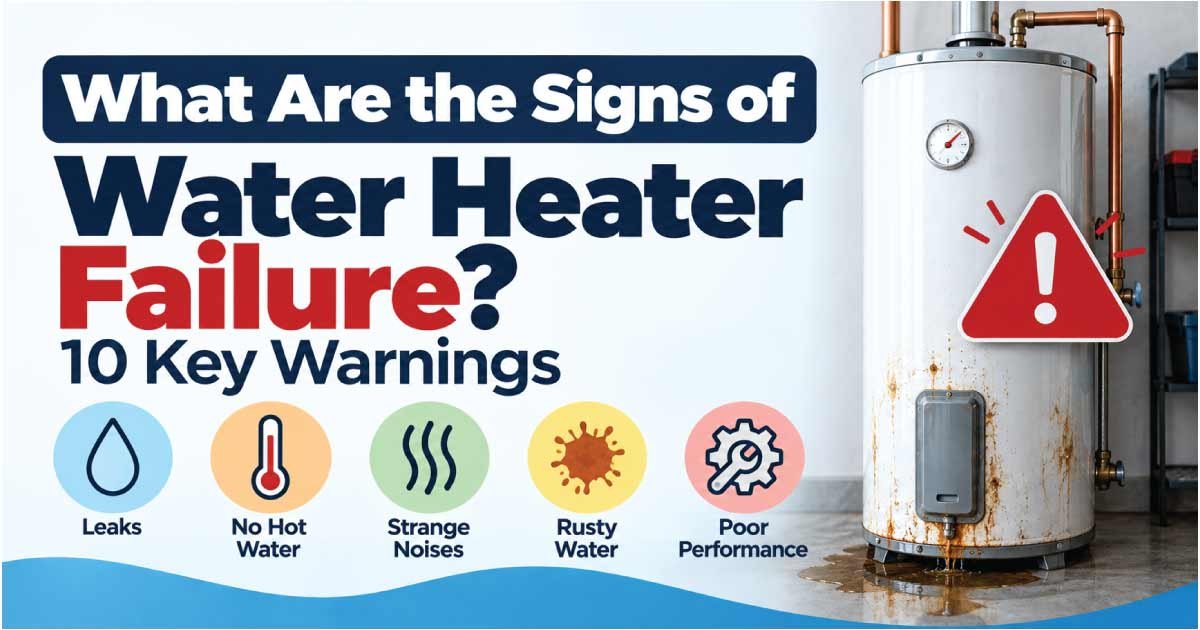
A water heater rarely fails without giving some warning first. Changes in water temperature, unusual noises, leaks, discolored water, slow heating, and rising energy use can all indicate that a water heater is developing a problem.
Recognizing these signs early can help you determine whether the unit needs simple maintenance, a component repair, or complete replacement. Some problems are relatively minor, while others can indicate a serious safety issue or a deteriorating storage tank.
This guide explains 10 key signs of water heater failure, what each warning can mean, and what you should do when you notice it.
Why Is It Important to Recognize Water Heater Failure Signs?
A water heater is responsible for supplying hot water for showers, washing dishes, laundry, cleaning, and other household activities. When its performance begins to change, the problem can gradually become worse.
Early warning signs may indicate:
- A failing heating element
- A defective thermostat
- Sediment buildup
- Corrosion
- A leaking tank
- A faulty gas-control component
- A pilot or ignition problem
- Electrical problems
- Pressure-related issues
- An aging or inefficient water heater
Identifying the problem early can sometimes prevent a complete loss of hot water or reduce the risk of water damage.
10 Signs Your Water Heater May Be Failing
The following table summarizes the most important warning signs.
| Warning Sign | Possible Cause | Urgency |
|---|---|---|
| 1. No hot water | Element, thermostat, gas, ignition | High |
| 2. Lukewarm water | Heating problem or mixing valve | Medium–High |
| 3. Running out of hot water quickly | Element, sediment, demand | Medium |
| 4. Strange noises | Sediment or tank deterioration | Medium |
| 5. Rusty or discolored water | Corrosion or anode problem | Medium–High |
| 6. Water leaking from tank | Tank corrosion or failure | High |
| 7. Frequent breaker trips | Electrical fault | High |
| 8. Pilot repeatedly goes out | Thermocouple, burner, gas control | High |
| 9. Slow heating | Sediment or failing components | Medium |
| 10. Old age and declining performance | General deterioration | Medium–High |
1. Your Water Heater Produces No Hot Water
One of the clearest signs of water heater failure is a complete lack of hot water.
If every faucet and shower produces cold water, the water heater may not be heating the water at all.
For an electric water heater, possible causes include:
- Tripped circuit breaker
- Failed heating element
- Faulty thermostat
- High-temperature cutoff activation
- Electrical wiring problem
- Control failure
For a gas water heater, possible causes include:
- Extinguished pilot light
- Thermocouple problem
- Failed ignition system
- Gas supply issue
- Burner problem
- Gas-control malfunction
Before assuming the water heater needs replacement, determine whether the issue is related to the energy supply or a replaceable component.
If you smell gas, however, do not attempt to troubleshoot the gas system yourself.
2. The Water Is Only Lukewarm
Lukewarm water is another important warning sign.
A water heater may still be operating while failing to reach or maintain the expected temperature.
Possible causes include:
- Weak or failed heating element
- Faulty thermostat
- Sediment buildup
- Burner problem
- Incorrect temperature setting
- Malfunctioning mixing valve
- Excessive hot-water demand
An electric water heater with multiple heating elements may produce some hot water even when one element has failed.
If the water used to be consistently hot but has gradually become lukewarm, the change should be investigated.
3. You Run Out of Hot Water Much Faster Than Before
A reduction in hot-water capacity can be an early indication that a water heater is losing heating performance.
For example, if the household previously had enough hot water for several showers but now runs out after one or two, something may have changed.
Possible causes include:
- Failed lower heating element
- Weak burner
- Faulty thermostat
- Sediment accumulation
- Increased household demand
- Incorrect temperature setting
- Aging water heater
A sudden reduction in capacity is particularly important.
If your household’s hot-water usage has not increased but available hot water has decreased, the heating system should be inspected.
4. The Water Heater Makes Strange Noises
Unusual sounds coming from a storage water heater can indicate sediment buildup or other developing problems.
Common sounds include:
- Popping
- Crackling
- Rumbling
- Banging
- Hissing
- Clicking
Popping and Rumbling
Popping or rumbling sounds are often associated with sediment collecting at the bottom of the tank.
Water can become trapped beneath sediment deposits and produce noise when heated.
Hissing
Hissing may have several possible causes depending on the heater design and operating conditions. It should be investigated if it is new or accompanied by poor heating performance or leakage.
Clicking
Clicking may occur during normal operation in some systems, but persistent or unusual clicking can indicate an ignition, control, or electrical issue.
A new sound combined with declining hot-water performance deserves attention.
5. Rusty, Brown, or Discolored Hot Water
Discolored hot water can indicate corrosion somewhere in the water-heating system or plumbing.
If only the hot water is discolored while cold water remains clear, the water heater becomes a more likely source.
Possible causes include:
- Corroding tank components
- Deteriorated anode rod
- Rust inside the plumbing
- Sediment
- Corroded connections
A rusty appearance does not automatically mean the tank has failed, but it should not be ignored.
If corrosion is accompanied by a tank leak, replacement may be necessary.
6. Water Is Leaking From the Water Heater
A water leak is one of the most important warning signs.
The location of the leak matters because not every leak means the tank itself has failed.
Water can come from:
- Inlet connection
- Outlet connection
- Drain valve
- Temperature and pressure relief valve
- Heating-element seal
- Pipe connection
- Tank body
Leak From the Tank
A leak originating from the storage tank itself is particularly serious.
The tank may have developed internal corrosion or structural deterioration. A tank that has begun leaking generally cannot be restored by simply replacing a heating component.
Water around the base of the heater should therefore be investigated promptly.
7. The Circuit Breaker Keeps Tripping
Frequent breaker trips are an important warning sign for an electric water heater.
The breaker is designed to interrupt electrical power when it detects a potentially unsafe electrical condition.
Possible causes include:
- Shorted heating element
- Damaged wiring
- Faulty thermostat
- Loose electrical connection
- Defective breaker
- Electrical overload
If the breaker trips repeatedly, do not keep resetting it.
Repeatedly restoring power without identifying the problem can create a serious electrical hazard.
A qualified professional should diagnose recurring electrical faults.
8. The Pilot Light Keeps Going Out
For a gas water heater, a pilot light that repeatedly goes out is a significant warning sign.
Possible causes include:
- Weak pilot flame
- Dirty pilot assembly
- Faulty thermocouple
- Gas-control problem
- Draft or airflow issue
- Ignition-system problem
The pilot system is part of the water heater’s safety and ignition system, so repeated failure should not simply be treated as an inconvenience.
If you smell gas, leave the area and follow appropriate gas-emergency procedures rather than attempting to repair the appliance yourself.
9. The Water Takes Too Long to Heat
A water heater that takes significantly longer than normal to produce hot water may be losing heating efficiency.
Potential causes include:
- Sediment buildup
- Failing heating element
- Weak burner
- Faulty thermostat
- Insufficient power or fuel
- Excessive mineral deposits
- Aging components
A longer recovery time can be especially noticeable when several people use hot water consecutively.
If the problem has gradually developed, maintenance may improve performance. If it appeared suddenly, a failed component should be considered.
Discover More:
10. The Water Heater Is Old and Performance Is Declining
Age by itself does not prove that a water heater has failed, but an aging unit with several warning signs deserves careful evaluation.
As a storage water heater ages, it can experience:
- Internal corrosion
- Sediment accumulation
- Deteriorating components
- Reduced efficiency
- More frequent repairs
- Tank leakage
An older water heater that is also leaking, producing insufficient hot water, or requiring repeated repairs may be approaching the point where replacement makes more sense than continued repair.
Other Warning Signs You Should Not Ignore
The 10 signs above are the most common, but several other symptoms can also indicate developing problems.
Water Temperature Changes Suddenly
Rapid temperature fluctuations may indicate:
- Faulty thermostat
- Heating-element problem
- Mixing valve issue
- Control problem
- Plumbing cross-connection
If the temperature changes at only one faucet, investigate the fixture before assuming the water heater is failing.
The Heater Requires Frequent Resets
A water heater should not repeatedly require manual resets to operate.
Frequent resetting may indicate:
- High-temperature cutoff activation
- Thermostat failure
- Heating element problem
- Electrical fault
- Control-system malfunction
A reset may restore operation temporarily, but the underlying cause still needs attention.
The Burner Starts and Stops Abnormally
For gas models, an unusually short or inconsistent burner cycle can indicate problems with:
- Flame sensing
- Thermocouple
- Burner
- Gas control
- Thermostat
Gas components should be diagnosed carefully by a qualified professional.
Discover More:
How to Tell if the Problem Is Serious
Not every water heater problem requires immediate replacement.
| Situation | Typical Response |
|---|---|
| Slightly reduced hot-water capacity | Monitor and inspect |
| Mild sediment-related noise | Maintenance may help |
| Faulty heating element | Repair may be possible |
| Faulty thermostat | Repair may be possible |
| Repeated breaker trips | Professional electrical diagnosis |
| Repeated pilot failure | Professional gas diagnosis |
| Tank leaking | Prompt replacement evaluation |
| Gas odor | Treat as a safety emergency |
| Burned wiring | Turn off power and seek professional service |
| Severe corrosion | Evaluate for replacement |
The combination of symptoms is often more important than a single warning sign.
What Should You Check When You Notice Water Heater Failure Signs?
Start by determining exactly what has changed.
Check the Hot Water at Multiple Fixtures
Run hot water at several faucets.
If every fixture is affected, the water heater or main hot-water system is likely involved.
If only one fixture is affected, the problem may be a faucet cartridge or mixing valve.
Determine Whether the Heater Is Electric or Gas
Electric and gas water heaters have different failure points.
For electric models, consider the power supply, breaker, thermostats, heating elements, and safety controls.
For gas models, consider the pilot, ignition, burner, thermocouple, gas supply, and gas-control system.
Record the Symptoms
Before calling a technician, note:
- When the problem started
- How frequently it occurs
- How long hot water lasts
- Whether the water is cold or lukewarm
- Whether the heater makes unusual sounds
- Whether the breaker trips
- Whether the pilot goes out
- Whether there is visible leakage
These details can make diagnosis easier.
Discover More:
Water Heater Failure Signs: Electric vs. Gas
| Sign | Electric Water Heater | Gas Water Heater |
|---|---|---|
| No hot water | Element, thermostat, power | Pilot, burner, gas supply |
| Lukewarm water | Element, thermostat | Burner, thermostat |
| Breaker trips | Common diagnostic clue | Less applicable |
| Pilot goes out | Not applicable | Important warning |
| Slow recovery | Element, sediment | Burner, sediment |
| Strange noises | Sediment/elements | Sediment/burner |
| Water leaks | Tank, valves, connections | Tank, valves, connections |
| Temperature fluctuation | Thermostat/mixing valve | Thermostat/mixing valve |
Can a Failing Water Heater Be Repaired?
Yes, many water heater problems are repairable.
Replaceable components can include:
- Heating elements
- Thermostats
- Thermocouples
- Pilot assemblies
- Ignition components
- Burners
- Valves
- Electrical components
- Anode rods
However, the tank itself is different.
If a storage tank has developed a structural leak because of corrosion, replacing an individual heating component will not solve the underlying problem.
When Should You Replace a Water Heater?
Replacement may be the better option when the water heater has significant deterioration or repeated major failures.
Consider replacement when:
- The tank itself is leaking.
- Corrosion is extensive.
- Repairs are becoming frequent.
- Replacement parts are difficult to obtain.
- Heating performance continues to decline.
- Repair costs are becoming excessive.
- The unit is old and inefficient.
A single failed heating element or thermostat does not automatically justify replacing the complete water heater.
How to Prevent Water Heater Failure
Regular maintenance can help extend useful service life and identify problems before they become major failures.
Monitor Performance
Pay attention to changes in:
- Water temperature
- Heating speed
- Hot-water capacity
- Noise
- Energy use
- Burner operation
- Electrical behavior
Inspect for Leaks
Regularly look around the heater and visible connections for signs of water.
Small leaks can become larger problems if ignored.
Manage Sediment
Storage water heaters can accumulate sediment over time. Appropriate maintenance can help reduce buildup and preserve heating efficiency.
Always follow the manufacturer’s maintenance instructions.
Check the Anode Rod When Applicable
The anode rod helps protect many storage tanks from corrosion.
Its condition can affect the long-term health of the tank, so inspection and replacement may be appropriate depending on the heater design and manufacturer’s recommendations.
When Is a Water Heater Failure an Emergency?
Some warning signs require immediate attention rather than routine troubleshooting.
Gas Odor
If you smell gas, do not attempt to locate or repair the leak yourself. Avoid ignition sources and follow local gas-emergency procedures.
Electrical Burning Smell
A burning electrical odor can indicate overheating wiring or components.
Do not continue operating an appliance with obvious electrical damage.
Major Water Leak
A substantial leak can cause significant property damage.
If safe to do so, shut off the appropriate water supply and arrange professional service.
Signs of Overheating
Excessive water temperature, repeated safety cutoff activation, or other overheating symptoms should be investigated promptly.
Safety controls should never be bypassed.
Frequently Asked Questions
What are the first signs of a failing water heater?
Early signs can include lukewarm water, reduced hot-water capacity, longer heating times, unusual noises, fluctuating temperatures, and small leaks.
How do I know if my water heater is going bad?
A combination of declining hot-water performance, unusual sounds, leaks, corrosion, repeated shutdowns, and frequent component failures can indicate that the water heater is deteriorating.
What is the most common sign of water heater failure?
The most noticeable sign is usually insufficient or completely absent hot water. However, leaks, unusual noises, temperature fluctuations, and electrical or gas problems can also indicate failure.
Can a water heater fail without leaking?
Yes. A water heater can stop heating because of a failed element, thermostat, burner, pilot system, electrical problem, or control component without the tank leaking.
Does lukewarm water mean my water heater is failing?
It can. A heating element, thermostat, burner, sediment buildup, or mixing valve can cause lukewarm water. The cause should be identified before replacing the heater.
Why does my water heater make popping noises?
Popping and rumbling noises in storage water heaters are commonly associated with sediment buildup and trapped water near the bottom of the tank.
How long can a failing water heater last?
There is no reliable universal timeframe. A heater with a repairable component may continue operating after repair, while a leaking or severely corroded tank generally requires replacement.
Should I replace my water heater if it is making noise?
Not necessarily. Noise alone does not prove that the tank has failed. Sediment buildup may be responsible and can sometimes be addressed through appropriate maintenance.
Can a bad thermostat cause water heater failure?
Yes. A faulty thermostat can prevent proper heating, cause incorrect temperatures, or repeatedly activate safety controls.
What does rusty water from a water heater mean?
Rusty hot water can indicate corrosion in the heater or plumbing. If the discoloration is persistent or accompanied by a tank leak, professional inspection is recommended.
Final Thoughts
Recognizing the signs of water heater failure can help you address problems before they turn into a complete loss of hot water or significant water damage.
The 10 key warnings include no hot water, lukewarm water, rapidly depleted hot water, unusual noises, rusty water, leaks, repeated breaker trips, pilot problems, slow heating, and declining performance in an aging unit.
Some issues, such as a failed heating element or thermostat, may be repairable. Others, particularly a leaking or severely corroded storage tank, may indicate that replacement is the more practical solution.
Pay special attention to safety-related symptoms. Gas odors, damaged electrical wiring, repeated breaker trips, significant leaks, and overheating should not be ignored.
By monitoring your water heater’s temperature, recovery time, sounds, water quality, and overall performance, you can often recognize developing problems early and make a more informed repair-or-replacement decision.