
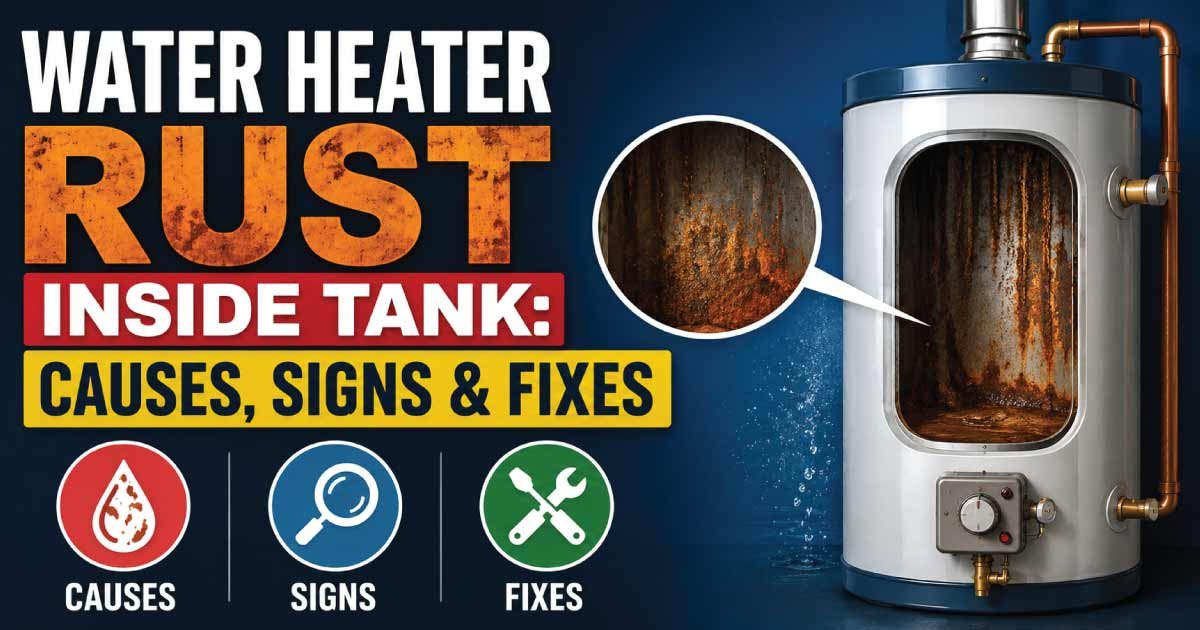
Finding rust inside a water heater tank can be concerning, especially if you notice rusty hot water, sediment, a metallic smell, or visible corrosion around the unit. Rust inside a tank does not always mean the water heater has immediately failed, but it can be an early warning sign of corrosion and potential tank deterioration.
A traditional tank water heater contains several components that can corrode over time. The tank itself is protected by a lining and a sacrificial anode rod, while water chemistry, temperature, sediment, and age can affect how well those protections work.
The most important question is whether the rust is coming from a replaceable component or whether the steel tank itself is corroding. If rust is coming from the tank body, especially along with leaking water, replacement is usually a more practical solution than attempting to repair the tank.
Rust can also appear in hot water because of a deteriorating anode rod, rusty plumbing, corroded fittings, or sediment inside the tank. Identifying the source before replacing the water heater can prevent unnecessary expense.
What Causes Rust Inside a Water Heater Tank?
Rust forms when iron or steel comes into contact with water and oxygen under conditions that allow corrosion to occur.
A water heater tank is designed to resist corrosion, but its protective systems gradually wear down.
Common causes of rust include:
- Deteriorated anode rod
- Damaged tank lining
- Old water heater
- Hard or chemically aggressive water
- High sediment accumulation
- Corroded fittings
- Rusty plumbing
- Excessive temperature
- Poor maintenance
- Internal tank corrosion
The condition of the anode rod is particularly important because it is designed to corrode before the steel tank does.
| Cause | How It Can Lead to Rust | Common Sign |
|---|---|---|
| Bad anode rod | Tank loses corrosion protection | Rust or metallic odor |
| Damaged lining | Exposes steel to water | Internal corrosion |
| Old tank | Protective components deteriorate | Rust and leaks |
| Hard water | Increases mineral deposits | Rust-colored sediment |
| Sediment | Holds moisture and minerals against surfaces | Reduced efficiency |
| Corroded fittings | Introduces rust into water | Rust near connections |
| Rusty plumbing | Corrosion enters hot-water supply | Rust at several fixtures |
Can a Water Heater Tank Rust From the Inside?
Yes. A steel water heater tank can eventually develop internal corrosion.
Tank manufacturers generally use protective measures such as a glass lining and anode rod to reduce corrosion. However, these protections are not permanent.
Over time, the protective lining may develop small imperfections, while the anode rod gradually becomes consumed.
Once enough protection is lost, exposed steel can begin to corrode.
Why Internal Rust Is Difficult to See
Most of the inside of a water heater tank cannot be visually inspected during normal use.
Instead, homeowners may notice indirect signs such as:
- Rust-colored hot water
- Brown particles
- Metallic odor
- Reduced hot-water quality
- Rust around fittings
- Leaking tank
- Unusual sediment
- Increasing maintenance problems
Visible rust on the outside of the tank can be an even more serious warning because it may indicate that corrosion has progressed through the tank wall.
What Is the Anode Rod and Why Does It Matter?
The anode rod is one of the most important corrosion-protection components in a traditional tank water heater.
It is sometimes called a sacrificial anode because it is designed to corrode instead of the steel tank.
As the anode rod deteriorates, it sacrifices itself to help protect exposed steel surfaces inside the tank.
What Happens When the Anode Rod Is Used Up?
Once the anode rod has been substantially consumed, the tank has less protection against corrosion.
This can increase the risk of:
- Internal rust
- Tank corrosion
- Rust-colored water
- Leaks
- Reduced tank life
Replacing an aging anode rod may help extend the service life of a tank that is otherwise in good condition.
However, replacing the rod cannot reverse corrosion that has already damaged the tank.
Signs of Rust Inside a Water Heater Tank
Rust inside the tank can produce several warning signs.
Rusty or Brown Hot Water
If only the hot water appears rusty or brown, the water heater may be contributing to the problem.
Run the hot water at several fixtures and compare it with cold water.
If cold water is clear but hot water is discolored, investigate the water heater and hot-water plumbing.
Metallic Smell
Rust or mineral deposits can sometimes produce a metallic odor.
However, odor alone does not prove that the tank itself is rusting.
Other plumbing components may also contribute.
Rust-Colored Sediment
Brown or orange particles may appear in:
- Faucet aerators
- Showerheads
- Bathtubs
- Sink basins
- Hot-water lines
These particles may come from the water heater, pipes, fittings, or other plumbing components.
Water Heater Leaking
A leaking tank combined with visible rust is a major warning sign.
If the tank itself has developed a leak, internal corrosion may have weakened the steel.
Rusty Hot Water but Clear Cold Water
This is an important clue.
If cold water is clear while hot water is rusty, the source may be somewhere in the hot-water system.
Possible causes include:
- Water heater corrosion
- Deteriorating anode rod
- Corroded hot-water pipes
- Rusty fittings
- Sediment inside the tank
Test multiple hot-water fixtures.
If all hot-water fixtures have similar discoloration, investigate the central hot-water system.
If only one fixture is affected, the problem may be local.
Rust Inside Water Heater but No Leak
A water heater can have signs of internal rust without immediately leaking.
Early corrosion does not necessarily mean the tank has failed.
However, it should not be ignored.
A technician may inspect:
- Anode rod condition
- Tank age
- External corrosion
- Drain valve
- Water quality
- Sediment
- Tank fittings
If the tank body remains intact, maintenance or component replacement may be possible.
Rust Inside Water Heater and Leaking
Rust combined with a leak is considerably more concerning.
The location of the leak matters.
Leak From a Connection
A leak from a threaded fitting or pipe connection may be repairable.
Leak From the Drain Valve
A faulty drain valve may sometimes be replaced.
Leak From the T&P Relief Valve
The temperature and pressure relief valve may discharge water because of pressure or temperature conditions, or because the valve itself has a problem.
It should never be blocked or capped.
Leak From the Tank Body
A leak from the actual tank shell is usually a sign of tank deterioration.
Once a steel tank has corroded through, the tank itself generally cannot be permanently repaired like a replaceable valve or fitting.
Rust at the Bottom of the Water Heater
Rust around the bottom of a water heater deserves attention.
The bottom area can be exposed to:
- Leaking water
- Condensation
- Sediment
- Corrosion
- Drain valve leakage
- Tank deterioration
If rust appears around the base, determine whether the moisture is coming from an external fitting or from the tank itself.
A rusty base does not automatically prove that the tank is leaking, but it should be inspected.
Rust Around Water Heater Fittings
Sometimes rust is coming from the fittings rather than the tank.
Common areas include:
- Hot-water outlet
- Cold-water inlet
- Drain valve
- Pipe connections
- Relief valve connection
Corroded fittings can create localized rust and staining.
A plumber can determine whether the tank itself is healthy or whether only an external component needs replacement.
Can Sediment Cause Rust in a Water Heater?
Sediment and rust are different problems, but they can occur together.
Sediment consists primarily of minerals and other material that settles inside the tank.
Heavy deposits can:
- Reduce heating efficiency
- Increase heating time
- Cause popping or rumbling
- Trap moisture and minerals
- Make maintenance more difficult
Rust particles can also mix with sediment and appear as brown or orange material.
If the tank has significant sediment and corrosion, professional inspection can help determine its overall condition.
Hard Water and Water Heater Rust
Hard water contains dissolved minerals, especially calcium and magnesium.
These minerals can form scale and sediment inside a water heater.
Hard water does not directly mean that a tank will rust immediately, but mineral buildup can contribute to conditions that reduce efficiency and increase maintenance requirements.
Signs of hard-water effects include:
- White mineral deposits
- Scale around fixtures
- Reduced water flow
- Noisy water heater
- Sediment accumulation
- Reduced heating efficiency
Water quality testing can help determine whether mineral content is contributing to the problem.
Does an Old Water Heater Rust Inside?
Age is an important factor.
As a water heater gets older:
- The anode rod becomes depleted.
- Protective lining may deteriorate.
- Sediment accumulates.
- Components wear out.
- Corrosion risk increases.
An older heater with rusty water should therefore receive closer attention than a recently installed unit.
However, age alone does not prove that the tank needs replacement.
The tank’s physical condition and leak status are more important.
How to Check for Water Heater Rust
You can begin with simple observations.
Check the Cold Water
Run cold water into a clean glass.
Observe whether it is:
- Clear
- Yellow
- Brown
- Orange
- Cloudy
Check the Hot Water
Run hot water into another clean container.
Compare the two samples.
If cold water is clear and hot water is discolored, the hot-water system is a likely source.
Check Multiple Fixtures
Test:
- Kitchen faucet
- Bathroom sink
- Shower
- Laundry faucet
If several hot-water fixtures show the same discoloration, investigate the water heater or central hot-water plumbing.
How to Fix Rust Inside a Water Heater Tank
The correct solution depends on where the rust originates.
| Rust Source | Possible Solution | Replacement Required? |
|---|---|---|
| Deteriorated anode rod | Replace anode rod | Usually no |
| Rusty fitting | Replace fitting | Usually no |
| Sediment | Flush tank | Usually no |
| Corroded valve | Replace valve | Usually no |
| Damaged tank lining | Monitor/service as appropriate | Depends |
| Rusty hot-water pipe | Repair or replace pipe | No |
| Tank shell corrosion | Replace water heater | Usually yes |
| Tank leak | Replace water heater | Usually yes |
The key is determining whether the tank itself is damaged.
Can You Remove Rust From Inside a Water Heater?
You generally cannot simply scrub the inside of a sealed water heater tank to remove all corrosion.
The tank is not designed for routine interior cleaning by opening it.
Maintenance may involve:
- Flushing sediment
- Inspecting or replacing the anode rod
- Checking water quality
- Servicing valves
- Addressing plumbing corrosion
These measures can help manage the conditions contributing to corrosion, but they cannot restore steel that has already corroded away.
Discover More:
Should You Replace the Anode Rod?
If the water heater tank is otherwise in good condition, replacing a depleted anode rod may be worthwhile.
Anode rod replacement can help maintain corrosion protection.
It is particularly worth discussing when:
- The tank is relatively young.
- There is no tank leak.
- The tank body is not severely corroded.
- The anode rod is substantially depleted.
- You want to extend the service life of the heater.
However, an anode rod is not a cure for a tank that is already leaking.
How to Flush Rust and Sediment From a Water Heater
Flushing may remove loose sediment and rust particles.
Always follow the manufacturer’s instructions because procedures vary by water heater.
A general tank-flushing process may include:
- Turn off the heater.
- Shut off the gas or electrical supply as appropriate.
- Allow the water to cool.
- Close the cold-water supply.
- Connect a suitable hose to the drain valve.
- Route the hose to a safe drainage location.
- Open the drain valve.
- Drain the tank.
- Flush according to the manufacturer’s instructions.
- Continue until the discharged water becomes clearer.
- Close the drain valve.
- Refill the tank completely.
- Restore operation according to the manufacturer’s instructions.
Important Safety Precautions
Water inside a water heater can be extremely hot.
Burns can occur during draining or flushing.
An electric water heater must be completely filled before electrical power is restored.
If you are unsure how to perform the procedure safely, have a qualified professional do it.
Why Is My Water Heater Still Rusty After Flushing?
Flushing does not necessarily remove the source of rust.
If rusty water continues afterward, possible causes include:
- Depleted anode rod
- Internal corrosion
- Rusty pipes
- Corroded fittings
- Damaged tank lining
- Continued sediment formation
If the tank is old or showing external corrosion, professional inspection is recommended.
Can a Water Heater Rust From the Bottom?
Yes.
The bottom of a tank can develop corrosion over time.
This may be associated with:
- Internal tank corrosion
- External water leakage
- Sediment
- Moisture
- Drain valve problems
If rust is concentrated around the bottom and the area remains wet, determine whether the water is coming from the tank or from another component.
A tank leak generally means replacement is necessary.
Rust in Water Heater Relief Valve
Rust or mineral deposits around the temperature and pressure relief valve may indicate corrosion or leakage.
The relief valve is an important safety device.
Do not:
- Block it
- Cap it
- Remove it without proper replacement
- Tie it shut
- Ignore repeated discharge
If the valve leaks or discharges water, have the system evaluated to determine whether the valve or an underlying temperature or pressure problem is responsible.
Discover More:
Rust Inside Water Heater vs. Rusty Pipes
Not all rusty hot water comes from the tank.
Old galvanized or steel plumbing can also corrode.
A useful diagnostic approach is to compare:
- Cold water
- Hot water
- Multiple fixtures
- First water from the faucet
- Water after running for several minutes
If rust appears only at one fixture, the local plumbing may be responsible.
If every hot-water fixture has rusty water, the water heater or central hot-water plumbing deserves closer attention.
Can Rust Inside a Water Heater Make Water Unsafe?
Rust itself is generally a sign of corrosion rather than proof of a specific contamination problem.
However, rusty or discolored water should not simply be ignored.
The source should be identified.
If water has unusual:
- Color
- Taste
- Odor
- Particles
consider having the water and plumbing evaluated.
If the discoloration is persistent or severe, professional plumbing or water-quality advice can help determine the appropriate response.
Discover More:
How to Prevent Rust Inside a Water Heater
Preventive maintenance can reduce corrosion risk.
Useful steps include:
- Follow the manufacturer’s maintenance schedule.
- Inspect the anode rod when appropriate.
- Flush tank-style heaters as recommended.
- Monitor water quality.
- Address hard-water problems.
- Repair leaks promptly.
- Inspect fittings for corrosion.
- Watch for rusty hot water.
- Have older water heaters inspected.
The anode rod is especially important because replacing it before it is completely depleted can help preserve tank protection.
Water Heater Rust Prevention Checklist
Use this simple checklist to monitor your water heater:
| Item | What to Check | Warning Sign |
|---|---|---|
| Anode rod | Corrosion level | Rod mostly consumed |
| Tank body | Rust and moisture | Rust streaks or leaks |
| Fittings | Corrosion | Green, brown, or rust deposits |
| Water | Color and particles | Brown or orange water |
| Drain valve | Leaks | Persistent dripping |
| T&P valve | Discharge | Repeated water release |
| Sediment | Buildup | Popping or rumbling |
| Plumbing | Corrosion | Rust at connections |
When to Replace a Rusty Water Heater
Replacement is usually the better option when corrosion has damaged the tank itself.
Consider replacement when:
- The tank shell is leaking.
- Rust is coming from the tank body.
- Corrosion is extensive.
- The tank is heavily deteriorated.
- The heater has multiple major problems.
- Repair costs are approaching replacement costs.
- The unit is near the end of its expected service life.
A replaceable component such as an anode rod or valve does not automatically mean the entire heater needs to be replaced.
Can a Rusty Water Heater Be Repaired?
It depends on what is rusting.
A water heater may be repairable when the problem involves:
- Anode rod
- Drain valve
- Relief valve
- External fitting
- Heating element
- Thermostat
- Connected plumbing
A tank with structural corrosion is different.
Once the steel tank itself has corroded through and started leaking, replacing the tank or entire water heater is normally the practical solution.
Water Heater Rust Inside Tank: Repair or Replace?
Use the following comparison as a general guide.
| Problem | Repair | Replace Heater |
|---|---|---|
| Depleted anode rod | ✓ | |
| Rusty fitting | ✓ | |
| Faulty drain valve | ✓ | |
| Sediment buildup | ✓ | |
| Rusty pipe | ✓ | |
| Damaged thermostat | ✓ | |
| Minor external corrosion | Possibly | |
| Tank shell corrosion | ✓ | |
| Tank leak | ✓ | |
| Severe corrosion | ✓ | |
| Repeated failures | ✓ |
The condition of the tank itself should be the deciding factor.
Water Heater Rust and Unusual Noises
Rust and sediment can occur together.
A corroded or sediment-filled tank may also make:
- Popping sounds
- Rumbling sounds
- Crackling sounds
- Banging noises
- Hissing sounds
If rusty water and unusual noises appear together, the heater may need more extensive maintenance or inspection.
Water Heater Rust and Low Hot-Water Pressure
Rust particles can sometimes contribute to restrictions in plumbing components.
If rusty debris reaches:
- Faucet aerators
- Showerheads
- Mixing valves
- Screens
- Small passages
water flow may decrease.
If low pressure occurs only at hot-water fixtures, inspect the hot-water system for restrictions or debris.
When to Call a Professional
Professional inspection is recommended when:
- Rust appears throughout the hot-water system.
- The tank is leaking.
- Rust is visible on the tank body.
- The water heater is heavily corroded.
- The T&P valve is discharging.
- You cannot determine where the rust originates.
- The water contains significant particles.
- The heater is old and showing several symptoms.
- You suspect internal tank corrosion.
A professional can determine whether the problem is a serviceable component or a failing tank.
Frequently Asked Questions
Why is there rust inside my water heater tank?
Rust can develop when the tank’s corrosion protection becomes less effective. A depleted anode rod, damaged lining, age, water chemistry, sediment, and corrosion can all contribute.
Is rust inside a water heater normal?
Some corrosion can occur as a water heater ages, but significant rust should not be considered normal maintenance-free operation. It may indicate that corrosion protection needs attention.
Can a water heater tank rust from the inside out?
Yes. Once the protective lining and anode system no longer adequately protect the steel, internal corrosion can gradually weaken the tank.
Can a bad anode rod cause rust inside a water heater?
A depleted anode rod can increase the risk of tank corrosion because it is no longer providing the same level of sacrificial protection.
Can I remove rust from inside my water heater?
Loose rust and sediment may be removed through appropriate flushing, but internal tank corrosion itself cannot simply be scrubbed away. A damaged tank cannot be restored through normal flushing.
Why is my hot water rusty but my cold water is clear?
The source may be the water heater or hot-water plumbing. Test several fixtures to determine whether the discoloration is widespread.
Why does my water heater have rust at the bottom?
Rust at the bottom can be caused by a leaking connection, drain valve, moisture, external corrosion, or deterioration of the tank itself.
Does flushing a water heater remove rust?
Flushing can remove loose sediment and rust particles, but it does not repair internal tank corrosion or replace a depleted anode rod.
Should I replace a water heater with rust inside?
Not automatically. If only the anode rod, fitting, valve, or plumbing is corroded, the component may be repairable. If the tank shell is leaking or severely corroded, replacement is usually appropriate.
How long can a rusty water heater last?
There is no reliable time estimate based solely on visible rust. The location and severity of corrosion, tank age, leakage, and overall condition are more important.
Can hard water cause rust in a water heater?
Hard water primarily contributes to mineral scale and sediment. These conditions can increase maintenance requirements and may contribute to problems associated with corrosion, but hard water alone does not necessarily mean the tank will rust.
Is rusty hot water dangerous?
Rusty water should be investigated rather than ignored. Rust discoloration can originate from the water heater or plumbing, and persistent discoloration may require professional water-quality or plumbing evaluation.
Can I replace the anode rod instead of the water heater?
If the tank is structurally sound and the anode rod is the primary issue, replacing the rod may be a useful maintenance step. It cannot repair a tank that is already leaking from corrosion.
When should I call a plumber for a rusty water heater?
Call a professional if the tank is leaking, rust is visible on the tank body, corrosion is extensive, rusty water persists, or you cannot identify the source of the rust.
Final Thoughts
Finding rust inside a water heater tank does not automatically mean that the entire water heater has failed. The most important step is identifying where the corrosion is coming from.
A depleted anode rod, rusty fitting, corroded valve, sediment buildup, or deteriorating hot-water pipe may be repairable. However, corrosion of the actual tank shell is much more serious. Once the steel tank begins leaking because of internal corrosion, replacement is generally the practical solution.
Rusty hot water, brown particles, metallic odors, rust around the tank base, and visible corrosion are all reasons to investigate the system. Testing both hot and cold water at multiple fixtures can help determine whether the water heater or another part of the plumbing is responsible.
Regular maintenance can help slow corrosion. Flushing the tank when appropriate, monitoring water quality, inspecting the anode rod, and repairing leaks promptly can all contribute to longer water heater life.
If your water heater has rust inside the tank and is also leaking, do not delay professional inspection. A leaking tank can eventually cause significant water damage, and corrosion-related tank failure cannot usually be solved by replacing a small component.
The key distinction is simple: rust on a replaceable component may be repairable; rust that has compromised the tank itself usually means it is time to replace the water heater.