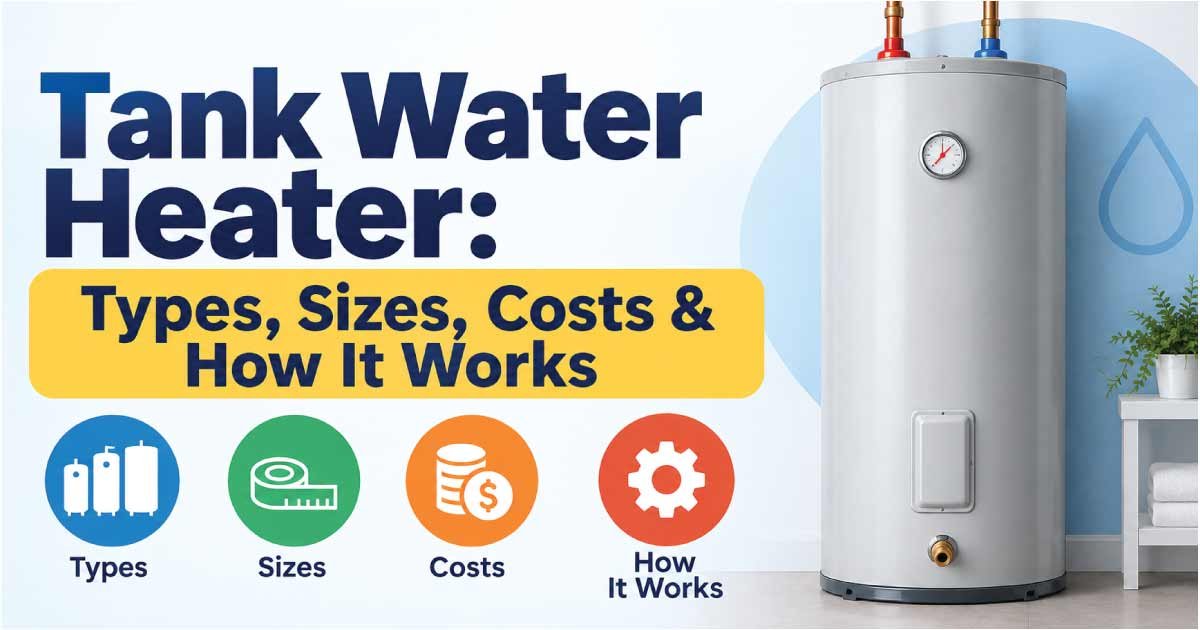
A tank water heater is one of the most common systems used to heat and store hot water for homes, apartments, offices, and other buildings. Unlike a tankless water heater, which heats water as it flows through the system, a tank water heater keeps a supply of heated water ready for use.
Understanding how a tank water heater works, the different types available, standard tank sizes, energy sources, efficiency ratings, installation requirements, and maintenance needs can make it much easier to choose the right model. The correct water heater depends on household size, hot-water demand, available fuel, installation space, and budget.
This guide explains tank water heaters in detail, including conventional storage water heaters, electric and gas models, tank capacities, operating principles, advantages and disadvantages, energy efficiency, maintenance, common problems, and how to select the right size.
What Is a Tank Water Heater?
A tank water heater is a water-heating appliance that stores a specific quantity of water inside an insulated storage tank. A heating element or burner raises the water temperature, and the insulation helps slow down heat loss.
When a hot-water tap is opened, hot water leaves the tank through the hot-water outlet. Cold water then enters the bottom of the tank to replace the water that was used. The heating system continues operating as necessary to maintain the desired temperature.
A typical storage water heater contains several important components:
- Storage tank
- Cold-water inlet
- Hot-water outlet
- Heating element or gas burner
- Thermostat
- Temperature and pressure relief valve
- Drain valve
- Insulation
- Anode rod
- Dip tube
- Flue or venting system on many gas models
The storage tank is generally made from steel with a protective interior lining. The outside is surrounded by insulation to reduce standby heat loss.
Tank water heaters are available in different capacities, fuel types, dimensions, and configurations. Common options include electric storage water heaters, gas storage water heaters, and conventional tank models.
How Does a Tank Water Heater Work?
The basic operating principle is relatively simple: water enters the tank, the heating system raises its temperature, and the heated water remains stored until it is needed.
The process normally works as follows:
- Cold water enters the tank through the cold-water inlet.
- The thermostat monitors the water temperature.
- When the temperature falls below the selected setting, the heating system activates.
- An electric heating element or gas burner heats the water.
- Heated water rises toward the upper portion of the tank.
- When a hot-water fixture is opened, hot water flows from the tank.
- Incoming cold water replaces the hot water that leaves.
- The heating system reheats the water when necessary.
This cycle continues throughout normal operation.
A tank water heater does not necessarily heat all of its water continuously. Instead, the thermostat activates the heating system when the stored water temperature drops below the set point.
How an Electric Tank Water Heater Works
An electric storage water heater normally uses one or two electric heating elements installed inside the tank. These elements work similarly to large immersion heaters.
When the thermostat detects that the water temperature has fallen, it sends power to the heating element. The element heats the surrounding water until the desired temperature is reached.
Many electric models use:
- An upper heating element
- A lower heating element
- One or more thermostats
- Electrical controls
- Thermal safety devices
The lower element is especially important for heating most of the tank’s stored water, while the upper element can provide faster recovery when hot water is being used.
How a Gas Tank Water Heater Works
A gas storage water heater uses a burner positioned below the storage tank. Natural gas or another compatible fuel is burned to generate heat.
The heat transfers through the bottom of the tank and warms the water. Combustion gases are then directed through a flue and venting system.
Gas water heaters typically require:
- A gas supply
- Burner assembly
- Thermostat or gas control valve
- Combustion air
- Proper venting
- Safety controls
Because combustion is involved, installation and venting requirements are particularly important for gas water heaters.
Types of Tank Water Heaters
Tank water heaters can be classified according to their energy source, design, installation method, and intended application.
The most common types are conventional gas and electric storage water heaters, but other variations are also available.
Conventional Storage Water Heater
A conventional storage water heater stores heated water in an insulated tank and maintains it at a preset temperature.
This is the traditional tank-style water heater found in many residential properties. It is available in multiple capacities and can operate using electricity or gas.
Its main characteristics include:
- Large insulated storage tank
- Continuous temperature control
- Hot water available from storage
- Relatively simple operating principle
- Multiple capacity options
Electric Storage Water Heater
An electric storage water heater uses electrical resistance heating elements instead of a gas burner.
Electric models are often suitable where natural gas is unavailable or where electrical installation is more convenient.
Advantages include:
- No combustion gases
- No gas line required
- Generally straightforward installation
- Flexible placement options
- No gas burner or flue required in many installations
However, electricity costs and available electrical capacity should be considered before choosing a large electric model.
Gas Storage Water Heater
A gas storage water heater uses a burner to heat water stored inside the tank.
Gas models can provide strong heating performance and may recover hot water relatively quickly, depending on the model and burner capacity.
They normally require appropriate gas connections, ventilation, combustion air, and flue arrangements.
Heat Pump Water Heater With a Tank
A heat pump water heater also stores hot water in a tank, but instead of generating most of its heat directly through electrical resistance, it transfers heat from surrounding air into the water.
This can significantly reduce electricity consumption compared with conventional electric resistance heating under suitable conditions.
Heat pump models generally cost more initially and require appropriate installation space and environmental conditions, but their operating efficiency can make them attractive for long-term use.
Tank Water Heater Sizes
Water heater size is normally expressed by tank capacity. In the United States, capacity is commonly measured in gallons, while other markets may use liters.
Choosing the correct tank capacity is important because an undersized heater may run out of hot water, while an oversized heater can increase purchase, installation, and standby energy costs.
The ideal size depends more on peak hot-water demand than simply the number of people living in a home.
| Household Size | Typical Tank Capacity | General Application |
|---|---|---|
| 1–2 people | 20–40 gallons | Small household |
| 2–3 people | 30–50 gallons | Apartment or small home |
| 3–4 people | 40–60 gallons | Average household |
| 4–5 people | 50–70 gallons | Larger household |
| 5+ people | 60–80+ gallons | High hot-water demand |
These ranges are general planning guidelines rather than exact sizing requirements. Actual requirements depend on shower duration, bathtub use, dishwasher operation, laundry, fixture flow rates, and the heater’s recovery rate.
Small Tank Water Heaters
Small storage water heaters may have capacities around 20 to 40 gallons. They can be suitable for one- or two-person households, apartments, guest spaces, or applications with limited hot-water demand.
A smaller tank can also make sense where installation space is restricted.
Medium Tank Water Heaters
Medium-size tanks commonly fall in the approximately 40- to 60-gallon range.
These capacities are frequently considered for average households because they provide a balance between storage capacity, physical size, and operating requirements.
Large Tank Water Heaters
Large storage tanks may provide 60 gallons or more of capacity and are generally intended for households or applications with greater hot-water demand.
Larger tanks are useful when several people may need hot water within a relatively short period.
However, bigger does not automatically mean better. If demand is low, an unnecessarily large tank can waste energy through standby heat loss.
How to Choose the Right Tank Size
The best water heater size should be based on peak demand rather than household size alone.
Consider how much hot water is typically used during the busiest period of the day.
For example, a household may have several people taking showers close together while a dishwasher or washing machine is also operating. That situation creates considerably more demand than the same number of people using hot water at separate times.
Important factors include:
- Number of household members
- Number of bathrooms
- Number of showers used simultaneously
- Bathtub frequency
- Dishwasher usage
- Washing machine usage
- Shower flow rate
- Desired water temperature
- Recovery rate of the heater
A water heater’s first-hour rating can also be useful when comparing storage models. It considers both the amount of hot water initially available and the heater’s ability to replenish hot water during a high-demand period.
Tank Capacity vs Recovery Rate
Tank capacity tells you how much water can be stored, while recovery rate describes how quickly the system can replace and reheat water that has been used.
This distinction is important.
A smaller tank with a high recovery rate can sometimes perform better than a larger tank with a slower recovery rate, depending on the household’s usage pattern.
For this reason, selecting a water heater based only on gallon capacity can produce an inaccurate result.
Common Tank Water Heater Dimensions
Physical dimensions vary significantly between manufacturers and models. Two water heaters with the same tank capacity may have different heights and diameters.
Typical residential storage heaters can be broadly categorized as:
| Tank Type | Approximate Capacity | Common Physical Design |
|---|---|---|
| Compact | 20–30 gal | Short and narrow |
| Small | 30–40 gal | Standard residential |
| Medium | 40–50 gal | Standard or tall |
| Large | 50–60 gal | Tall residential |
| Extra-large | 60–80+ gal | Tall or specialty |
These are general categories rather than manufacturer-specific dimensions.
Before purchasing a replacement, measure:
- Available height
- Available width
- Tank diameter
- Doorway clearance
- Service clearance
- Pipe locations
- Vent location for gas models
- Electrical connection location
- Drain access
A new tank may have the same capacity as an old one but still fail to fit because of differences in height or diameter.
Tank Water Heater Temperature Settings
Most residential water heaters have an adjustable temperature control. The selected temperature affects comfort, energy consumption, and the risk of scalding.
Many households use a setting around 120°F (49°C), although the appropriate setting depends on the household, appliance, local requirements, and manufacturer instructions.
Higher temperatures can increase scalding risk and energy consumption.
Lower settings can reduce energy use but may not be suitable for every application.
Temperature should therefore be selected carefully rather than simply choosing the highest possible setting.
Why Temperature Matters
Temperature affects several aspects of water-heater performance:
- Hot-water availability
- Energy consumption
- Scalding risk
- Recovery requirements
- Household comfort
- System operation
For safety, always follow the manufacturer’s instructions and applicable local plumbing requirements.
Energy Efficiency of Tank Water Heaters
A tank water heater consumes energy in two main ways: heating water when demand occurs and maintaining the temperature of stored water.
The second factor is known as standby heat loss.
Even when nobody is using hot water, the tank gradually loses heat to its surroundings. The heating system periodically activates to restore the water temperature.
Modern storage water heaters use improved insulation and controls to reduce this loss.
Factors That Affect Water Heater Efficiency
Efficiency can be affected by:
- Fuel type
- Tank insulation
- Water temperature
- Household hot-water demand
- Climate and installation location
- Pipe insulation
- Heater age
- Sediment accumulation
- Operating conditions
An efficient heater is not necessarily the heater with the smallest tank. Correct sizing is important because an oversized tank can store more hot water than necessary and may experience unnecessary standby losses.
Tank Water Heater vs Tankless Water Heater
Tank and tankless water heaters use different approaches to supplying hot water.
A storage tank keeps a reserve of heated water, while a tankless system heats water as it passes through the unit.
| Feature | Tank Water Heater | Tankless Water Heater |
|---|---|---|
| Stores hot water | Yes | No |
| Continuous storage supply | Yes | No |
| Initial cost | Often lower | Often higher |
| Physical tank | Yes | No |
| Standby heat loss | Yes | Very low or none |
| Hot-water capacity | Limited by storage and recovery | Limited by flow rate and heating capacity |
| Installation space | Requires tank space | Usually more compact |
| Recovery | Reheats stored water | Heats incoming water |
| Best suited for | Traditional hot-water demand | On-demand applications |
Neither technology is automatically best for every property.
A tankless water heater can provide continuous hot water under appropriate conditions, but its flow rate and heating capacity must match the home’s simultaneous demand.
A tank model provides stored hot water and can be easier to understand, size, and replace.
Advantages of Tank Water Heaters
Storage water heaters remain popular because of their relatively simple design and established technology.
Key advantages include:
- Large supply of stored hot water
- Familiar technology
- Multiple capacity choices
- Electric and gas options
- Generally straightforward operation
- Suitable for many residential applications
- Hot water can be available immediately from storage
- Often lower initial equipment cost than some alternatives
For households with predictable hot-water usage, a correctly sized storage tank can provide reliable performance.
Discover More:
Disadvantages of Tank Water Heaters
Tank water heaters also have limitations.
Limited Stored Capacity
Once the stored hot water is depleted, the system needs time to heat additional water. This can become noticeable when several people take long showers consecutively.
Standby Heat Loss
The stored water gradually loses heat even when no hot-water fixtures are operating.
Large Physical Footprint
A traditional storage tank requires floor or vertical space and adequate service clearance.
Potential for Sediment Buildup
Minerals and sediment can accumulate inside the tank, especially in areas with hard water.
Finite Tank Lifespan
The tank and internal components eventually deteriorate. Corrosion and leakage can ultimately require replacement.
Tank Water Heater Maintenance
Regular maintenance can help maintain performance and identify problems before they become serious.
Important maintenance tasks may include:
- Inspecting the tank for leaks
- Checking the temperature and pressure relief valve
- Inspecting plumbing connections
- Flushing sediment according to manufacturer guidance
- Inspecting the anode rod when applicable
- Checking gas and venting components on gas models
- Checking electrical components on electric models
- Insulating hot-water pipes where appropriate
- Watching for unusual noises
Maintenance requirements vary by model, water quality, fuel type, and local conditions.
Why Flushing a Tank Matters
Sediment can settle at the bottom of a storage tank. In gas water heaters, sediment can interfere with efficient heat transfer from the burner. It can also contribute to popping, rumbling, or crackling noises.
Flushing procedures should follow the manufacturer’s instructions and should be performed safely.
If you are unfamiliar with water-heater servicing, professional maintenance is preferable to attempting a procedure that involves hot water, electricity, gas, or pressurized components.
Anode Rod Maintenance
Many storage tanks use a sacrificial anode rod designed to help protect the tank from corrosion.
Over time, the anode material is consumed. Its condition can therefore affect the long-term protection of the tank.
Inspecting the anode rod periodically can be particularly useful for extending the service life of some storage water heaters.
Discover More:
Common Tank Water Heater Problems
A storage water heater can develop several common problems over its service life.
Water Heater Not Heating
If the water is completely cold, possible causes include:
- Failed heating element
- Electrical supply problem
- Thermostat issue
- Gas supply problem
- Burner problem
- Faulty gas control
- Safety control activation
The correct troubleshooting process depends on the heater type.
Not Enough Hot Water
If the water becomes cold too quickly, the heater may be undersized for the household’s peak demand.
Other possibilities include:
- Failed heating element
- Thermostat problem
- Sediment buildup
- Incorrect temperature setting
- Dip-tube problem
- High simultaneous water usage
Water Heater Leaking
A leak should never be ignored.
Water can come from:
- Plumbing connections
- Temperature and pressure relief valve
- Drain valve
- Tank fittings
- Internal tank corrosion
- Condensation in some situations
If the actual storage tank is leaking because of internal corrosion, replacement is often necessary rather than a simple repair.
Water Heater Making Noise
Popping, rumbling, cracking, or knocking sounds may indicate sediment buildup or other operating problems.
The exact cause depends on the sound and water-heater type.
Water Temperature Is Too Hot
Excessively hot water can increase scalding risk.
Check the thermostat or temperature control and follow the manufacturer’s recommended settings. If temperature control is malfunctioning, professional service may be required.
Discover More:
Gas vs Electric Tank Water Heater
Choosing between gas and electric storage water heaters depends on fuel availability, installation conditions, energy costs, efficiency, and household requirements.
| Factor | Gas Tank | Electric Tank |
|---|---|---|
| Energy source | Natural gas or compatible fuel | Electricity |
| Combustion | Yes | No |
| Venting | Usually required | Generally not required for combustion |
| Gas connection | Required | Not required |
| Electrical connection | Required for some controls | Required |
| Installation considerations | More complex | Often simpler |
| Suitable where gas is unavailable | No | Yes |
Gas models can be attractive where an existing gas connection and appropriate venting are already available. Electric models can be convenient where electrical service is readily available and gas infrastructure is absent.
How Long Does a Tank Water Heater Last?
The service life of a tank water heater depends on construction, water quality, maintenance, operating conditions, installation, and usage.
A commonly cited planning range for conventional storage water heaters is roughly 8 to 12 years, although some units can last longer and others may fail sooner.
Warning signs that a water heater may be approaching replacement include:
- Frequent repairs
- Rust-colored water
- Visible corrosion
- Persistent leaking
- Reduced hot-water capacity
- Unusual noises
- Increasing operating problems
- Age approaching or exceeding the expected service range
Age alone does not guarantee failure, but an older heater should be monitored carefully.
When Should You Replace a Tank Water Heater?
Replacement becomes more practical when repair costs are increasing or the storage tank itself has begun leaking.
Consider replacement when:
- The tank is leaking
- Corrosion is extensive
- Repairs are becoming frequent
- Hot-water performance has declined
- The heater is significantly outdated
- Energy consumption is higher than desired
- Replacement parts are difficult to obtain
When replacing a tank, do not automatically purchase the same capacity. Recalculate the household’s current hot-water requirements.
How to Select the Best Tank Water Heater
The best tank water heater is not simply the largest or cheapest model. It should match the property’s actual requirements.
Use the following selection process:
- Determine the household’s peak hot-water demand.
- Estimate the required tank capacity.
- Compare electric and gas availability.
- Check the heater’s recovery capability.
- Review efficiency information.
- Measure the available installation space.
- Confirm plumbing and connection requirements.
- Consider maintenance requirements.
- Compare purchase and installation costs.
- Check local installation regulations.
For replacement projects, measuring the existing installation before purchasing a new unit can prevent compatibility problems.
Tank Water Heater Installation Considerations
Installation should comply with manufacturer instructions and applicable local plumbing, electrical, gas, and building requirements.
Important considerations include:
- Proper location
- Adequate service clearance
- Water connections
- Shutoff valve
- Drainage
- Temperature and pressure protection
- Electrical protection
- Gas supply where applicable
- Proper venting for combustion appliances
- Seismic or anchoring requirements where applicable
- Safe discharge piping
Gas water heaters require particular attention to combustion and venting. Electrical models require appropriate electrical circuits and protection.
Professional installation is recommended when the work involves gas lines, electrical wiring, or major plumbing modifications.
How Much Does a Tank Water Heater Cost?
The total cost of a tank water heater includes more than the appliance itself.
Potential expenses include:
- Water heater purchase price
- Delivery
- Installation labor
- Plumbing modifications
- Electrical work
- Gas-line work
- Venting modifications
- Removal of the old unit
- Disposal
- Additional safety equipment
Prices vary significantly by tank capacity, fuel type, brand, efficiency, geographic location, and installation complexity.
A lower purchase price does not always mean a lower total cost of ownership. Energy consumption, maintenance, expected service life, and installation requirements should also be considered.
Frequently Asked Questions About Tank Water Heaters
What is a tank water heater used for?
A tank water heater heats and stores a supply of hot water for showers, sinks, bathtubs, dishwashers, washing machines, and other household applications.
Is a tank water heater better than a tankless water heater?
It depends on the application. Tank models provide stored hot water and are familiar and widely available, while tankless models heat water on demand and can reduce standby losses.
What size tank water heater do I need for a family of four?
A 40- to 60-gallon storage tank is often considered a starting range for a four-person household, but actual sizing should consider peak demand, recovery rate, fixture usage, and household habits.
How many gallons is a standard water heater?
Common residential storage capacities include approximately 30, 40, 50, 60, and 80 gallons, although many other sizes are available.
Are electric tank water heaters efficient?
Modern electric storage water heaters can be efficient, but they still experience standby heat loss. Heat pump water heaters with tanks can achieve substantially higher efficiency than conventional electric resistance models under suitable operating conditions.
Do tank water heaters run all the time?
No. The heating system cycles on and off according to the thermostat. It activates when the stored water temperature falls below the selected setting.
Why does a tank water heater run out of hot water?
The tank can run out when hot-water demand exceeds the amount available from stored water plus the heater’s recovery capability. An undersized tank, high usage, or a malfunctioning heating system can contribute.
Can a tank water heater be installed outside?
Some specially designed models can be installed outdoors, but standard indoor water heaters should not automatically be placed outside. Installation must follow the manufacturer’s requirements and local codes.
How often should a tank water heater be maintained?
Maintenance frequency depends on the model, water quality, usage, and manufacturer recommendations. Regular inspection can help identify leaks, corrosion, sediment, and component problems early.
Final Thoughts on Tank Water Heaters
A tank water heater remains a practical solution for many homes because it stores a ready supply of hot water and is available in numerous capacities and fuel configurations.
The most important factors when selecting a storage water heater are tank capacity, peak hot-water demand, recovery performance, energy source, efficiency, physical dimensions, installation requirements, and long-term operating costs.
Electric storage water heaters can be useful where electrical service is readily available, while gas storage water heaters may be attractive where gas infrastructure already exists. Conventional tank systems are also straightforward to understand and maintain compared with more specialized technologies.
The right choice is therefore not necessarily the biggest tank or the lowest-priced model. A properly sized and correctly installed water heater that matches household demand can provide dependable hot water while avoiding unnecessary capacity, energy use, and installation expense.