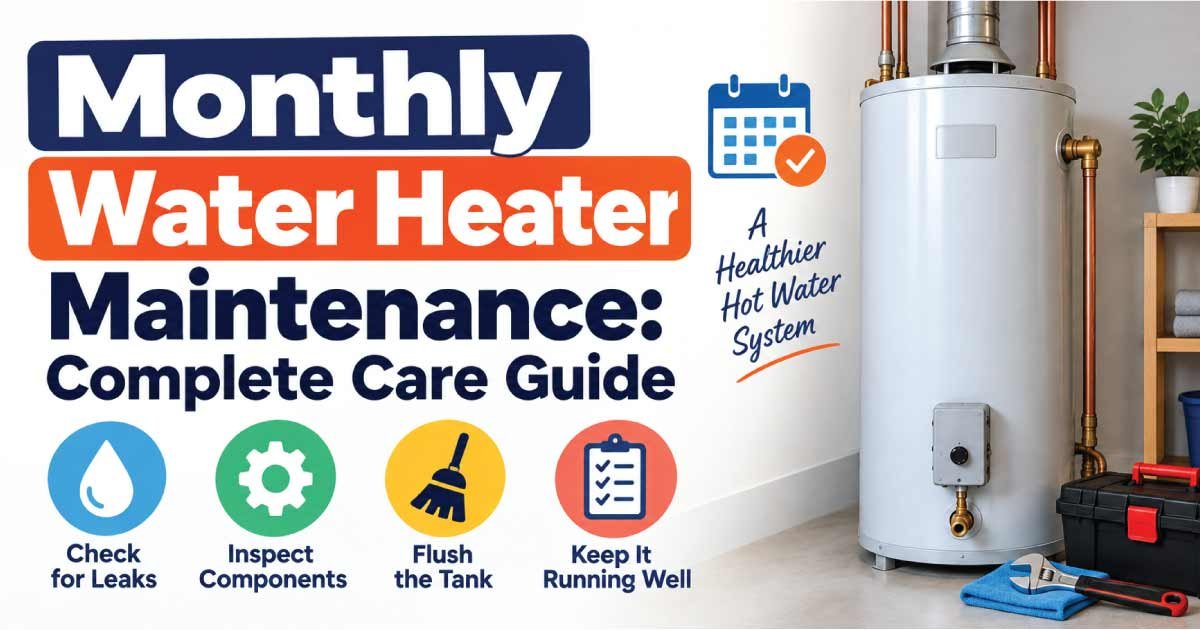
A water heater works quietly in the background every day, providing hot water for showers, washing dishes, laundry, cleaning, and other household needs. Because it operates continuously, regular maintenance is important for maintaining efficiency, reducing unexpected problems, and extending the equipment’s service life.
Monthly water heater maintenance does not necessarily mean completely draining or disassembling the unit every month. Instead, monthly care focuses on simple inspections, cleaning, leak detection, temperature checks, and early identification of problems. More involved tasks, such as flushing a storage tank or inspecting an anode rod, are generally performed less frequently depending on the heater type, water quality, and manufacturer recommendations.
A consistent maintenance routine can help homeowners identify small problems before they become expensive repairs. It can also help maintain proper hot-water performance and provide an opportunity to check important safety components.
Why Monthly Water Heater Maintenance Matters
Water heaters are exposed to heat, water pressure, minerals, corrosion, and repeated heating cycles. Over time, these factors can affect the tank, heating elements, burner, valves, pipes, and other components.
Monthly inspections provide an opportunity to catch warning signs early.
Important benefits include:
- Identifying water leaks before they cause significant damage
- Detecting unusual noises or changes in heating performance
- Checking visible pipes and connections
- Monitoring the temperature setting
- Looking for corrosion or rust
- Checking the area around the heater for moisture
- Confirming that safety components appear normal
- Keeping the heater’s surrounding area clean and accessible
- Reducing the possibility of unexpected breakdowns
- Supporting efficient operation
Regular maintenance is particularly useful for conventional storage tank water heaters, because sediment can accumulate inside the tank and affect heating performance.
Tankless, heat-pump, gas, and electric water heaters have different maintenance requirements, so the manufacturer’s instructions should always take priority over a generic maintenance schedule.
Monthly Water Heater Maintenance Checklist
A practical monthly inspection can usually be completed by visually checking the heater and its surrounding components.
| Maintenance Task | Monthly Check | What to Look For |
|---|---|---|
| Leak inspection | ✓ | Water around tank, valves, or connections |
| Pipe inspection | ✓ | Corrosion, loose fittings, moisture |
| Temperature check | ✓ | Excessively hot or inconsistent water |
| Pressure relief valve area | ✓ | Leaks or discharge |
| Tank exterior | ✓ | Rust, corrosion, dents, moisture |
| Burner area on gas models | ✓ | Unusual condition or debris |
| Electrical area on electric models | ✓ | Visible damage or overheating |
| Surrounding area | ✓ | Clutter, moisture, combustible materials |
| Unusual sounds | ✓ | Popping, rumbling, hissing |
| Hot-water performance | ✓ | Changes in supply or temperature |
This checklist is designed as a monthly inspection, not a replacement for professional servicing or manufacturer-recommended annual maintenance.
Inspect the Water Heater for Leaks
One of the most important monthly tasks is checking for water leaks.
Begin by looking around the bottom of the tank and examining the visible plumbing connections. Check the cold-water inlet, hot-water outlet, drain valve, temperature and pressure relief valve area, and nearby pipe joints.
Even a small amount of moisture deserves attention.
Common Places Water Heater Leaks Occur
Potential leak locations include:
- Tank connections
- Water inlet and outlet fittings
- Drain valve
- Temperature and pressure relief valve
- Flexible water connectors
- Pipe joints
- Heating-element gasket on some electric models
- Tank itself
A leak from a connection may sometimes be repairable, while water leaking directly from the tank can indicate internal corrosion or tank failure.
If water is accumulating rapidly, the tank is severely corroded, or a safety valve is continuously discharging water, professional evaluation is appropriate.
Check the Water Heater Temperature
Temperature is another useful part of monthly maintenance.
Water that is excessively hot can create a scalding risk, while water that is not hot enough may indicate a heating problem, incorrect settings, sediment accumulation, or a failing component.
Many residential water heaters are commonly set around 120°F (49°C), but the appropriate setting depends on the household, equipment, manufacturer instructions, and local requirements.
How to Check Hot-Water Temperature
You can check the temperature at a faucet using an appropriate thermometer.
Run hot water for a short period and measure the water temperature. Avoid relying solely on how the water feels because skin sensation is not an accurate temperature measurement.
If the temperature is substantially different from the expected setting, investigate the thermostat or controls according to the heater’s instructions.
For gas and electric models, avoid opening electrical compartments or gas controls unless you are qualified to work on those components.
Look for Sediment and Mineral Buildup
Sediment is a common issue in conventional tank-style water heaters.
Water naturally contains minerals and particles. When water is heated, some minerals can settle at the bottom of the storage tank. Over time, this sediment can form a thicker layer.
Sediment buildup can:
- Reduce available tank capacity
- Make heating less efficient
- Cause popping or rumbling sounds
- Increase heating time
- Put additional stress on heating components
- Contribute to premature equipment problems
The severity of sediment accumulation depends heavily on local water quality and the type of water entering the home.
Does a Water Heater Need Flushing Every Month?
Usually, no.
Monthly maintenance should include checking for signs associated with sediment, but complete tank flushing is normally performed according to the manufacturer’s recommendations and the household’s water conditions.
Some heaters may benefit from more frequent flushing in areas with hard water, while others may require less frequent service.
If the heater has never been flushed for many years, forcing a neglected valve open or performing an aggressive flush without understanding the equipment can create problems. Professional assistance may be appropriate for heavily neglected units.
Inspect the Temperature and Pressure Relief Valve
The temperature and pressure relief valve, often called the T&P valve, is an important safety component on many storage water heaters.
Its purpose is to provide a way for excessive temperature or pressure to be relieved under certain conditions.
During a monthly visual inspection, check the valve and discharge pipe for:
- Continuous dripping
- Corrosion
- Mineral deposits
- Visible damage
- Improper discharge-pipe conditions
Do not block, cap, or remove the discharge pipe.
Should You Test the Relief Valve Every Month?
Not necessarily.
Although some maintenance instructions discuss periodic testing, operating an old or corroded relief valve can cause it to leak afterward. Always follow the water heater manufacturer’s instructions and local plumbing requirements.
If the valve is already leaking or showing signs of corrosion, professional inspection is preferable to repeatedly operating it.
Inspect the Water Heater Anode Rod
The anode rod is particularly important on traditional storage tank water heaters.
An anode rod is designed to help protect the steel tank from corrosion by providing a material that corrodes preferentially.
Over time, the rod is consumed.
Once an anode rod has deteriorated significantly, the tank can become more vulnerable to corrosion.
How Often Should an Anode Rod Be Checked?
Anode-rod inspection is not usually a monthly task. However, monthly maintenance is a good opportunity to remember when the component was last inspected.
Depending on water chemistry, usage, heater design, and manufacturer recommendations, an anode rod may require inspection periodically rather than every month.
If you own a storage tank water heater and do not know whether it has an anode rod or when it was last inspected, checking the manufacturer documentation or asking a qualified professional can be worthwhile.
Check the Water Heater Pipes and Connections
Water heater connections should be visually inspected every month.
Look for:
- Drips
- White or green mineral deposits
- Rust
- Corrosion
- Loose-looking fittings
- Damaged insulation
- Condensation
- Discoloration around joints
Mineral deposits around a fitting can indicate that a small leak has been occurring for some time.
Do not automatically tighten every fitting you see. Excessive tightening can damage plumbing components or create additional problems.
If a connection is leaking, identify the source carefully before attempting a repair.
Keep the Area Around the Water Heater Clean
The space around the water heater should remain accessible and free of unnecessary clutter.
For gas water heaters, keeping combustible materials away from the appliance is particularly important.
Avoid storing:
- Cardboard boxes
- Paper
- Cleaning chemicals
- Clothing
- Gasoline or flammable liquids
- Other combustible materials
Do not use the water heater closet or utility area as general storage.
Maintaining clear access also makes it easier to identify leaks and perform future maintenance.
Monthly Maintenance for Gas Water Heaters
Gas water heaters require some checks that do not apply to electric models.
A monthly visual inspection should include the area around the burner and visible venting components.
Look for obvious warning signs such as:
- Unusual odors
- Soot or dark discoloration
- Damaged visible vent components
- Unusual burner behavior
- Pilot-light problems
- Repeated ignition issues
- Unusual sounds
If you smell gas, do not treat it as routine maintenance.
Avoid operating electrical switches or creating flames, leave the area if necessary, and contact the appropriate gas emergency service or qualified professional according to local procedures.
Check the Pilot Light and Burner Area
If your gas water heater uses a pilot light, observe its operation according to the manufacturer’s instructions.
A recurring pilot-light failure may indicate an issue with the thermocouple, gas supply, burner assembly, venting, or another component.
Do not repeatedly attempt repairs without identifying the cause.
Monthly Maintenance for Electric Water Heaters
Electric storage water heaters have different components from gas models.
Instead of a burner and pilot light, they typically use electric heating elements controlled by thermostats.
Monthly visual checks can focus on:
- Water leaks
- Pipe connections
- Tank corrosion
- Temperature performance
- Unusual noises
- Electrical components that are visibly accessible
- Changes in heating performance
Never remove electrical covers while the unit is energized unless you are qualified to perform electrical work.
Signs of an Electric Heating Element Problem
Potential symptoms include:
- Water takes longer to heat
- Hot water runs out unusually quickly
- Water is only lukewarm
- The heater repeatedly trips a circuit breaker
- Heating performance changes suddenly
A faulty heating element or thermostat generally requires electrical troubleshooting.
Monthly Maintenance for Tankless Water Heaters
Tankless water heaters do not store a large volume of heated water, so their maintenance routine differs from conventional tank heaters.
Common maintenance considerations include:
- Checking for leaks
- Inspecting water connections
- Monitoring error codes
- Checking water flow performance
- Inspecting filters where applicable
- Maintaining the manufacturer-recommended filtration system
- Monitoring mineral buildup
- Scheduling periodic descaling when required
Hard water can cause mineral deposits inside tankless heat exchangers.
Tankless Water Heater Descaling
Descaling frequency depends on water hardness, usage, heater design, and manufacturer recommendations.
A household with hard water may require more frequent descaling than one with relatively soft water.
Monthly maintenance should therefore focus on monitoring performance and remembering the recommended service interval rather than automatically performing a chemical flush every month.
Monthly Maintenance for Heat Pump Water Heaters
Heat pump water heaters transfer heat from surrounding air rather than relying solely on traditional electric resistance heating.
Their maintenance requirements can include:
- Checking for water leaks
- Inspecting air filters
- Cleaning accessible filters as directed
- Checking condensate drainage where applicable
- Keeping airflow around the unit unobstructed
- Monitoring operating modes
- Checking for unusual sounds
Because airflow is important to heat pump operation, avoid placing boxes or other objects around the unit that could restrict the manufacturer-specified clearance.
Discover More:
Water Heater Maintenance Schedule
Not every maintenance task should be performed monthly. A better approach is to divide maintenance into monthly, periodic, and professional tasks.
| Task | Monthly | Periodic | Professional When Needed |
|---|---|---|---|
| Check for leaks | ✓ | — | ✓ |
| Inspect visible pipes | ✓ | — | ✓ |
| Check temperature | ✓ | — | ✓ |
| Clean surrounding area | ✓ | — | — |
| Check for unusual noises | ✓ | — | ✓ |
| Tank flushing | — | ✓ | ✓ |
| Anode rod inspection | — | ✓ | ✓ |
| Tankless descaling | — | ✓ | ✓ |
| Heating-element inspection | — | — | ✓ |
| Gas burner service | — | ✓ | ✓ |
| Venting inspection | — | ✓ | ✓ |
| Electrical diagnosis | — | — | ✓ |
The exact interval should always be adjusted according to the equipment manufacturer, water quality, local regulations, age of the unit, and actual operating conditions.
What to Do During a Monthly Water Heater Inspection
A simple monthly routine can follow this order.
Step 1: Inspect the Surrounding Area
Make sure the water heater is accessible and the floor or surrounding space is dry.
Remove unnecessary clutter from the area.
Step 2: Look for Leaks
Inspect the tank, pipes, fittings, drain valve, and visible connections.
Pay particular attention to small drops or mineral deposits.
Step 3: Check Hot-Water Performance
Notice whether the heater provides the normal amount of hot water.
Sudden changes can indicate developing problems.
Step 4: Check Temperature
Use a thermometer when appropriate rather than relying only on touch.
Step 5: Listen for Unusual Sounds
Popping, rumbling, hissing, banging, or other unusual noises may deserve investigation.
Step 6: Inspect Visible Components
Look for corrosion, rust, damaged insulation, moisture, or other visible abnormalities.
Step 7: Review Your Maintenance Log
Record what you checked and whether anything changed from the previous month.
Discover More:
Water Heater Maintenance Log
Keeping a simple log can make long-term maintenance easier.
| Month | Leak Check | Temperature | Noise Check | Visible Condition | Action Needed |
|---|---|---|---|---|---|
| January | ✓ | ✓ | ✓ | Good | None |
| February | ✓ | ✓ | ✓ | Good | None |
| March | ✓ | ✓ | ✓ | Good | None |
| April | ✓ | ✓ | ✓ | Good | None |
| May | ✓ | ✓ | ✓ | Good | None |
| June | ✓ | ✓ | ✓ | Good | None |
| July | ✓ | ✓ | ✓ | Good | None |
| August | ✓ | ✓ | ✓ | Good | None |
| September | ✓ | ✓ | ✓ | Good | None |
| October | ✓ | ✓ | ✓ | Good | None |
| November | ✓ | ✓ | ✓ | Good | None |
| December | ✓ | ✓ | ✓ | Good | None |
This type of log does not replace professional maintenance records, but it can help identify gradual changes.
Signs Your Water Heater Needs Attention
Monthly inspection becomes especially valuable when you know what warning signs to look for.
Water Around the Tank
Moisture near the water heater should never be ignored.
Determine whether the water is coming from a pipe connection, valve, drain opening, condensation, or the tank itself.
Rust or Corrosion
Visible rust may occur on fittings, pipes, valves, or the tank.
Corrosion can progress over time, particularly in areas exposed to moisture.
Popping or Rumbling Sounds
Popping and rumbling can occur when sediment accumulates inside a conventional storage tank.
If the noise is persistent or worsening, investigate the cause.
Insufficient Hot Water
Reduced hot-water capacity may result from sediment, heating-element problems, thermostat issues, incorrect settings, undersized equipment, or changes in household demand.
Water Is Too Hot
Excessive water temperature can create a serious scalding hazard.
Check the thermostat or temperature setting according to the manufacturer’s instructions.
Frequent Circuit Breaker Trips
On electric water heaters, repeated breaker trips should not simply be reset again and again.
There may be an electrical fault, heating-element problem, wiring issue, or another condition requiring diagnosis.
Discover More:
Common Monthly Maintenance Mistakes
A maintenance routine can become counterproductive when tasks are performed incorrectly.
Avoid these common mistakes:
- Ignoring small leaks
- Setting the temperature unnecessarily high
- Blocking access to the water heater
- Storing combustible materials near gas appliances
- Performing electrical repairs without proper qualifications
- Repeatedly resetting a tripped breaker
- Forcing an old relief valve to operate
- Flushing a neglected tank without considering its condition
- Using cleaning chemicals not approved by the manufacturer
- Ignoring unusual sounds
- Failing to follow the owner’s manual
- Assuming every water heater has identical maintenance requirements
The goal of monthly maintenance is early detection and prevention, not performing every possible repair yourself.
DIY Maintenance vs Professional Water Heater Service
Some maintenance tasks are suitable for homeowners, while others should be handled by trained professionals.
Tasks Homeowners Can Usually Monitor
Depending on the equipment and manufacturer instructions, homeowners can generally:
- Look for leaks
- Check visible pipes
- Keep the surrounding area clean
- Monitor water temperature
- Listen for unusual sounds
- Observe changes in hot-water performance
- Record maintenance dates
Tasks Better Suited to Professionals
Professional assistance is appropriate for tasks involving:
- Gas lines
- Gas valves
- Burner troubleshooting
- Electrical wiring
- Heating-element replacement
- Thermostat replacement
- Tank replacement
- Serious leaks
- Pressure problems
- Venting issues
- Internal corrosion
- Persistent relief-valve discharge
When safety-critical components are involved, professional diagnosis is generally safer than trial-and-error repairs.
How Water Quality Affects Maintenance Frequency
Water quality is one of the biggest factors affecting water heater maintenance.
Hard water contains higher concentrations of minerals that can contribute to scale and sediment. These deposits can affect conventional tank heaters and tankless heat exchangers.
If you live in an area with hard water, you may need to pay additional attention to:
- Sediment accumulation
- Scale deposits
- Tank flushing
- Tankless descaling
- Anode rod condition
- Reduced heating performance
Water quality can therefore make a standard maintenance calendar more or less frequent.
How Heater Age Changes Maintenance Needs
A newer water heater may require relatively little intervention beyond routine inspections and manufacturer-recommended service.
As a unit ages, however, monitoring becomes increasingly important.
Older equipment may be more susceptible to:
- Corrosion
- Valve problems
- Heating-element failure
- Thermostat issues
- Sediment accumulation
- Leaks
- Reduced efficiency
If an older water heater begins showing multiple warning signs, compare the likely repair cost with replacement options rather than repeatedly repairing individual components.
How to Improve Water Heater Efficiency
Maintenance and efficiency are closely related.
Simple practices can help the system operate effectively:
- Use an appropriate temperature setting
- Address leaks promptly
- Keep tankless filters clean as instructed
- Maintain proper airflow around heat pump models
- Flush or descale equipment according to recommendations
- Inspect insulation where applicable
- Avoid unnecessary hot-water consumption
- Replace failing components promptly
- Follow the manufacturer’s maintenance schedule
Efficiency also depends on heater type, age, household demand, installation quality, insulation, incoming water temperature, and energy source.
Monthly Water Heater Maintenance: Quick Checklist
For a simple monthly routine, use this checklist:
- ☐ Inspect the tank for visible leaks
- ☐ Check water connections
- ☐ Look for corrosion
- ☐ Check the area around the heater
- ☐ Make sure access is unobstructed
- ☐ Monitor hot-water temperature
- ☐ Listen for unusual sounds
- ☐ Check for changes in heating performance
- ☐ Inspect visible valves and pipes
- ☐ Check gas-heater areas for unusual conditions
- ☐ Check electric models for obvious signs of electrical trouble
- ☐ Check tankless filters when applicable
- ☐ Review the maintenance log
- ☐ Schedule professional service if warning signs appear
This routine takes only a small amount of time but can help homeowners notice problems before they become major failures.
Frequently Asked Questions About Monthly Water Heater Maintenance
Is monthly water heater maintenance necessary?
Monthly inspection is useful because it provides regular opportunities to identify leaks, corrosion, unusual sounds, temperature problems, and changes in performance. However, not every maintenance procedure needs to be performed every month.
What should I check on my water heater every month?
Check for leaks, corrosion, unusual noises, temperature changes, pipe problems, moisture, and changes in hot-water performance. Keep the surrounding area clean and accessible.
Should I flush my water heater every month?
Usually not. Tank flushing should follow the manufacturer’s recommendations and should take water quality and equipment condition into account.
How often should a water heater be serviced?
The appropriate service interval varies by heater type, manufacturer, water quality, age, and usage. Use the manufacturer’s maintenance instructions as the primary reference.
Why does my water heater make popping noises?
Popping or rumbling can be associated with sediment accumulation in conventional storage tank water heaters. Persistent or worsening noises should be investigated.
How often should I inspect the anode rod?
Anode rods generally require periodic rather than monthly inspection. The appropriate interval depends on water chemistry, usage, heater design, and manufacturer guidance.
What temperature should a water heater be set to?
Around 120°F (49°C) is a commonly used residential setting, but the correct setting depends on the equipment, household requirements, manufacturer instructions, and applicable safety considerations.
Can I maintain a gas water heater myself?
Homeowners can perform visual checks and monitor basic conditions, but gas connections, burner problems, venting issues, and other safety-critical components should be handled by qualified professionals.
How do I know if my water heater needs replacement?
Frequent leaks, severe corrosion, repeated component failures, inadequate hot-water supply, persistent performance problems, and an aging tank can all indicate that replacement should be considered.
Final Monthly Water Heater Maintenance Routine
A good maintenance program does not require homeowners to dismantle their water heater every month. The most valuable habit is consistent observation.
Every month, inspect the heater for leaks, corrosion, unusual sounds, temperature changes, plumbing problems, and changes in hot-water performance. Keep the surrounding area clean and accessible, record your observations, and schedule periodic service according to the manufacturer’s instructions.
For storage tank models, pay particular attention to sediment and anode-rod condition. For tankless systems, monitor scale buildup and follow the recommended descaling schedule. Gas models require additional attention to burner and venting conditions, while electric models require awareness of heating-element and electrical symptoms.
The best monthly water heater maintenance strategy is therefore a combination of routine inspection, appropriate periodic servicing, prompt repair of warning signs, and professional help when a problem involves gas, electricity, pressure, or other safety-critical components.