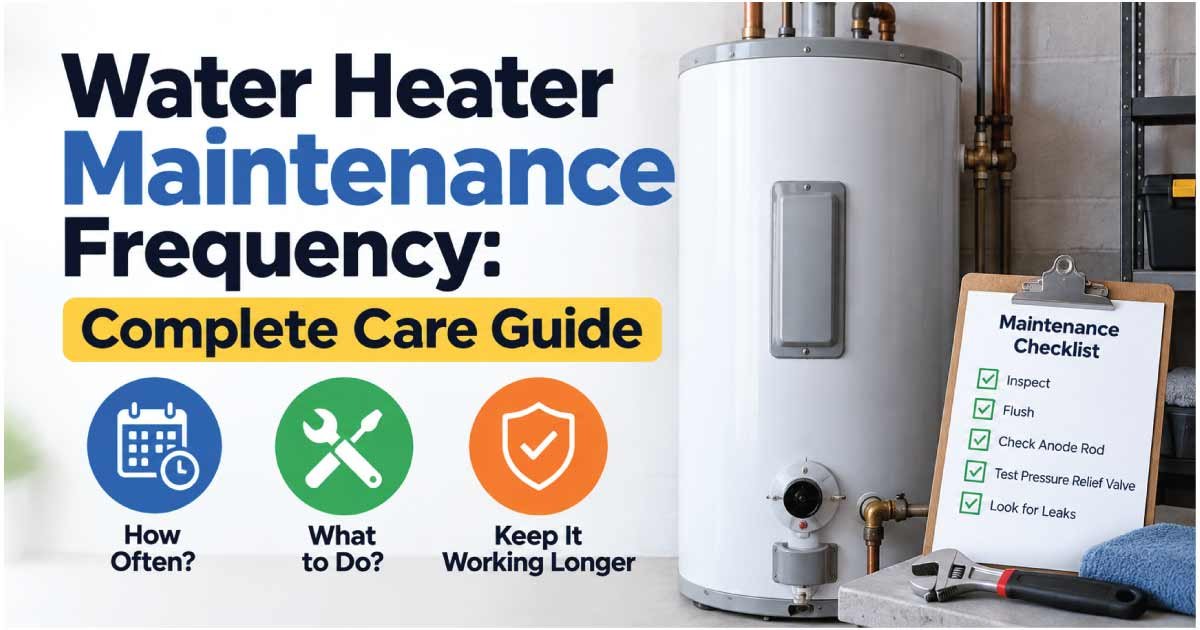
Knowing how often to maintain a water heater is essential for reliable hot-water performance, energy efficiency, safety, and equipment longevity. A water heater operates regularly, often heating and reheating water throughout the day, so its components naturally experience wear, mineral buildup, corrosion, and temperature-related stress.
The ideal water heater maintenance frequency depends on several factors, including the type of heater, water quality, household usage, age of the equipment, fuel source, and manufacturer’s recommendations. A traditional storage tank water heater has different maintenance requirements from a tankless, heat pump, gas, or electric system.
For most homes, maintenance should not be viewed as one annual task. Instead, it is better to divide maintenance into monthly inspections, quarterly checks, biannual service, and annual professional evaluation when appropriate.
This complete guide explains how often different water heater maintenance tasks should be performed, what to inspect at each interval, and how to create a practical maintenance schedule.
Why Water Heater Maintenance Frequency Matters
A water heater can appear to work normally while developing problems internally. Sediment can accumulate inside a storage tank, anode rods can become depleted, heating elements can deteriorate, and plumbing connections can begin leaking.
Regular maintenance provides an opportunity to identify these problems before they become major failures.
A consistent maintenance schedule can help:
- Detect leaks early
- Reduce sediment accumulation
- Monitor corrosion
- Maintain heating performance
- Protect important components
- Support energy efficiency
- Reduce unexpected breakdowns
- Improve system reliability
- Identify safety concerns
- Extend useful equipment life
The correct frequency is not identical for every household. A home with hard water and heavy hot-water demand may need more frequent service than a lightly used system operating with relatively low mineral content.
How Often Should a Water Heater Be Maintained?
For general household planning, a water heater should receive some level of attention throughout the year rather than only once annually.
A practical maintenance frequency is:
| Maintenance Frequency | Recommended Focus |
|---|---|
| Monthly | Visual inspection and performance check |
| Every 3 Months | Deeper inspection and component review |
| Every 6 Months | Preventive maintenance and applicable cleaning |
| Annually | Comprehensive inspection |
| As Needed | Repairs, leaks, unusual noises, error codes |
Monthly maintenance is usually quick. It involves looking for leaks, corrosion, unusual sounds, and changes in hot-water performance.
Quarterly maintenance involves a more detailed review of accessible components.
Biannual maintenance may include flushing a storage tank, inspecting the anode rod, cleaning filters, or completing other manufacturer-recommended tasks.
Annual maintenance provides an opportunity for a complete review and professional service where necessary.
Water Heater Maintenance Frequency by Task
Different components require different maintenance intervals. There is no need to perform every task every month.
| Task | Recommended Frequency | Applies Mainly To |
|---|---|---|
| Check for leaks | Monthly | All systems |
| Check hot-water performance | Monthly | All systems |
| Inspect visible corrosion | Monthly | All systems |
| Listen for unusual noises | Monthly | Mainly tank systems |
| Inspect plumbing connections | Quarterly | All systems |
| Check accessible filters | Quarterly | Applicable systems |
| Inspect venting | Quarterly | Gas systems |
| Flush storage tank | 6–12 months | Tank systems |
| Inspect anode rod | 6–12 months | Tank systems |
| Descale heat exchanger | As required | Tankless systems |
| Clean air filter | According to manufacturer | Heat pump systems |
| Inspect electrical components | Annually/professionally | Electric systems |
| Inspect gas components | Annually/professionally | Gas systems |
| Full professional inspection | Annually or as needed | All systems |
These intervals are general planning guidelines. Always prioritize the maintenance instructions supplied for the specific model.
Monthly Water Heater Maintenance Frequency
Monthly maintenance is primarily about early detection. Most homeowners can perform basic visual and operational checks without taking the water heater apart.
Check for Leaks Every Month
Inspect the area around the heater for moisture.
Check:
- Tank bottom
- Cold-water inlet
- Hot-water outlet
- Shutoff valve
- Drain valve
- Pressure relief discharge pipe
- Nearby plumbing connections
- Floor and surrounding walls
A small leak should not automatically be dismissed as harmless. Water damage can become significantly more expensive if the source is ignored.
Check Water Temperature and Performance
Pay attention to whether the water heater is producing hot water as expected.
Potential changes include:
- Water becoming lukewarm
- Hot water running out sooner
- Longer recovery time
- Fluctuating temperature
- Reduced hot-water flow
A noticeable change in performance can be an early indication that the system requires inspection.
Listen for Unusual Noises
Storage tank water heaters may produce sounds associated with sediment or mineral deposits.
Watch for:
- Popping
- Rumbling
- Crackling
- Banging
- Hissing
A new sound or a sound that becomes progressively louder deserves investigation.
Inspect for Visible Corrosion
Look at accessible metal components for rust or corrosion.
Pay attention to connections, valves, fittings, and exposed piping.
Corrosion accompanied by moisture may indicate an active plumbing problem.
Quarterly Water Heater Maintenance Frequency
Every three months, perform a more detailed inspection than the basic monthly check.
Inspect Plumbing Connections
Look carefully at the connections between the water heater and household plumbing.
Check for:
- Mineral deposits
- Rust
- Moisture
- Damaged fittings
- Loose-looking connections
- Discoloration
Do not apply excessive force to fittings or valves without knowing what you are doing. Some components can be damaged by overtightening.
Review the Pressure Relief System
Many storage water heaters have a temperature and pressure relief valve.
This safety component is designed to release pressure or water when specific unsafe conditions occur.
Follow the manufacturer’s instructions for inspection or testing. If the valve leaks continuously, appears damaged, or does not function correctly, professional service may be required.
Inspect Gas Water Heater Venting
Gas water heaters require appropriate combustion and exhaust ventilation.
Check accessible venting for obvious signs of:
- Corrosion
- Damage
- Disconnection
- Obstruction
- Improper changes
Do not modify a gas water heater’s venting system without professional guidance.
Check Filters and Screens
Some water heaters have accessible filters or screens that collect debris.
Depending on the system, these may include:
- Tankless inlet filters
- Heat pump air filters
- Water inlet screens
- Other manufacturer-specified filters
The correct cleaning frequency depends on the model and operating environment.
Biannual Water Heater Maintenance Frequency
Biannual maintenance means approximately twice per year. This interval is useful for more involved preventive tasks.
Flush a Storage Tank Water Heater
Sediment naturally settles at the bottom of many storage tank water heaters.
Over time, sediment can interfere with efficient heating and contribute to unusual noises.
Flushing the tank can help remove accumulated sediment when performed correctly.
A typical process may involve:
- Follow the manufacturer’s shutdown instructions.
- Allow the water to cool to a safe temperature.
- Connect an appropriate hose to the drain valve.
- Direct water to a suitable drainage location.
- Open the drain valve according to the manufacturer’s instructions.
- Allow sediment and water to drain.
- Follow the correct refill and restart procedure.
Do not improvise the procedure, particularly if the drain valve is corroded or blocked.
Inspect the Anode Rod
Many traditional storage tank water heaters contain a sacrificial anode rod.
Its purpose is to corrode preferentially and provide protection to the steel tank.
The rate at which an anode rod wears depends on water chemistry, temperature, usage, and other factors.
If the rod is significantly depleted, replacing it may help maintain tank corrosion protection.
Check Tank Condition
Inspect the tank for:
- Rust
- Dampness
- Bulging
- Corrosion
- Mineral deposits
- Leaking seams
A tank that is actively leaking from its body may have reached a condition where replacement is more appropriate than repair.
Annual Water Heater Maintenance Frequency
Annual maintenance is the most comprehensive routine service interval for many households.
Perform a Complete Inspection
An annual review should consider the entire water heater system.
Important areas include:
- Tank condition
- Plumbing connections
- Shutoff valve
- Drain valve
- Pressure relief system
- Heating components
- Thermostat
- Electrical connections
- Gas components
- Venting
- Insulation
- Filters
- Anode rod
- Sediment condition
Not every component should be opened or serviced by a homeowner. Electrical and gas components may require qualified professional attention.
Review Manufacturer Requirements
The manufacturer’s maintenance schedule should always take priority over a generic maintenance calendar.
Different models can have different requirements for:
- Flushing
- Descaling
- Filter cleaning
- Anode inspection
- Pressure relief testing
- Burner inspection
- Electrical inspection
- Heat exchanger cleaning
Keep the owner’s manual available or record the model number so the correct maintenance instructions can be identified.
Electric Water Heater Maintenance Frequency
Electric water heaters do not use combustion, so their maintenance routine differs from gas systems.
Monthly Electric Water Heater Checks
Inspect for leaks, corrosion, unusual noises, and changes in hot-water performance.
If the water heater suddenly produces less hot water, takes much longer to recover, or produces inconsistent temperatures, the heating elements or thermostatic controls may require inspection.
Annual Electric Water Heater Service
An annual inspection can include:
- Heating elements
- Thermostats
- Electrical connections
- Wiring
- Tank condition
- Pressure relief valve
- Anode rod
- Sediment accumulation
Electrical repairs should be performed using appropriate electrical safety procedures and by a qualified professional when required.
Repeated circuit breaker trips should not simply be ignored or repeatedly reset.
Gas Water Heater Maintenance Frequency
Gas water heaters require additional maintenance because they rely on combustion.
Gas Water Heater Monthly Checks
Look for obvious changes around the appliance, including unusual odors, soot, corrosion, damaged venting, or changes in performance.
Never ignore a gas smell.
If gas is suspected, leave the area and follow local emergency and utility instructions.
Annual Gas Water Heater Inspection
Professional service may include inspection of:
- Burner assembly
- Gas connections
- Gas controls
- Ignition system
- Venting
- Combustion
- Safety components
Gas-related repairs and combustion adjustments should be handled by appropriately qualified professionals.
Tankless Water Heater Maintenance Frequency
Tankless water heaters do not contain a conventional storage tank, but they still need periodic maintenance.
One of the most important considerations is mineral scale.
How Often Should a Tankless Water Heater Be Descaled?
The appropriate descaling frequency depends heavily on water hardness, usage, and the manufacturer’s recommendations.
Some systems may require more frequent attention in hard-water environments.
Signs that maintenance may be needed include:
- Reduced hot-water flow
- Longer heating response
- Temperature fluctuations
- Error codes
- Reduced performance
- Unusual operating sounds
A tankless system may also have an inlet filter that needs periodic cleaning.
Tankless Water Heater Maintenance Tasks
Depending on the model, maintenance can include:
- Cleaning the inlet filter
- Inspecting water connections
- Descaling the heat exchanger
- Checking the flow system
- Inspecting gas venting
- Cleaning applicable components
- Reviewing error codes
Always use the manufacturer’s recommended procedure and approved materials.
Discover More:
Heat Pump Water Heater Maintenance Frequency
Heat pump water heaters use a different technology from conventional electric storage systems.
Their maintenance may include inspection and cleaning of the air filter, checking airflow, and inspecting the condensate drainage system where applicable.
Heat Pump Water Heater Maintenance Tasks
Check:
- Air filter
- Airflow
- Condensate drain
- Water connections
- Tank condition
- Temperature settings
- Error indicators
A dirty air filter can restrict airflow and affect heat pump operation.
Follow the model-specific instructions for filter cleaning and replacement.
Water Heater Maintenance Frequency in Hard Water Areas
Water quality is one of the biggest factors affecting maintenance frequency.
Hard water can contribute to mineral deposits and scale. In storage tanks, sediment may accumulate. In tankless systems, mineral scale can form on heat-transfer surfaces.
If your household has hard water, monitor the heater for signs of buildup more closely.
Possible signs include:
- Popping sounds
- Rumbling
- Reduced flow
- Longer heating time
- White mineral deposits
- Reduced tankless performance
- Increasing energy consumption
Homes with significant mineral buildup may need more frequent flushing or descaling than the general annual schedule.
Water Heater Maintenance Frequency Based on Usage
Household hot-water demand also affects maintenance needs.
A small household using relatively little hot water may place less demand on a system than a large household with frequent showers, laundry, dishwashing, and other hot-water consumption.
Low-Usage Household
A basic monthly inspection combined with periodic and annual maintenance may be sufficient.
Average-Usage Household
A regular monthly, quarterly, biannual, and annual schedule provides a practical maintenance framework.
High-Usage Household
Heavy usage may justify closer monitoring of sediment, performance, filters, scale, and component condition.
The actual maintenance interval should still follow the manufacturer’s recommendations.
Discover More:
Water Heater Maintenance Frequency by Age
The older a water heater becomes, the more important condition monitoring becomes.
| Water Heater Age | Maintenance Priority |
|---|---|
| New | Follow manufacturer schedule |
| 3–5 Years | Monitor condition and routine maintenance |
| 6–10 Years | Increase attention to corrosion and components |
| Older System | Frequent condition monitoring and repair planning |
Age alone does not determine whether a water heater needs replacement. Condition, performance, maintenance history, corrosion, repair frequency, and operating costs should also be considered.
Seasonal Water Heater Maintenance Schedule
Seasonal maintenance can make recurring tasks easier to remember.
| Season | Maintenance Focus |
|---|---|
| Spring | Leak inspection, tank flushing if due, corrosion check |
| Summer | Temperature and performance check |
| Fall | Connections, anode rod, filters and venting |
| Winter | Leak monitoring and hot-water performance |
The specific month is less important than maintaining the intended interval.
Water Heater Maintenance Frequency Checklist
Every Month
- Check for visible leaks
- Inspect surrounding area
- Look for corrosion
- Check hot-water performance
- Listen for unusual noises
- Watch for changes in heating time
Every Three Months
- Inspect plumbing connections
- Review safety components
- Check applicable filters
- Inspect gas water heater venting
- Look for mineral deposits
- Review system performance
Every Six Months
- Flush storage tank when appropriate
- Inspect anode rod
- Check tank condition
- Clean applicable filters
- Inspect accessible components
- Review manufacturer maintenance requirements
Every Year
- Perform comprehensive maintenance
- Inspect heating components
- Review electrical or gas components
- Inspect venting
- Evaluate corrosion
- Schedule professional service when appropriate
As Needed
Do not wait for the next scheduled maintenance date when you notice:
- A significant leak
- Gas odor
- Burning electrical odor
- Severe corrosion
- Repeated breaker trips
- No hot water
- Major temperature changes
- Persistent unusual noises
- Error codes
- Pressure-related problems
Signs Your Water Heater Needs Maintenance More Often
A standard schedule may need to be adjusted when warning signs appear.
Frequent Sediment Buildup
If sediment returns quickly after flushing, water quality may require a more frequent maintenance approach.
Repeated Temperature Problems
Frequent temperature fluctuations or reduced hot-water capacity may indicate a component or sizing issue.
Recurring Leaks
Repeated leaks around fittings or valves deserve professional attention rather than simply being monitored indefinitely.
Rapid Corrosion
Visible corrosion that progresses quickly can indicate a more serious condition.
Frequent Tankless Scale Problems
If a tankless water heater repeatedly develops scale, the descaling frequency may need to be adjusted according to water quality and manufacturer guidance.
Discover More:
Common Water Heater Maintenance Frequency Mistakes
Only Maintaining the Heater Once It Breaks
Maintenance is preventive. Waiting until the water heater stops working eliminates many of the benefits of scheduled inspections.
Using the Same Frequency for Every Heater
Tankless, gas, electric, heat pump, and conventional storage systems have different maintenance needs.
Ignoring Water Quality
Hard water can accelerate mineral accumulation and change how frequently flushing or descaling is needed.
Forgetting the Anode Rod
Storage tank owners sometimes focus only on flushing and overlook the anode rod.
Ignoring Manufacturer Instructions
A generic maintenance schedule should never override the instructions supplied for a particular model.
Performing Unsafe Repairs
Gas and electrical repairs can create serious hazards when performed without appropriate knowledge and equipment.
How to Create a Water Heater Maintenance Calendar
A maintenance calendar makes the recommended frequency easier to follow.
Start by recording:
- Water heater type
- Brand
- Model
- Installation date
- Tank capacity, if applicable
- Energy source
- Last inspection date
- Last flushing date
- Last anode inspection
- Last professional service
Then create recurring reminders.
A simple calendar might look like this:
| Calendar Reminder | Action |
|---|---|
| Monthly | Visual inspection |
| March | Quarterly inspection |
| June | Mid-year maintenance |
| September | Quarterly inspection |
| December | Annual system review |
Adjust these dates to match the actual installation and service history of the water heater.
Can Regular Maintenance Extend Water Heater Life?
Regular maintenance can help preserve performance and identify problems before they become severe, but it cannot guarantee a particular service life.
For storage tank systems, controlling sediment and monitoring the anode rod can help protect important components.
For tankless systems, keeping filters clean and managing scale can help maintain heat-transfer performance.
For all systems, early detection of leaks, corrosion, electrical issues, gas problems, and other faults can reduce the risk of sudden failure.
The key benefit is not simply making the water heater last longer. It is maintaining a system that operates safely and reliably for as long as its condition reasonably allows.
When Professional Water Heater Maintenance Is Necessary
Some maintenance tasks should be left to qualified professionals.
Professional service is particularly important for:
- Gas leaks
- Gas control problems
- Combustion problems
- Venting concerns
- Electrical faults
- Damaged wiring
- Repeated circuit breaker trips
- Major leaks
- Severe corrosion
- Failed safety components
- Complex tankless descaling
- Heating element replacement
If a water heater shows a serious safety warning, do not wait for the next scheduled maintenance interval.
Frequently Asked Questions About Water Heater Maintenance Frequency
How often should a water heater be serviced?
A practical schedule includes monthly visual checks, quarterly inspections, biannual preventive maintenance when applicable, and a comprehensive annual review. Exact requirements vary by heater type and manufacturer.
Is water heater maintenance required every year?
Annual maintenance is a useful general guideline, but some tasks need to occur more frequently while others may be required less often. Always follow the manufacturer’s maintenance instructions.
How often should I flush a water heater?
Storage tank water heaters are commonly flushed periodically to remove sediment. The appropriate interval depends on water quality, usage, heater condition, and manufacturer guidance.
How often should I maintain a tankless water heater?
Tankless maintenance depends largely on water quality and usage. Filter cleaning and descaling may be required periodically, with hard-water conditions potentially requiring more frequent attention.
How often should I check my water heater for leaks?
A quick visual leak inspection once a month is a practical habit. Any significant or active leak should be addressed immediately rather than waiting for the next scheduled inspection.
How often should an anode rod be checked?
Anode rod condition varies by water chemistry and usage. Including it in periodic or annual maintenance is a practical approach, but the manufacturer’s instructions should determine the exact interval.
Does hard water affect water heater maintenance frequency?
Yes. Hard water can increase mineral and scale accumulation, potentially requiring more frequent flushing, cleaning, or descaling.
Can I maintain my water heater myself?
Basic visual inspections and some manufacturer-approved cleaning tasks may be suitable for homeowners. Gas, electrical, major plumbing, and safety-related repairs may require qualified professional service.
Final Water Heater Maintenance Frequency Guide
The best water heater maintenance frequency is a schedule rather than a single date on the calendar.
Check your water heater every month for leaks, corrosion, unusual noises, and changes in hot-water performance. Perform a more detailed inspection every three months. Every six months, complete appropriate preventive tasks such as flushing a storage tank or inspecting an anode rod when recommended. Once a year, review the complete system and arrange professional service when needed.
Water quality, heater type, household demand, system age, and manufacturer requirements can change the ideal schedule.
A simple maintenance routine can help you detect problems early, maintain consistent hot-water performance, support efficiency, and reduce the chance of unexpected breakdowns.
The most important rule is simple: follow the manufacturer’s maintenance instructions first, monitor your system regularly, and address warning signs promptly.