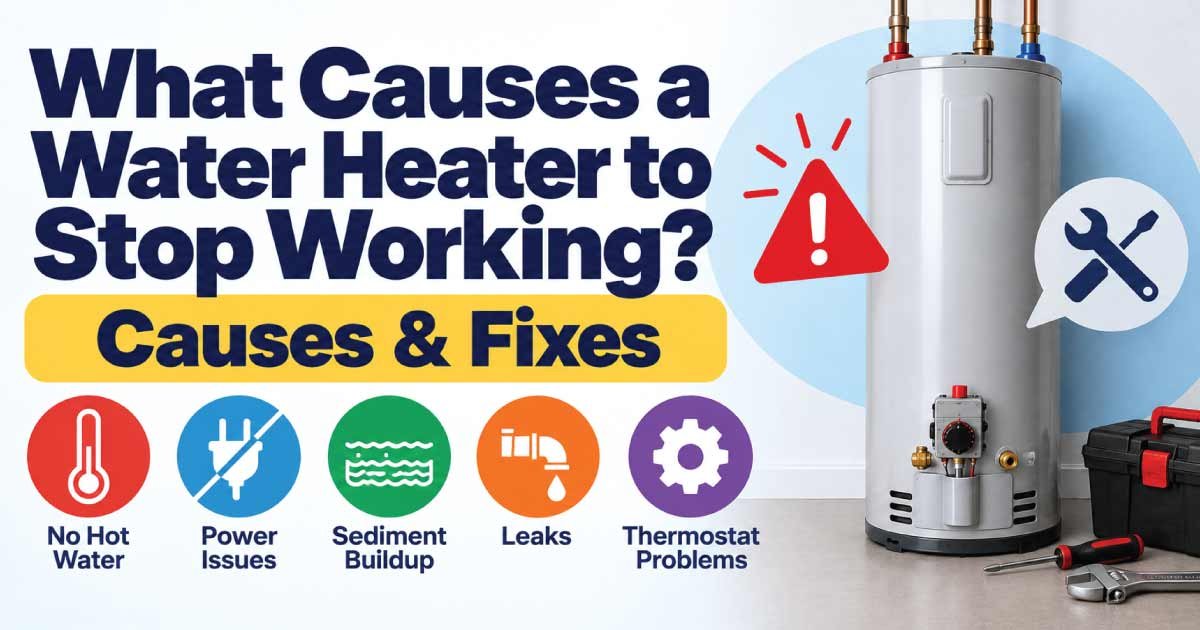
A water heater that suddenly stops working can leave you without hot water when you need it most. The cause may be something simple, such as a tripped circuit breaker or incorrect temperature setting, or it may involve a failed heating element, thermostat, pilot light, thermocouple, gas valve, control board, or another internal component.
The symptoms often provide useful clues. An electric water heater that produces no hot water may have an electrical or heating-component problem, while a gas water heater that stops heating may have an ignition, pilot, burner, gas-supply, or safety-control issue.
This guide explains the most common reasons a water heater stops working, how to identify the likely cause, what you can safely check, and when repair or replacement is necessary.
What Does It Mean When a Water Heater Stops Working?
A water heater has stopped working when it can no longer provide the expected amount of hot water or cannot heat water at all.
The failure can be complete or partial.
A complete failure means the water remains cold regardless of how long the heater operates. A partial failure may produce lukewarm water, a smaller supply of hot water, or unusually long heating times.
Common symptoms include:
- No hot water anywhere in the house
- Lukewarm water instead of hot water
- Hot water runs out unusually quickly
- Heater does not turn on
- Electric heater repeatedly trips the breaker
- Gas pilot light goes out
- Burner fails to ignite
- Heating element does not operate
- Water heater repeatedly needs resetting
- Unusual popping, rumbling, clicking, or humming sounds
- Water leaking around the tank
Identifying the exact symptom is the first step toward finding the cause.
What Causes a Water Heater to Stop Working?
Water heaters can stop working because of problems with their power supply, heating components, controls, fuel supply, safety devices, plumbing, or tank itself.
| Possible Cause | Electric | Gas | Common Result |
|---|---|---|---|
| Tripped circuit breaker | ✓ | Sometimes | No heating |
| Faulty thermostat | ✓ | ✓ | Incorrect temperature |
| Failed heating element | ✓ | — | Cold/lukewarm water |
| High-limit cutoff | ✓ | — | Heater stops heating |
| Pilot light failure | — | ✓ | Burner will not operate |
| Bad thermocouple | — | ✓ | Burner/pilot shuts down |
| Gas supply problem | — | ✓ | No burner operation |
| Faulty gas valve | — | ✓ | Intermittent/no heating |
| Sediment buildup | ✓ | ✓ | Slow heating |
| Electrical wiring fault | ✓ | Sometimes | Power loss |
| Failed control board | ✓ | ✓ | System malfunction |
| Leaking tank | ✓ | ✓ | Water loss/damage |
The correct diagnosis depends on the type of heater and the symptoms you are experiencing.
Why Does an Electric Water Heater Stop Working?
Electric water heaters rely on electricity, thermostats, heating elements, high-temperature safety controls, and wiring.
If any important component fails, the heater may stop heating.
The most common causes are:
- Tripped breaker
- Faulty thermostat
- Failed heating element
- Activated high-limit switch
- Loose electrical connection
- Burned wiring
- Failed control component
- Sediment buildup
Because electric water heaters use high-voltage electrical circuits, internal electrical troubleshooting should be performed only by someone qualified to do so.
Tripped Circuit Breaker
One of the first things to check when an electric water heater suddenly stops working is the electrical panel.
A tripped breaker cuts power to the heater. Without power, the heating elements cannot operate.
A breaker may trip because of:
- Shorted heating element
- Damaged wiring
- Loose connection
- Faulty thermostat
- Electrical overload
- Defective breaker
If the breaker has tripped, it may be possible to reset it once according to the manufacturer’s instructions.
However, if it trips again, do not repeatedly reset it. A recurring trip indicates that an electrical fault requires diagnosis.
Failed Heating Element
Electric tank water heaters use heating elements to heat water.
Over time, an element can fail because of age, mineral deposits, overheating, corrosion, or electrical damage.
A failed element can cause:
- No hot water
- Lukewarm water
- Reduced hot-water capacity
- Very slow recovery
- Hot water that runs out quickly
Many electric storage water heaters have upper and lower heating elements.
Upper Heating Element Failure
The upper heating element plays an important role in the heating sequence. If it fails, the heater may produce little or no usable hot water.
Lower Heating Element Failure
A failed lower element may allow some hot water to remain available initially, but the tank may struggle to recover after significant water usage.
This can make the heater appear to work normally at first before producing cold or lukewarm water.
Faulty Thermostat
A thermostat tells the heating system when to turn on and off based on water temperature.
If the thermostat fails, the heating element may not receive power when needed.
A defective thermostat can cause:
- Cold water
- Lukewarm water
- Overheating
- Inconsistent temperature
- Long heating cycles
- No heating at all
Electric storage water heaters can have multiple thermostats, depending on the design.
A thermostat should be tested according to the manufacturer’s specifications before replacement.
High-Temperature Limit Switch Has Tripped
Electric water heaters commonly include a high-temperature cutoff designed to stop heating if the water becomes excessively hot.
If the cutoff activates, the heater may stop working.
Possible reasons include:
- Faulty thermostat
- Wiring problem
- Control malfunction
- Excessive temperature
- Component failure
A reset may temporarily restore operation, but repeated activation means the underlying problem needs to be identified.
Loose or Burned Electrical Wiring
Electrical connections can loosen or deteriorate over time.
A poor connection may allow the heater to operate temporarily before electrical contact is interrupted.
Signs of an electrical connection problem include:
- Heater works intermittently
- Breaker trips
- Burn marks
- Melted insulation
- Electrical odor
- Discolored terminals
Do not touch exposed wiring or attempt electrical repairs unless you are qualified to safely work on high-voltage equipment.
Why Does a Gas Water Heater Stop Working?
Gas water heaters use fuel, ignition, a pilot or electronic ignition system, a burner, temperature controls, and safety devices.
A gas water heater may stop working because of:
- Pilot light failure
- Thermocouple failure
- Burner problem
- Gas supply interruption
- Gas control valve failure
- Ignition system malfunction
- Venting or combustion problem
- Control-system fault
Gas-related problems require additional caution because incorrect servicing can create fire, explosion, or carbon monoxide hazards.
Pilot Light Has Gone Out
A traditional gas water heater may depend on a pilot light to ignite the main burner.
If the pilot goes out, the burner cannot continue heating the tank.
Possible causes include:
- Dirty pilot assembly
- Weak pilot flame
- Thermocouple problem
- Drafts
- Gas-control issue
- Combustion or airflow problem
If the pilot repeatedly goes out after being relit, the cause should be investigated rather than treating relighting as the permanent solution.
Bad Thermocouple
The thermocouple is a safety component used in many gas water heaters.
It detects whether the pilot flame is present. If the flame is not properly detected, the gas supply can be interrupted.
A failing thermocouple may cause the heater to:
- Start normally.
- Ignite the pilot.
- Begin heating.
- Lose the flame signal.
- Shut down.
- Stop producing hot water.
This can create an intermittent or complete heating failure.
Gas Supply Problem
A gas water heater cannot operate normally without an adequate fuel supply.
Possible causes include:
- Closed gas shutoff
- Gas service interruption
- Supply problem
- Gas-pressure issue
- Fault in the appliance’s gas-control system
If you smell gas, do not attempt to diagnose or repair the gas system yourself. Follow appropriate gas-safety procedures and contact the relevant qualified professional or emergency service.
Faulty Gas Control Valve
The gas control valve manages gas flow and can incorporate temperature and safety controls.
A defective valve may prevent the burner from operating correctly.
Possible symptoms include:
- Burner does not ignite
- Burner shuts off unexpectedly
- Pilot behaves abnormally
- Water remains cold
- Heater operates inconsistently
Gas control components should generally be diagnosed and replaced by a qualified technician.
Dirty or Malfunctioning Burner
The burner must operate correctly to transfer heat into the tank.
Dirt, combustion problems, or component failure can interfere with burner operation.
Signs can include:
- Burner fails to ignite
- Burner starts and stops
- Unusual flame behavior
- Soot
- Delayed ignition
- Poor heating performance
Do not modify the burner or gas pressure to force the heater to operate.
Sediment Buildup
Sediment accumulates inside many storage water heaters over time.
Minerals can settle at the bottom of the tank and interfere with efficient heat transfer.
Heavy sediment can cause:
- Longer heating times
- Reduced hot-water capacity
- Popping or rumbling noises
- Increased energy consumption
- Poor recovery
- Inconsistent heating
Sediment buildup may not cause an immediate complete failure, but it can contribute to declining performance.
Water Heater Has a Leak
A leaking water heater can stop functioning properly and may indicate anything from a loose connection to a deteriorating tank.
Possible leak locations include:
- Inlet connection
- Outlet connection
- Drain valve
- Temperature and pressure relief valve
- Heating-element seal
- Tank itself
A leak from the tank itself is particularly serious because the tank is generally not repairable in the same way as an external valve or connection.
Discover More:
Thermostatic Mixing Valve Problem
Sometimes the water heater is heating normally, but the water at the faucet is not hot enough.
A thermostatic mixing valve can blend hot and cold water. If it malfunctions, it may send excessive cold water into the hot-water supply.
Consider this possibility when:
- The heater itself reaches normal temperature.
- Only certain fixtures have problems.
- Hot-water temperature fluctuates.
- The issue is isolated to one area of the plumbing system.
A faulty faucet cartridge can produce similar symptoms.
Why Does My Water Heater Stop Working Suddenly?
A sudden failure is often associated with a component that has reached the end of its useful life or a safety device that has interrupted operation.
For an electric heater, common sudden-failure causes include:
- Breaker trip
- Failed heating element
- Thermostat failure
- High-limit activation
- Wiring fault
For a gas heater:
- Pilot failure
- Thermocouple failure
- Gas supply problem
- Burner failure
- Gas-control issue
- Ignition problem
The exact cause should be determined before replacing major components.
Discover More:
Why Does My Water Heater Stop Working After a Few Minutes?
A heater that starts and then stops may be experiencing a safety or control problem.
An electric heater could have a thermostat or high-limit problem. A gas heater could have a pilot, flame-sensing, burner, or gas-control problem.
The timing of the shutdown is useful information.
Ask:
- Does it stop after the burner starts?
- Does the breaker trip?
- Does the pilot go out?
- Does resetting restore operation?
- Does the water become lukewarm or completely cold?
These details can help narrow down the fault.
Why Is My Water Heater Not Producing Enough Hot Water?
A heater that produces some hot water but not enough may not have a complete heating failure.
Possible causes include:
- Failed lower heating element
- Weak heating element
- Faulty thermostat
- Sediment buildup
- Excessive hot-water demand
- Incorrect temperature setting
- Mixing-valve problem
- Undersized water heater
If your household’s hot-water usage has increased, the heater may simply be unable to recover quickly enough.
However, if the problem appeared suddenly without a change in usage, a component failure is more likely.
Discover More:
What Should I Check First When My Water Heater Stops Working?
Start with simple observations and external checks.
Check the Type of Water Heater
Identify whether the heater is:
- Electric storage
- Gas storage
- Tankless
- Heat pump/hybrid
The troubleshooting process differs between systems.
Check Other Hot-Water Fixtures
Run hot water at another faucet or shower.
If every fixture is affected, investigate the heater.
If only one fixture is affected, the problem may be a faucet cartridge, mixing valve, or local plumbing issue.
Check the Electrical Panel
For an electric water heater, look for a tripped breaker.
If the breaker has tripped, reset it only according to the manufacturer’s instructions and only if there are no signs of an electrical hazard.
If it trips again, stop resetting it and arrange professional diagnosis.
Look for Error Codes
Modern water heaters may display diagnostic codes.
Record the code and consult the manufacturer’s documentation rather than guessing which component has failed.
Look for Leaks
Inspect the area around the heater for visible water.
A leak from the tank requires particular attention because it can indicate tank deterioration.
Water Heater Troubleshooting Chart
| Symptom | Likely Causes | First Area to Investigate |
|---|---|---|
| No hot water | Power, gas, thermostat, element | Energy supply |
| Lukewarm water | Element, thermostat, mixing valve | Heating system |
| Hot water runs out quickly | Element, sediment, demand | Recovery capacity |
| Breaker keeps tripping | Element, wiring, breaker | Electrical system |
| Pilot keeps going out | Thermocouple, pilot, gas control | Gas safety system |
| Burner will not ignite | Ignition, gas supply, control | Gas system |
| Heater works after reset | Safety cutoff, control issue | Safety system |
| Slow heating | Sediment, weak element/burner | Heating efficiency |
| Water leaking | Valve, connection, tank | Leak source |
| Only one faucet affected | Cartridge, mixing valve | Fixture/plumbing |
How to Fix a Water Heater That Stops Working
The correct fix depends on the confirmed cause.
Reset the Heater
A reset can restore operation after certain safety interruptions.
However, it should not be considered a permanent repair when the heater repeatedly stops.
Replace a Failed Heating Element
An electric heating element can often be replaced if the tank remains in good condition.
The replacement should match the manufacturer’s specifications for:
- Voltage
- Wattage
- Mounting style
- Thread configuration
- Physical dimensions
Replace a Faulty Thermostat
A defective thermostat can be replaced when testing confirms that it is malfunctioning.
High-voltage electrical work should be performed by a qualified person.
Service the Pilot and Burner
Gas-water-heater ignition and burner problems may require cleaning, adjustment, or component replacement.
Gas appliances should be serviced according to manufacturer requirements.
Address Sediment Buildup
If sediment is affecting performance, appropriate tank maintenance may improve heat transfer and recovery.
The correct procedure depends on the heater’s condition and manufacturer instructions.
When Should You Call a Professional?
Some water heater problems should not be handled as DIY repairs.
Professional service is especially important when you notice:
- Gas odor
- Repeated pilot failure
- Abnormal burner operation
- Carbon monoxide concerns
- Repeated breaker trips
- Burned wiring
- Electrical burning smell
- Significant water leakage
- Tank corrosion
- Persistent overheating
- Repeated safety cutoff activation
Never bypass safety controls to keep a water heater running.
Can a Water Heater That Stops Working Be Repaired?
In many cases, yes.
A water heater may be repairable if the failure involves a replaceable component such as:
- Heating element
- Thermostat
- Thermocouple
- Pilot assembly
- Ignition component
- Burner component
- Valve
- Electrical connection
Replacement may be more appropriate when the tank itself is leaking or severely corroded.
The decision should consider the age, condition, efficiency, repair cost, and expected remaining service life of the unit.
When Should You Replace the Water Heater?
A complete water heater replacement may be justified when the tank has suffered structural deterioration or repeated expensive failures.
Consider replacement when:
- The storage tank is leaking.
- Corrosion is severe.
- Major components repeatedly fail.
- Repair costs become excessive.
- The heater provides consistently poor performance.
- The system is inefficient compared with newer alternatives.
- Replacement parts are difficult to obtain.
A failed heating element alone usually does not automatically mean the entire water heater must be replaced.
How to Prevent Water Heater Failure
Regular maintenance can help identify developing problems before the heater stops completely.
Monitor Water Temperature
Notice changes in:
- Maximum temperature
- Recovery time
- Amount of hot water available
- Temperature fluctuations
A gradual decline can indicate a component beginning to fail.
Watch for Unusual Noises
Popping and rumbling can indicate sediment buildup.
Clicking or other unusual sounds may point toward ignition or electrical issues depending on the heater type.
Inspect for Leaks
Check visible connections and the area around the heater regularly.
Early detection can help prevent extensive water damage.
Follow Manufacturer Maintenance Recommendations
Different water heaters have different maintenance requirements.
Depending on the design, maintenance may involve sediment management, anode-rod inspection, burner-area inspection, filter cleaning, or other procedures.
Frequently Asked Questions
What causes a water heater to stop working?
The most common causes include a tripped breaker, failed heating element, faulty thermostat, high-temperature cutoff, pilot failure, bad thermocouple, gas-supply problem, gas-control issue, sediment buildup, or electrical fault.
What are the first things to check when a water heater stops working?
Check whether the problem affects all hot-water fixtures, identify the heater type, look for a tripped breaker on electric models, check for visible leaks, and look for error codes or obvious warning signs.
Why did my water heater suddenly stop heating?
A sudden failure can result from a failed heating element, thermostat, breaker, high-limit cutoff, pilot system, thermocouple, burner, gas supply, or control component.
Why does my water heater have power but no hot water?
Power alone does not guarantee heating. A faulty thermostat, failed heating element, activated safety cutoff, or wiring problem can prevent an electric heater from heating even when electrical power is present.
Why does my gas water heater have no hot water?
Possible causes include an extinguished pilot, bad thermocouple, ignition failure, burner problem, gas-supply issue, or gas-control malfunction.
Can sediment cause a water heater to stop working?
Heavy sediment can significantly reduce heating efficiency and hot-water capacity. It can also contribute to overheating, unusual noises, and longer recovery times.
Why does my water heater keep shutting off?
Repeated shutdowns can be caused by safety controls, faulty thermostats, electrical faults, pilot problems, thermocouples, gas controls, or other component failures.
Is it safe to reset a water heater?
A reset may be appropriate as a basic troubleshooting step when recommended by the manufacturer. However, repeated resets are not a solution for a recurring fault.
How do I know whether my water heater needs repair or replacement?
A replaceable component failure often supports repair. A leaking or severely corroded tank, repeated major failures, or uneconomical repair may justify replacement.
How long can I use a water heater that keeps stopping?
There is no safe universal timeframe. If the heater repeatedly shuts down, especially because of an electrical, gas, overheating, or safety issue, it should be diagnosed rather than continuously operated or reset.
Final Thoughts
A water heater can stop working for many reasons, but the symptoms usually provide valuable clues. Electric models most commonly require investigation of the breaker, heating elements, thermostats, high-temperature cutoff, and electrical connections. Gas models require attention to the pilot, thermocouple, burner, ignition system, gas supply, and gas-control components.
Before replacing the entire heater, determine whether the problem is caused by a repairable component. A failed heating element or thermostat, for example, may be significantly easier and less expensive to address than replacing an otherwise healthy tank.
At the same time, safety should come first. Repeated breaker trips, gas odors, damaged wiring, persistent pilot failure, overheating, and significant leaks should not be ignored.
The most effective approach is to identify the heater type, document the symptoms, check safe external conditions, and have a qualified professional diagnose internal electrical or gas components when necessary.