
Choosing the correct PEX pipe size is essential for maintaining adequate water pressure, reliable flow, and efficient plumbing performance. Whether you are installing a new water supply system, replacing old plumbing, or planning a radiant heating project, understanding PEX pipe dimensions helps you select compatible tubing and fittings.
PEX tubing is available in several nominal sizes, including 3/8-inch, 1/2-inch, 3/4-inch, 1-inch, and larger diameters. However, the nominal size is not the same as the actual outside diameter or inside diameter. Wall thickness, fitting design, pipe length, and water demand also affect performance.
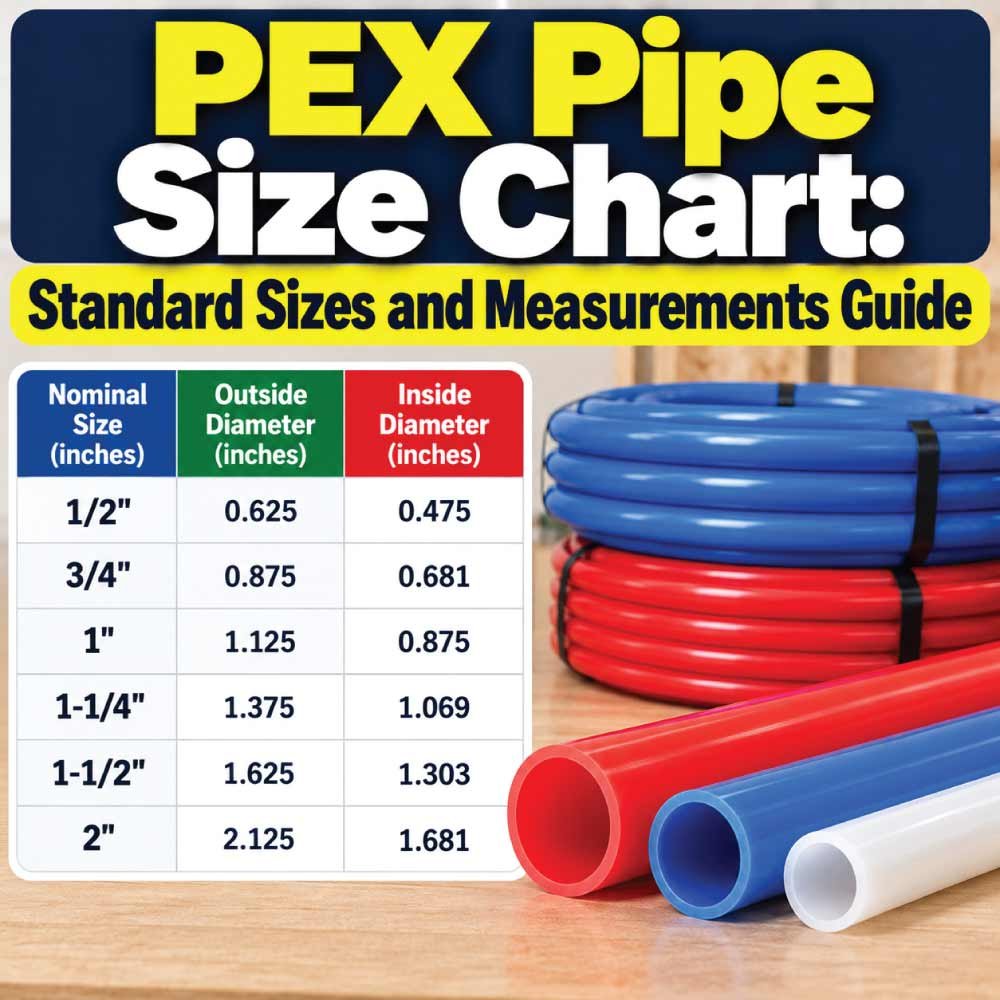
This PEX pipe size chart explains standard dimensions, outside and inside diameters, wall thickness, common plumbing applications, and practical sizing considerations. You will also learn how to choose a suitable size for fixtures, branches, and main water supply lines.
What Is PEX Pipe and How Is It Sized?
PEX stands for cross-linked polyethylene, a flexible plastic tubing material used in residential and commercial plumbing. It is commonly installed in hot- and cold-water distribution systems and can also be used in compatible hydronic heating applications.
PEX is popular because it can bend around many obstacles, resist corrosion, and reduce the number of fittings needed along a pipe run. Its flexibility also makes it useful for installations where rigid copper or plastic piping would require numerous elbows.
Understanding Nominal PEX Pipe Sizes
PEX tubing is commonly identified by its nominal size, such as 1/2 inch or 3/4 inch. In North American residential plumbing, standard PEX water-distribution tubing generally follows the Copper Tube Size (CTS) dimensional system for common sizes.
This means the nominal size does not directly represent the actual outside diameter.
For example, standard 1/2-inch CTS PEX tubing has an outside diameter of approximately 5/8 inch, or 0.625 inch. Standard 3/4-inch PEX tubing has an outside diameter of approximately 7/8 inch, or 0.875 inch. These dimensions are associated with ASTM F876 dimensional requirements. <Cite refs={[“turn666710search0″,”turn666710search2”]}/>
Three measurements are particularly important:
Nominal size: The size designation printed on the tubing.
Outside diameter (OD): The measurement across the outside of the tube.
Inside diameter (ID): The usable internal opening through which water flows.
Wall thickness is also important because it affects the inside diameter and the tubing’s dimensional and pressure characteristics.
Why Does PEX Pipe Size Matter?
Selecting the correct diameter helps ensure that the plumbing system can supply the required flow without excessive pressure loss.
A pipe that is too small may cause poor flow when several fixtures operate simultaneously. An unnecessarily large pipe may increase material costs and the amount of water stored in the distribution system.
Correct sizing depends on more than the fixture connection. The designer must consider the entire pipe route, available pressure, developed length, fittings, elevation changes, and simultaneous water demand.
Standard PEX Pipe Size Chart: Dimensions in Inches and Millimeters
The following chart summarizes common North American PEX tubing sizes and representative dimensions for standard SDR 9 tubing made to ASTM F876. Actual inside diameters can vary with manufacturing tolerances and product specifications.
| Nominal Size | Outside Diameter (in.) | Outside Diameter (mm) | Minimum Wall Thickness (in.) | Approx. Inside Diameter (in.) |
|---|---|---|---|---|
| 3/8 inch | 0.500 | 12.70 | 0.070 | 0.510 |
| 1/2 inch | 0.625 | 15.88 | 0.070 | 0.510 |
| 3/4 inch | 0.875 | 22.23 | 0.097 | 0.681 |
| 1 inch | 1.125 | 28.58 | 0.125 | 0.875 |
| 1-1/4 inch | 1.375 | 34.93 | 0.153 | 1.069 |
| 1-1/2 inch | 1.625 | 41.28 | 0.181 | 1.263 |
| 2 inch | 2.125 | 53.98 | 0.236 | 1.653 |
Reference: ASTM F876 dimensional information and published PEX tubing dimension tables. Inside diameters are representative values, not guaranteed minimum openings for every product. <Cite refs={[“turn666710search2″,”turn666710search5”]}/>
Important: This table is intended as a general reference for standard tubing. Some manufacturers publish slightly different nominal inside diameters because of their production tolerances and measurement conventions. Always check the technical data sheet for the exact tubing being installed.
How to Read the PEX Size Chart
Consider a common 3/4-inch PEX tube:
- Nominal size: 3/4 inch.
- Outside diameter: approximately 0.875 inch.
- Minimum wall thickness: approximately 0.097 inch.
- Representative inside diameter: approximately 0.681 inch.
The nominal size identifies the tubing category, while the outside diameter helps determine dimensional compatibility. The inside diameter is particularly relevant to hydraulic calculations because it influences the available flow area.
The actual water flow also depends on pressure, pipe length, fittings, and the number of fixtures operating at the same time.
Are All PEX Brands the Same Size?
PEX-A, PEX-B, and PEX-C products manufactured to the same applicable dimensional standard and nominal size generally share the relevant standard dimensions. However, product-specific approvals, fitting systems, and connection requirements still matter.
Do not assume that every tubing product sold as PEX is interchangeable with every fitting. Verify the manufacturer’s compatibility requirements before assembly.
Common PEX Pipe Sizes and Their Applications
Different pipe sizes serve different purposes in a plumbing system. Smaller tubing is commonly used for individual fixtures, while larger sizes may serve multiple branches or supply lines.
These are general applications rather than universal sizing rules. Final selection should be based on the plumbing design and applicable code.
3/8-Inch PEX Pipe
Nominal 3/8-inch PEX tubing is used in selected low-demand or short-run applications, depending on the system design.
Common uses include:
- Certain fixture supply arrangements.
- Short distribution runs designed for low flow.
- Specialized plumbing installations that permit this size.
Its relatively small internal diameter can create greater pressure loss over longer distances or at higher flow rates. It should not automatically be selected for a long fixture branch simply because the fixture connection is small.
1/2-Inch PEX Pipe
1/2-inch PEX is one of the most common sizes for residential plumbing branches.
Typical applications include:
- Individual bathroom fixtures.
- Bathroom and kitchen supply branches.
- Short hot- and cold-water distribution runs.
- Fixture connections within an appropriately designed system.
It is often convenient for supplying a single fixture, but the suitability of 1/2-inch tubing depends on the fixture’s flow demand, pipe length, and the number of outlets served.
A long run supplying a shower or several fixtures may require a different size.
3/4-Inch PEX Pipe
3/4-inch PEX provides a larger flow area than 1/2-inch tubing and is often used for higher-demand branches.
Common applications include:
- Residential hot- or cold-water distribution branches.
- Supply lines serving multiple fixtures.
- Runs between a distribution manifold and a group of fixtures.
- Certain water heater connections, when permitted by the equipment instructions and plumbing design.
Because larger tubing generally produces less friction loss at the same flow rate, 3/4-inch PEX can help maintain performance on suitable multi-fixture branches.
However, increasing pipe size does not eliminate restrictions caused by undersized fittings, inadequate supply pressure, or poorly designed connections.
1-Inch PEX Pipe
1-inch PEX is commonly considered for larger distribution lines and systems with greater flow requirements.
Potential applications include:
- Main distribution lines in appropriately sized homes.
- Branches supplying several bathrooms or fixture groups.
- Larger residential and commercial plumbing systems.
- Certain hydronic heating distribution arrangements.
Whether 1-inch tubing is necessary depends on the total demand, available pressure, pipe length, and design calculations. It is not automatically the correct choice for every house’s main supply.
1-1/4-Inch, 1-1/2-Inch, and 2-Inch PEX
Larger PEX sizes are used in selected commercial, multi-unit, mechanical, and engineered distribution systems where the product is approved for the intended application.
They may be appropriate for:
- Large distribution headers.
- Commercial plumbing branches.
- Engineered hydronic systems.
- Higher-capacity supply arrangements.
These sizes are not normally needed for an ordinary single-fixture branch. Confirm that the tubing, fittings, valves, and other system components are approved for the intended pipe size and operating conditions.
PEX Pipe Size Chart by Application
The following table offers a quick starting point for common residential plumbing decisions. It is not a substitute for a complete pipe-sizing calculation.
| Application | Common Size to Evaluate | Important Consideration |
|---|---|---|
| Single lavatory supply branch | 1/2 inch | Check length and fixture demand |
| Kitchen sink branch | 1/2 or 3/4 inch | Account for additional connected fixtures |
| Shower supply branch | 1/2 or 3/4 inch | Check shower flow and pressure loss |
| Branch serving multiple fixtures | 3/4 inch or larger | Calculate simultaneous demand |
| Main residential distribution | 3/4 or 1 inch | Depends on total demand and available pressure |
| Large distribution header | 1 inch or larger | Requires system-specific sizing |
| Engineered commercial system | Project-specific | Follow design calculations and code |
A single nominal size cannot be prescribed for every application. For example, two showers with the same fixture connections may require different supply arrangements if one has a short pipe run and the other has a long route with several fittings.
Also Read:
PEX-A vs. PEX-B vs. PEX-C: Does the Type Affect Pipe Size?
PEX-A, PEX-B, and PEX-C refer to different methods of cross-linking polyethylene. The letters do not indicate pipe diameter or a simple quality ranking.
PEX-A
PEX-A is manufactured using the peroxide method. Many PEX-A products are relatively flexible and may support approved expansion-style connection systems.
PEX-B
PEX-B is manufactured using the silane method. It is widely used in residential water distribution and is available in common nominal sizes.
PEX-C
PEX-C is manufactured using electron-beam irradiation. Its flexibility and handling characteristics depend on the particular product.
Do PEX Types Have Different Dimensions?
When products conform to the same applicable dimensional standard and size designation, their standard outside dimensions are generally comparable. The specific inside diameter, wall tolerances, and approved connection method should still be checked against the manufacturer’s documentation.
More importantly, fittings must match the tubing’s size and the connection system. Expansion fittings, crimp fittings, clamp fittings, and push-fit connectors have different compatibility requirements.
Never select a fitting solely because its nominal size matches the tubing label.
Also Read:
PEX Pipe Size vs. Copper Pipe Size
PEX and copper plumbing often use the same nominal Copper Tube Size designations for common residential water-distribution sizes. However, matching nominal sizes does not mean that their internal openings are identical.
For example, standard 1/2-inch PEX tubing has an outside diameter of approximately 0.625 inch, while nominal 1/2-inch copper tube also has an outside diameter of approximately 0.625 inch. Their internal diameters can differ because of material-specific wall thicknesses and fitting designs. <Cite refs={[“turn666710search2″,”turn666710search6”]}/>
| Nominal Size | Standard CTS PEX Outside Diameter | Typical Copper Tube Outside Diameter |
|---|---|---|
| 1/2 inch | 0.625 inch | 0.625 inch |
| 3/4 inch | 0.875 inch | 0.875 inch |
| 1 inch | 1.125 inches | 1.125 inches |
The values above describe common CTS sizes. Other pipe-sizing systems may use different dimensions.
Why Internal Diameter Matters
Water flow depends partly on the cross-sectional area available inside the tube. A smaller internal diameter generally creates more friction loss at a given flow rate, all else being equal.
PEX fittings can also reduce the flow passage, particularly with insert-style connections. Therefore, a pipe-size comparison should account for the complete system rather than relying only on nominal diameter.
Use approved transition fittings when connecting PEX to copper, and follow the manufacturer’s assembly instructions.
Also Read:
How to Choose the Correct PEX Pipe Size
Selecting the correct tubing diameter involves several factors. The best size is the one that supplies the required flow at an acceptable pressure loss while meeting applicable plumbing requirements.
1. Determine the Water Demand
List the fixtures supplied by each branch. A line serving one lavatory has a different demand from a line serving several showers and appliances.
Consider which fixtures may operate simultaneously rather than adding up only the number of connections.
2. Measure the Pipe Run
Longer runs generally produce greater friction loss than shorter runs of the same diameter at the same flow rate.
Measure the approximate developed length from the source to the fixture or branch. Include the effect of fittings, valves, and other restrictions in the sizing method.
3. Check the Available Water Pressure
Available pressure affects the flow a plumbing system can deliver. Pressure at the source may differ from pressure at a fixture because of elevation, friction, valves, and other restrictions.
A larger pipe can reduce friction loss, but it cannot correct every low-pressure problem.
4. Consider Fittings and Manifolds
PEX systems may use manifolds, tees, valves, and different fitting styles. Each component can influence pressure loss and must be compatible with the tubing.
A manifold system with individual fixture lines may be sized differently from a trunk-and-branch layout.
5. Follow Plumbing Codes and Manufacturer Instructions
Applicable codes establish requirements for water distribution, approved materials, and installation practices. Manufacturer documentation identifies the permitted operating conditions and connection methods for the selected product.
For complex systems, have a qualified plumber or plumbing designer calculate the appropriate pipe sizes.
PEX Pipe Pressure Ratings and Temperature Limits
Pipe diameter alone does not determine whether PEX is suitable for a plumbing installation. The tubing must also be rated for the system’s operating pressure and temperature.
PEX pressure ratings can vary with temperature. ASTM F876 addresses dimensional requirements and performance characteristics, including pressure-related testing at specified water temperatures. The permissible operating conditions must be verified for the actual product
Before selecting tubing, review:
- The printed product markings.
- The manufacturer’s pressure and temperature ratings.
- Potable-water or other application approvals, where applicable.
- Compatibility with the fittings and valves.
- Any limitations related to UV exposure, installation, or the intended system.
Do not assume that every PEX product has the same pressure rating at every temperature. Use the product’s technical documentation and local code requirements to confirm suitability.
Common PEX Pipe Sizing Mistakes to Avoid
Incorrect pipe sizing can lead to disappointing flow, unnecessary material costs, or compatibility problems.
Watch for these common mistakes:
Confusing nominal size with outside diameter: A 1/2-inch PEX tube does not measure 1/2 inch across its outside.
Ignoring pipe length: A size suitable for a short run may cause excessive pressure loss on a longer run.
Sizing by fixture connection alone: The connection size does not necessarily determine the correct upstream tubing diameter.
Overlooking fitting restrictions: The internal passage through a fitting may be smaller than the tubing bore.
Assuming all fittings are interchangeable: Verify the approved fitting system and assembly method.
Ignoring simultaneous demand: Multiple fixtures operating together can increase the required flow.
Choosing a size without checking ratings: Pressure, temperature, and application approvals must match the intended installation.
The most reliable approach is to combine the size chart with a proper assessment of water demand, pressure, length, and system configuration.
Frequently Asked Questions About PEX Pipe Sizes
What is the most common PEX pipe size for residential plumbing?
1/2-inch and 3/4-inch PEX are widely used in residential water distribution. The appropriate size depends on the number of fixtures served, pipe length, flow demand, and available pressure.
What is the actual outside diameter of 1/2-inch PEX?
Standard 1/2-inch CTS PEX tubing has an outside diameter of approximately 0.625 inch, or 15.88 mm. Verify the manufacturer’s specifications for the exact product.
What size PEX should I use for a main water line?
The answer depends on total demand, available pressure, pipe length, and the plumbing layout. Both 3/4-inch and 1-inch tubing may be considered in residential systems, but neither is universally correct.
Is 3/4-inch PEX better than 1/2-inch PEX?
Not in every situation. 3/4-inch tubing generally provides a larger flow area and lower friction loss at comparable flow conditions, but 1/2-inch tubing may be appropriate for shorter, lower-demand branches.
Can I use 1/2-inch PEX for a shower?
It can be suitable for some shower installations. The correct size depends on the shower’s flow requirements, line length, available pressure, fittings, and local plumbing rules.
Does PEX pipe size change between PEX-A, PEX-B, and PEX-C?
Products made to the same applicable dimensional standard and nominal size generally share the standard outside dimensions. Inside dimensions and fitting compatibility should be verified for the exact product.
How do I convert PEX pipe sizes from inches to millimeters?
Multiply inches by 25.4 to convert to millimeters. For example, an outside diameter of 0.625 inch equals approximately 15.88 mm.
Can I connect PEX directly to copper plumbing?
PEX can be connected to copper using an approved transition fitting. Confirm compatibility with both materials and follow the fitting manufacturer’s installation instructions.
Conclusion
A reliable PEX pipe size chart helps you compare nominal sizes, outside diameters, wall thicknesses, and representative inside diameters before starting a plumbing project. Common residential sizes include 1/2-inch, 3/4-inch, and 1-inch tubing, while larger sizes are available for higher-demand distribution systems.
Remember that nominal size alone does not determine water flow. Pipe length, available pressure, fitting restrictions, fixture demand, and operating conditions all affect performance.
Use standard dimension charts as a starting point, confirm the selected product’s specifications, and follow applicable plumbing codes. When sizing a main supply line or a system serving multiple fixtures, use a proper hydraulic calculation or consult a qualified plumbing professional.