
PEX pipe is widely used in residential plumbing because it is flexible, durable, and relatively easy to install. However, choosing the correct pipe requires more than knowing whether you need 1/2-inch, 3/4-inch, or 1-inch PEX. You also need to understand its outside diameter (OD), inside diameter (ID), wall thickness, nominal size, and fitting compatibility.
A PEX pipe outside diameter chart helps homeowners, plumbers, and contractors identify the correct dimensions before purchasing materials or connecting plumbing components. Although PEX is sold in nominal inch sizes, its outside diameter is generally standardized within a given sizing system, while its inside diameter varies with wall thickness and product specifications.
This guide explains standard PEX pipe outside diameters, provides practical measurement charts, compares common sizes, and shows how to measure pipe accurately. You will also learn how PEX sizing relates to fittings, water flow, installation requirements, and common plumbing mistakes.
What Is PEX Pipe Outside Diameter?
The outside diameter of PEX pipe is the measurement across the pipe’s exterior, from one outside edge to the opposite outside edge through its center. It is commonly abbreviated as OD.
PEX stands for cross-linked polyethylene, a flexible plastic material used in hot- and cold-water plumbing, radiant floor heating, and other approved piping applications.
PEX pipe dimensions are often described using nominal sizes, such as 3/8 inch, 1/2 inch, 3/4 inch, and 1 inch. These labels help identify the pipe size, but they are not always equal to the pipe’s actual outside or inside diameter.
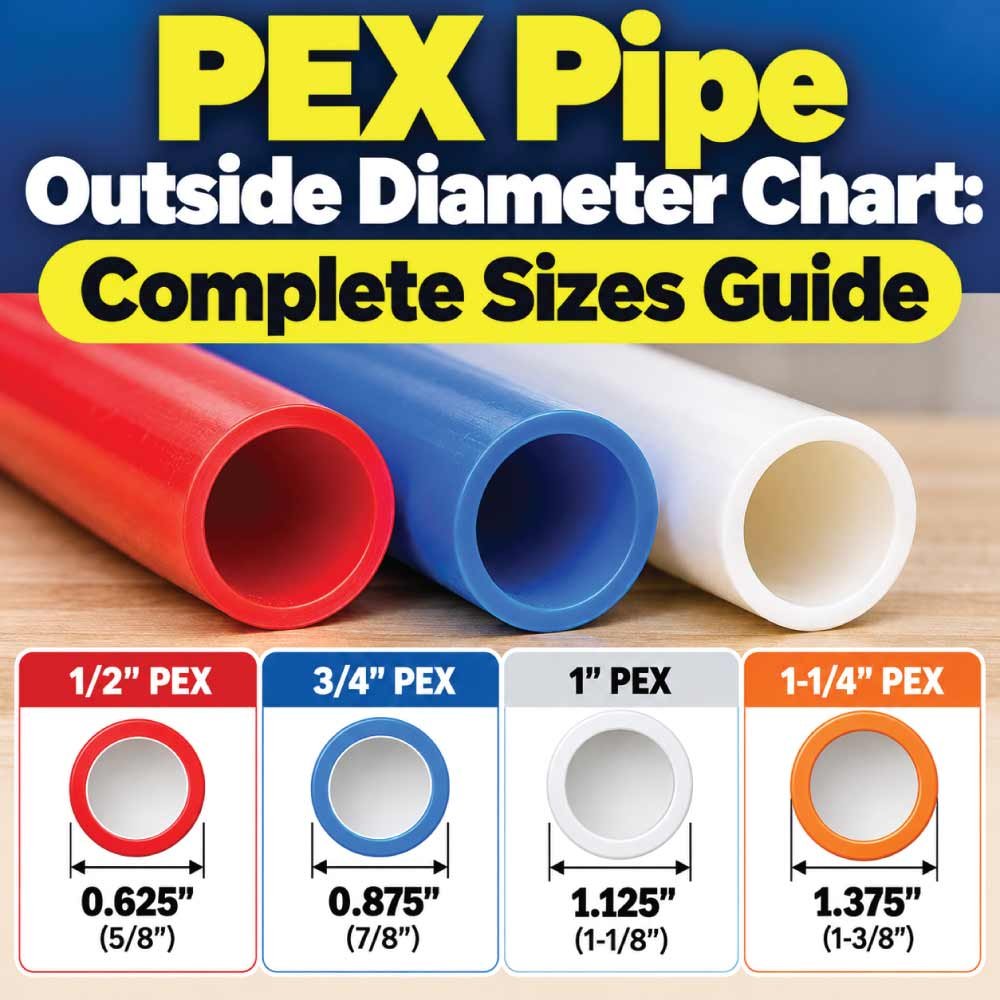
For example, 1/2-inch PEX is commonly manufactured with an outside diameter of approximately 5/8 inch, or 0.625 inch. Its inside diameter is smaller because the pipe wall occupies some of the available space.
Understanding this distinction helps prevent errors when selecting fittings, measuring clearances, or comparing PEX with copper, CPVC, and other plumbing materials.
Why Outside Diameter Matters
Outside diameter is important for several reasons:
-
Fitting compatibility: Some fitting systems depend on the pipe’s specified outside dimensions.
-
Installation clearance: Pipe supports, drilled holes, and protective sleeves must accommodate the pipe and any required movement or protection.
-
Measurement accuracy: OD helps identify pipe dimensions when the original packaging is unavailable.
-
Product identification: It helps distinguish nominal pipe sizes when used alongside manufacturer markings and standards.
-
System compatibility: Correct dimensions help ensure that pipe, fittings, and connection tools work together as intended.
Remember that measuring OD alone does not establish whether a pipe is suitable for a particular plumbing system. Its standard, pressure rating, temperature rating, and intended application also matter.
Standard PEX Pipe Outside Diameter Chart
The following chart shows common dimensions for CTS (Copper Tube Size) PEX tubing manufactured to the ASTM F876 SDR9 dimensional system. These dimensions are useful for identifying pipe sizes and checking compatibility with plumbing components. ASTM publishes the dimensional requirements for this type of PEX tubing, including outside diameter tolerances.
PEX Outside Diameter Size Chart in Inches and Millimeters
| Nominal PEX Size | Outside Diameter (in.) | Outside Diameter (mm) |
|---|---|---|
| 3/8 in. | 0.500 in. | 12.70 mm |
| 1/2 in. | 0.625 in. | 15.88 mm |
| 5/8 in. | 0.750 in. | 19.05 mm |
| 3/4 in. | 0.875 in. | 22.22 mm |
| 1 in. | 1.125 in. | 28.58 mm |
| 1-1/4 in. | 1.375 in. | 34.92 mm |
| 1-1/2 in. | 1.625 in. | 41.28 mm |
| 2 in. | 2.125 in. | 53.98 mm |
| 2-1/2 in. | 2.625 in. | 66.68 mm |
| 3 in. | 3.125 in. | 79.38 mm |
| 4 in. | 4.125 in. | 104.78 mm |
Source: ASTM F876 dimensional data for SDR9 PEX tubing. The 2-1/2-inch and larger sizes are specialty or system-dependent sizes; confirm product availability and certification before specifying them.
The most commonly encountered residential sizes are 3/8-inch, 1/2-inch, 3/4-inch, and 1-inch PEX. Larger diameters may be used for distribution lines or specialized systems, depending on the design.
Notice that the outside diameter is larger than the nominal size. For example, 3/4-inch PEX has an outside diameter of 0.875 inch, while 1-inch PEX measures 1.125 inches across the exterior.
Important: This chart applies to the specified CTS SDR9 sizing system. Do not automatically apply these dimensions to every product labeled PEX, especially products manufactured under different dimensional standards or systems.
PEX Pipe Wall Thickness and Inside Diameter Chart
Outside diameter is only one part of a pipe’s dimensions. The wall thickness determines how much space remains inside the tubing for water to flow.
The inside diameter can be calculated using this formula:
For example, if a pipe has an outside diameter of 0.625 inch and a wall thickness of 0.070 inch, its calculated inside diameter is:
This is a calculation based on the specified wall thickness, not necessarily the manufacturer’s published nominal inside diameter.
PEX Tubing Dimensions Chart
The following table uses minimum wall thickness values associated with common ASTM F876 SDR9 PEX tubing sizes. The calculated inside diameter is the outside diameter minus twice the minimum wall thickness.
| Nominal Size | OD (in.) | Minimum Wall (in.) | Calculated ID (in.) |
|---|---|---|---|
| 3/8 in. | 0.500 | 0.070 | 0.360 |
| 1/2 in. | 0.625 | 0.070 | 0.485 |
| 5/8 in. | 0.750 | 0.083 | 0.584 |
| 3/4 in. | 0.875 | 0.097 | 0.681 |
| 1 in. | 1.125 | 0.125 | 0.875 |
| 1-1/4 in. | 1.375 | 0.153 | 1.069 |
| 1-1/2 in. | 1.625 | 0.181 | 1.263 |
| 2 in. | 2.125 | 0.236 | 1.653 |
How to interpret the chart: A larger outside diameter generally provides more potential space inside the tube, but wall thickness also increases with size. The table’s calculated inside diameters use minimum wall values and should not be treated as guaranteed actual bores.
Manufacturers may publish different nominal inside diameters based on their dimensional conventions and actual wall thickness targets. Use the product’s technical data sheet when an exact internal dimension is required.
Why Inside Diameter Matters for Water Flow
Inside diameter affects the available flow area and contributes to friction losses through the plumbing system. A larger bore generally allows more flow at the same average water velocity, all other factors being equal.
However, pipe sizing should not be based on diameter alone. You should also consider:
-
The required flow rate and fixture demand.
-
The length of the pipe run.
-
The number and type of fittings.
-
Available water pressure.
-
Pressure loss through valves and other components.
-
The applicable plumbing code and system design.
PEX fittings can also restrict the internal flow passage. Consequently, a pipe’s calculated bore does not by itself determine the actual performance of the complete plumbing system.
Understanding Nominal PEX Size vs. Actual Outside Diameter
One of the most common plumbing measurement mistakes is assuming that the nominal pipe size equals its actual outside diameter.
In the standard CTS SDR9 PEX sizing system, the nominal designation and outside diameter are different values. This is an intentional feature of the sizing system rather than a manufacturing error.
For example:
| Nominal PEX Size | Actual OD (in.) | OD Minus Nominal Size (in.) |
|---|---|---|
| 3/8 in. | 0.500 | 0.125 |
| 1/2 in. | 0.625 | 0.125 |
| 3/4 in. | 0.875 | 0.125 |
| 1 in. | 1.125 | 0.125 |
| 1-1/4 in. | 1.375 | 0.125 |
| 1-1/2 in. | 1.625 | 0.125 |
| 2 in. | 2.125 | 0.125 |
These relationships apply to the listed CTS SDR9 sizes, not universally to all plastic piping products.
Nominal Size, OD, and ID Explained
-
Nominal size: The size designation printed on the pipe, such as 1/2 inch.
-
Outside diameter: The measurement across the outside surface of the tubing.
-
Inside diameter: The measurement across the internal opening.
-
Wall thickness: The distance from the inside wall to the outside wall at a given point.
-
SDR: Standard Dimension Ratio, a relationship between pipe outside diameter and wall thickness.
For tubing with a specified SDR, wall thickness is related to the outside diameter. However, minimum-wall requirements and product-specific tolerances can affect the exact dimensions.
Why This Difference Is Important
Suppose you measure a PEX tube and find an outside diameter of approximately 5/8 inch. Under the CTS SDR9 system, that measurement corresponds to nominal 1/2-inch PEX.
Buying tubing based only on a tape-measure reading without confirming its markings can lead to mistakes. Always verify the nominal size, applicable standard, and fitting system before purchasing replacement parts.
PEX Pipe Outside Diameter in Millimeters
Millimeter measurements are particularly useful when working with metric tools, international product specifications, or installations that use metric dimensions.
To convert inches to millimeters, multiply the measurement by 25.4.
For example, 0.625 inch multiplied by 25.4 equals 15.875 mm, commonly rounded to 15.88 mm.
PEX OD Conversion Chart
| Nominal Size | OD (in.) | OD (mm) |
|---|---|---|
| 3/8 in. | 0.500 | 12.70 |
| 1/2 in. | 0.625 | 15.88 |
| 3/4 in. | 0.875 | 22.22 |
| 1 in. | 1.125 | 28.58 |
| 1-1/4 in. | 1.375 | 34.92 |
| 1-1/2 in. | 1.625 | 41.28 |
| 2 in. | 2.125 | 53.98 |
These conversions are rounded to two decimal places where appropriate. For applications involving tight tolerances, use the original standard’s dimensions and tolerances rather than rounded conversion values.
Can You Use Metric PEX Fittings With Inch-Sized PEX?
Not simply because the measurements appear close. A metric fitting and an inch-sized fitting may differ in their intended pipe dimensions, connection method, or tolerance requirements.
Before combining products, verify that the fitting manufacturer explicitly approves the combination. Never assume that a fitting will seal properly because its listed dimensions seem similar.
How to Measure PEX Pipe Outside Diameter Correctly
Measuring PEX pipe is straightforward when you have access to a clean, straight section of tubing. A caliper provides the most practical way to check its outside diameter, while a ruler or measuring tape can help with approximate identification.
Tools You Need
Gather the following tools before measuring:
-
Digital or vernier caliper: Best for checking outside diameter accurately.
-
Ruler: Useful for rough measurements when a caliper is unavailable.
-
Tape measure: Helpful for measuring pipe lengths and installation clearances.
-
Pipe markings or packaging: Useful for confirming nominal size, material, and product standard.
Step-by-Step Measurement Method
Step 1: Select a straight section
Choose an accessible portion of the pipe away from fittings, bends, crimps, and visibly damaged areas. A distorted or compressed section may not provide a representative measurement.
Step 2: Position the caliper
Place the caliper’s outside jaws across the pipe. Keep the jaws perpendicular to the pipe’s length and apply gentle pressure without squeezing or deforming the tubing.
Step 3: Read the measurement
Record the measurement in inches or millimeters. If possible, repeat it at another angle to check whether the pipe is round and whether the reading is consistent.
Step 4: Verify the pipe markings
Compare the measured diameter with the printed size, manufacturer information, and applicable dimensional standard. Use these details together rather than relying on OD alone.
How to Measure Without a Caliper
If a caliper is unavailable, you can measure the circumference of the pipe with a flexible measuring tape and calculate its approximate diameter.
The formula is:
For example, if the measured circumference is approximately 1.96 inches:
This is close to the standard 0.625-inch outside diameter of nominal 1/2-inch CTS SDR9 PEX.
However, circumference measurements are less reliable when the pipe is oval, the tape is loose, or the tubing is difficult to access. Use a caliper and manufacturer documentation when precise identification is necessary.
Also Read:
PEX Pipe Size and Fitting Compatibility
Correct fitting selection is essential for a secure plumbing connection. Two components may look similar but use different connection standards, installation methods, or dimensional requirements.
PEX plumbing systems can use crimp, clamp, expansion, push-fit, and other approved connection methods. Each fitting system has its own compatibility requirements.
Common PEX Fitting Types
| Fitting Type | How It Connects | Important Consideration |
|---|---|---|
| Crimp fitting | A compatible ring is compressed around the pipe and fitting | Use the specified ring, tool, and gauge |
| Clamp fitting | A clamp is tightened around the connection | Verify the approved clamp and tool system |
| Expansion fitting | Compatible PEX is expanded before the fitting is inserted | Follow the manufacturer’s pipe and fitting requirements |
| Push-fit fitting | The tubing is inserted into a fitting that seals and retains it | Check approved tubing types, dimensions, and insertion requirements |
| Compression-style connection | A compression mechanism secures a compatible connection | Confirm that the fitting is designed for the particular PEX application |
Does PEX Outside Diameter Determine Fitting Size?
OD is an important dimension, but it does not independently establish fitting compatibility.
For example, nominal 1/2-inch CTS PEX typically has a 0.625-inch outside diameter. A fitting intended for a different pipe material or sizing system may not create a correct seal, even if its nominal label appears similar.
Before installing a fitting, confirm:
-
The nominal pipe size.
-
The fitting’s approved tubing standard and connection method.
-
Whether the pipe and fitting are from compatible product systems.
-
The required installation tool and connection procedure.
-
Any applicable code requirements.
Never force a fitting onto tubing that does not match its specifications. If a connection requires unusual force or fails to seat correctly, stop and verify the components.
Also Read:
How to Choose the Right PEX Pipe Size
Selecting a PEX size requires considering water demand, pressure, pipe length, fittings, and the type of plumbing system. A larger pipe is not automatically the best choice, and a smaller pipe is not necessarily adequate simply because it fits the installation space.
Common Applications by Nominal Size
The table below provides general examples of where these sizes may be encountered. It is not a substitute for a plumbing calculation or a code-compliant design.
| Nominal Size | Typical Applications | Selection Consideration |
|---|---|---|
| 3/8 in. | Certain small branches or appliance connections | Confirm the required flow and approved application |
| 1/2 in. | Many residential fixture branches | Evaluate simultaneous fixture demand and run length |
| 3/4 in. | Larger branches and residential distribution lines | Check demand, pressure loss, and fitting restrictions |
| 1 in. | Main distribution or higher-demand sections | Size according to the complete system design |
| 1-1/4 in. and larger | Specialized distribution and larger systems | Verify system requirements and product availability |
These applications are illustrative rather than universal rules. Local codes, building design, water supply conditions, and fixture requirements may call for different sizes.
Consider Flow Rate and Pressure Loss
A longer pipe run creates more friction loss than a shorter run of the same diameter under comparable flow conditions. Fittings, valves, and other restrictions also contribute to pressure loss.
When selecting tubing, consider:
-
Total developed length: Include the actual routing of the pipe, not just the straight-line distance.
-
Fixture demand: Estimate how much water the connected fixtures may require simultaneously.
-
Available pressure: Account for supply pressure and expected losses.
-
Fitting restrictions: Include the effect of elbows, tees, valves, and connection hardware.
-
Temperature and pressure ratings: Confirm the pipe is approved for the system’s operating conditions.
For complex installations, use an accepted plumbing sizing method or consult a qualified plumbing professional.
PEX Size for Hot and Cold Water Lines
Hot- and cold-water distribution systems may use the same nominal tubing sizes, but their sizing requirements depend on the layout and demand.
Hot-water lines can also have additional considerations, such as delivery time, heat loss, insulation, and recirculation design. Cold-water lines require adequate capacity for the fixtures they supply.
Do not choose a smaller pipe simply because the run supplies only one type of water. Select the size based on the actual design requirements.
Also Read:
PEX vs. Copper and CPVC Pipe Outside Diameter
PEX, copper, and CPVC are commonly used in plumbing, but their dimensional conventions and connection methods differ. A nominal size printed on one material should not be assumed to have the same outside diameter as the same nominal size printed on another.
Pipe Dimension Comparison
| Pipe Material | Common Sizing System | Important Dimension Detail |
|---|---|---|
| PEX | Often CTS SDR9 for ASTM F876 tubing | Nominal size differs from actual OD |
| Copper tubing | Copper Tube Size (CTS) | Outside dimensions follow the applicable copper tube standard |
| CPVC | Often CTS for plumbing products | OD and wall thickness depend on the applicable product standard and size |
For a practical example, nominal 1/2-inch PEX in the CTS SDR9 system has a 0.625-inch outside diameter. Copper tubing in the corresponding nominal CTS size also commonly has a 0.625-inch OD, while the wall thickness and inside diameter depend on the specific tubing type.
CPVC tubing manufactured to a compatible CTS dimensional system can also share that nominal outside dimension. However, dimensional similarity does not mean that fittings or joining methods are interchangeable.
Can PEX Replace Copper Pipe Directly?
PEX can replace copper in many approved plumbing applications, but the change requires more than matching outside diameters.
Consider the following factors:
-
The approved transition fitting between the two materials.
-
The condition and compatibility of existing plumbing components.
-
Required supports, bend allowances, and protection against abrasion.
-
The pipe’s pressure and temperature ratings.
-
Local plumbing codes and installation requirements.
Use a transition fitting specifically designed and approved for the two materials being joined. Never assume a copper fitting will work directly with PEX simply because the nominal sizes match.
Common PEX Pipe Measurement Mistakes
Even a small measurement or identification error can result in the wrong pipe or an incompatible fitting. These mistakes are avoidable when you verify dimensions before installation.
1. Confusing Nominal Size With Outside Diameter
A 1/2-inch PEX label does not mean that the pipe measures exactly 1/2 inch across its exterior. Standard CTS SDR9 1/2-inch PEX typically measures 0.625 inch in OD.
Solution: Check a verified PEX outside diameter chart and confirm the product standard.
2. Measuring the Inside Diameter Instead of the Outside Diameter
The opening inside the pipe is smaller than its exterior dimensions. Measuring the opening and comparing it with an OD chart will lead to an incorrect identification.
Solution: Position the caliper jaws across the outside surface when checking OD.
3. Ignoring Wall Thickness
Two tubes with similar outside diameters may have different wall thicknesses or internal bores if they follow different product specifications.
Solution: Check both OD and wall thickness when internal capacity or dimensional compatibility matters.
4. Assuming All PEX Fittings Are Interchangeable
Crimp, clamp, expansion, and push-fit connections use different installation principles. Compatibility depends on the fitting’s design and approved tubing specifications.
Solution: Follow the fitting manufacturer’s instructions and use the specified tools.
5. Relying on a Distorted Pipe Section
A tube that has been crushed, sharply bent, or damaged may no longer have its normal cross-sectional shape.
Solution: Measure an undamaged section and replace tubing that does not meet the manufacturer’s acceptance requirements.
6. Using Rounded Conversions for Precision Work
A converted dimension rounded to two decimal places may not preserve the tolerance needed for a close-fitting connection.
Solution: Use the original specified dimensions and tolerances for engineering or installation decisions.
Frequently Asked Questions About PEX Pipe Outside Diameter
What is the outside diameter of 1/2-inch PEX pipe?
For standard CTS SDR9 PEX tubing manufactured to ASTM F876, the nominal 1/2-inch size has an outside diameter of 0.625 inch, or approximately 15.88 mm. Confirm the product markings before using this value for an unfamiliar tube.
What is the outside diameter of 3/4-inch PEX?
The standard CTS SDR9 outside diameter for nominal 3/4-inch PEX is 0.875 inch, or approximately 22.22 mm. Its actual inside diameter is smaller and depends on wall thickness.
What is the outside diameter of 1-inch PEX?
Nominal 1-inch CTS SDR9 PEX has an outside diameter of 1.125 inches, approximately 28.58 mm. Do not confuse this measurement with the pipe’s inside diameter.
Is PEX measured by inside diameter or outside diameter?
PEX is commonly identified by its nominal size, while ASTM F876 specifies outside diameter and dimensional tolerances for the covered tubing. For connection compatibility, verify the nominal size and the fitting system rather than relying on a single measurement.
Does PEX pipe size include the wall thickness?
The nominal size is a designation, not a direct measurement of the internal opening. The outside diameter and wall thickness determine the inside diameter.
For example, 1/2-inch CTS SDR9 PEX has a 0.625-inch OD and a specified minimum wall thickness of 0.070 inch. Subtracting twice that minimum wall gives a calculated ID of 0.485 inch, not a guaranteed actual bore.
Can I use a standard ruler to measure PEX pipe?
Yes, a ruler can provide a rough measurement if the pipe is accessible. However, a digital caliper is more suitable for accurate outside diameter measurements, particularly when identifying tubing for fittings.
Are all PEX pipes the same outside diameter?
No. Dimensions depend on the applicable sizing system, nominal size, and product specification. The chart in this article covers common CTS SDR9 PEX dimensions associated with ASTM F876. Verify other products against their own technical documentation.
Does a larger PEX outside diameter mean better water flow?
Not necessarily. Outside diameter alone does not determine flow capacity. Inside diameter, wall thickness, fitting restrictions, pipe length, available pressure, and required flow all affect performance.
What is the difference between PEX-A, PEX-B, and PEX-C outside diameters?
PEX-A, PEX-B, and PEX-C describe different manufacturing methods for cross-linked polyethylene. When products follow the same applicable dimensional specification and nominal size, their outside dimensions may be the same even though their manufacturing characteristics differ. Always check the individual product’s standard and technical documentation rather than assuming that every product is dimensionally identical.
Conclusion
Understanding PEX pipe outside diameter makes it easier to identify tubing, select compatible fittings, and plan plumbing installations accurately. For common CTS SDR9 PEX, 1/2-inch tubing has a 0.625-inch OD, 3/4-inch tubing has a 0.875-inch OD, and 1-inch tubing has a 1.125-inch OD.
Use the size charts in this guide as a reference, but verify the pipe’s markings, dimensional standard, wall thickness, and manufacturer specifications before purchasing fittings or completing an installation. The correct PEX size is the one that meets your system’s flow requirements, dimensional compatibility, and applicable plumbing codes.