
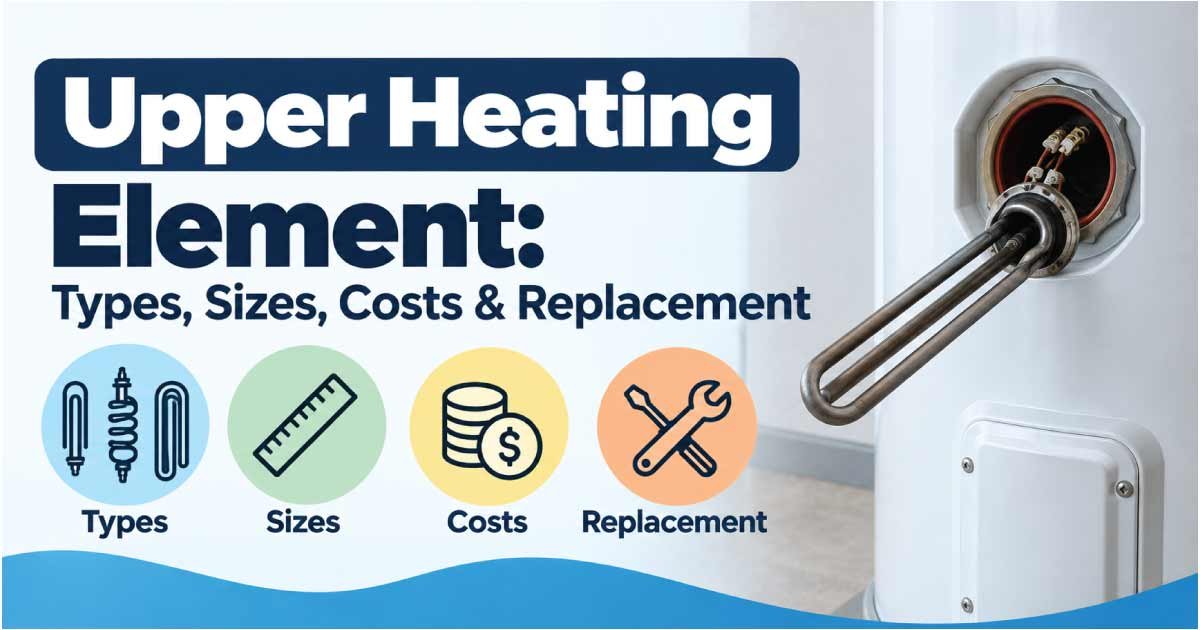
An upper heating element is one of the main components inside a two-element electric water heater. It heats water in the upper portion of the storage tank and works together with the upper thermostat and lower heating element to provide a reliable supply of hot water.
When an upper element fails, a water heater may produce little hot water, no hot water, or experience slow recovery. Choosing a replacement requires more than matching the physical appearance of the old element. Voltage, wattage, mounting style, element length, watt density, and compatibility with the water heater must all be considered.
This guide explains upper heating element types, standard sizes, wattages, costs, symptoms of failure, testing methods, replacement considerations, and maintenance.
What Is an Upper Heating Element?
An upper heating element is an electrically powered resistance heater installed in the upper section of an electric storage water heater.
When electricity passes through the element, electrical resistance generates heat. The element transfers that heat into the surrounding water inside the tank.
Two-element electric water heaters typically contain:
- An upper heating element
- A lower heating element
- An upper thermostat
- A lower thermostat
- High-temperature safety controls
- Electrical connections
- A storage tank
The upper element has an important role because the heating sequence normally gives priority to the upper portion of the tank.
How Does an Upper Heating Element Work?
The upper element works as part of a coordinated heating system rather than operating independently.
When the tank needs heating, the thermostat detects that the water temperature has fallen below the selected setting. Depending on the heater’s control design, the upper element is energized first.
The element then heats the water around it.
Once the upper portion reaches the thermostat’s target temperature, the control system can redirect electrical power toward the lower element.
This sequence helps the water heater restore usable hot water efficiently.
Basic Heating Sequence
A typical two-element system works approximately like this:
- Water temperature drops.
- The upper thermostat calls for heat.
- Electrical power reaches the upper heating element.
- The upper element heats the upper portion of the tank.
- The upper thermostat reaches its set temperature.
- Heating control transfers toward the lower element.
- The lower element heats the remaining tank water.
- The system cycles as needed to maintain temperature.
The exact control sequence varies by water heater design, so the manufacturer’s documentation should always take priority.
Upper Heating Element vs Lower Heating Element
The upper and lower heating elements can look similar, but they serve different positions and functions.
| Feature | Upper Heating Element | Lower Heating Element |
|---|---|---|
| Location | Upper tank | Lower tank |
| Primary role | Heats upper portion first | Heats lower tank volume |
| Control | Upper thermostat | Lower thermostat |
| Priority | Usually first in heating sequence | Usually operates after upper demand |
| Failure effect | Can cause major loss of hot water | Often reduces available hot water |
| Typical design | Screw-in or bolt-in | Screw-in or bolt-in |
| Replacement requirement | Must match specifications | Must match specifications |
A replacement element should be selected according to the position and specifications listed for the particular water heater.
Types of Upper Heating Elements
Upper heating elements can be classified by their mounting system, watt density, construction, and physical design.
The most common categories include:
- Screw-in upper heating elements
- Bolt-in upper heating elements
- Universal upper heating elements
- High-watt-density elements
- Low-watt-density elements
- Foldback elements
- Copper elements
- Stainless-steel elements
Screw-In Upper Heating Element
A screw-in upper heating element has a threaded mounting base that screws directly into the water heater tank.
This is a common design in residential electric storage water heaters.
The threaded connection allows the element to be secured firmly against the tank opening while a gasket creates the water-tight seal.
Advantages of Screw-In Elements
Screw-in elements are popular because they are widely available and relatively straightforward to replace when the correct specifications are known.
Advantages include:
- Common replacement design
- Many wattage options
- Multiple material choices
- Easy identification
- Simple threaded installation
- Wide aftermarket availability
However, the replacement must have the correct thread and electrical specifications.
Bolt-In Upper Heating Element
A bolt-in upper heating element attaches to the tank with a flange and bolts.
Instead of screwing into a threaded tank opening, the element uses a mounting plate that is secured with several bolts.
Bolt-in designs are found on certain water heater models, including some older or specialty systems.
Bolt-In Element Specifications
Before purchasing a bolt-in element, verify:
- Number of mounting bolts
- Bolt-hole spacing
- Flange dimensions
- Gasket shape
- Element length
- Voltage
- Wattage
- Terminal arrangement
A bolt-in element should not be replaced with a screw-in model unless the water heater manufacturer specifically supports that conversion.
Universal Upper Heating Element
A universal upper heating element is designed to work with multiple compatible water heater models.
The term “universal” refers to broader compatibility, not universal compatibility with every water heater.
Before using one, verify:
- Voltage
- Wattage
- Mounting style
- Element length
- Terminal design
- Thread or flange configuration
- Manufacturer compatibility
A universal element can be convenient, but the heater’s specifications remain the deciding factor.
Upper Heating Element Wattage Sizes
Wattage determines how much electrical heating power an element can produce.
Common upper-element ratings include approximately:
| Wattage | Relative Heating Power | Typical Application |
|---|---|---|
| 1,000 W | Low | Smaller systems |
| 1,500 W | Low–moderate | Compact applications |
| 2,000 W | Moderate | Selected heaters |
| 2,500 W | Moderate | Residential systems |
| 3,000 W | Moderate–high | Higher demand |
| 3,500 W | High | Selected residential heaters |
| 4,000 W | High | Higher-output systems |
| 4,500 W | High | Common residential rating |
| 5,000 W | Very high | Selected systems |
| 5,500 W | Very high | Compatible high-output heaters |
The actual rating required depends on the water heater.
A 4,500-watt element should not automatically be replaced with a 5,500-watt element merely because the latter appears more powerful.
Common Upper Heating Element Sizes
There are two different meanings of “size” when discussing heating elements: electrical size and physical size.
Electrical size generally refers to voltage and wattage. Physical size refers to length, diameter, mounting dimensions, and terminal configuration.
Common Voltage Ratings
| Voltage | Typical Use |
|---|---|
| 120 V | Smaller/specialty systems |
| 208 V | Some commercial systems |
| 220 V | Selected installations |
| 240 V | Common residential systems |
| 277 V | Certain commercial heaters |
| 480 V | Industrial/commercial applications |
Never assume the voltage based solely on the appearance of the element.
Upper Heating Element Length
The physical length of an upper element varies by design.
Common replacement lengths can include approximately:
| Element Length | General Description |
|---|---|
| 7 inches | Short/foldback designs |
| 8 inches | Compact applications |
| 9 inches | Short elements |
| 10 inches | Medium-short elements |
| 11 inches | Medium elements |
| 12 inches | Common size range |
| 13 inches | Longer designs |
| 14 inches | Extended elements |
| 15+ inches | Specialty applications |
Length alone does not determine compatibility.
A 12-inch element with the wrong wattage, voltage, or mounting design is not a suitable replacement for a different 12-inch element.
Upper Heating Element Size Chart
The following table provides a practical reference for commonly encountered specifications.
| Specification | Common Range |
|---|---|
| Voltage | 120–240 V residential; higher in commercial systems |
| Wattage | 1,000–5,500 W |
| Common residential wattage | Around 3,500–5,500 W |
| Common residential voltage | 240 V |
| Physical length | Approximately 7–15+ inches |
| Mounting | Screw-in or bolt-in |
| Position | Upper tank |
| Materials | Copper, stainless steel, specialty alloys |
| Watt density | Low, medium, or high |
Use this as a reference rather than a substitute for the manufacturer’s specifications.
Upper Heating Element Costs
The price of an upper heating element varies according to its wattage, construction, mounting style, brand, material, and whether it is an original or aftermarket component.
A basic replacement element may be relatively inexpensive, while specialty or premium elements can cost considerably more.
Potential cost categories include:
| Cost Factor | Effect on Price |
|---|---|
| Standard screw-in element | Usually lower |
| Bolt-in element | Can cost more |
| Universal element | Moderate |
| Low-watt-density element | Often higher |
| Stainless-steel element | Often higher |
| Specialty commercial element | Potentially much higher |
| Professional replacement | Adds labor cost |
Because prices change by location, manufacturer, and model, the most reliable approach is to compare the exact replacement part number rather than relying on a generic heating-element price.
What Causes an Upper Heating Element to Fail?
An upper heating element operates under demanding conditions. It repeatedly heats water while being exposed to minerals, corrosion, electrical current, and temperature changes.
Common causes of failure include:
Mineral Deposits
Hard water can cause mineral scale to accumulate around the heating element.
Heavy scale can reduce efficient heat transfer and increase stress on the element.
Corrosion
Water chemistry can contribute to corrosion of the element’s outer sheath.
Eventually, corrosion can damage the element and allow water to reach internal electrical components.
Electrical Problems
Loose electrical connections, incorrect voltage, damaged wiring, or electrical faults can contribute to premature failure.
Dry-Firing
A heating element is designed to transfer heat into water.
If power is applied while the tank is not properly filled, the element can overheat rapidly and fail.
This is why electrical power should remain off until the tank is correctly filled after maintenance.
Age
Repeated heating and cooling cycles place mechanical and thermal stress on the element.
Over time, the element can develop an internal break and stop producing heat.
Discover More:
Symptoms of a Bad Upper Heating Element
A defective upper element can produce several recognizable symptoms.
Common signs include:
- No hot water
- Very limited hot water
- Water remains lukewarm
- Slow recovery
- Inconsistent water temperature
- Upper element fails a resistance test
- Circuit breaker repeatedly trips
- Visible corrosion
- Burn marks around electrical terminals
However, these symptoms do not automatically prove that the upper element is defective.
The thermostat, wiring, breaker, high-limit switch, or another component may also be responsible.
What Happens When the Upper Element Fails?
The effect depends on the type of failure.
If the upper element fails open, the water heater may be unable to complete its normal heating sequence.
This can result in:
- Little or no hot water
- Poor recovery
- Cold water entering the tank without being adequately reheated
- Lower-element operation being affected by the control sequence
A lower-element failure can produce a different pattern, often allowing some initial hot water before the supply becomes insufficient.
This distinction can help during troubleshooting.
Discover More:
How to Test an Upper Heating Element
Testing should be performed only after the water heater has been safely disconnected from its electrical supply.
A multimeter can be used to check the resistance of the element.
Resistance Calculation
For a resistive heating element:
R = V² ÷ P
Where:
- R = resistance in ohms
- V = voltage
- P = wattage
For example, a 4,500-watt element rated at 240 volts has an expected resistance of approximately:
240² ÷ 4,500 = 12.8 Ω
A 3,500-watt, 240-volt element would have approximately:
240² ÷ 3,500 = 16.5 Ω
A 5,500-watt, 240-volt element would have approximately:
240² ÷ 5,500 = 10.5 Ω
Actual readings may vary somewhat because of manufacturing tolerances and measurement conditions.
Testing for a Ground Fault
The element can also be checked for unintended electrical continuity between its terminals and the tank.
A ground fault can indicate a damaged element.
Because water heaters combine electricity and water, electrical troubleshooting should be performed by someone qualified to work safely on the system.
Discover More:
How to Choose a Replacement Upper Heating Element
Choosing the correct element starts with identifying the water heater model.
Look at the manufacturer’s rating plate and record:
- Manufacturer
- Model number
- Voltage
- Wattage
- Tank capacity
- Element specifications
Then compare those details with the replacement element.
Important Matching Specifications
Before purchasing, verify:
Voltage: The replacement must match the heater’s required voltage.
Wattage: Match the specified wattage unless the manufacturer explicitly approves another rating.
Mounting: Confirm screw-in or bolt-in construction.
Length: Make sure the physical dimensions are suitable.
Terminal configuration: Confirm that the electrical terminals are compatible.
Material: Consider copper, stainless steel, or other available constructions based on the application.
Gasket: Use the appropriate sealing gasket for the element.
Upper Heating Element Replacement
Replacing an upper heating element involves electrical, plumbing, and sealing considerations.
The general process includes:
- Turn off electrical power at the appropriate disconnect or circuit breaker.
- Verify that power is actually disconnected.
- Allow the water to cool where appropriate.
- Shut off the water supply if required.
- Drain enough water to expose the element.
- Remove the electrical connections.
- Remove the old element.
- Inspect the opening and sealing surface.
- Install the correct gasket.
- Install the replacement element.
- Reconnect the wiring according to the heater’s specifications.
- Refill the tank completely.
- Check for leaks.
- Restore electrical power only after confirming that the element is properly submerged.
The exact procedure differs by water heater design.
Why the Tank Must Be Full Before Power Is Restored
This is one of the most important considerations when replacing an electric heating element.
The element relies on the surrounding water to absorb the heat it produces.
If the element is energized while exposed to air, it can overheat extremely quickly.
This condition is commonly called dry-firing and can destroy a new element.
After replacement, the tank should be completely filled before electrical power is restored.
Opening an appropriate hot-water fixture can help release trapped air while the tank fills, depending on the system and manufacturer’s procedure.
High-Watt-Density vs Low-Watt-Density Upper Elements
| Feature | High-Watt-Density | Low-Watt-Density |
|---|---|---|
| Heating surface | Smaller | Larger |
| Surface temperature | Generally higher | Generally lower |
| Recovery potential | High | High depending on total wattage |
| Scale sensitivity | Can be higher | Can be lower |
| Hard-water suitability | Model dependent | Often attractive |
| Cost | Often lower | Often higher |
| Availability | Very broad | Broad but more specialized |
Low-watt-density does not necessarily mean lower total heating power. Watt density describes how that power is distributed over the heating surface.
Copper vs Stainless Steel Upper Heating Elements
| Feature | Copper | Stainless Steel |
|---|---|---|
| Heat transfer | Excellent | Good |
| Corrosion resistance | Application dependent | Often strong |
| Typical availability | Very common | Common |
| Hard-water considerations | Model dependent | Model dependent |
| Cost | Often economical | Can be higher |
| Compatibility | Must be verified | Must be verified |
The best material depends on the water heater and water chemistry rather than simply choosing the most expensive option.
How to Make an Upper Heating Element Last Longer
Proper water heater maintenance can reduce unnecessary stress on the heating system.
Useful practices include:
- Maintain the water heater according to the manufacturer’s instructions.
- Check for signs of leaks.
- Address unusual electrical symptoms promptly.
- Keep the tank properly maintained.
- Inspect the anode rod where applicable.
- Reduce excessive mineral accumulation through appropriate maintenance.
- Use the correct replacement element.
- Never energize an empty or partially filled tank.
- Keep electrical connections secure and correctly configured.
Hard-water environments may require more attention because mineral scale can accumulate more quickly.
Frequently Asked Questions
What is the upper heating element in a water heater?
The upper heating element is the electric resistance heater installed in the upper portion of a two-element storage water heater. It normally participates in the initial heating stage.
What size is an upper heating element?
There is no single universal size. Residential elements commonly use ratings around 3,500–5,500 watts and 240 volts, but the correct size depends on the heater model.
Is the upper heating element the same as the lower element?
They can have similar physical and electrical specifications, but they occupy different positions and perform different roles in the heating sequence.
How much does an upper heating element cost?
Cost depends on wattage, voltage, mounting design, material, manufacturer, and whether the element is standard or specialty. Labor can add significantly to the total replacement cost.
Can I use a higher-wattage upper element?
Not unless the water heater manufacturer specifically allows it. A higher wattage can increase electrical current and may exceed the design limits of the heater or circuit.
How do I know if my upper element is bad?
Common symptoms include no hot water, poor recovery, lukewarm water, and abnormal resistance measurements. However, the thermostat and wiring should also be checked.
How many watts is a common upper heating element?
Around 4,500 watts is a common rating in many residential electric storage water heaters, but other ratings are also used.
How long does an upper heating element last?
Service life varies according to water chemistry, scale buildup, electrical conditions, maintenance, element construction, and usage. There is no universal guaranteed lifespan.
Upper Heating Element Replacement Checklist
Before replacing an upper heating element, confirm all of the following:
- Water heater model number
- Manufacturer
- Element position
- Voltage
- Wattage
- Mounting type
- Thread or bolt configuration
- Element length
- Terminal arrangement
- Gasket size
- Element material
- Manufacturer compatibility
Matching these specifications helps prevent installation problems and unnecessary purchases.
Final Thoughts
The upper heating element is a critical part of a two-element electric water heater. It helps heat the upper section of the tank and plays an important role in the heater’s overall operating sequence.
When selecting a replacement, focus on the complete specification rather than appearance. Voltage, wattage, mounting style, physical length, terminal configuration, material, and heater compatibility all matter.
Screw-in elements are common in residential systems, while bolt-in and universal designs are also available. High-watt-density and low-watt-density options provide different approaches to distributing heating power.
If your upper element fails, diagnosing the actual cause before purchasing a replacement can save money and prevent repeat failures. Always disconnect electrical power before servicing the heater, and never restore power until an electric water heater tank has been properly filled.