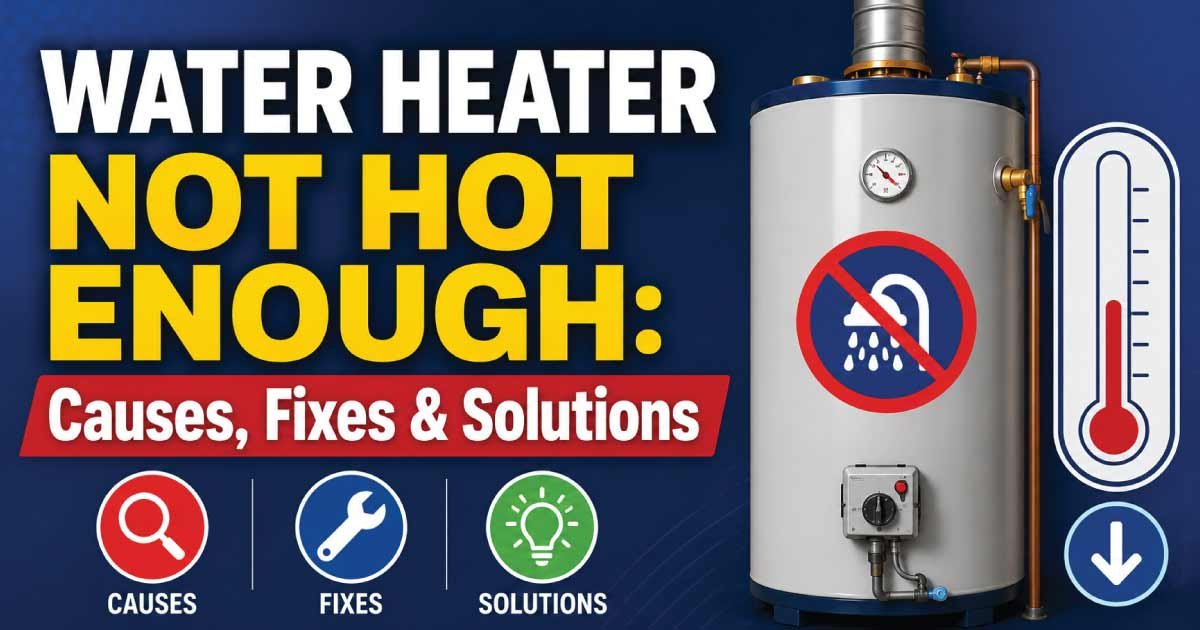
your water heater is not hot enough, the problem can quickly become frustrating. You may notice that showers turn lukewarm after a few minutes, the kitchen faucet never gets fully hot, or there simply is not enough hot water for everyone in the household.
A water heater that produces lukewarm water can have several causes. The problem may be as simple as an incorrect temperature setting, but it can also result from sediment buildup, a faulty thermostat, a damaged heating element, a burner problem, a broken dip tube, a plumbing issue, or an undersized water heater.
The first thing to determine is whether all hot-water fixtures are affected or only one faucet or shower. If the entire house has lukewarm water, the water heater is more likely to be responsible. If only one fixture has a temperature problem, the local faucet or mixing valve may be the cause.
Both gas and electric water heaters can experience insufficient hot water, but the components involved are different. Understanding the symptoms can help you identify the likely problem and determine whether a simple adjustment or professional repair is needed.
Why Is My Water Heater Not Hot Enough?
A water heater may not produce sufficiently hot water for several reasons.
Common causes include:
- Incorrect temperature setting
- Faulty thermostat
- Failed heating element
- Sediment buildup
- Mineral scale
- Gas burner problems
- Damaged dip tube
- Malfunctioning mixing valve
- Water heater that is too small
- Excessive hot-water demand
- Plumbing crossover
- Faulty temperature sensor
- Cold-water mixing into the hot-water line
The age and type of water heater can also help identify the likely cause.
| Possible Cause | Common Symptom | Potential Solution |
|---|---|---|
| Low temperature setting | Water is consistently lukewarm | Check setting |
| Faulty thermostat | Temperature fluctuates | Inspect thermostat |
| Failed heating element | Limited hot water | Test element |
| Sediment buildup | Slow heating | Flush tank |
| Burner problem | Gas heater does not heat properly | Professional service |
| Broken dip tube | Hot water becomes lukewarm quickly | Inspect dip tube |
| Mixing valve issue | Water temperature is too low | Inspect valve |
| Undersized heater | Hot water runs out quickly | Evaluate capacity |
| Plumbing crossover | Cold water enters hot line | Diagnose plumbing |
Check the Water Heater Temperature Setting
One of the simplest reasons for insufficiently hot water is an incorrect temperature setting.
Someone may have lowered the setting to save energy or because the water previously felt too hot.
The setting may also have been changed during maintenance.
How to Check the Setting
Depending on the water heater, the temperature control may be located:
- On the front control panel
- Behind an access panel
- On an electric thermostat
- On a gas control valve
Follow the manufacturer’s instructions when checking or adjusting the setting.
Avoid removing electrical covers or gas components unless you are qualified to work on them.
If the setting appears appropriate but the water remains lukewarm, another problem may be present.
Faulty Thermostat and Lukewarm Water
A thermostat controls when the heating system operates.
Electric water heaters commonly use thermostats to control heating elements. Some models have separate upper and lower thermostats.
If a thermostat becomes defective, it may not activate the heating element correctly.
This can result in:
- Lukewarm water
- Short heating cycles
- Inconsistent temperature
- Reduced hot-water supply
- Long recovery times
Signs of a Thermostat Problem
A thermostat problem is more likely when the water temperature changes unpredictably or the heater does not appear to complete normal heating cycles.
Because testing electrical thermostats involves electrical hazards, professional diagnosis is recommended if you are not trained to perform the work safely.
Electric Water Heater Not Hot Enough
Electric water heaters generally use one or two heating elements.
If an element fails, the heater may still produce some hot water while failing to provide the expected amount.
This is especially noticeable with electric water heaters that use upper and lower heating elements.
Signs of a Failed Heating Element
Possible symptoms include:
- Water is only lukewarm.
- Hot water runs out quickly.
- Recovery takes unusually long.
- One heating cycle appears ineffective.
- The circuit breaker trips.
- Temperature is inconsistent.
A failed element may require testing and replacement.
Why Two Elements Matter
In many electric tank water heaters, the elements do not necessarily operate simultaneously. The controls determine which element heats the water.
If one element fails, the system may still provide some hot water but have significantly reduced capacity.
Gas Water Heater Not Hot Enough
A gas water heater depends on a burner to heat the water.
If the burner does not operate correctly, the tank may fail to reach the desired temperature.
Possible causes include:
- Burner contamination
- Ignition problems
- Gas supply problems
- Faulty gas control
- Thermostat or sensor issue
- Venting or combustion problems
Signs of a Gas Heating Problem
You may notice:
- Water remains lukewarm.
- Heating takes much longer.
- The burner does not stay on normally.
- The heater repeatedly shuts down.
- There are unusual burner sounds.
- The pilot or ignition system has problems.
Gas components should be inspected by a qualified professional.
If you smell gas, leave the area and contact the appropriate gas or emergency service.
Sediment Buildup Can Reduce Hot Water
Sediment buildup is a common problem in tank-style water heaters.
Water naturally contains minerals such as calcium and magnesium. These minerals can settle at the bottom of the tank over time.
A thick sediment layer can interfere with efficient heat transfer.
The result may be:
- Longer heating times
- Lukewarm water
- Reduced efficiency
- Popping noises
- Rumbling noises
- Reduced tank capacity
How Sediment Affects Heating
The heating source must work through the sediment layer to heat the water.
The deposits can act as an insulating barrier, reducing the effectiveness of the heating process.
If sediment is suspected, appropriate tank maintenance may help.
Water Heater Not Hot Enough Because of Hard Water
Hard water can accelerate mineral accumulation.
Hard water contains higher concentrations of dissolved minerals. Repeated heating can cause these minerals to form scale inside the tank or around heating elements.
Hard water can contribute to:
- Reduced heating efficiency
- Sediment buildup
- Mineral scale
- Noisy operation
- Shorter component life
Homes with hard water may need more frequent maintenance than homes with relatively soft water.
Broken Dip Tube and Lukewarm Water
A dip tube is an important component inside many tank water heaters.
Its job is to direct incoming cold water toward the bottom of the tank.
If the dip tube breaks or deteriorates, cold incoming water may mix near the hot-water outlet.
This can result in lukewarm water.
Common Signs of a Damaged Dip Tube
A damaged dip tube may cause:
- Water that never becomes fully hot
- Hot water that turns lukewarm quickly
- Small plastic pieces in faucet aerators
- Sudden temperature changes
- Reduced hot-water performance
If a dip tube is suspected, professional inspection may be necessary.
Mixing Valve Problems
Some plumbing systems use a thermostatic mixing valve to control the temperature delivered to fixtures.
The valve blends hot water with cold water to produce a safer outlet temperature.
If the valve becomes faulty or incorrectly adjusted, the water reaching your faucets may be cooler than expected even though the water heater itself is operating normally.
Signs of a Mixing Valve Problem
Consider the mixing valve when:
- The tank water is hot.
- Fixture water is consistently lukewarm.
- Multiple fixtures are affected.
- The problem began after plumbing work.
- The water temperature changes unexpectedly.
A technician can test the valve and determine whether it is limiting hot-water delivery.
Water Heater Too Small for Your Household
Sometimes the water heater is working correctly but simply does not have enough capacity.
A household with several people may use hot water faster than a small storage tank can recover.
For example, hot-water demand can increase when multiple people take showers while appliances are also using hot water.
Signs of an Undersized Water Heater
Your heater may be too small if:
- Hot water runs out predictably during busy periods.
- The first shower is hot but later showers are lukewarm.
- The heater recovers normally after a waiting period.
- The system works well when only one person uses hot water.
- Household hot-water demand has increased.
If your household has grown or hot-water usage has increased, capacity may need to be reassessed.
Hot Water Runs Out Too Quickly
There is an important difference between not hot enough and not enough hot water.
If the water starts hot but becomes lukewarm after several minutes, the problem may involve capacity, recovery, sediment, a heating component, or a damaged dip tube.
Possible causes include:
- Excessive demand
- Failed heating element
- Sediment
- Broken dip tube
- Thermostat problem
- Undersized tank
Tracking when the temperature drops can help identify the cause.
Only One Faucet Has Lukewarm Water
If only one faucet produces lukewarm water, the water heater may not be the problem.
The local fixture could have:
- Faulty cartridge
- Mixing valve issue
- Incorrect connection
- Clogged component
- Plumbing crossover
Test several hot-water fixtures.
If the kitchen sink, bathroom sink, and shower all have the same problem, investigate the water heater.
If only one fixture is affected, focus on that fixture first.
All Faucets Have Lukewarm Water
When every hot-water fixture produces lukewarm water, the central heating system is more likely to be responsible.
Possible causes include:
- Incorrect temperature setting
- Faulty thermostat
- Heating element failure
- Gas burner problem
- Mixing valve issue
- Dip tube failure
- Plumbing crossover
A systematic diagnosis can prevent unnecessary replacement of the entire water heater.
Water Heater Not Hot Enough in the Morning
If hot water is insufficient mainly in the morning, household usage patterns may be responsible.
Several people may be using hot water within a short period.
Other possibilities include:
- Heater recovery is too slow.
- Temperature setting is too low.
- Heating element is failing.
- Gas burner is not operating correctly.
- Tank capacity is insufficient.
If the water is hot again after several hours but runs out during periods of high demand, capacity or recovery rate may be an important factor.
Water Heater Not Hot Enough After a Shower
If the water becomes lukewarm during or after a long shower, the tank may simply have reached its usable hot-water capacity.
However, if this happens much sooner than it used to, investigate the system.
Potential causes include:
- Failed heating element
- Sediment buildup
- Thermostat problem
- Dip tube issue
- Reduced burner performance
- Increased household demand
A sudden reduction in hot-water duration is more concerning than a predictable limitation caused by a small tank.
Discover More:
How to Troubleshoot a Water Heater Not Hot Enough
A systematic approach can help identify the cause.
Step 1: Test Multiple Fixtures
Run hot water from several faucets and showers.
Determine whether the problem is:
- One fixture only
- One bathroom
- Several fixtures
- The entire house
Step 2: Check the Temperature Setting
Verify the heater’s setting according to the manufacturer’s instructions.
Step 3: Observe Heating Behavior
For a tank heater, note whether the unit appears to heat normally.
Do not remove covers or inspect energized components.
Step 4: Look for Other Symptoms
Check for:
- Leaks
- Corrosion
- Unusual noises
- Burner problems
- Circuit breaker trips
- Pressure relief valve discharge
Step 5: Consider Household Demand
Ask whether hot-water usage has recently increased.
A new family member, additional bathroom, longer showers, or new appliances can change demand.
Discover More:
How to Fix a Water Heater That Is Not Hot Enough
The correct repair depends on the cause.
| Cause | Possible Fix | Professional Service |
|---|---|---|
| Low temperature setting | Adjust according to manufacturer guidance | Usually not required |
| Sediment | Flush tank | Sometimes |
| Faulty thermostat | Test/replace | Recommended |
| Failed heating element | Test/replace | Recommended |
| Burner problem | Inspect/service | Yes |
| Broken dip tube | Replace | Recommended |
| Mixing valve | Inspect/replace | Recommended |
| High hot-water demand | Reduce demand or increase capacity | Consultation recommended |
| Plumbing crossover | Diagnose plumbing | Recommended |
Avoid replacing expensive components until the actual cause has been identified.
How to Flush a Water Heater for Better Heating
If sediment is suspected, tank flushing may improve heating performance.
Always follow the manufacturer’s instructions.
A general process may include:
- Turn off the water heater.
- Shut off gas or electrical power as appropriate.
- Allow the water to cool.
- Close the cold-water supply.
- Connect a suitable hose to the drain valve.
- Direct the hose to a safe drainage location.
- Open the drain valve.
- Drain the tank.
- Flush the tank according to manufacturer instructions.
- Continue until the discharged water becomes relatively clear.
- Close the drain valve.
- Refill the tank completely.
- Restore operation according to manufacturer instructions.
Safety During Flushing
Water inside a water heater can be extremely hot.
Use caution when draining the tank.
An electric water heater should be completely full before power is restored.
If you are not comfortable performing maintenance, hire a qualified professional.
Discover More:
What If Flushing Does Not Make the Water Hotter?
If the heater remains lukewarm after appropriate maintenance, another problem may be present.
Possible causes include:
- Faulty thermostat
- Failed heating element
- Burner issue
- Broken dip tube
- Mixing valve problem
- Plumbing crossover
- Undersized heater
At this point, replacing parts without diagnosis can become expensive.
A professional can test the heating and plumbing system to identify the actual problem.
Water Heater Not Hot Enough and Making Noise
If the heater is both noisy and producing lukewarm water, sediment is worth investigating.
Sediment can cause:
- Popping
- Rumbling
- Crackling
- Longer heating cycles
- Reduced efficiency
However, noise combined with poor heating can also indicate a heating component problem.
Pay attention to whether the noise happens during the heating cycle or when water is flowing.
Water Heater Not Hot Enough and Leaking
A leaking water heater that also produces lukewarm water may have multiple problems.
Possible leak sources include:
- Drain valve
- Water supply connection
- T&P relief valve
- Heating element gasket
- Pipe fitting
- Tank body
If the tank itself is leaking, replacement may be necessary.
Do not assume that a temperature problem is caused by the leak or vice versa.
How to Prevent a Water Heater From Becoming Lukewarm
Regular maintenance can help preserve heating performance.
Useful practices include:
- Follow the manufacturer’s maintenance recommendations.
- Flush tank-style heaters when appropriate.
- Monitor water temperature.
- Address hard-water problems.
- Inspect visible connections.
- Watch for leaks.
- Avoid excessive simultaneous hot-water use.
- Have older units inspected.
- Address unusual sounds early.
Preventive maintenance is particularly important for older tank water heaters.
When to Call a Plumber or Technician
Professional assistance is recommended when:
- The water remains lukewarm despite a proper temperature setting.
- A thermostat may have failed.
- An electric heating element may be defective.
- A gas burner does not operate correctly.
- The tank is leaking.
- The T&P valve is discharging.
- A dip tube may have failed.
- A mixing valve may be malfunctioning.
- The heater repeatedly shuts down.
- Electrical or gas components require testing.
Do not attempt gas or electrical repairs without the appropriate knowledge and equipment.
Should You Replace a Water Heater That Is Not Hot Enough?
Not necessarily.
Many causes of lukewarm water can be repaired.
Replacement may be appropriate when the water heater has reached the end of its useful life or has multiple major problems.
| Condition | Repair May Be Suitable | Replacement May Be Better |
|---|---|---|
| Low temperature setting | ✓ | |
| Faulty thermostat | ✓ | |
| Failed heating element | ✓ | |
| Sediment buildup | ✓ | |
| Faulty mixing valve | ✓ | |
| Broken dip tube | ✓ | |
| Leaking tank | ✓ | |
| Severe corrosion | ✓ | |
| Frequent major failures | ✓ | |
| Poor performance from an aging unit | ✓ |
A professional evaluation can help compare repair costs with replacement.
Water Heater Not Hot Enough: Quick Checklist
Before calling for service, consider these questions:
- Is every hot-water fixture affected?
- Did the problem begin suddenly?
- Is the temperature setting appropriate?
- Does the water start hot and then become lukewarm?
- Is the water heater making popping or rumbling sounds?
- Is there visible sediment or corrosion?
- Has household hot-water demand increased?
- Is the heater leaking?
- Does the burner or heating system appear to operate normally?
- Has the unit recently been serviced?
These observations can give a technician useful information and make diagnosis easier.
Frequently Asked Questions
Why is my water heater not hot enough?
A water heater may produce lukewarm water because of a low temperature setting, faulty thermostat, failed heating element, sediment buildup, burner problem, damaged dip tube, mixing valve issue, or insufficient capacity.
Why does my water heater only produce lukewarm water?
If all fixtures are affected, the water heater may not be heating correctly. Possible causes include a thermostat problem, heating element failure, burner issue, low temperature setting, or heavy sediment.
Why does my hot water run out so quickly?
Hot water can run out quickly because of excessive demand, an undersized tank, sediment buildup, a failed heating element, burner problems, or a damaged dip tube.
Can sediment cause lukewarm water?
Yes. Heavy sediment can interfere with heat transfer and make a tank water heater less efficient. It can also cause popping and rumbling noises.
Why is my electric water heater not getting hot enough?
A failed heating element or thermostat is a common possibility. Sediment and mineral scale can also reduce heating performance.
Why is my gas water heater not getting hot enough?
Possible causes include burner problems, gas supply issues, faulty temperature controls, ignition problems, or sediment buildup.
Why is only my shower water lukewarm?
If other hot-water fixtures work normally, the shower’s mixing valve, cartridge, or plumbing may be responsible rather than the water heater.
Can a broken dip tube cause lukewarm water?
Yes. A damaged dip tube can allow incoming cold water to mix incorrectly near the hot-water outlet, resulting in lukewarm water.
Will flushing a water heater make it hotter?
Flushing may improve heating performance when sediment is interfering with heat transfer. It will not fix a failed thermostat, heating element, burner, mixing valve, or other unrelated problem.
How can I get more hot water from my water heater?
Start by making sure the heater is operating correctly and that sediment or component problems are not reducing performance. If demand exceeds the heater’s capacity, the system may need a larger or higher-capacity solution.
Should I replace my water heater if the water is lukewarm?
Not automatically. Many causes are repairable. Replacement becomes more appropriate when the tank is leaking, severely corroded, very old, inefficient, or experiencing repeated failures.
When should I call a plumber for lukewarm water?
Call a professional when the problem affects the whole house, persists despite a reasonable temperature setting, involves gas or electrical components, or occurs with leaks, pressure problems, or other unusual symptoms.
Final Thoughts
A water heater not hot enough can result from something simple, such as an incorrect temperature setting, or from a more significant issue such as a failed thermostat, heating element, burner, dip tube, mixing valve, or heavy sediment buildup.
Start by determining whether the problem affects the entire house or only one fixture. If all faucets and showers are lukewarm, focus on the water heater and central plumbing system. If only one fixture is affected, its mixing valve or cartridge may be responsible.
For electric water heaters, thermostats and heating elements are important components to investigate. For gas water heaters, the burner, gas control, ignition system, and temperature controls may be involved.
Sediment is another common cause, especially when lukewarm water is accompanied by popping or rumbling sounds. Appropriate maintenance can help remove buildup and improve heating efficiency.
If the problem appears suddenly, continues despite a reasonable temperature setting, or occurs with leaking water, unusual noises, gas odor, electrical problems, or abnormal pressure, professional inspection is recommended.
Identifying the cause early can help restore reliable hot water while avoiding unnecessary replacement of an otherwise serviceable water heater.